

The past week the world learned—from both local and national news—that the ostensible progressive congressional candidate for newly-gerrymandered House District 35 has been posting antisemitic conspiracy theories on her campaign social media feed.
This was not news to us. A few months back, one of the groups that organizes locally for Palestinian rights gave a heads up to followers of Galindo’s Instagram account. Looking at the screenshots and posts they shared, we saw some pretty bog-standard conspiracy discourse about “the Jews who own Hollywood,” alongside admonitions to follow “Jesus as a radical” who has been fighting the “synagogue of Satan” for the past 2,000 years.
No, it wasn’t antisemitic in the ways that term has been weaponized against anyone who opposes Israel’s genocidal military campaign in Gaza, or the occupation, displacement, and immiseration of Palestinians since the formation of Israel in 1948. No, it wasn’t a critique of Zionism as a political movement that responded to Europe’s anti-Jewish pogroms and genocide in reactionary ways, turning to settler colonial forms of nation building—not unlike those that produced the United States, Canada, and Australia.
It was just your basic conspiracy talk about Jewish cabals secretly running global politics, indistinguishable from what might appear on the social media feeds of Nick Fuentes or Candace Owens.
And sadly, Galindo is not the only influential community leader we’ve seen who doesn’t seem to be able to distinguish between antisemitic memes and legitimate criticism of Israel as a state or Zionism as a political movement—and more broadly between conspiracy thinking and grounded historical analysis.
The organization who contacted us had reached out to Galindo, they said, but she’d responded defensively and blocked them on social media. As a small publication that doesn’t chronicle campaigns or issue voters’ guides, we privately mulled what to do. Seeing Galindo’s campaign gaining traction in the community, we circled back to the organizers who’d messaged us to see if anything had changed. It hadn’t: we scrolled through a flood of Instagram posts claiming Israel was running DHS and ICE en route to occupying the U.S., and that “billionaire Zionist Jews” were trafficking women and children in South Texas. Then the news went splat all over.
We can’t tell people how to vote (literally, as a 501c3 organization). But seeing the way Galindo’s candidacy risks undermining the already-fragile solidarities we need in this moment to effectively counter global fascisms and ethnonationalisms, we do feel it’s important to share some context that we hope can help our readers make better sense of things—or at least to know where we stand.
The first point we want to make is that while it is dangerous—and itself antisemitic—to conflate Zionism with Judaism, the state of Israel with Jewish people, or to treat all criticism of Israel as antisemitic, it is becoming increasingly important to be able to identify when criticism of Israel is grounded in anti-Jewish racism.
This is especially true as fascist elements of the right jump the ship of Christian Zionism for the shores of an older, more nakedly antisemitic Christian nationalism.
Much criticism of Israel is not antisemitic; even much of Galindo’s early discussion of local economic ties to Israeli occupation and genocide was not. Scrolling through her Instagram to try to figure out what in the world happened to someone we remember as a powerful organizer around gentrification and housing, and meeting up recently to share our concerns, we could see that even her later conspiracy posts at bottom rested on deep grief and rage at impunity.
So many of us carry this wrenching pain: at the impunity of U.S. war profiteering and military aid to Israel, of Israeli state terror against Palestinians, of ICE kidnappings and Epstein trafficking—all of this unfolding on stolen Indigenous lands, even as a leading candidate to oversee oil and gas regulation in Texas has called for deporting Native Americans. Those conditions are real, and it is imperative for all peoples of conscience to forcefully oppose them.
But also for that reason, because these horrors are real, it is that much more important to recognize the bright line between structural analysis of power and harmful conspiracy theory or white supremacist disinformation. Just because a lot of criticism of Israel is not antisemitic, that doesn’t mean none of it is.
So how can you tell the difference? Though not without its own critiques, one place to start is the Jerusalem Declaration. Developed by international scholars working in Jewish, Holocaust, Israel, Palestine, and Middle East Studies, the Jerusalem Declaration is an alternative to the IHRA definition that federal and state agencies have used to malign, censor, fire, and detain those calling for Palestinian freedom and human rights. According to the Jerusalem Declaration:
“What is particular in classic antisemitism is the idea that Jews are linked to the forces of evil. This stands at the core of many anti-Jewish fantasies, such as the idea of a Jewish conspiracy in which ‘the Jews’ possess hidden power that they use to promote their own collective agenda at the expense of other people. This linkage between Jews and evil continues in the present: in the fantasy that ‘the Jews’ control governments with a ‘hidden hand,’ that they own the banks, control the media, act as ‘a state within a state,’ and are responsible for spreading disease (such as Covid-19). All these features can be instrumentalized by different (and even antagonistic) political causes.”
According to this definition, support for Palestinian calls for basic human rights, freedom from occupation, and full citizenship is not antisemitic, nor opposition to Zionism as a form of nationalism, nor “evidence-based criticism of Israel as a state … includ[ing] its institutions and founding principles.”
Rather, criticism of Israel is antisemitic when it draws on “the symbols, images and negative stereotypes of classical antisemitism,” as described above.
The longest running example is the Christian stereotype of Jews as a shadowy cabal plotting global domination, which drove centuries of displacement and ethnic cleansing in Europe before codification in an early 20th century Russian hoax called The Protocols of the Elders of Zion—tropes Galindo has only tripled down on as criticisms of her have mounted.
Another way to distinguish critiques of Israel rooted in human rights from these long-lived conspiracy theories is to learn from intersectional, left, and antifascist Jewish analyses of antisemitism. Just as there can be no pro-Jewish politics that ignores Palestinian suffering or is rooted in Islamophobia, struggles against white supremacy must recognize and oppose antisemitism as a very old form of racism, rooted in Christian dominionism and later taken up as a central plank of fascist movements. So when a political candidate or community leader or your uncle on Facebook posts an antisemitic meme, it must be named as such and refused.
It strikes us as no coincidence that those who responded most quickly to Galindo’s online activities were those most intimate at the local level—that is, offline—with Palestinian solidarity work. If Galindo had spent time organizing on the ground in defense of Palestinian lives since the onset of the genocide, she would probably know this already. As organizers reported telling Galindo:
“Antisemitism (or any form of marginalization) has no place in pro-Palestinian, anti-Zionist, or justice-centered movements.”
Palestinian solidarity movements have taken great care to disentangle Judaism from Zionism, anti-Zionism from antisemitism, not only in service of building intersectional alliances against all forms of white supremacy, but also because when people can’t tell the difference between antisemitic tropes and cries for justice, it is the pro-Palestine movement—which is to say, Palestinians, Muslims, immigrants, international students, people of color more broadly—that will shoulder the blowback and state repression that results.
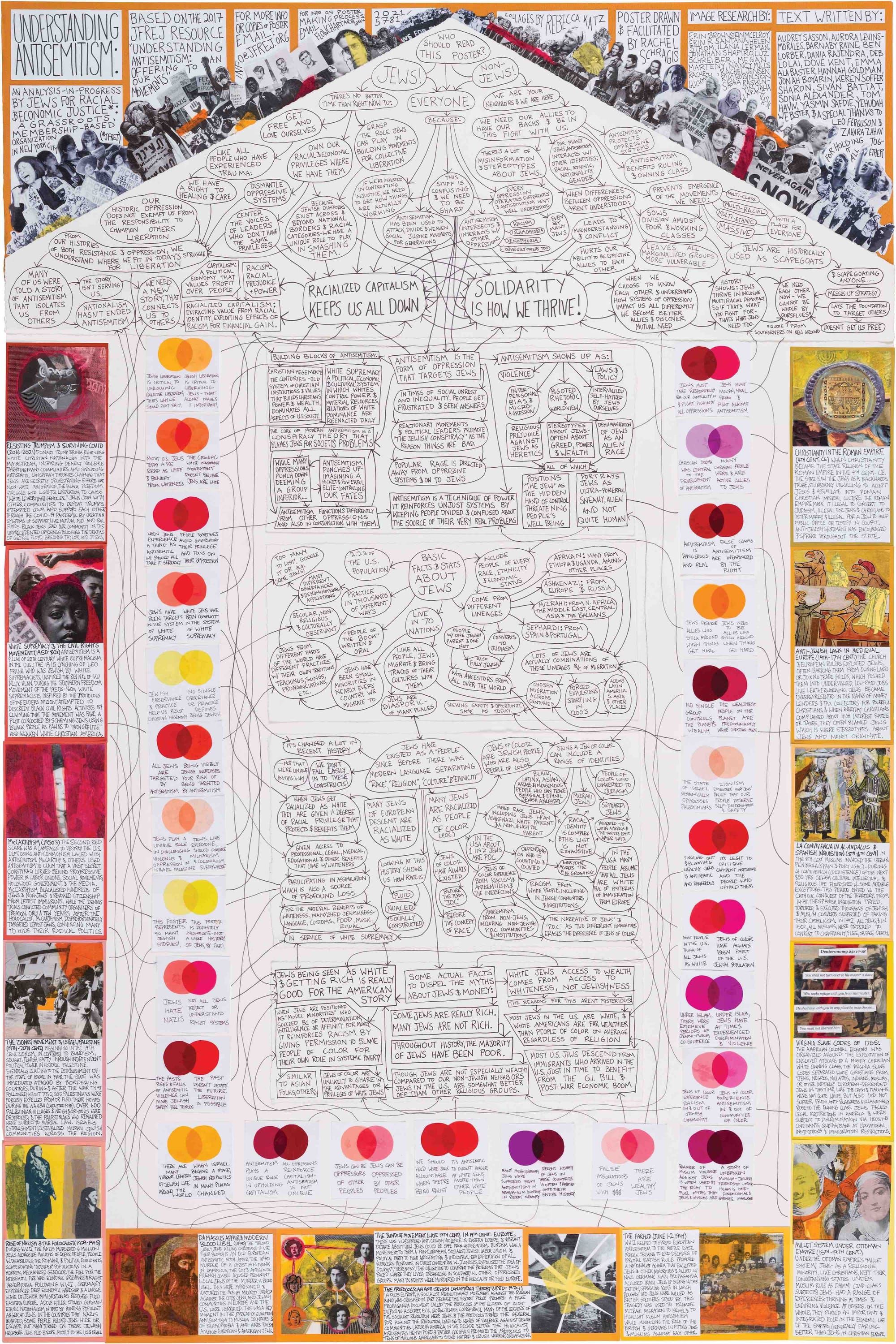
We’ve found this infographic by Jews for Racial and Economic Justice to be a helpful resource in visualizing the fuller and more liberatory understanding of antisemitism we need in this moment, recognizing that we cannot isolate fights against antisemitism from fights for Palestinian, Black, Indigenous, and trans/queer liberation (or vice versa):
The quick defense of Galindo by many in the community—friends and neighbors who are legitimately anguished by the violence of Israel and ICE, and desperate to see a progressive challenger to neoliberal, collaborationist Dems—raises the urgent need for all of us to be able to distinguish a principled and historical analysis of power from the seductions of conspiracy thinking.
In “Why Conspiracy Theories Are Corrosive to Social Movements,” antifascist researcher Shane Burley writes:
“Opposition to the current state of the world is not synonymous with fighting for a liberatory future. And the inability to parse out this reality has revealed instability across a radical left that often clamors after any ally in the struggle against systemic injustice. Without safeguards and clarity on the mission, nearly any voice against the status quo can be mistaken for a friend — including those who want to replace it with something even more deadly or whose analysis relies on conspiracy theories.”
What’s dangerous about what Galindo circulates—and, really, what’s dangerous about the memification of thinking in the social media era, and its substitution for actually organizing offline with other people across differences—is that it mixes something valid, something we feel on a visceral level (the obscenity of genocide and our complicity in it, from our legacy media outlets and universities to us as individual taxpayers) with something bogus and dangerous (the idea that a “Jewish cabal” stands behind it all).
As Naomi Klein points out in Doppelganger: A Trip into the Mirror World: conspiracy theories “get the facts wrong but often get the feelings right.”
But in confusing the latter for the former, Galindo unwittingly gives comfort to fascist elements in ascendance, which are only too happy to see a progressive candidate take up their own toxic rhetoric—as seen in the many apparently right-wing accounts posting approval on Galindo’s Instagram posts, as first flagged for us months back, all largely unchallenged by Galindo.
This is what fascism researchers have long called a “red-brown alliance,” or a “political collaboration or synthesis between fascists and radical leftists.” As elaborated by Three Way Fight, a journal of anti-fascist research:
“Such alliances strengthen the far right, spread ideological poison and confusion among left-minded people, and are disastrous for building liberatory movements. Fascists have been pushing red-brown politics for generations – sometimes openly, sometimes by repackaging their ideas to sound leftist. Unfortunately, sections of the left have repeatedly gone along by forming coalitions with far rightists or offering platforms for far right propaganda.”
More recently, political science researchers have described these tendencies as diagonalism—the way online spaces in particular have functioned as a left-to-right pipeline, mixing wellness culture and QAnon (“MAHA”), environmentalism and anti-trans disinformation.
In this moment, as we struggle to build the mass movements capable of defeating fascism, ethnonationalism, and theocracy globally, we have to be able to tell the difference between reality and conspiracy thinking. For without a good analysis, which depends on our ability to recognize and resist the easy scapegoating preferred by reactionary forces, effective organizing becomes impossible.
We too wish we had a principled progressive candidate for D35. And so we lament that a grassroots voice with values that resonate with many has been swept up by the lures of diagonalist politics and popular support on social media, leaving the key campaign elements she launched with—participatory democracy, people over profits, an end to ICE warehouses and surveillance tech and US genocide funding—without a real champion.
But there's a greater risk in play: A failure to recognize Galindo's politics for what they are only props the door to the fascists and racists who hate us all equally, and would be only too happy to see us perish together.


