It’s been a year since I went up Texas’ coast to Freeport, then to Cameron Parish, Louisiana, to try answering what cities look like after they get a liquefied natural gas (LNG) export plant. Not specifically how they look in a physical sense, even though I got to see that, too. I mean how these facilities change how a place feels, whether it can ever really be like it was before.
I had no baseline besides a coastal Laguna Madre upbringing which, contrary to what those who grew up landlocked assume, doesn’t give me a birthright understanding of places like it. I felt confident only in knowing that these places are best left as close to how the wind and gulf created them. Any straying from this was a betrayal against all that lived there, whether it was self-inflicted or imposed upon them.
I went to these places because they’ve had LNG export facilities longer than anywhere else on the gulf coast. I went to Freeport, Texas first, the coastal edge of Brazoria County and a damn fine town, if we’re talking about the people solely. The city itself, from what I heard from residents and saw myself, had better times, even if its origin and history has never been separate from some kind of extractive industry.
Parties in the ship channel and shrimping are over. Downtown is dead. It’s the era of Port Freeport’s Take-A-Child Fishing Tournament (sponsored by Freeport LNG) and other industry-backed events that turned local culture into exercises of compromise.
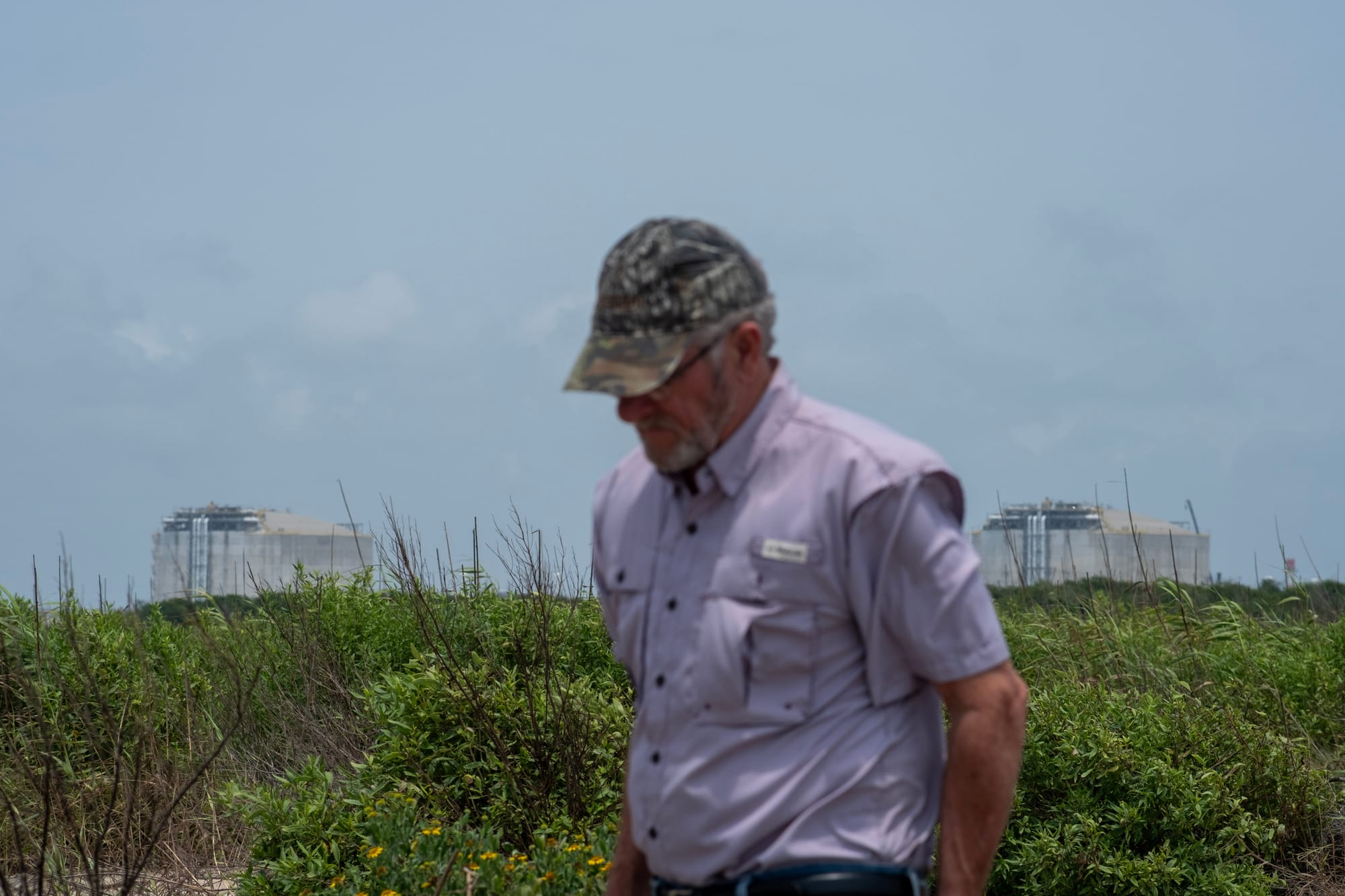
Freeport LNG takes its name from the town but it’s actually on Quintana, which is now a company town and county park. Besides a derelict, never-completed pier project in the gulf and the LNG storage tanks, its beaches are the closest to South Padre Island’s that I’ve personally visited.
A week later I went to Cameron Parish, Louisiana, not realizing that was just the point of origin of the state (and country’s) LNG export facilities. More facilities were being built towards Lake Charles and New Orleans. Plaquemines LNG, the facility near New Orleans, just started operating. The facilities being built towards Lake Charles follow a ship channel that has been there a long time, so long that the first LNG ever exported out of the U.S. was from said channel. So long that a steam boat was how people used to go from Cameron to Lake Charles, before there were roads.
Cameron Parish and Cameron County, Texas, are two different places, the latter having many more people and types of industries. But their similarities are not coincidental. To me they’re places that are only separate in distance and place in time. There was one point in history where the Laguna Madre area looked a lot like Cameron Parish, before it was even the U.S.
A report from The Data Center published in April, about Louisiana’s industrialization over the past decade, much of it from LNG terminals, feels prophetic in a way that most everything contemporary does when you spend any time reading history. All of the job and prosperity promises from petrochemical companies, which also came from the same elected officials that approved tax abatements for them, didn’t happen in any way that mattered.
All that occurred, based on data and what I saw with my own eyes, was betrayal. A betrayal that could be measured in pollution and erasure, the latter being cultural, physical, or people leaving their communities. The following is what I saw and what I can corroborate in the report, however informally empirical it may be.
— Gaige Davila
Industry Boosters Pledged Billions Would Flow to Local Communities on the Louisiana Coast—But Most Everything Flowed in Reverse Instead
Gaige Davila | Deceleration
When all of these companies and their projects came to Louisiana more than a decade ago, The Data Center published a 2014 report that the billions of dollars industry would spend building their plants would do the state some good. That report focused on projects coming to southeast Louisiana then, which the Data Center estimated could bring up to 42,000 jobs to the state.
I didn’t witness the dire straits the state was in back then, but being there last year gave me some idea. Like in Texas, the oil bust hit Louisiana hard in the 1980s and unemployed a lot of people. Louisiana also endured an unfathomable amount of storm damage, leading to an exodus of people from the southwestern part of the state.
In 2005, Hurricane Rita hit southwest Louisiana just a few weeks after Hurricane Katrina drowned New Orleans. Some people didn’t come back because there simply wasn’t anything to come back to. Every building in Holly Beach was destroyed, and nearly everywhere else in the parish fared the same. A few years later it all happened again with Hurricane Ike. Then again during the COVID-19 pandemic with Hurricanes Laura and Delta.
Rita gave hell and then some. The storm pulled bodies out of graves and carried away homes into the gulf. That was enough for some people. A couple years after Rita, in 2007, at least 2,000 people left Cameron Parish, then another 1,000 by 2009. The population has been decreasing across the parish since, with the fewest people, it seems, staying along the coast. The exorbitant home insurance costs there are to blame for this partly. They’ve increased statewide, too.

I mention the storms because no matter how hard people tried they couldn’t engineer their way out of nature’s violence. And I don’t mean the people who lived in the parish or those homegrowns still there bravely waking up every morning. I mean the leadership that thought the problem of people leaving could be "solved" by something like an LNG plant, not seeing that these companies saw places like Cameron Parish as locations with less people who could get in the way.
These LNG plants are far away from each other but they have a metaphysical sprawl over the land and coast. There isn't one aspect of life here that wasn’t interrupted or changed because of their presence. It now borders on being a cliche, but for whatever reason people who work at LNG plants seem to believe that their sole goal during their drives home is to see how close they can get themselves or the people around them to death's door. The speed that these employees drive out of these facilities is common discussion in the parish. The LNG tankers that come in and out of the ship channel make a wake that blows out both shrimp and the edges of the channel, another instance of the industry's fuel-injected hubris.
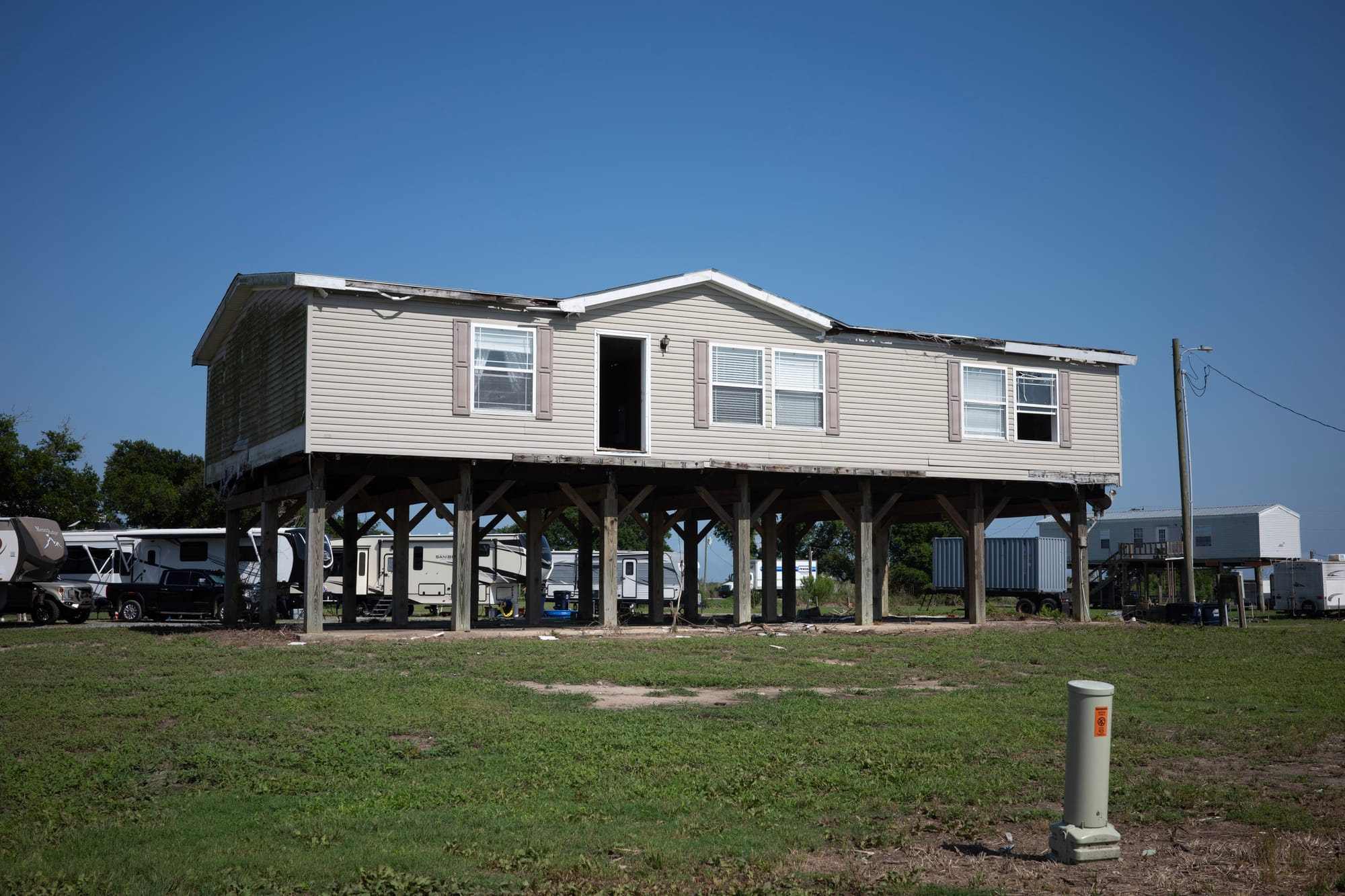
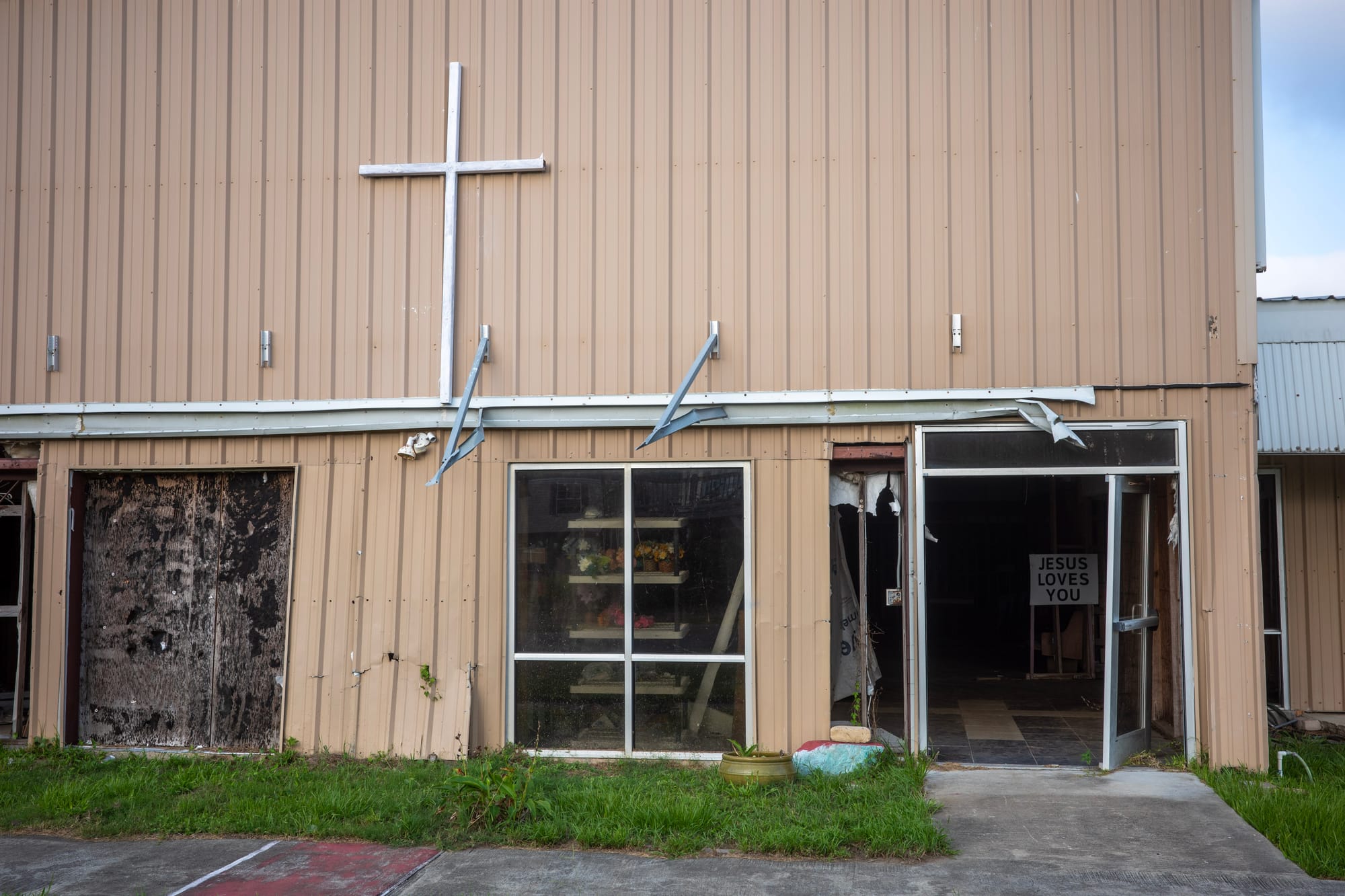
In Cameron the town, I saw homes exorcised by the gusts of hurricanes. Which storm didn’t matter to me so much as the fact of the home sitting empty, on pylons, haunting the neighborhood from its perch. Time is flat everywhere in the parish but at Calcasieu Pass LNG, where the facility grows forever, the employee traffic, too, with license plates from Texas and Arkansas and other states that aren’t Louisiana, and the sense that Cameron proper, the town, the one that had a roller rink and a movie theater and grocery stores and churches every block would one day not exist even in memory. CP2, the expansion of Calcasieu Pass LNG, has already cleared land south of town that was lush and green when I was there. Now that’s gone, and the wetlands north of town, behind the courthouse, will be, too, for CP3.
The plants didn’t bring anything back to Cameron other than a Venture Global-built restaurant and convenience store that seemed empty every time I drove by. People seemed to prefer going to the locally owned gas station and Anchor’s Up Grill, the latter operating out of a food truck since Hurricane Laura destroyed its brick and mortar location, remains of which lie a block away next to the First Baptist Church, which is also destroyed.
I spent half an hour walking around Cameron before I was asking myself what the hell this was all for. I didn’t see people that didn’t have hi-vis clothing or a hard hat. I’m there on the day of the shrimp season opener and all the boats are tied up. Every truck you can think of is cutting through the town’s lone two-way in either direction with an urgency unknown to anyone but the drivers.
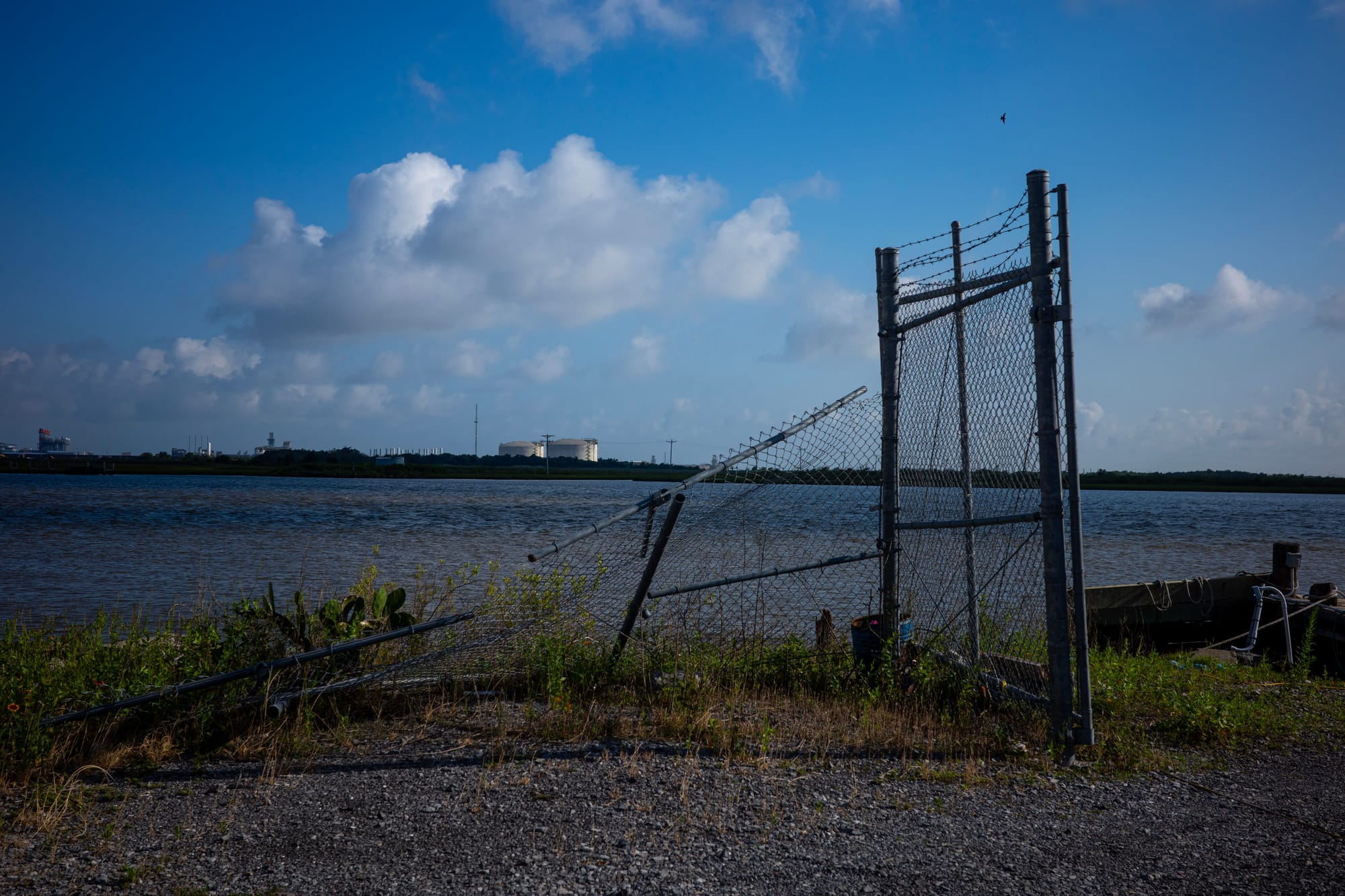
By my last day in Louisiana, I’ve collected more stories I can handle, all of it about loss. Some of it physical, like the parish jetty pier cut off from the public, with the Venture Global plant between it and the town. Some of it is intangible, like the feeling that home wasn’t home anymore. A shrimper cries telling me how he had to ask a friend for money to make it through the season. Another shrimper tells me she’s begging her son to get out of the industry. A lifelong resident tells me it's not if but when she leaves. Venture Global keeps offering to buy her home.
The latest Data Center report estimates that at least 52,000 people have left the state since 2014, and that the job growth has been “flat.”
“A decade ago, Southeast Louisiana stood on the threshold of what appeared to be a generational economic boom,” the report states.
“Billions in petrochemical and manufacturing investment promised tens of thousands of job openings. That promise has gone unfulfilled. While capital and billions of dollars in tax subsidies did flow into refineries, chemical plants, and LNG facilities, job growth has failed to materialize.”
The ardent among Cameron Parish remain, where coastal spoils placate whatever primal intuition to escape for higher ground, storm after storm, still exists. Everyone but those in fifth wheels put their homes on pylons that are at least 10 feet off the ground, thanks to a parish ordinance. There’s less and less of those spoils as time goes on.
Across from Cameron is Holly Beach, which is only accessible by ferry, unless you want to drive an hour around the Calcasieu Ship Channel. The ferry is out of order often, but I got lucky the week I was there, meaning I could regularly take the 10 or so minute ride from shore to shore and watch dolphins chase the barge and listen to seagulls and the boat’s diesel engine whine with the car off and windows down. Had I still smoked cigarettes, this is where I’d be doing it, and seeing all this shit brought me as close as I’ve ever been to doing so again.
I got my nicotine fix secondhand from John Allaire, a retired geologist and environmental compliance specialist that worked with all kinds of oil and gas in a past life. He’s lived on several acres of property in Holly Beach, which he refers to affectionately as “camp,” since the late 1990s. Allaire is Venture Global’s nightmare, and is also soon to be the same boogeyman for yet another LNG project coming to the parish called Commonwealth LNG, which is building a facility just a few hundred yards from his home. He documents with regularity how often CP1 violates its air permit.
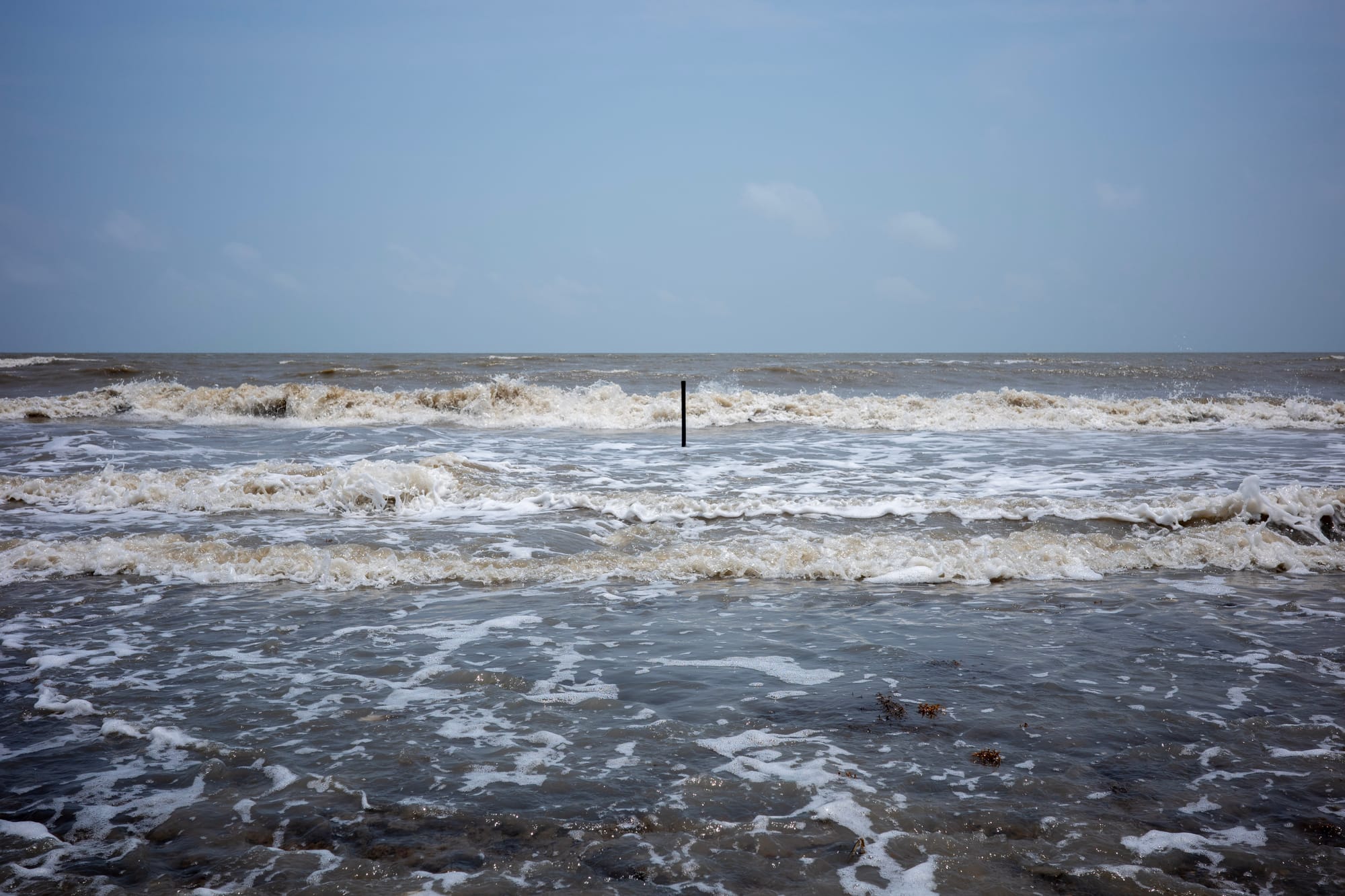
I spent most of the day with Allaire listening to stories about past storms, long-gone gas projects along Highway 82 and absorbing as much of his land as I could. There’s layers: first there’s coastal prairie, then wetlands, then a beach with gritty sand and layers of shells, sea glass and debris from anyone’s guess. A property marker from Commonwealth LNG, once staked on the beach, is now pummelled incessantly by waves more than twenty yards into the gulf. As the industry inches closer to Allaire’s property from the east, the gulf takes it away from the south.
It’s the same across the Louisiana coast. Last year, he told me he’d lost about 90 yards of shoreline, in between showing me photos of him and his sons catching bull reds off that same surf, which I looked at for a long time, having done the same damn thing hundreds of miles away.
Commonwealth LNG just recently, after a similar legal battle as Rio Grande LNG, got clearance to develop all that land next to Allaire. When I read this news I thought of the last hour or so I spent with him: He and I are in his trailer, because it’s become too hot and humid to be outside much longer. He’s looking for an email exchange he had with Jane Fonda, after she visited him to film some segments of GASLIT. He starts telling me that he gets offers on his land all the time because these projects want to develop a man camp on it for all the labor building these facilities. He declines the offers with little discussion.
I start thinking about Venture Global expanding their facilities across the ship channel from him, and Cameron LNG up the road, in Hackberry. And now Commonwealth LNG, the latest iteration of the oil and gas industry, will be just yards away from Allaire’s home, after he spent a career regulating its predecessors. Allaire’s camp is just as reflective of Louisiana’s nickname–"Sportsman’s paradise”—as any place you could find in this state. It’s also illustrative of the consequences of a government wholly supportive of the oil and gas industry and seemingly little else.
With all that in mind, it’s just a matter of time, it seems, before resisting the project becomes untenable. I try to ask Allaire if there’s a breaking point, but I can’t phrase the question. No words seem sufficient to define the power he’s taking on.
“I’m going to keep fighting, if that’s what you’re asking.”
The Data Center Report spends much of its pages detailing Louisiana’s health burdens. Using data entirely from the Center for Disease Control, the report highlights the state’s unenviable list of superlatives: fourth lowest life expectancy; first in prostate cancer; second in low birth weights; fourth highest maternal mortality after birth; eighth highest population with COPD; third highest in mortality from a stroke; and ninth in heart attacks.
The organization attributes this, partly, to industrial pollution.
“While other factors contribute to each condition, the evidence makes clear that air, water, and soil pollution in Louisiana plays a meaningful role in these health burdens."
Maybe none of this is all that surprising in a state that has a “Cancer Alley” in the river parishes in between Baton Rouge and New Orleans. But, as the report notes, this doesn’t mean that people outside of that zone aren’t immune to industrial plant exhalations. Ninety percent of the state’s parishes have at least one industrial plant in them.
Or if you’re in Cameron Parish, you neighbor at least one of three operating LNG plants. Venture Global’s CP1 plant violated its air permit, according to Allaire’s research published with the Louisiana Bucket Brigade, over 2,000 times in 2022. Cameron Parish’s population is low, but its cancer rate is high. Newer data is hard to find, and I know there’s more to the rate than just the LNG plants. But I think there’s a cancer there of a different sort, the kind that has become the guide to all governments that do not serve its people and don’t plan to.
This is bestial management, the prolonging of death throes when there’s no way back or forward. Growth is the state of being for the entwined industry, chambers of commerce, and parish government. Had Cameron Parish been a body, would ‘growth’ still mean something good?
I didn’t see a lot of flaring from these plants during that week in May, not that I could really see it all anyway. But I saw what wasn’t there, which was people. And, hell, some people wanted the industry there. Fair enough, if it meant that people could come back. But they didn’t return. Now whatever is left of the town will turn now into temp lots and mancamps and whatever else it needs. And Venture Global will not even need to ask.
VIDEO: Border Walls & 'Murder' Buoys
Until Trump began to unleash ICE troops on U.S. cities there wasn't much understanding from the interior of the country about what it meant to live on an increasingly militarized border. Tricia Cortez of the Rio Grande International Study Center shares how local residents came to understand Trump's declared 'national emergency' and the harms his desired border wall would bring to local communities. She opened a 3-hour block of presentations and panel discussion with audience Q&A—all documented by Deceleration. We saw so much value packed in here that we wanted to share it as completely as possible with our subscribers. Recorded Thursday, May 14, 2026, at the River Network's 'River Rally' convention in San Antonio, Texas.
Buy Gaige a Coffee
Buy Gaige a Coffee...or three!
If you enjoyed this newsletter, let the author know by hitting the tip jar.
Further Reading
 Alex.Bandonipropublica.org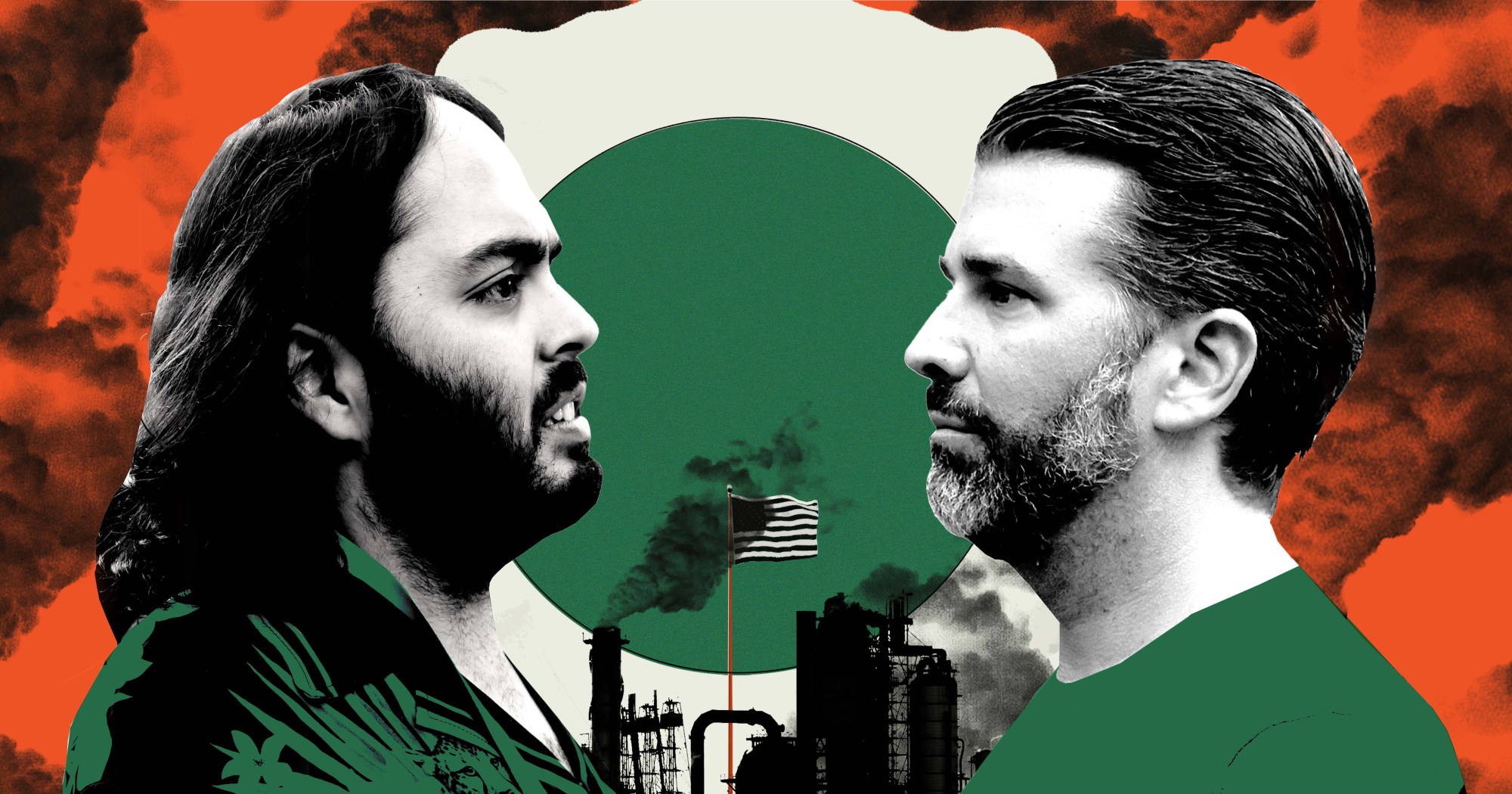
This investigation examines the company behind the oil refinery slated for construction in the Port of Brownsville announced by the Trump administration.
 Derek Harrison
 Candice Bernd