

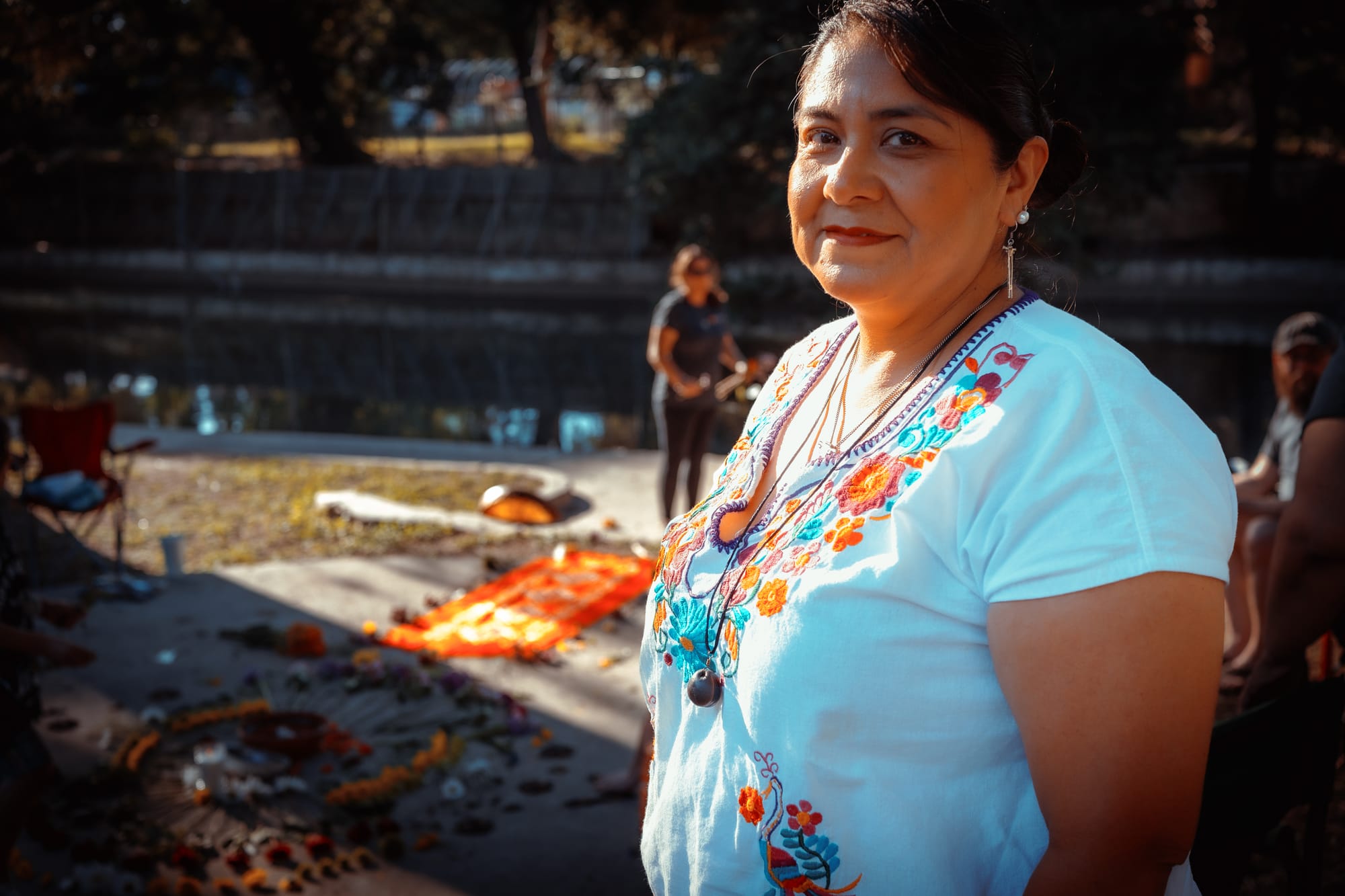
Brackenridge Park is a beloved and historic gathering place for San Antonio’s modern-day residents, but Indigenous peoples, drawn to the sacred springs that form the headwaters of the San Antonio River, have been gathering at the site for the past 12,000 years. The area was known as Yanaguana or “land of the spirit waters” to the Payaya people, a band of the Coahuiltecan Nation and some of the first inhabitants of what would later come to be known as the city of San Antonio.
Cultural bearer Matilde Torres, a descendant of the Otomi people of Central Mexico, has dedicated herself to the continuation of Indigenous spiritual traditions that are closely tied to place and specifically connected to Yanaguana. Since 2022, the ability to practice those traditions in Brackenridge Park has been under threat. And Matilde is at the forefront of the fight to protect and preserve the right to practice healing indigenous religious ceremonies within the landscape of trees, water, and birds held sacred in the Yanaguana creation story.
“This for us is our church. There's a creation story about the water bird that flew into the Blue Hole, and it encountered the blue panther. When it encountered the blue panther the water bird flew out immediately, and from its tail feathers, that’s how life came to be.”
The Blue Hole is the heart of Yanaguana, located on the campus of Incarnate Word University within the Headwaters Preserve and adjacent to Brackenridge Park. Known locally as both the Blue Hole and the San Antonio Spring, it can easily be overlooked and, sadly, is not currently flowing. For years, Matilde and her partner Gary Perez have worked diligently to increase people’s knowledge of the site’s historical and cultural importance.
Matilde contributed the name “Circle of Springs” to the native plants garden at the Headwaters; the garden’s circular design was inspired by the prehistoric White Shaman mural in the Lower Pecos. The mural was created by Coahuiltecan people at least 4,000 years ago, and depicts 16 springs across Texas that scholars believe drew Indigenous tribes coming from as far away as Northern Mexico to the region during an annual pilgrimage. Perez and Torres have studied the White Shaman mural extensively, citing it as another key element in the multi-faceted mythos of Yanaguana.
“Many people still don't know about the Blue Hole because there's no water flowing through it right now. But it’s part of one connected landscape. This spring here, it connects to the other three springs —New Braunfels, San Marcos, and Austin. Those are four springs that connect together, but they are also analogous to stars in the sky, to the constellation of Eridanus. And so there's a pilgrimage that would take place throughout the Camino Real, or the Old People's Road, or the Buffalo Road.”
In 2022, when San Antonio’s Parks and Recreation department announced their plans to drastically alter the sacred and ancient landscape in Brackenridge by cutting down hundreds of trees, a diverse group of citizens came together and responded with outrage and activism. The grassroots ‘Stop the Chop’ movement tenaciously pressured the city to change course and preserve the trees. Matilde participated in the movement while maintaining a specific focus that emphasized the religious importance of keeping the sacred landscape intact.
Related: ‘The sacred and the law: Indigenous claims on trial in the Brackenridge lawsuit‘
That landscape includes the birds of Brackenridge, and especially the Double-crested cormorant, which is the water bird referred to in the Yanaguana creation myth. The cormorant is also represented in the constellation Eridanus that aligns with the sacred river and the many springs along the pilgrimage path.
“Our creation story is played out at a certain time of year, when the blue panther is in the constellation of Leo. The shape of the river in the constellation Eridanus mirrors this river here, Yanaguana, it’s identical to that constellation. And then you have the water bird, which is the Double-crested cormorant. All of that comes together for us.”
One particularly disturbing aspect of the Brackenridge story has been the city’s continued harassment of migratory birds, including Snowy Egrets, Little Blue Herons, and Double-crested Cormorants. The stated goal of the USDA-sanctioned bird attacks is to discourage the birds from nesting in the park due to public health concerns. (Bird displacement was also a goal of the original bond-funded redevelopment project.) Activists see a link between the planned destruction of trees and the project of removing the birds from the park.
For Matilde, the attacks brought up feelings about the violent displacement of her ancestors from their lands by colonial powers. She describes the experience of witnessing the city’s cruel assaults on the birds as the moment where she began to process the impact and trauma of colonialism.
“I never really opened myself to the history of colonization. I just didn't open that part of me until I witnessed what they were doing to the birds, and hearing all the pyrotechnics, the shootings, the explosives. That's when it hit me, what our people experienced. And I was able to put myself in their shoes, and their times, and so that was the beginning.”
In 2022, citing safety concerns about falling branches, San Antonio Parks and Recreation Department fenced off the sacred area along the river where Matilde, Gary, and many others had been participating in religious ceremonies for years, denying them access. Torres and Perez enlisted the help of lawyers and sued the city to regain access to the area, invoking a 2021 amendment to the Texas Constitution, which prohibits government limitations of religious services. In October of 2023, a judge ordered that the fencing be removed.
The plaintiffs also demanded that the City cease its harassment of the nesting cormorants in that area, and the United States Court of Appeals for the Fifth Circuit ordered the City to discontinue those activities in the vicinity of nesting cormorants. (The City keeps appealing the restraining order intended to limit bird harassment; the court keeps denying their appeals, yet somehow bird harassment continues in the park.)
“I think they [the City of San Antonio] really thought they had a win for themselves, you know, 'We're just gonna come in here and bulldoze and there's nothing they can do.' But I believe in the power of prayer. This place has memory. The water has memory, the trees have memory, everything has a memory, right? We’ve just got to start connecting more, and bringing more awareness of why we're trying to preserve this.”
In advance of the rulings, Matilde was inspired by a message from Indigenous elders that was delivered by her friend Ceiba ili, a local musician, teacher, and activist for indigenous rights and environmental justice. The elders said that in the tough times ahead gathering people together for prayer in sacred sites was an urgent action.
Matilde began facilitating ceremonial prayer gatherings on every new and full moon to honor the land and the ancestors who have camped on the shores of Yanaguana. It’s a continuation of ancient indigenous spiritual practices that are older than history itself. Participants are invited to bring seeds, flowers, and other organic offerings. Songs are sung, prayers are given, and a mandala-like altar is created as an act of reverence to the life-giving waters.
“The way I was taught to do these altars, it's always mirroring what's above and connecting it to the underworld. You’ve got the underworld, the middle world, and then the upper world, so you're connecting with the three worlds. Then you have the elements: the fire, the water, the earth, and the wind. Then the fifth is your heart. That's how you complete it, by being present. "Sometimes we need to come back to prayer. There are so many people right now who have moved away from even just going into a church or any religion, and so they're trying to find a way to connect back with a creator, with God, with Jesus, with the Lord. And I think this is kind of like going back to the beginning—when everything was more than a resource to our people. Everything had spirit, everything had energy. The water is a living entity. This water still has memory. And so we pray with that water, the spirit waters. There's just so much knowledge and so much that we can learn from water.”
Matilde hopes that the ceremonies, which have only recently been opened to the public, will offer support and solace to people who are going through hard times, and build community amongst people who share a reverence for the natural world. She also hopes to raise people’s awareness of the sacred nature of Yanaguana, and the fact that this important sacred space is right beneath our feet, in a public park.
“It's just coming together in prayer. And helping guide them more into being conscious of this area, how spiritual it is. For them, it's been mind-blowing to know we actually have this here in San Antonio. It's just not going to a circle inside a building. There's actually something outside, something spiritual in San Antonio which is this area, Yanaguana. We don't really think back 15 or 20 thousand years ago and wonder what would it have been like. There are so many artifacts throughout this park. It’s not history, it’s prehistory. And there is so much life here. There's still so much life here because the birds still come to this place. If the water was no good, then you would not see any life here. It’s the resilience of life. ”
-30-
New moon and full moon offerings are facilitated by Matilde Torres and the Brackenridge Yanaguana Coalition in Brackenridge Park near Joske Pavilion on the day of each new and full moon. Participants are encouraged to bring herbs, flowers, and bird seed. Parking is free and the location is wheelchair accessible.


