

Marisol Cortez
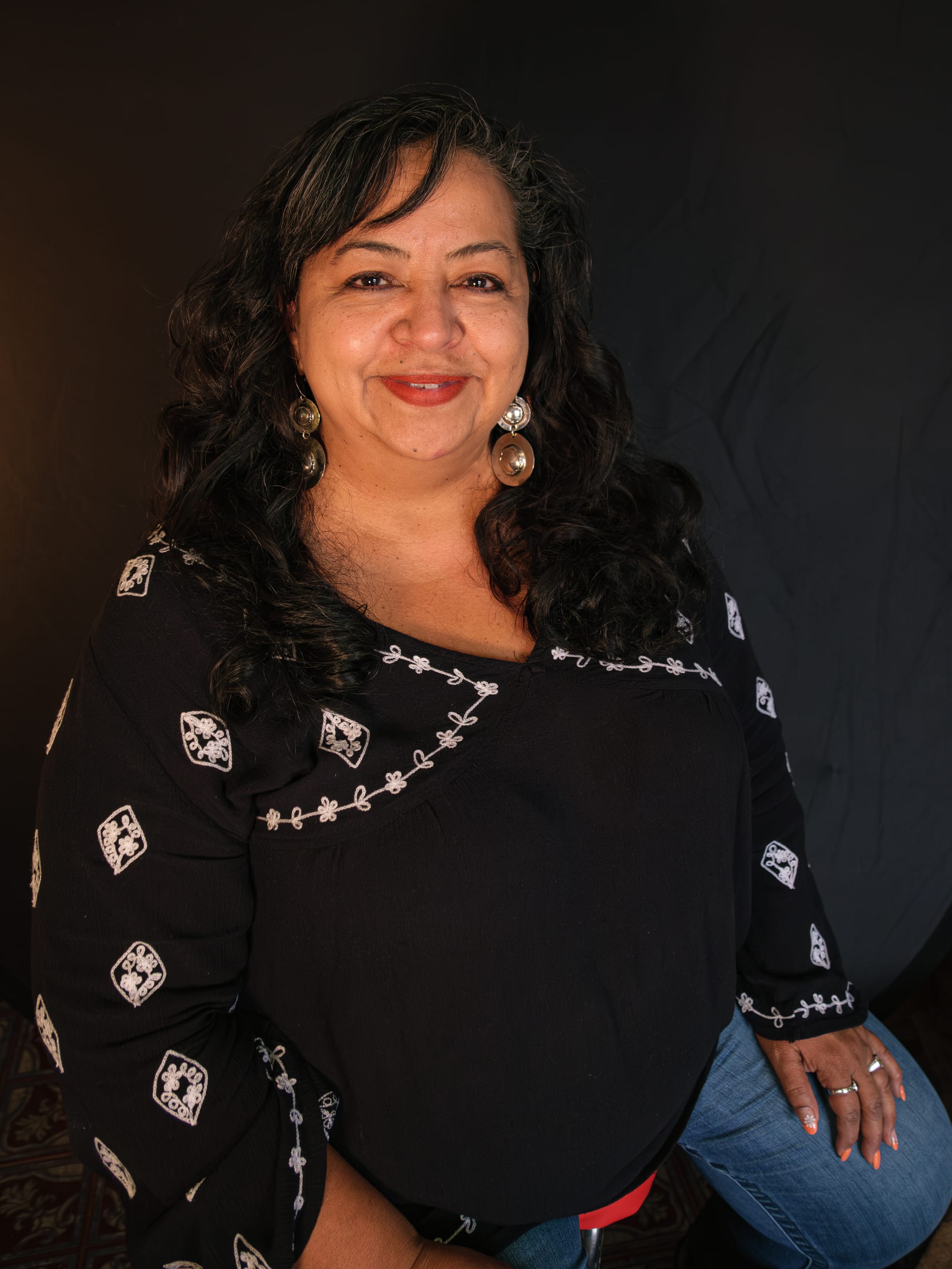
In early summer of 2024, I caught wind through local climate justice networks that Debbie Ponce was involved in some kind of mutual aid project involving mini-split heat pumps—the high-efficiency HVAC units mounted to your favorite taquería wall. A Southside resident and local organizer with Public Citizen, Ponce has long advocated for climate resilience and environmental justice, as a promotora working to sign people up for CPS Energy’s free weatherization program and bringing neighbors together to fight the polluting practices of local metal recyclers.
Having spent the past year trying to figure out how to take advantage of IRA tax credits for high-efficiency residential upgrades, tracking funding as it trickled from the feds to Texas to our local Lowe’s, I was intrigued by this new project. So on a hot August morning, temps already pushing past 90 degrees at 10 a.m., I sat down with Ponce to get the details. While the project is still in the planning stages, its neighborhood collaborators waiting for funds to come through from the City of San Antonio’s Climate Ready Neighborhood program, what’s most remarkable to me about Ponce’s vision is the way something as wonky as HVAC systems opens up a complex social understanding of heat as an economic and housing justice issue—but also the occasion for deep adaptation from the bottom up, not to mention working class ingenuity and solidarity.
Regeneration Event: South San Heat Resilience Community Workshop (6pm, Sept. 23, 2024)
This interview has been edited lightly for length and clarity. The embedded videos supplement the story and include conversations with Ponce partners Fuerza Unida, Larry Garcia, and a visual narrative of our own experience installing mini-splits.
Marisol Cortez, Deceleration: Tell me some of the history of the heat pump project, the story of how it came about.
Debbie Ponce, Public Citizen: When I got hired with Public Citizen, my job was to help get more people signed up for weatherization. It was noted in our city that we weren’t getting enough signups. They were still lacking people in low-income neighborhoods. So they hired me to go out to the community and get some sign ups.
So I right away saw some major challenges, because in low income neighborhoods there’s also high crime. So everybody has a fence. You can’t even get to the door to knock on it to say, “Hey, would you like to get signed up for weatherization?” We tried flyers, we tried mail. We tried even going to a couple of streets and putting flyers there and setting up at the corner. I think I got one sign up [that way]. On another occasion, I got none.
The only way [sign up] was successful was by going to bingos at church events, or showing up at the church parking lot after Sunday Mass. And sometimes I got invited in by the pastor to come while everybody was eating afterwards and do a presentation. So in doing all of that work, what I noticed is, when I did get into the houses, I was sweating buckets. And they had these window units, you could clearly see where they were. They’re in all the windows in these pier-and-beam homes in the neighborhoods I was at. And they were basically fans. And I was like, Wow. I didn’t say anything at those houses, but it was in my head.
And then I asked some friends. I said, “Well, what do you do, like to get it cooler?”
She goes, “It doesn’t get cooler.”
I said, “So your air conditioner is running day and night?”
“Yes.”
And you either turn it on or turn it off. The older ones are made that way. Well, [I said,] “Why don’t you replace it? Could you replace it?” Because I went to Home Depot for the one family, and they’re like $200.
And she’s like, “I don’t know how to get it out of the window. And then I got to put it back in. I’m old.”
So there were all these challenges. And then, [when] I tried to get them signed up for weatherization, they didn’t qualify because their electricity was too old and they had some holes in the roof. So now we have a person who can’t physically do the job of switching out their air conditioner, may have the money, may not, and then the electricity situation is not good. So that’s why the weatherization didn’t happen [in those neighborhoods].
So not only are they going through the heat wave, they also have no insulation from the outside. Most recently, Fuerza Unida has been doing heat studies. They’ve been going in and paying people to measure the weather. Last night I was at a meeting, and one of them said, “My temperature inside the house last week was 105°.” Wow.
So I was thinking air conditioning units. And then I went to an energy conference in Austin.
And that’s where I learned all about heat pumps. And they can be converted [to 220V] or they can run at 110 volts, which would match up with the electricity level that is in those houses. So we can just basically unplug the window unit and replace it. So those are all these things I was researching already. So then we went to the Eco SA meeting [where the City presented information about its new Climate Ready Neighborhoods program], and I had this dream. I dreamed I was replacing people’s air conditioners.
[At the meeting,] the icebreaker question was, “If you were given $20,000, what would you do?” And that’s where I shared my dream. I said, “Well, I dreamed that I could take that $20,000 and replace air conditioners in neighborhoods that I’ve been in, and make it so that they don’t have to live in that kind of heat anymore.”
And [the heat pumps] are also heaters. They can also be warm in freezing temperatures. And then the next person that was beside me, Larry Garcia, said, “I would take my $20,000 and join Debbie and put air conditioning in.” And then another member said the same thing. I ended up having six people pledging their $20,000 to replace air conditioners in low-income neighborhoods.
After the meeting, Kate [Jaceldo, from the San Antonio Office of Sustainability] comes up to us with all the flyers and she described the Climate Ready Neighborhoods community grant. Anybody is eligible for $20,000. She gave us deeper information and put the flyers in our hands. And so I went back and found out that our nonprofit [Public Citizen] doesn’t take government money, so I couldn’t apply. But I could support and organize and help. And we were able to get six people [from the neighborhoods] who were interested. In the end, only five applied. And out of the five that applied, we got three [funded]: Fuerza Unida, the Westwood Square neighborhood, and Thompson Neighborhood Association. We found out that Fuerza got $19,000, the other two got $18,000. So we’re putting our money together and working smarter, not harder.
So this is completely a community group effort. And in doing this, we have all learned about heat pumps, mini splits, we’ve learned about energy consumption. And so our goal is to not only give relief to the families that have low-functioning or non-functioning window units, but to also study what their energy usage looked like before and then after. Some of those neighbors in houses smaller than even yours are paying $400 a month for electricity.
And you know, for people on limited incomes, paying $400 for energy is crazy. But they don’t have any other choice. So now they have a choice, and we can prove that they’re pulling less energy off the grid. They’re saving money, which actually helps our economy, right? Now they have some free money to spend in the neighborhood or to take care of themselves, buy their medicine, whatever.
The challenge is, we were going to get $20,000, and we got a little bit less. We’re finding out that the mini split cost isn’t the issue, it’s the process to install it.
That’s what we learned too. Our house was all window units. I think some of them had been installed in the ’90s, going by the little tag on the side. And they ran pretty good. But yeah, high bills in the summer, and they were getting older and older. Then we started hearing about [federal] IRA funding coming down to give tax credits for installing heat pumps. And so last summer we started doing some research—like, has that money reached Texas? How do you actually access those rebates? Because we knew you paid upfront, but then you got it back at tax time, and there are other rebates at the local level. But it’s been really interesting to see the process, and also where the challenges lie, the unexpected roadblocks.
We only had the money to do two heat pump units, which cool half the house. Basically the two front bedrooms. And then there’s a third bedroom in the back that still has a window unit that’s new, which we replaced last summer. The window unit here in the living room is the main one. I think it’s actually an old heat pump, because it does both the AC and the heat. But it’s very old and energy intensive and blows out our circuits in the winter if we try to run the heat. So through a friend, we started asking, hey—who does good installation? Who do you trust? He referred us to somebody. That guy was like, oh yeah, I can come out and do that really fast. That’s easy, basically $500 in labor per unit.
[Note: The units we installed cost about $750 each, though you can find units at any big box hardware store for as little as $500. However, only Energy Star-rated units are eligible for federal tax credits. Under the IRA, up to $3,200 in project costs per year—$2,000 for Energy Star-rated heat pump units and $1,200 for any electrical or insulation work needed to install them—is eligible for a tax credit.]
But when [the contractor] came, he said, “Oh, your house has rock walls on this side. I wasn’t expecting that. We can do it, but we’re going to need a special part. It’s going to cost more.” And then, because we don’t have insulation in our attic or in the walls for that bedroom, we also had some issues with one of the units dripping, which we didn’t anticipate. We also didn’t anticipate that the local rebates through CPS are a really long process. It’s very complicated to apply for those rebates. You need all this documentation, and the crew who installs it has to—basically, it can’t be this more informal, sort of a DIY kind of process. It’s really intended more for new-build construction. So what it would cost to get the inspection is about what you would get from the rebate. So the local rebate isn’t really worth it. The federal part? We’ll see come tax time.
But we’ve been really happy with the units so far. We don’t need to run the big a/c anymore. It feels good just from those two little units in our bedrooms. And even those, we set them at 80 and it keeps the main part of the house cool enough. And we just got the bill for [August] and it was lower [than July]. Usually our bills go up every month through September. This year it went up, it went up, it went up—and then it went down from July to August. And that’s just from installing those two heat pumps towards the end of [July]. So you can see the impact of it.
One of the [neighborhood groups] that didn’t get the grant, she has mini splits in her house, and she’s got the solar panels, and she says she paid just $50 [in July] for her electricity.
You know, I ran across a woman who’s got four kids. This is another reason why the air conditioning thing was hitting me. So she had a mobile home, and I don’t know if you’ve ever been in a mobile home, but the very back room is the master. So she threw extra mattresses in there. And all through COVID, she just put a window unit in her back window and turned off the central air and heat, and they all just lived back there, because [running the central a/c and heat] she was paying almost $500 a month. She said by doing that, even with an energy efficient window unit, her bill dropped to $200, which for her was amazing. You can do a lot as a mom with $250 bucks. I mean, I know what that’s like.
And so all those stories that I hear from people, we’re talking about the heat and weatherization and they share all these things. Yes, I want my house weatherized. But mobile homes can’t get weatherized. I mean, they’ll do the windows, but there’s no place to put insulation. So all these challenges. So I was able to share a lot of this with city officials.
You know, I can spend time handing out these flyers [for weatherization]. I show up at events and people are like, oh, Casa Verde— so obviously CPS is doing a really good job of getting it out there. But I just started sharing my story. You know, I didn’t know I could qualify [for these programs]. And I got the [eligibility] numbers. You know, that was the focus of my speech: “Do you make less than this?” And then I started getting way more signups. People in our neighborhoods don’t—if you were saying, “well, this is for low income neighborhoods.” But we don’t consider ourselves low income, right? We’re doing fine. You know, you’ve got air conditioning, you’ve got your cars paid for, you’ve got good clothes on your children, your pantry’s filled.
We’re used to our life, and that’s the way it is, right? And so when sometimes these big groups go out there, they present it like, you know, we’re in these low income neighborhoods. And I’m like, oh, well, I don’t want to take that pot of money, because I’m fine. Give it to somebody who really needs it, right? And so that’s what I saw happening. They don’t know they qualify.
Or there was another conversation I was in the same room with, and she’s like, “Oh, well, what we do is, I take a string and we run it through half of the room. And then that way the air just stays on that side of the room. We just kind of pull it like a curtain when we go to sleep at night, and that way we sleep more comfortable.” So [if my house is hot,] you might give me that advice, and that teaches me to accept my circumstance and not complain about it, because you and me are going through the same thing. I’m not different than you. You’re not different than me, right? So I won’t go ask for help.
So in your engagement with the neighborhoods, what is people’s lived experience of the increasing heat? What strategies have people used in the past to manage the heat, and have you seen that those strategies are now hitting a limit as temperatures increase?
When I’m in the neighborhood I’ve been in, specifically the Quintana neighborhood, I would see the senior couple outside between the hours of 3 and 5pm, and they were just wetting themselves with the baby pool. And then they would sit outside ’cause it was cooler outside than inside. [Or at] this meeting [with Adaptation International] they were talking about taking more baths, and a lot of them just get dressed and go to the mall and go shopping. Sometimes they don’t buy anything. They just window shop all day, and take a lunch, and then they come back when it’s a little cooler in their house.
And then the air conditioner, whatever status air conditioner they have seems to be comfortable for those evening hours until the morning. Or if they’re old enough to go to the Senior Center, they may go hang out at the Senior Center. We don’t have libraries, you know, on our side of the city. There’s 30 libraries, but below Highway 90, that red line of inequity that I call it, there’s only six, and only five are open. So, you know, libraries aren’t really a place to go on our side of town. And some of them, a lot of them just aren’t paying their bills. They can’t afford their electricity bill. And they’re like, “When CPS shuts us down—” They’ll just have to figure out something then.
And I know that I’ve talked to city staff, the ones that do the constituent services, and they get calls all the time. They’re always figuring out how to help people pay their electricity bill. Constituent service people on more affluent sides of town aren’t having to do as much of that. It’s really weird. You go to different [districts] and you see the [staff] in like [Districts] 4, 5, 3, 2, and they look—you could tell which ones are doing all the arranging and helping. And then you go to the other side of town and everybody’s all, you know, crisp and clean.
And so the neighborhoods for the heat pump project, they’re all kind of in the same area, near Kelly and Lackland [Air Force Bases], right? Like on the Southwest side of town?
Yes, we put the word out. I’d go to different neighborhood associations, and I had the [City’s] Climate Ready Neighborhoods flyer with me. And I tried to get some other neighborhoods to do it, but [some] were afraid of getting and managing $20,000. That’s why we lost one person. They didn’t want to put their name on $20,000 and something happens and—what are they going to do? So I’m glad that there were a few that were willing to put it together and try.
So what are the goals of the project, in terms of the number of houses, the number of heat pump units?
Right now we were trying to do ten in each [neighborhood], 15 if we could. But again, we kind of got sidetracked because the cost part. We’re seeing the cost go from $300 to $600 for the heat pumps, then there’s the $250 city inspection fee. All right, so now we’re at $550 [per unit] if we were lucky enough to get them for $300. And then there’s the installation. You have to have an electrician, and you have to have a licensed air conditioning person do the installation, so that it’ll pass whatever inspections required by the city.
So when we put those together, now we’re like $1200 [per unit]. So unless we can get the inspection fees waived, unless we can get some air conditioning companies to step forward and either help us with the funding of the mini splits or with their labor, that’s what we’re going to go for. [Originally] I think it was going to be 18 or 19 [units] per [neighborhood] group. [But with the real costs factored in,] we’re trying to get the numbers for 30 units [total]. So that’d be 10 for each neighborhood, or 45 [total], which would be 15 for each neighborhood.
Of course we’d rather have 15, because then we would have a bigger pool of people getting relief and also our research [footprint] would be larger, you know. So we’re going, what if we had an extra $15,000, could we find somebody to help us with that? Could we get that funded? Anything’s possible. I mean, we’re South and Westsiders.
We do have one person, his name is Larry Garcia and he’s organizing the installation of everything. He’s going to do the initial inspection of the house to make sure it’s even possible. I mean, if the sheetrock can’t hold up the [unit]—you know, there may be houses [where] they meet all of the criteria, but with their construction we still can’t do it. And we’re going to try like heck to figure it out. But if it’s going to cost us more, we aren’t going to be able to do it, sadly. But he’s been meeting with different groups.
So what we were brainstorming is going to Alamo Community College, where they’re teaching people how to do the air conditioning. And then maybe even go to a union. What if—I’m just naming names—Elmer Air Conditioning says, you know what, we’ll do three. And Goodman Air says we’ll do three. And if we could get everybody to do some as their community contribution, we’re happy to put their name on a brochure. They could take pictures of their wonderful community service and utilize it for their company.
I wanted to ask too—you know, we often hear about these more efficient technologies being just for Northsiders, for affluent people, right? So it’s been really cool to see the way working class communities of color have taken up the heat pumps. I see them all over my neighborhood. Once I started seeing that, I was like, “Oh, how do we do that?” What’s your observation on how working poor, working class communities of color have adopted these technologies and made them more accessible? How are they doing it?
They’re basically doing it how you did it. They’re buying the unit. It’s not that expensive. And they’re figuring out how to get it installed afterwards.
That’s the cool thing about blue collar neighborhoods like ours, right? Everybody is a construction worker, a cement layer, a roofer. I mean, just among my son’s friends and our friend group, we could build a whole house, you know what I mean? We network. That’s how we do it, because we have to, and we help each other. Or you have a tío in the family who knows how to do it. So that’s how they’re getting it done.
I’ve noticed too that there’s this movement to get solar in our neighborhoods, right? They don’t even have solar in our parks. So until our community starts seeing these things, they’re not going to look for it. Like you said, the heat pumps, you started seeing it. So then you started asking about it. And that’s what we need to keep doing.
We need to get it in the neighborhoods so that people will try, because we’re a resourceful group of people. You know, I might have a neighbor who buys an awful house and has a really rickety car. But they work hard. And then pretty soon they replace the car with a nicer car. And then on the weekends they work on their house. And before long, they have a nicer house and a nicer car than me! So that’s how we’re made. And so people like us, in these neighborhoods, that’s what we do. But this needs to be done in affluent neighborhoods too, though. We can’t neglect that side. We’re just starting on this side.
Yeah, so it’s an economic justice issue as much as it is a climate issue. It shows the intersection of those issues really clearly, you know? Racial, economic, and climate justice. But I also think something that gets overlooked a lot in the discussion around climate justice is age and disability. We tend to think in terms of race and class, in terms of who gets impacted the most from climate change. But every time there’s a disaster, extreme heat or cold, or a storm, it’s elders and disabled people too. If you break it down—you know, who died in this disaster? It’s people of color, it’s low income people, and it’s elders, elders and disabled people.
And the baby boomers are all becoming elders, and we are also Military City, USA. There’s lots of retired people in our neighborhood near Kelly [Air Force Base]. And I rarely run across a senior who isn’t a veteran or isn’t married to a veteran. So what’s happening right now is veterans are suffering, senior veterans—you know, like my dad.
Have you been seeing in your work on the ground that property taxes are going up, not because of land speculation—which is always why our property taxes went up in the past, because this area is being targeted for redevelopment, right? But this last year, our mortgage went up $200 a month, and it’s from hazard insurance. It’s not from land values going up, it’s from hazard insurance going up. And that is because of climate change. Have you heard any other sort of people talking about that?
No, I don’t think anybody’s realized that’s what the increase was. And it would be people who still own their homes that are going to be affected that way.
I feel like that is one more harbinger, right, of things to come and how climate change is going to impact housing stability for the most vulnerable. It’s another form of displacement pressure, right, that will hit the neighborhoods in the communities that are already struggling to hold on to their houses, or to have a place where they can live comfortably.
Exactly. And then there’s another challenge I’m seeing around weatherization, which is people won’t sign up because they don’t trust [the city] coming onto their properties. I’m going to go back to the seniors that have educated me so much. Even [your] house, say it was owned by a senior back in the 1940s, and they built a shed in the backyard. And you just used a little ingenuity and got a couple of electrical cords and popped them together and, voilà! Your light bulb was working back there. You know, mom, mother-in-law needed a place to stay while she was aging. Well, let’s put them back there and figure out another electrical cord to run the air conditioner. And things just stayed that way. There weren’t codes to follow. And nobody came out to the neighborhoods and said, “Oh, well, all of you do-it-yourselfers, now the electric code has changed and all of you need to get your wires upgraded.” Nobody did that.
And so now you get people come out for weatherization or something, to actually earnestly help, and they see situations that are so dangerous that they’ll shut the house down. We’ve demolished so many houses, I understand from friend organizers. I’m not well versed in that subject, but from what they’ve shared with me, we’ve demolished more houses than in many other large cities, right? I mean, like hundreds more. And so that news starts scaring everybody. We don’t want [the city] to see what we have. And when you demolish a house, are you really helping that person? At least they had a roof over their head. Even if the electricity wasn’t working, they had a roof over their head. Better than sleeping on the street.
I mean, at this point, that’s how real the situation is for people right now. And so that’s the kind of fear that we have of the government. So even if you can get help from the government, they’re going to have to figure out a way to overlook things.
Yeah. I mean, I think what it underscores for me is—housing justice is a climate issue, and climate is a housing justice issue, right? So my last question is just: Do you feel this is a project that could be scalable for other neighborhoods throughout the city? And what would that look like? What would that take, for it to be scalable?
Yes, I’m hoping that with the proof we have, it can be done on a huge level. If the city was to go in and just buy a thousand mini splits or energy efficient window units, whichever they chose—or, if they objected to giving them away to families and people that need them, well then sell them back to us! Buy them in bulk, at a great rate because you bought 1000 or 2000 or 3000. That $350 heat pump is probably now going to cost $200. Sell it to me for $200. I can afford $200. Maybe I can’t afford $600, but I can afford $200.
They call it low hanging fruit, right? In New York, they gave them away. I printed those flyers. I handed them to every single council member and the mayor. They’re just giving away energy efficient units and you figure out how to install them. And then Dallas followed suit. And so San Antonio could do that.
What we’re doing right now, we’re writing the blueprint. We’re learning as we go. I’m lucky because I have really cool leaders that are smart, and we’re all putting our best effort and skills together. I don’t know all the technical things about installing heat pumps, but Larry does. Fuerza Unida’s chief financial officer is handling all the money and the budgeting for us. We’ve got a contractor that does budgeting and other things. We’ve been creating the forms and the Google Sheets sign ups, and she’s going to help us with the selection process. And then we’ve got Linda, who knows her community really well, and she’s also got a restaurant. And it closes at 3, but she’s allowing us to have all our meetings there. And she’s not charging us because there are no places to have community meetings around here.
And so, yeah—so we’re full of hope.
-30-
TAKE ACTION: Join Fuerza Unida this Monday, Sept 23rd for a community workshop at Project Quest (203 Norton Street 78226) as they review findings from their heat monitoring data collection and discuss opportunities to take action against the impacts of extreme heat. Dinner provided and compensation available for participants. For questions, see calendar posting, contact info@fuerzaunida.org or call 210-927-2294.


