

When President Donald Trump declared a national emergency on the country’s southern border in 2019, usurping the role of Congress, some argued at the time, the folks living in the region couldn’t have known what it would mean for their lives and livelihoods. The action authorized the movement of massive amounts of money for border wall construction, some of which had already begun under President Obama.
“We didn’t know what that meant,” said Tricia Cortez, executive director of the Laredo-based Rio Grande International Study Center.
“People go birding, biking, fishing, they have their quinceañeras; they do all sorts of things on the river. We just didn’t know what that meant. Soon we found out and got involved right away with Earth Justice on a lawsuit at the federal level and been at it ever since.”
For many of the river lovers gathered in San Antonio from around the U.S. last week, convened for the annual conference of the River Network, which describes itself as a “national network of water, justice, and river advocates,” the border wall project is an offense for the harms it is already causing one of the Americas’ great rivers.
During a three-hour presentation, panel discussion, and audience Q&A on Thursday, prominent border wall opponents presented a damning survey of the environmental and humanitarian cost of what we’re told is border security. Since the U.S. Department of Homeland Security was formed in the wake of 9/11, more than $400B has been spent by the agencies charged with immigration enforcement.
Contracts for border barriers, floating buoy systems, and “smart walls” are announced by the billions. In the fall of 2025, $4.5B was unleashed for more barriers in the U.S. Southwest, quickly followed by another $3.3B that included land and water barriers in the Laredo area.
"The new contracts announced Thursday include a total of 56 miles of new border wall to be built in Laredo and 66 miles of waterborne barrier to be put in the Rio Grande there," Border Report reported at the time.
Trump's national emergency declaration harms communities: Tricia Cortez, executive director of the Laredo-based Rio Grande International Study Center, speaking at the River Rally.
Last week, after federal officials sought to calm tensions across the Big Bend by saying that section of wall had been cancelled, The Texas Tribune announced a $1.7B contract had been awarded for “border wall in Big Bend Texas.”
As Cortez tells the audience, the border wall isn’t “a this or that.” It’s a massive pile of all of the above.
Federal maps show the entire border between Texas and Mexico lined by either physical walls (bollards), water-borne buoys, or some combination of vehicle barriers and technology and patrol roads.
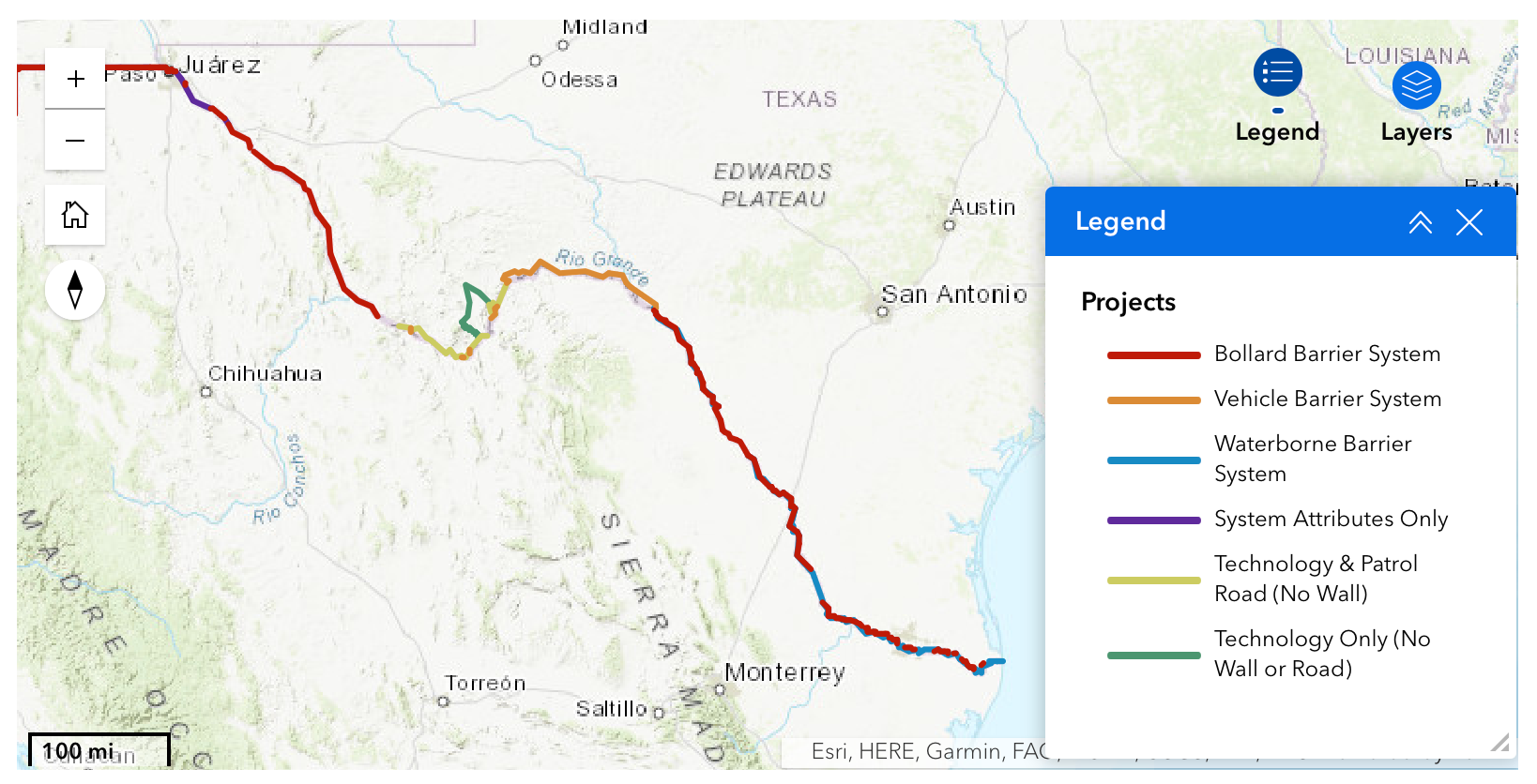
Before being saddled with the weight of a national boundary, the river was a natural joining place for millennia: a shared lifeblood cutting through high desert and thorny subtropical lands. Like the still-celebrated avian migratory corridor across the region, what became the Texas-Mexico borderland was one of the Americas' most traveled migratory and trade corridors. Extended families settled on both sides of the river.
But:
“When you think of the wall, think of these things. These are the key kind of features,” Cortez says, pointing to a projected list.
“Big Money
“Massive land grab
“Waiver of laws and protections for Americans,"
it read.
“This is about a massive taking of land that is privately owned, that is publicly owned, and putting it into the hands of the U.S. government permanently,” she said.
“It is a massive land grab. Probably the most egregious part of the whole … waiver of laws that doesn’t happen anywhere else in this country except for us on the border.”
And in spite of all that money and energy, things aren’t performing as their boosters might hope.
Wrecking one of the Americas' greatest rivers? Principal Engineering Geomorphologist Mark Tompkins.
It didn’t take long for rain-caused erosion to nearly topple a section of Trump’s prized border wall during his first term. Now in term two, floating buoys—oversized brightly colored markers, many wrapped with razor wire, started under Texas Governor Abbott, picked up more recently by Trump—have already started to silt over and form islands in the heart of the Rio Grande’s channel.
But, most concerning, is what will happen with these miles upon miles of buoys and wire are swept away by a 10-, 20-, or 30-foot wall of water (or worse). After all, the Rio Grande, in spite of being increasingly drenched by razor wire and bound on one side by rising metal walls, is still an “untamed” river, said engineer Mark Tompkins.
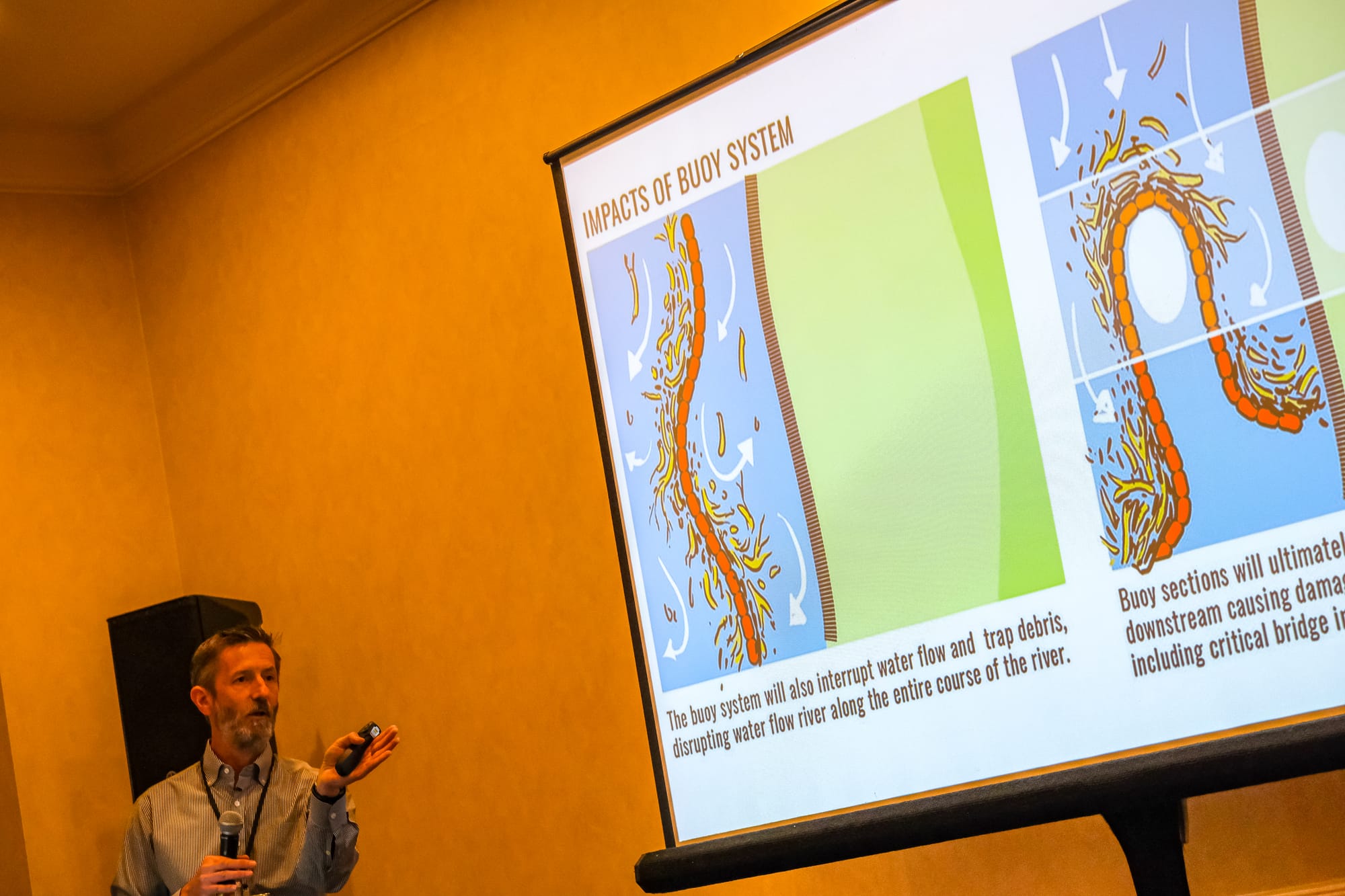
“It’s really hard as an engineer to get my head around that this has actually been reviewed in any real cautious way,” he said.
The regulatory reviews usually assigned to multi-billion dollar federal projects like these “normally inject some sanity and some review into what is, make no mistake, a massive unprecedented change to a river corridor.” As with the border barriers on land, these aquatic deterrents benefited (and suffer from) many waived federal regulations, Tompkins said.
None of the mishaps came as a surprise for Tompkins.
The collapsing wall? Privately built by Fisher Sand and Gravel, a company later sued by the federal government for violation of international laws for the flood risks they created.
“This wasn’t even a real flood and that’s a real problem when you have this thing undermined and tipping into the river,” said the engineering geomorphologist, an expert in landscapes and how construction projects can alter them over time.
Of the buoys he said there is “no way” that they can be secured within what he described as a “soft-bedded river” like the Rio Grande. Some stretches were already removed once due to problems with the anchoring systems.
Trading life on a living river for a border wall's shadow: Borderlands residents Jesse Fuentes, Elsa Hull, and Sam Karas.
Amidst the constant assault on the river in the name of border security are disappearing lifeways and people, as other members of the panel modeled.
Jesse Fuentes ran rafting adventures on the river for years and sued Governor Abbott to stop the buoys with some success, claiming they damaged his kayak rental business. The U.S. Department of Justice joined in under President Joe Biden, arguing the buoys were a threat to "navigation and public safety and present humanitarian concerns."
Then voters got involved, boosting Trump back into office. That settled the DOJ case.
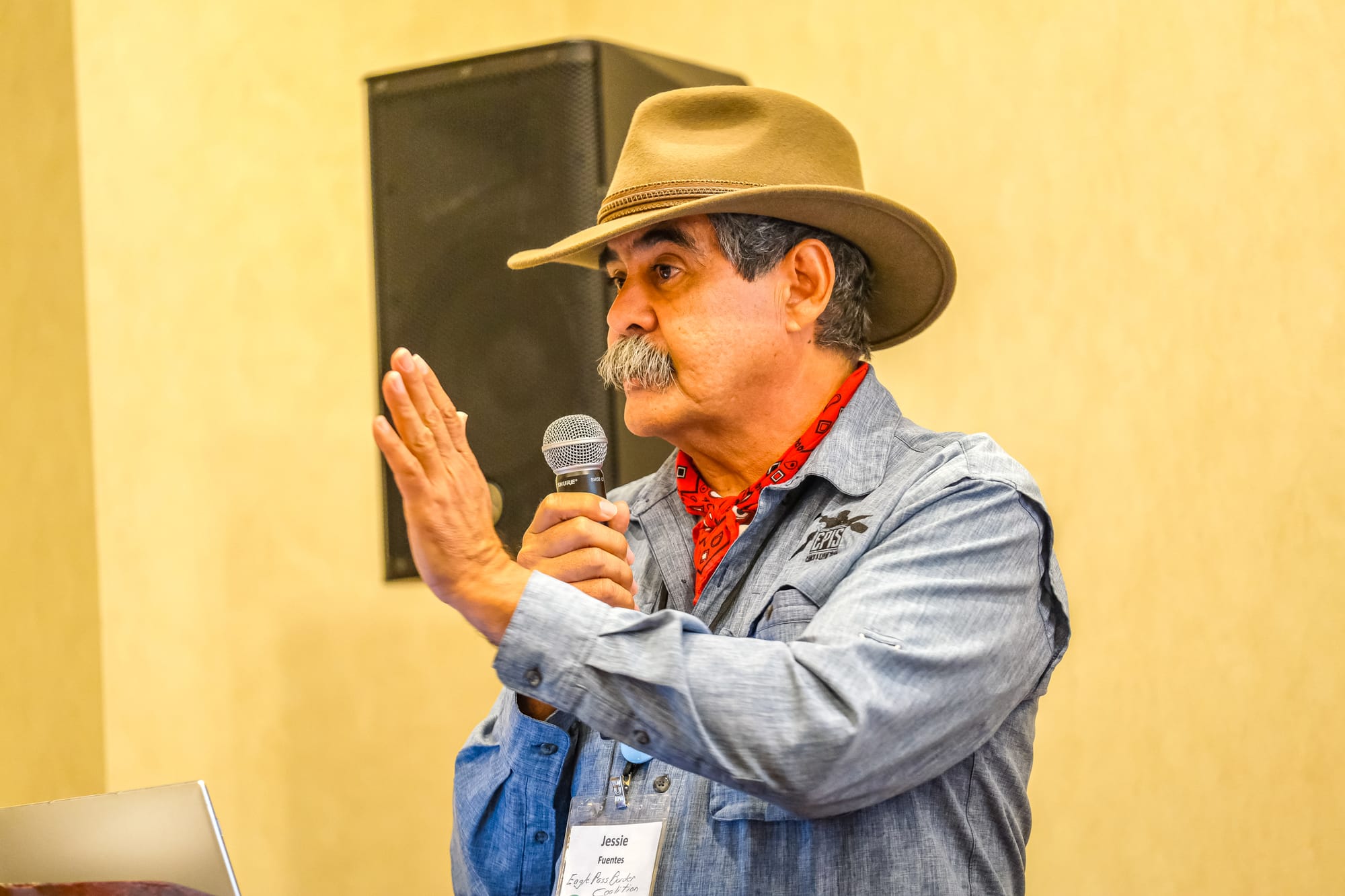
Fuentes said he spent roughly 45 years getting out on the river.
"My daddy did it til he was 88. And my granddad did it til he was 86. So that river means a lot. When I saw things happening to it, I decided to get help," he said.
For a time, Fuentes shuttled reporters on the waters documenting the loss of river access. But with rapid acceleration of security activities and related infrastructure, he has since been nearly blocked from the river entirely. He hasn't been out on a kayak since last fall, he said.
Fuentes describes in a soft-spoken manner witnessing the inhumane treatment of immigrants seeking a better life in the United States at the river. It's behavior much of the rest of the country has since witnessed with the empowering of ICE in U.S. cities far from the southern border.
“What I saw on the river is what I saw in Minneapolis,” Fuentes said, referring to the sustained abuse of local communities by ICE agents carried widely by television news in 2025: “people being mistreated. Being treated like animals, being herded left, right.”
“It was an opportunity for us as a human species to do good, but we chose to do bad.”
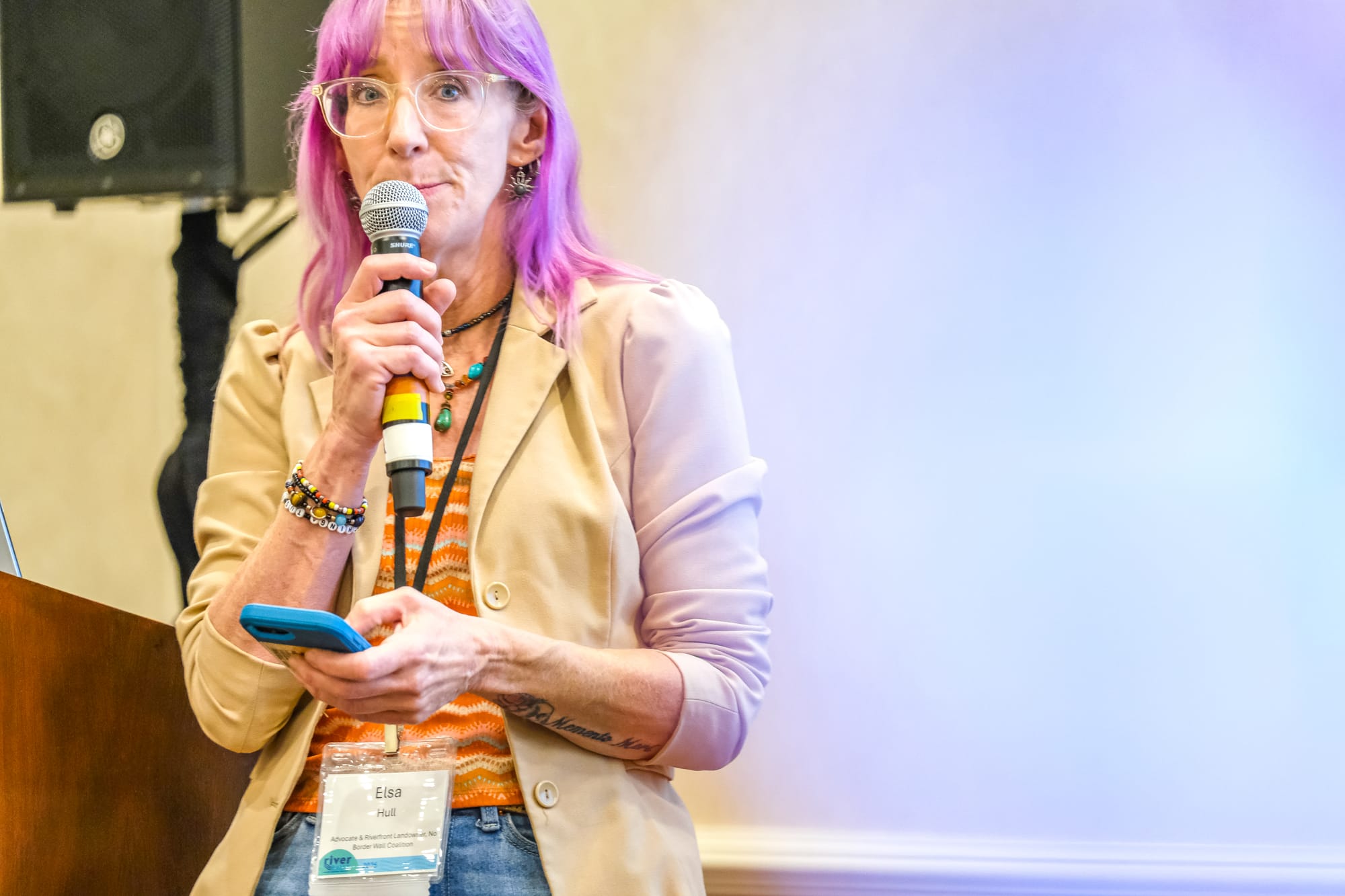
Elsa Hull said she moved to the river decades ago with a love for the waters and myriad creatures making it their home. She arrived thinking U.S. Border Patrol existed to help local residents. Her mind has changed over the years, as she saw her land trespassed upon by federal agents, as helicopters hovered dangerously close over her home, as agents “stalked” her and family members on their own land.
“I caught two Border Patrol agents walking down the road in front of my house with masks and hoods on. Why are they hiding? Why?” she asked. “They are the ones that cause us to fear for our safety.”
Panel Discussion & Q&A last week about federal and state border wall efforts at the River Network's River Rally in San Antonio.
How much of the border wall proper will "spill over" into the expansive Big Bend further west and northwest along the river's reach remains an open question. This much-beloved and remote landscape sees little notable migratory traffic (apart from a modestly growing population of black bears and bighorn sheep). But it has still had to rally itself to resist encroaching federal wall and river projects.
A coalition of five Big Bend area sheriffs recently signed a joint letter in favor of border security—but against a border wall. The recent contract announcement flew in the face of promises from the head of U.S. Customs and Border Protection just days earlier.
“Big Bend National Park has some just, like, unbelievably huge granite cliffs. It would be kind of silly to put like a 30-foot border wall on top of a 90-foot granite cliff,” Scott told the Washington Examiner in early May.
"It's not just the Rio Grande that we're worried about," said Sam Karas, a river guide and reporter at the Big Bend Sentinel. "I live on Cibolo Creek and that becomes a river for four months out of the year, so we're concerned about all those waterways as well."
Hull closed her presentation that, like Fuentes’s, included photographs showing off the natural beauty of the lands and waters she calls home, saying: “I will never feel safe again living next to this wall.”
“Please understand that what happens on the border does not stay on the border,” Hull said. “The lawlessness and brutality that the borderlands residents have been subjected to for decades has now spilled over into the rest of the country.”


