As a die-hard soccer fan, and given that climate change is impacting the World Cup, I thought about spending this week’s newsletter looking at FIFA’s fraught connection with the fossil fuel industry and the push by both players and fans to rid the sport of fossil fuel sponsorships.
But that didn’t feel like the kind of solutions-forward story that I aim to bring you here, so I knew I needed something else.
Then, an encounter with cups at a World Cup viewing event gave me the idea to revisit a topic and solution that my city has been pursuing for some years.
As you read what I discovered below, go ahead and leave a comment about the best reuse projects you've experienced or where the movement should be heading. I’d love to hear from you!
On to the Story,
Syris
On Sunday, I woke up early and eager to get to the World Cup Fan Fest that has taken over a once-thriving shopping mall in Downtown Seattle to watch Spain take on Saudi Arabia in the day’s first match at 9am. But as I rushed to get out the door so I could beat the line and grab a seat behind the mezzanine railing to watch the game on the four story screen erected on the opposite side of the atrium, I hadn’t the time to fill my thermos with coffee, so I just left my apartment with the prayer that the concessions in the fanzone would have what I needed to slake my caffeine craving.
As a climate journalist and a former climate advocate, I ache a little when I buy a drink at a cafe or concession stand, knowing it’ll come in a disposable cup. Despite coffee being as central to Seattle’s urban identity as our evergreen trees, our cafe culture remains much the same as the rest of the United States. Most Seattleites tend to filter through their favorite local roastery, exchange perfunctory pleasantries with the barista, then stride out clutching a branded paper cup, only occasionally taking the drink to stay while chatting with friends or working away on a laptop. Even then, the coffee tends to come in a single-use paper cup instead of a ceramic mug.
All those cups add up.

It’s hard to find solid data on just how many disposable cups Americans throw away each year. But estimates suggest it’s in the billions — anywhere from 25 billion to 50 billion, in fact. It’s a disaster all its own.
Millions of trees are felled each year to manufacture them, and the chemicals used to waterproof them make paper cups as toxic for the environment as plastic ones.
With that in mind, I always try my best to carry a thermos when I make a coffee run. My own individual choice doesn’t make a meaningful difference in isolation, of course, but at least it eases the burden of guilt I feel.
All to say, on Sunday, I wasn’t thrilled about drinking coffee from a paper cup while I watched the Spanish and the Saudis face off, but when I need a caffeine fix, I’ll take it however I can get it. Thankfully, the fanzone itself, aided by an initiative that the City of Seattle launched four years ago, helped keep my karmic landfill free of one less paper cup.
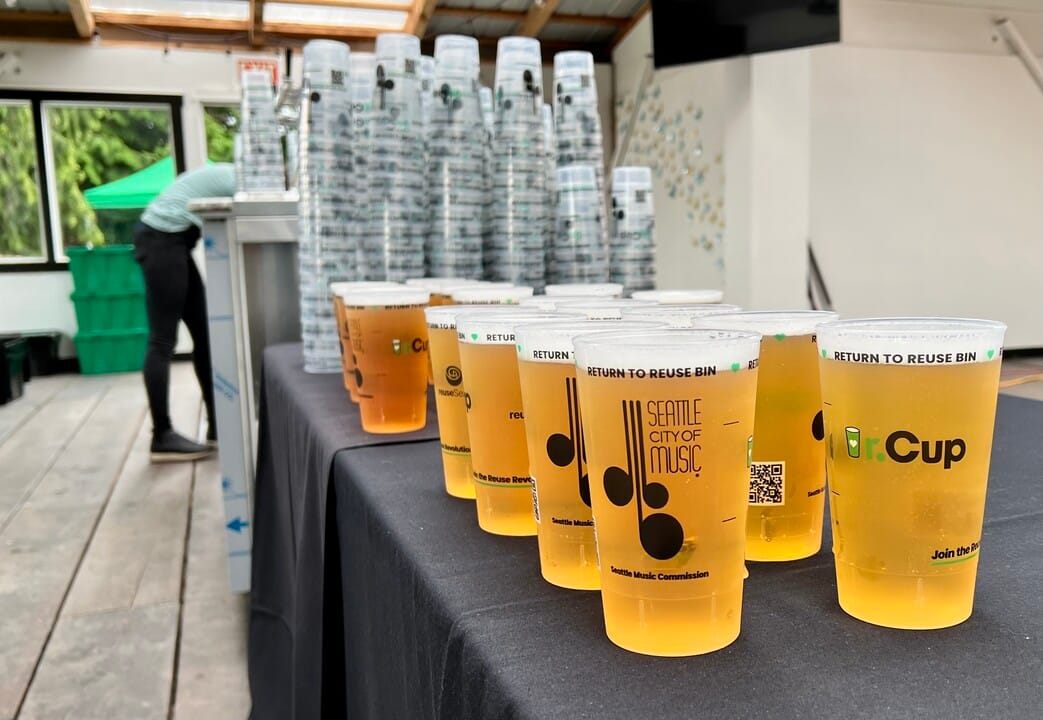
In June 2022, an annual concert series at Seattle’s Woodland Park Zoo became the small-scale pilot for the new Reuse Seattle program that aims to help eliminate single-use cups, plates, and silverware citywide by partnering reuse service providers with cafes, restaurants, and other businesses across the city. A company called r.World provided the cups at the “ZooTunes” concerts, and beside the usual suite of three bins — black for trash, blue for recycling, and green for compostables — sat a fourth, yellow bin for returnables and reusables where attendees could toss cups to be collected, taken to r.World’s operations hub in South Seattle, washed, and redistributed for reuse. Across those 12 concerts alone, r.World managed to prevent more than 27,000 cups from going into the landfill.
For the second half of 2022 and the early part of 2023, reusable cups were restricted to “closed venues”: theaters, stadiums, and concert halls. This helped normalize the idea of reuse, get providers established, and (most importantly) ensure that as many cups were returned as possible. Well over 90 percent of cups are returned in those kinds of spaces. But once reusable drinkware is sent out into the open world with customers, it becomes a lot harder to ensure they’re returned unless a fee is charged for the failure to do so — or some other incentive is established. But with the major kinks identified and straightened out, the reuse initiative has grown significantly since then.
“We've finally now gotten to the place where we have four or five or six reusable service providers who can step into the space and provide that reusable cup, reusable plate or clamshell,” said Pat Kaufman, the reuse program manager at Seattle Public Utilities.
“So the coffee shop doesn't have to wash it, and the customer doesn't have to bring it with them every time. It'll be there when they want to go get their coffee, it will be ready for them.”
Around 20 different cafes around Seattle have come on board to support that kind of “borrow-a-cup” program, along with nearly as many restaurants and more than a dozen entertainment venues. Even the Washington State ferries that dock in Seattle and cruise across the Puget Sound carry these reusables now. And, much to my delight, the same is true for the World Cup fan zone in the Downtown Seattle mall, which poured my coffee into a reusable cup that looked nearly identical to your typical paper coffee cup but was instead a durable, washable, plastic alternative provided by Bold Reuse.
The decision by Bold Reuse and r.World, as well as other reuse providers, to manufacture their cups out of plastic is a controversial one, given the growing desire to bring an end to plastics. “We really don't want it to be plastic,” said Heather Trim, executive director of Zero Waste Washington, who has been a vocal advocate for reuse in Seattle and the state. “We want those reusable items to be stainless steel or glass or some other material like that — and not plastic.”
One provider, Okapi Reusables, does provide cups and containers made solely from stainless steel. But Michael Martin, the founder and CEO of r.World, feels that there is a place for plastic in the reuse space. “Single use is the enemy, not plastic,” Martin said.
Reusable plastic cups, he argued, also have a lower environmental impact than those made of metal. When different teams of researchers investigated that specific question, their results conflicted with each other.
Some reports show that plastics are better than steel, and others claim stainless steel is superior. The results likely contradict each other because of the inherent challenges that come with attempting to conduct a comprehensive lifecycle assessment when no one has access to all the data required to reach a definitive solution.
What these studies don’t seem to account for, however, is to what degree even durable cups might shed microplastics that could migrate into foods and drinks, particularly when hot. Regardless, these studies all agree that, when it comes to the waste stream at least, reuse beats single-use.
But just bringing companies into the city and hoping they’ll make reuse work doesn’t guarantee a working system. Conflict and competition could easily depress opportunities for success. What this ultimately requires is a set of standards that ensure all players follow the same rules to ease people into participating. “That's where Amy [Larkin] and Claudette [Juska] at PR3 are really saving the day,” said Kaufman.
Larkin and Juska co-founded PR3 in 2019 to develop a set of universal standards that would guide the way businesses and governments develop and operate reuse programs, covering the way dishware is labeled, collected, shaped, sized, cleaned, and distributed. “[Standards] say: Okay, we're all going to do this, we're all going to follow these rules so that our systems are interoperable,” Juska said. “Standards are what enables so many of our global systems to work.”
“It makes it a lot easier for the consumer and for the businesses, if there's essentially a standard that people can use,” Trim said.
“And then everything is way more interchangeable. And in the end probably saves costs for everybody.”
The City of Seattle understands this well, which is why any reuse service provider that wants to operate with Seattle Public Utilities’ seal of approval must agree to comply with the PR3 standards as they evolve. And evolve the standards will. No set of guidelines are ever perfected. Even the rules of baseball are tweaked and changed from year to year. To improve them, reuse providers need to put the standards into practice and see what works and what doesn’t, which has already happened.
At first, PR3 wanted all reuse collection bins to be orange. But eventually, as r.World tried to meet that standard, they realized it wouldn’t work, Martin told me, so he went to Larkin at PR3 and said, “it's got to be yellow, not orange, Amy. Because you can't get orange bins.” And now, anywhere in Seattle that provides reusable dishware, you’ll eventually spot a bright yellow bin.
But, as with people’s difficulties sorting between compost, trash, and recycling, I’ve discovered that people don’t quite yet understand what does, or doesn’t, go in the yellow receptacle.
After the game was over, with Spain finally showing up to the World Cup with a 4-0 triumph, I glanced into the bin as I pitched in my cup, and I immediately saw straws, napkins, plates, and compostable bioplastic coffee cups likely brought in from a nearby cafe, almost all of which should have landed in the adjacent container for compostables. But there’s always a learning curve with these things, and at least Seattle is making an effort to get started now so we can eventually rid ourselves of as much landfill-bound waste as possible.
“Seattle is the furthest ahead at this point,” Juska said. “It's pretty exciting. And other cities are looking to do the same thing.”
Most of the other cities getting involved, however, are “Blue” cities in “Blue” states—cities like Denver, San Francisco, and Portland, Oregon. Reuse programs have also cropped up in a couple of “purple” states with less-cemented political identities, Ohio and Nevada specifically. But as far as I’m aware, reuse has yet to find even a toehold’s purchase in a deep Red state.
Thoughts and Feedback
But what about you, what do you think about the idea of reusable to-go cups and takeaway containers?
In a state like Texas, where even something as simple as a local ban on plastic bags has been essentially outlawed, what do you think it would take for a reuse movement to get established? Have you seen local/community-driven examples?
And, more importantly, what would it take for your city (or the people around you) to start to adopt reuse?
Alternative Futures Video
No more single use plastics of paper products—Reuse Seattle partnering with R.World, Bold Reuse, and Okapi to provide reusable cups and plates. How to make such programs the norm rather than niche policy? What are the best reuse programs you are tracking in your community? Follow Deceleration on YouTube.
Events

Also: On May 7, a group of experts inside the United Nations released a proposal for a dashboard that would help countries and the world measure social and economic progress in a way that goes beyond a growing GDP. This past week, the Wellbeing Economy Alliance hosted a webinar to hear from Ricardo Fuentes, who led the UN group that created and put forth the proposal.
Note: This event has passed, but recording can be viewed if you register here and request access.
More great events at Deceleration's Bioregional Events Calendar.

Tip Jar
Buy Syris a Coffee
Show your appreciation for all the positive energy and actionable intelligence that Alternative Futures brings every month.
News for the Future
- Though sales of electric vehicles have slumped since Trump took office, the surge in gas prices from the hopefully now officially ended war with Iran gave EVs a new excitement — and not just for buyers. A community-owned carsharing program operating in six cities across central California called Míocar has also gained popularity thanks to its fleet of EVs that can be rented for as little as $4 an hour. While it’s a lifeline for those who live in rural areas but don’t own cars, even folks who own gas-powered vehicles have started relying on Míocar for their daily errands.
- It turns out that a flooded, abandoned coal mine could actually be good for something: Keeping vintage wine at just the right temperature. For the last eight years, Lanchester Wines in northeast England has pumped water out of a nearby mine, which is roughly 66 degrees year round, and extracted a little bit of that “heat” to help keep their wines at a crisp 50 degrees during the harsh English winter, which ultimately cuts their electricity bills by more than a third.
- Indonesia and the islands that surround it sit in the Coral Triangle, the region with the most marine biodiversity in the entire world, but climate change and bomb fishing have devastated many of the reefs around it. To revive them, a Malaysian community has begun to install concrete imitation reefs that provide temporary shelter for fish while offering coral a foothold to reestablish.
- Restoring peatlands is a crucial way to sequester carbon, and it turns out that when solar farms are erected on top of them, those carbon sinks can become local hotspots for biodiversity as well.