

As they raise awareness of an ongoing genocide, activists for Palestinian liberation in San Marcos are transforming local politics in their Central Texas community.
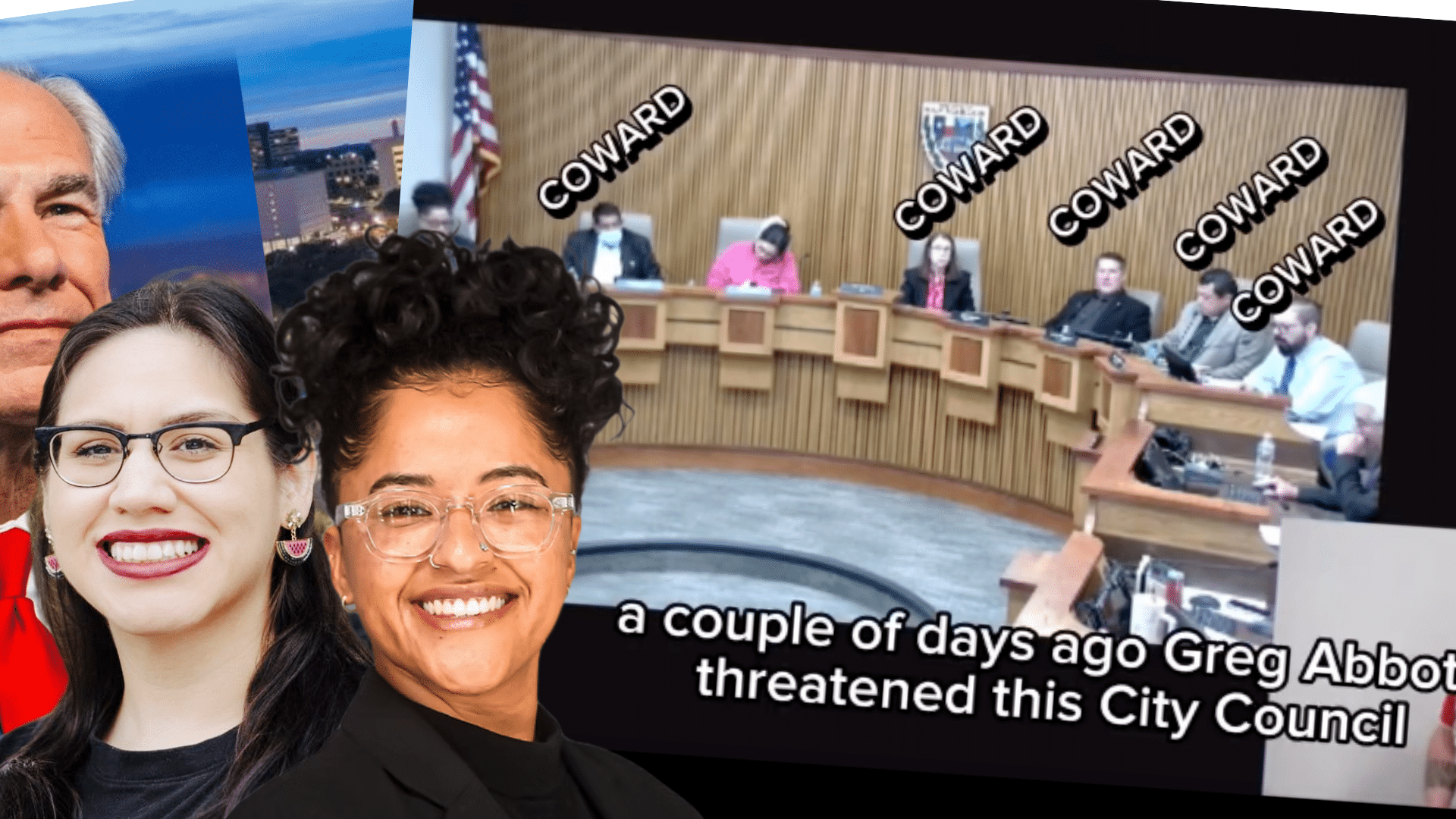
Last week, their city council became the first in Texas to vote on a resolution calling for a ceasefire in Gaza. In a state where even a hint of public support for Palestine brought threats from the governor to defund vital services, getting the resolution to a vote required years of coordinated organizing from a diverse, deeply engaged community who remain passionately opposed to the unfolding horrors of the Israeli occupation.
After hearing public comments from over 100 local residents in a meeting that stretched until late at night, the council members ultimately voted 5-2 against the measure. Despite this setback, the extreme dedication of the “San Martians” who wrote the resolution — and forced the city to hear hours of public testimony in support of human rights — may offer valuable lessons to other communities about what can be accomplished even in the face of intense opposition from a powerful Republican-led state political establishment.
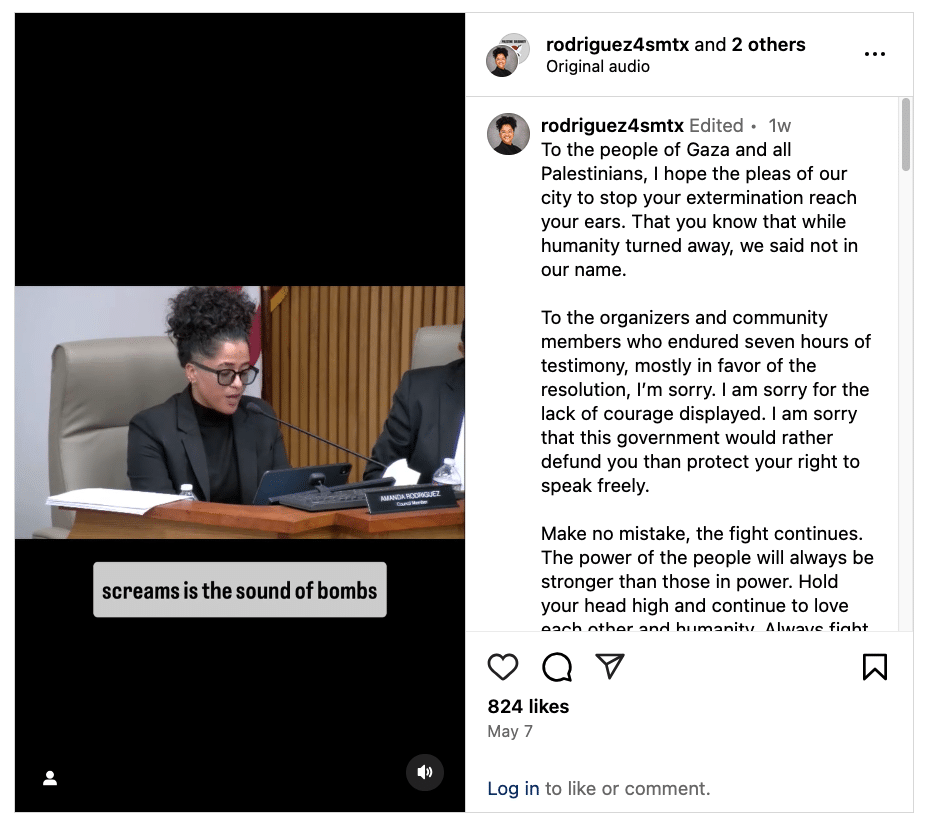
Palestine Solidarity SMTX first began petitioning the city council for a ceasefire resolution in 2024. To reach a formal vote in front of the full city council, the resolution required either the support of the mayor, or two sponsors from among the other seats on the council. Although Alyssa Garza, the Place 3 councilmember, was an early supporter, it failed to find that second sponsor. So Palestine Solidarity SMTX ran a candidate of their own in the 2024 election: Amanda Rodriguez, an experienced community organizer and lifelong San Marcos resident.
“I was a part of the organizers who were coming just meeting after meeting, month after month, pleading with our council people to do something, to raise some sort of alarm, to just even acknowledge the issue,” said Rodriguez, in an interview with Deceleration earlier this week.

Rodriguez easily won her election to become the Place 6 city council member, and the second necessary sponsor of the resolution. Although she never intended to become a politician, she told me she was inspired by the dedicated and diverse cross-section of residents that came together under the Palestine Solidarity SMTX umbrella, which includes both students at Texas State University, but also many locals such as herself.
“It’s, by far, one of the most diverse groups of people I’ve ever been blessed to organize with, not just in terms of race and ethnicity, but careers, religion, everything. I mean, just so many wonderful people locally who came together on an issue,” she said.
Tomás Diaz de Leon, an organizer with the group, agreed that casting a wide net helped them find success in both growing their organization and putting pressure on city council to take the vote.
“For about the last decade or so, I’ve been involved in various political organizations and movements, and I have not seen the level of coalition building in this small town that I’ve seen around this particular issue,” Diaz de Leon said. “I think it was the coming together and coordination between a bunch of different organizations that put us into a critical mass of support.”
Getting involved with the cause of Palestinian liberation also helped many participants become more engaged in civic life. “Before last year, I had never been to a city council meeting,” said Yansi Arévalo, another member of the community-led group. Although she said she never expected herself to be involved in local politics, now Arévalo says she and many other members have become regular attendees.
“We’ve been showing up together as a community, as organizers speak in support of Palestine and speaking out against genocide,” Arévalo told Deceleration. Along the way, she’s become “more familiar with the process of what it’s like to engage in local government [through] trying to figure out the rules of what we can and can’t do.”
Showing up for Gaza also meant members were better positioned and able to show up for other issues, too, Rodriguez told us: “I’ll give you a prime example: Malachi Williams.” When San Marcos police officer Alcedis Ventura fatally shot the 22-year old Williams in April 2024, members of Palestine Solidarity SMTX were already experienced at speaking before city council and raised concerns around Williams fate, such as the failure to render medical aid after the shooting. “Many of the organizers came there that day to speak for Palestinians, and left there speaking for both causes.”
One often repeated concern raised in opposition to municipal ceasefire resolutions is that local city governments have no control over federal policy, and should be focused on other, more pressing issues. But to Rodriguez, the intersection between Palestinian liberation and the problems her constituents face is crystal clear. While block walking for her city council campaign, Rodriguez said, she heard every day from people who were struggling to make ends meet.
“No matter what side of the highway you’re on, no matter what neighborhood people are struggling,” she continued. “You start to see the structural reasons why people are struggling, whether it be for housing, food, education.”
The U.S. continues to send millions in military aid to Israel, which is used to devastating effect on everyday people living in Gaza. “Palestinian Liberation has always shown us that everything is interconnected,” Rodriguez said.
“You can’t fund the depravity that we’re seeing [in Gaza] and not have impacts here at home. There are sacrifices that are made to do that, and unfortunately, the people, our people, bear the brunt of those sacrifices.”
As news spread of the impending vote on the ceasefire resolution, Rodriguez said her official phone and email were flooded with threats, including numerous voicemail messages that contained racial slurs. At least one person threatened to call ICE on pro-Palestinian activists. “This resolution just genuinely taught me how much racism still exists in this community, how deeply prejudiced people are,” Rodriguez told me.
She also expressed frustration at the lack of condemnation of Abbott’s threats from other members of the city council.
“The state has now learned that they can threaten bonds, that they can threaten public funding through grants … to hinder public opinion, to hinder action,” Rodriguez said. “That’s what terrifies me, that’s what pisses me off, is they used us to have that experiment and some of my colleagues couldn’t rebuke that on behalf of our people.”
The San Martian activists I spoke with echoed Rodriguez’s disappointment at the results of the ceasefire resolution vote, but also expressed determination to keep organizing on behalf of Palestine in their community. “Hopefully, other cities will be able to use this as a rallying cry … to stand against the suppression of our free speech and our ability to criticize the actions of our government,” Diaz De Leon said.
Despite the threats and the defeat of the resolution, Rodriguez said the vote inspired her and others to keep fighting.
“I’m proud to be from this city and to see so many people come out because their hearts are repulsed, their minds are repulsed by the evilness that we’re seeing,” Rodriguez concluded. “And that gives me a lot of hope for humanity and I think, ultimately, right now, in these times that we’re in, hope is everything.”


