Hello again, loyal reader. I thank you for taking the time to read again after a brief absence. For this newsletter I am making a short reflective detour. This is probably my tenth version of this introduction. I have written and re-written and thought and re-thought the words, the message, the information I want to share with you.
As we enter the 250th year since the establishment of this nation-state, I have been overcome by a loss for words. I’ve questioned what I could possibly offer you when the President thinks he spoke to Teddy Roosevelt IRL, Mercury is in the microwave, and the SCOTUS is acting a fool again. When the only voice of reason in the chambers of our nation’s highest judicial power, the only consistent voice of dissent, comes from a wise Latina.
Maybe that is what I can offer: voices of dissent amid despair that hopefully resonate with your rage and incite, if not joy, then the endurance that clears space for bridges of connection and community. In composing this newsletter for you, I ask the same question Audre Lorde did in relation to her own writing:
“Am I altering your aura, your ideas, your dreams or am I merely moving you to temporary reactive action?”
I would add that I question if even the latter is true. It is easy to fold to defeat when consistent pressure just to stay afloat compounds the constant drumbeat of devastating news. If you do anything this weekend—well, besides read this newsletter—I hope it is to challenge yourself to remain ungovernable.
—Roxana Rojas
If this newsletter speaks to you, be sure to share it with your friends, family, and community. Is there a story not being covered that you’d like to see? Join as a paying supporter and engage in the comments below. Let me know what you want to see in the next newsletter!
Consent of the Governed
˝All men recognize the right to revolution; that is the right to refuse allegiance to, and to resist, the government, when its tyranny or its inefficiency are great and unendurable.”
—Henry David Thoreau
In the last week of June alone, the Supreme Court issued a number of devastating rulings pertaining to the legal status of immigrants (and US citizens) and their treatment by the US government. On June 25, it both upheld the practice of “metering” to prevent refugees from filing asylum claims (a policy known as “Remain in Mexico”) and also made it easier for the government to revoke Temporary Protected Status beyond Haitians and Syrians (bad enough) by limiting the ability of the courts to hear any legal challenges to TPS determinations. In both rulings, Justice Sotomayor was joined only by women in her dissent, along with Justice Jackson and Kagan. In the former, Sotomayor herself delivered the dissent, after which Alito, in an unheard of manner, grumbled before the bench.
The one bright spot in June’s rulings (if you can call it that) was the Court’s narrow 5-4 reaffirmation of birthright citizenship, a right clearly and plainly stated in the Constitution’s 14th amendment, which the Trump administration nonetheless attempted to overturn in an executive order from January 2025. The audacity of the administration to unilaterally make changes to the Constitution, an act that by definition of our government system requires Congressional approval, does not surprise me—given that our president doesn’t know (or care) how the government works.
In light of these rulings, I have spent much of the last month in deep reflection on the sustainability of long-term resistance. It seems that no level of vile attack on our lives, our freedoms, and our very existence is beyond this administration, nor does it seem to spark significant collective action on a national level to mobilize and effectuate change.
What straw are we waiting for if the camel’s back is already broken? Did the sleeping giant take too much valerian or melatonin? Maybe the Ambien was laced with diazepam? What about everyone else?

I refuse to believe there is contentment amongst the average household that must spend the equivalent of the GDP of a small nation to pay for groceries and gas. I refuse to believe that the people of this land consent to being consistently surveilled, caged in a panopticon, while the 1% is exempt from the effects of the machinery they have built. I must hold tight to my conviction that the discontent and disquiet in fact has mobilized pockets of action—even if quiet, even if under the radar, even if unseen. I want to know, need to know, that the mainstream narrative is wrong and that the collective psyche is not numb. And above all, that there is an underground railroad to freedom and maybe we need to be paying more attention to the quilts hanging outside houses all along the route hidden in plain sight, showing us the way in coded design.
Dissent implies consent, and is the hallmark of free government; one who knows that he may dissent knows that he somehow consents when he does not dissent.
–Hannah Arendt
When it becomes increasingly difficult to sustain resistance—because the rent is due, the food bank is cutting down on distributions, and Bibles are now more ubiquitous in schools than hot lunches—it is imperative to ask ourselves:
“What do we do when we can’t do anything but survive?”
What do we do when urgent action is needed, yet your body feels like it is flailing in quicksand and your mind is lost in a haze of disquiet between reels of yet another indignity, another encroachment on our right to life, liberty, and pursuit of happiness, all amid the constant ringing of debt collectors (didn’t you put your number on the “do not call” list already?)
Out of my own rage, grief, and desperation I want to share what keeps me going, in the hope that you too will find respite and inspiration in the dissent of others. As Henry David Thoreau wrote on civil disobedience: “It matters not how small the beginning may seem to be.”
“Poetry is not a luxury. Poetry is not only dream and vision…it lays the foundations for a future of change.”
–Audre Lorde
Some would say that collective action is alive in the small things that add up to big effects: the mutual aid providing lifelines of support; the coffee shop meet-ups to discuss the latest ICE warehouse coming to town; the networks of neighbors who come together to protect their community; the professors who refuse to back down from creating safe spaces for students, even when it costs them their job; the employers who make it clear that ICE is not welcome, who turn the tables on ICE and demand: “show your papers!”. Collective action is alive as well in acts of imagination—art, poetry, music.
In these and many other forms of creative resistance, dissent is alive and well. Those who refuse to consent to a normalization of white supremacy—one that weaponizes fear and targets the most vulnerable—are normal and everyday people, not celebrities or politicians or influencers. Recalling that important reality helps us shift our focus from the devastating losses making the rounds in our feeds and inboxes and take a good look at what we HAVE and what we’ve GAINED.
In the last few weeks I visited Chicago to take a break from Texas.
Everywhere I went I saw small signs of creative refusal to consent: screen printed art opposing fascism, Know Your Rights yard signs, ICE activity hotline flyers posted at gas stations and on grocery store cork boards, coffee shops doing “No ICE” campaigns selling hot coffee to raise funds for mutual aid, city ordinance postings stating a boundary for ICE agents, and entire university galleries dedicated to subversive art.
In conversations with locals, I saw an immediate willingness to speak about the impacts of immigration enforcement on their neighborhoods. This is the same city where an Alderperson chased ICE down her constituents’ street, heels and all, yelling to warn them of ICE presence, the same city where another elected was arrested at a hospital for confronting ICE, demanding a warrant for their presence. Could you imagine our own Teri Castillo or Jalen McKee-Rodriguez doing the same?
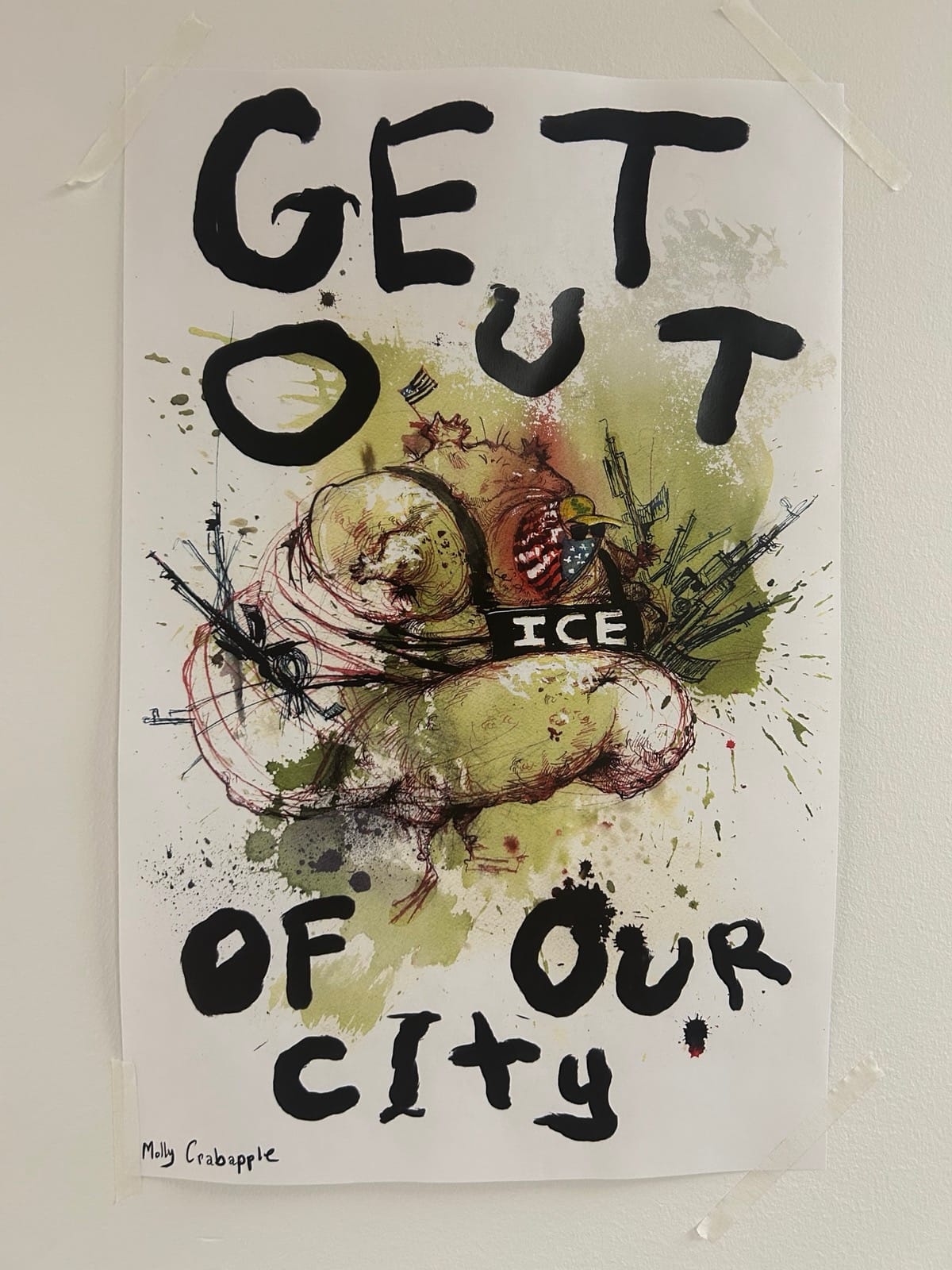
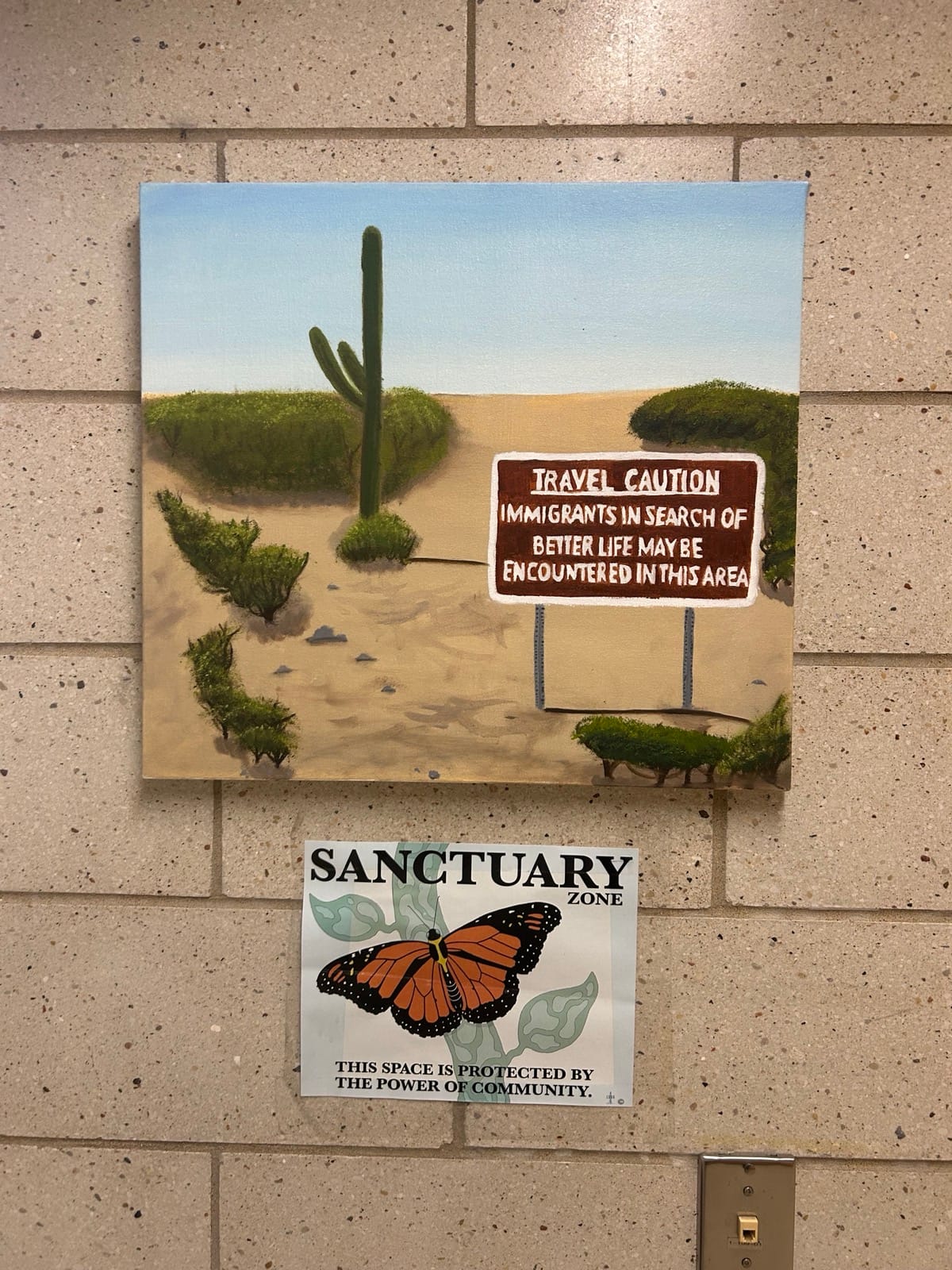
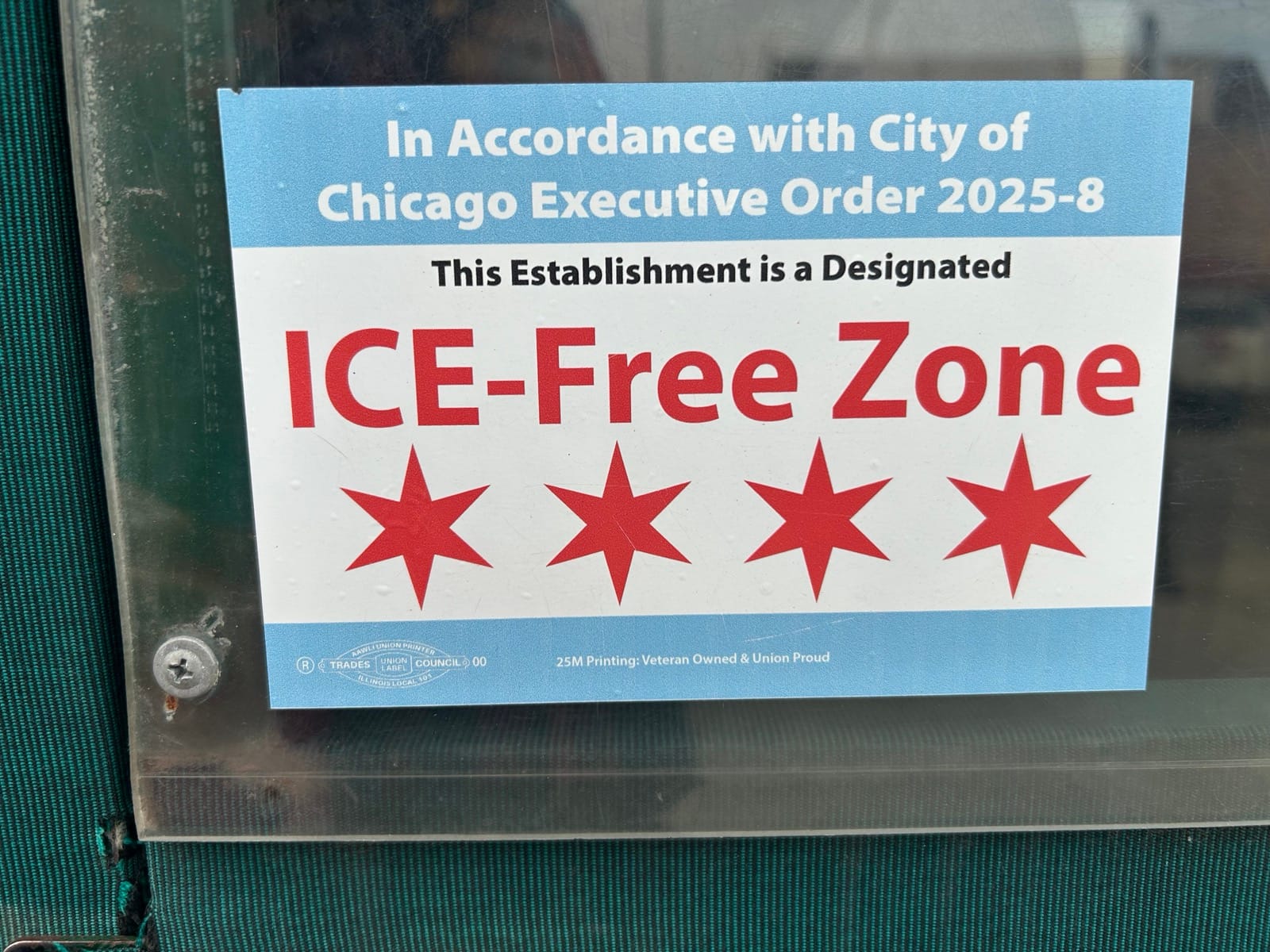
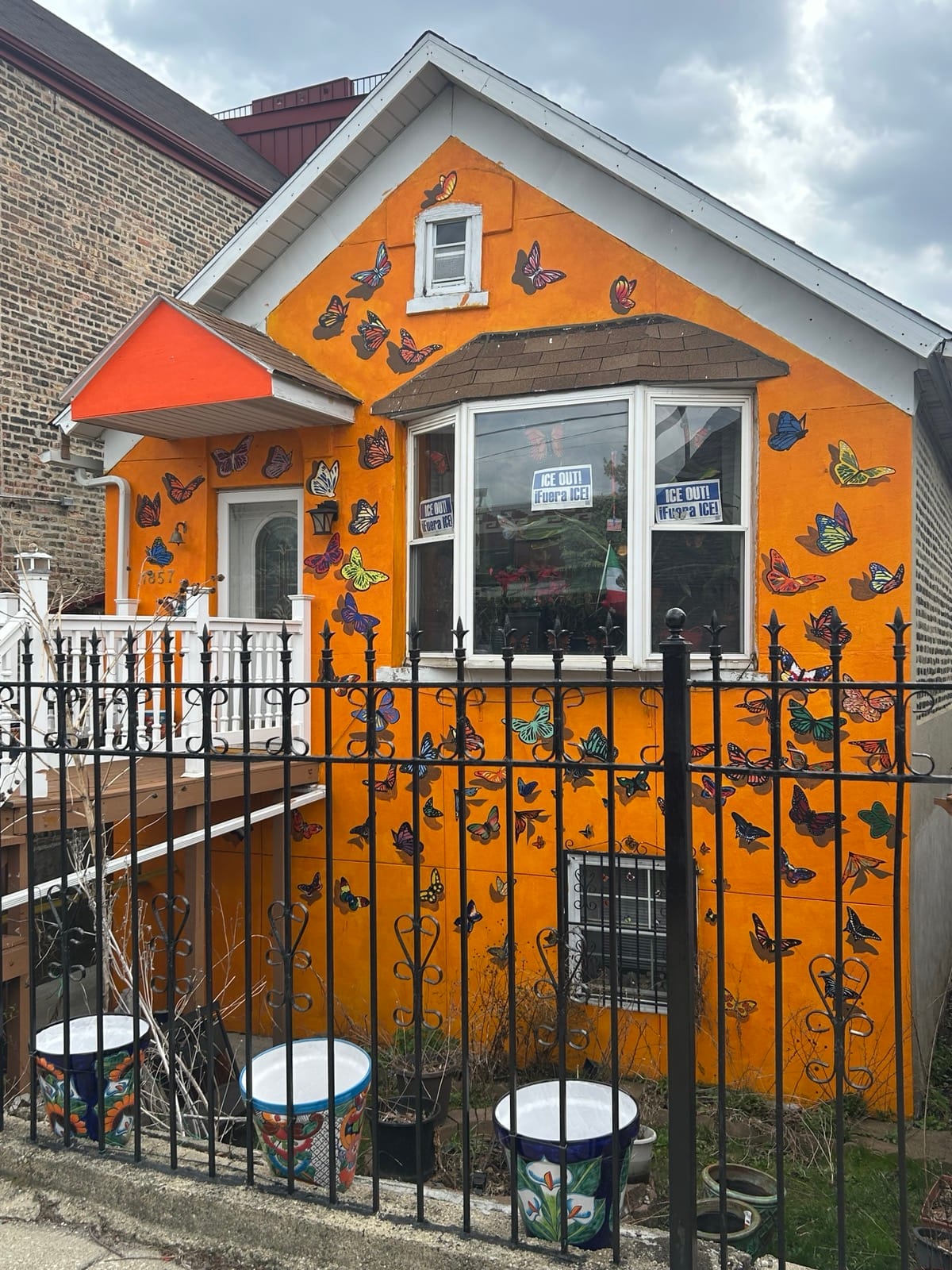
Fotos from Chicago. Credit: Roxana Rojas.
"There are men that fight one day and they’re good. Others fight one year and they’re better. There are those who fight many years and they’re very good. But those who fight their whole lives: those are the indispensable ones."
—Bertolt Brecht
Even before the start of this administration, those of us who saw the writing on the wall and anticipated this reality had already begun to organize and move accordingly. Some of us rushed to submit applications for immigration relief, applied for passports (including foreign ones). Some of us looked for safer (read: immigrant friendly) places to live, some of us outright picked up and left (with many taking exodus since). Others stayed, observant, and conversations anticipating the future were common dinner table talk. Immigrants’ rights and legal services organizations braced for the change.
We didn’t know exactly what it would look like, but some of us had a pretty good idea: the agents and benefactors of white supremacy, capitalism and patriarchy are all so predictable it's boring. They haven’t had a new idea here since 1492.
Since the inauguration, I have connected with strangers and friends alike in ways I would not have otherwise done had our world not changed the way it has. Even family members I hadn’t visited for years are now part of a close circle of mutual aid and support. I've been called upon to care for a stranger in the hospital because their only family feared being detained by ICE. I’ve seen faith leaders, activists, and elderly survivors of Japanese internment camps come together and walk miles under the hot Texas summer sun to sing songs, pray, and demand the closure of detention centers. I have seen young people start reading groups and develop tech solutions for tracking ICE activity. I have been a part of, and seen the growth in, food distribution groups, free pantries, and skill sharing spaces. I have seen what we can be: the indispensable ones.
And I choose to believe that we are without recourse, despite the horrors of seeing the highest surge in number of arrests in only 5 days and a record number of deaths either in ICE custody or directly at the hands of ICE, including the most recent murder of Lorenzo Salgado Araujo in Houston.
We only know of Lorenzo because of his murder, but did you know that Lorenzo built his own house, worked and created jobs with his bare hands and the tools he protected with his life?
It was those tools that were his livelihood, tools with which he gave an education to three sons, one of whom has educated hundreds of this country’s children. Lorenzo with his tools and dedication to his immediate family gave the larger community a teacher, offered others a livelihood so they might support their families, and was a dear friend as evidenced by those seen wailing at the site where he was murdered.
We have seen violence and hate parade freely on our streets—but we have also fought to keep each other safe and, in many cases, avoided tragedy via popular education, word of mouth, whistle kits, and Know Your Rights presentations. Those of us with privilege have stood in harm's way, asserting and upholding our constitution more bravely and faithfully than the government espousing it. Those stories rarely make the headlines, for it is as they say: no news is good news. But even truer, el pueblo salva al pueblo.
“We hold these truths to be self-evident, that all men are created equal, that they are endowed by their Creator with certain unalienable Rights, that among these are Life, Liberty and the pursuit of Happiness. That to secure these rights, Governments are instituted among Men, deriving their just powers from the consent of the governed. That whenever any Form of Government becomes destructive of these ends, it is the Right of the People to alter or to abolish it, and to institute new Government, laying its foundation on such principles and organizing its powers in such form, as to them shall seem most likely to effect their Safety and Happiness.”
—Preamble to the Declaration of Independence
So tell me, what is your story of resistance? I know mine is imperfect and not nearly enough. I am no one, but together with you, with community we are everything. It’s never too late to start or to grow, to refuse implied consent in the absence of dissent. NO, we must dissent, that we may become ungovernable. How are you working to become an indispensable one?
RESOURCES
- Latinx Therapists Action Network - Mental health resources for Latinx migrant peoples and movements.
- Black Mental Wellness - Mental health resources for Black migrant and African American communities needing resources for mental health.
- The National Asian American Pacific Islander Mental Health Association -Mental health and behavioral services for Asian Americans, Native Hawaiians, and Pacific Islanders.
- Additional mental health resources for communities facing the realities of criminalization, detention, and deportation
VIDEO
Deceleration ICE Watch Correspondent Roxana Rojas describes her process of taking time to reflect to deepen her resistance. Follow Deceleration on YouTube.
EVENTS
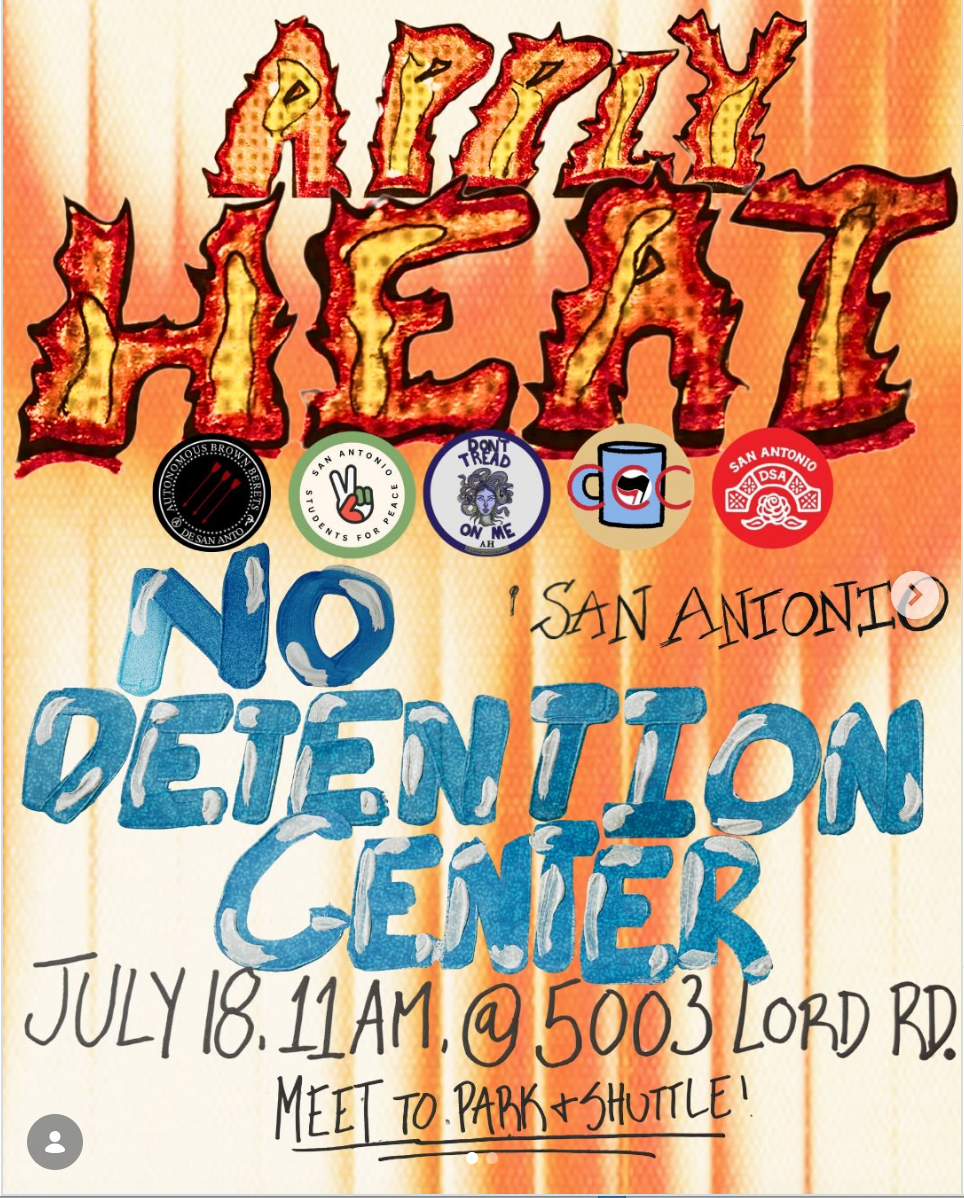
Apply Heat! Take Action against Proposed Detention Center in San Antonio
July 18 @ 11am
5003 Lord Rd
Meet up to park and shuttle to site
Via Comrade Coffee Collective: Be there, tell your friends about it! We need to show that running a detention center on the Eastside will be far more hassle than it’s worth. Seven other warehouses have been sold at a massive loss for DHS, with enough public pressure we can force them to abandon this one too!
- GoFundMe for the Family of Lorenzo Salgado Araujo
- On the morning of July 7, 2026, Lorenzo Salgado Araujo was murdered by ICE in Houston, Texas. He was 52 years old. He was a husband, a father of three sons, a small business owner, and the heart of his family. This fund exists to carry his family through the impossible days ahead, and to let them grieve without the added weight of how they will get by.
- Support the Prairieland 19 and the Minnesota 15
More events at Deceleration's Bioregional Events Calendar.
Tip Jar

Buy Roxana a Coffee
Show your appreciation for all the information and energy ICE Watch brings every month.
Further Reading
- Judge Orders Trump Administration to Resume Green Card Processing
- Former Wisconsin Judge Spared from Prison for Ushering Mexican Immigrant Away from ICE Agents
- ICE Delays Opening San Antonio Warehouse Detention Facility Yet Again
- Appeals Court Sharply Limits ICE’s Massive Expansion of Detention
- The Trump Administration is Charging These Minneapolis Protestors with Conspiracy. Organizers Won't Back Down
- 30-Year Sentence for Transporting Zines is a Five-Alarm Fire for Free Speech