Hello and welcome to this month’s edition of ICE Watch. This month I focused on ICE resistance efforts and ICE partnerships with state and local authorities. After all, how will they fill the existing detention centers—and the ones yet to be built? It is important to be informed on how this is happening on a local level as that is where we have the most impact. Read on for the outlook on Texas and immigration law enforcement activities in your local community.
If this newsletter speaks to you, be sure to share it with your friends, family, and community. Is there a story not being covered that you’d like to see? Join as a paying supporter and engage in the comments below. Let me know what you want to see in our next newsletter!
—Roxana Rojas
Is Your Local Police Chief Working With ICE? What About the Town Next Door?
Understanding 287(g) Agreements—and Who’s Got One
While people across the country continue to fight the expansion of immigrant detention nationwide, so too does the Trump regime’s commitment to the promised largest deportation action in U.S. history with a goal of a million deportations a year. Hiring fairs and recruitment efforts across the country continue to draw many, with the most recent events even luring in prospects with free Spurs tickets to a three-day U.S. Customs and Border Protection career expo in San Antonio, Texas.
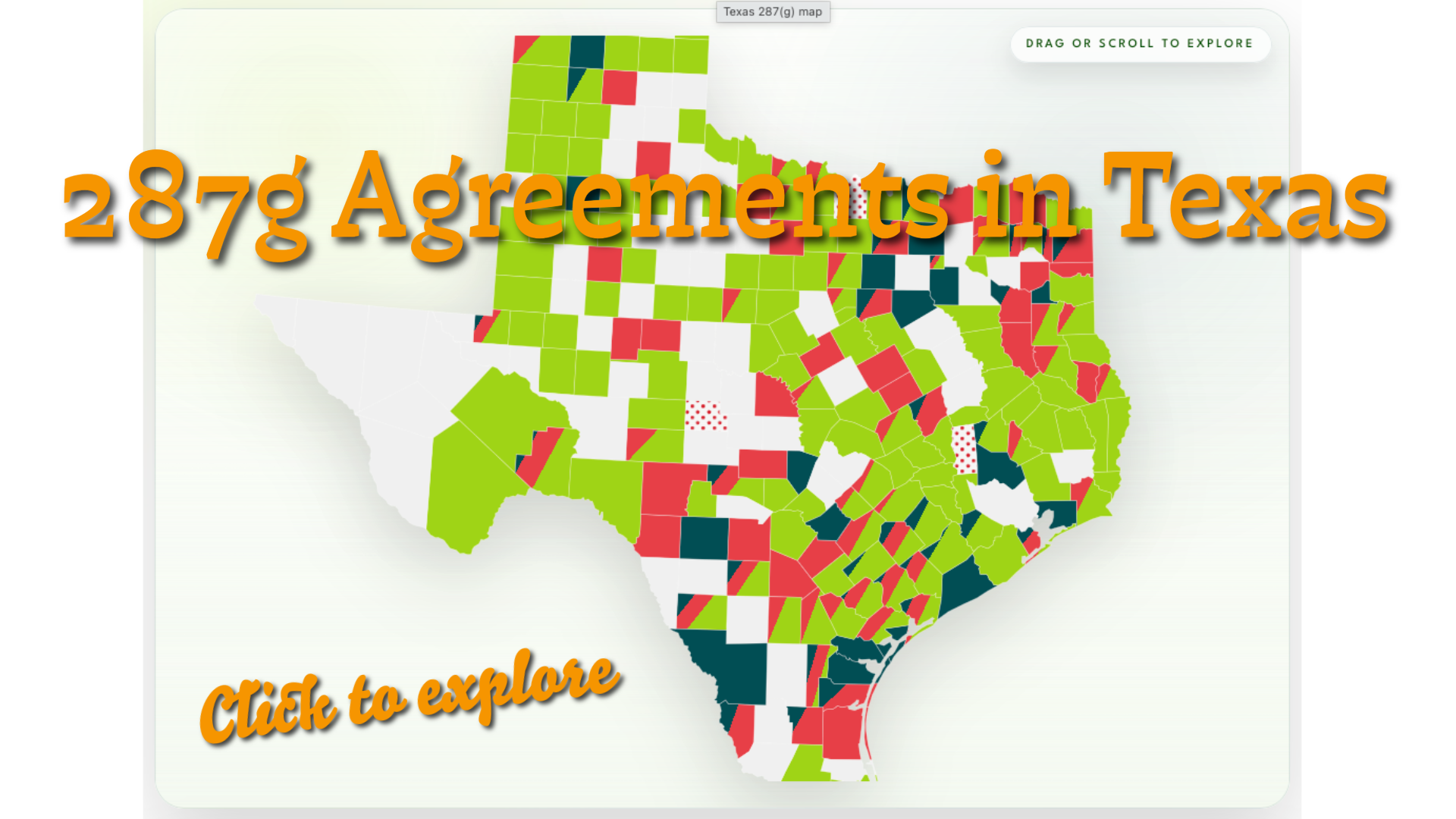
With the December 2026 deadline for Texas sheriffs to sign onto 287(g) agreements with ICE, effectively granting local cops the powers of federal immigration agents, Texas is already ahead of the curve nationally with 361 agreements active in 205 of the 254 total counties. That’s more than 80 percent of the total counties in the state, placing Texas second only to Florida, which has 370 such agreements in place. These agreements include municipalities, state agencies (such as the Department of Public Safety, in the case of Texas), and counties operating jails. In Florida, even university campus police have entered into these agreements.
The federal data no longer lists entities with pending agreements. This makes it more difficult for communities to anticipate if an agreement is in the works or what model will be adopted. It is important to note that under the recent Texas state law that codified cooperation between ICE and state and local law enforcement, SB8, only sheriffs are required to enter into 287(g) agreements. That didn’t stop 68 municipalities (which include city and township police departments) and four state agencies from voluntarily signing on.
So what is a 287(g) agreement and how does it impact your community? Well, the impact will be determined by the type of agreement model. There are three primary models listed below as described by ICE:

- Jail Enforcement Model: This allows officers to identify and process removable aliens who have pending or active criminal charges while those individuals are in local custody. This model operates primarily within the jail setting.
- Task Force Model: This model allows trained officers to exercise limited immigration enforcement authority while performing routine police duties or participating in ICE-led task forces. ICE oversight remains in place, but this model expands immigration enforcement activity beyond jail intake.
- Warrant Service Officer Program: The WSOP allows local officers to serve and execute administrative immigration warrants on non-citizens already in custody.
In the state of Texas, the Department of Public Safety has been deputized to enforce immigration law. This has raised concerns about the possible use of legitimate public-safety campaigns meant to keep all highway drivers safe being used as cover for heightened immigration-related stops. To find out if there is a local 287(g) agreement in a jurisdiction near where you live, work, or recreate and the type of model being enforced, you can check out the 287(g) Program Map or download the dataset with the listing of all 287(g) agreements.
In greater San Antonio, for instance: We find Bexar County Sheriff’s Department, Bexar County Constable Precinct 3, Balcones Heights Police Department, Hollywood Park Police Department, and China Grove Police Department—but not the San Antonio Police Department.
Who do you spot along your travels to work or home?
The reality in Texas is that with so many law enforcement agencies deputized to enforce immigration law, participating local governments will be strapped for resources given that they must pay for the costs of this additional behemoth of a task. Although there is some funding available, it does not provide sustainability long term. The cost of deputizing officers to enforce federal immigration law involves not only salaries, but also additional training, overtime, equipment, and other reporting requirements. This additional work pulls resources away from actual community needs and away from public safety, because, as I reported to you in my previous newsletter, the percentage of detained individuals with no criminal background is roughly 75 percent.
The fight is not only to limit expansion of misguided policing, but also end immigrant and family detention. In a state suffering so much drought alongside a massive expansion of data centers demanding millions of gallons of water better directed toward actual human need, the growth of detention capacity seems an oxymoron. Detention centers are also purposely located in remote and rural areas in order to keep them out of sight and distanced from legal resources and public view. This means that small communities with infrastructure designed for 10,000 people, for example, suddenly will see their resources stretched to the brink of implosion with a massive boom in population with detention centers with capacity 2,000 to 8,000 people in some cases.
This is the case in Hutchins, Texas, a locality with an approximate population of 8,000 and a detention center proposed to hold 9,500.
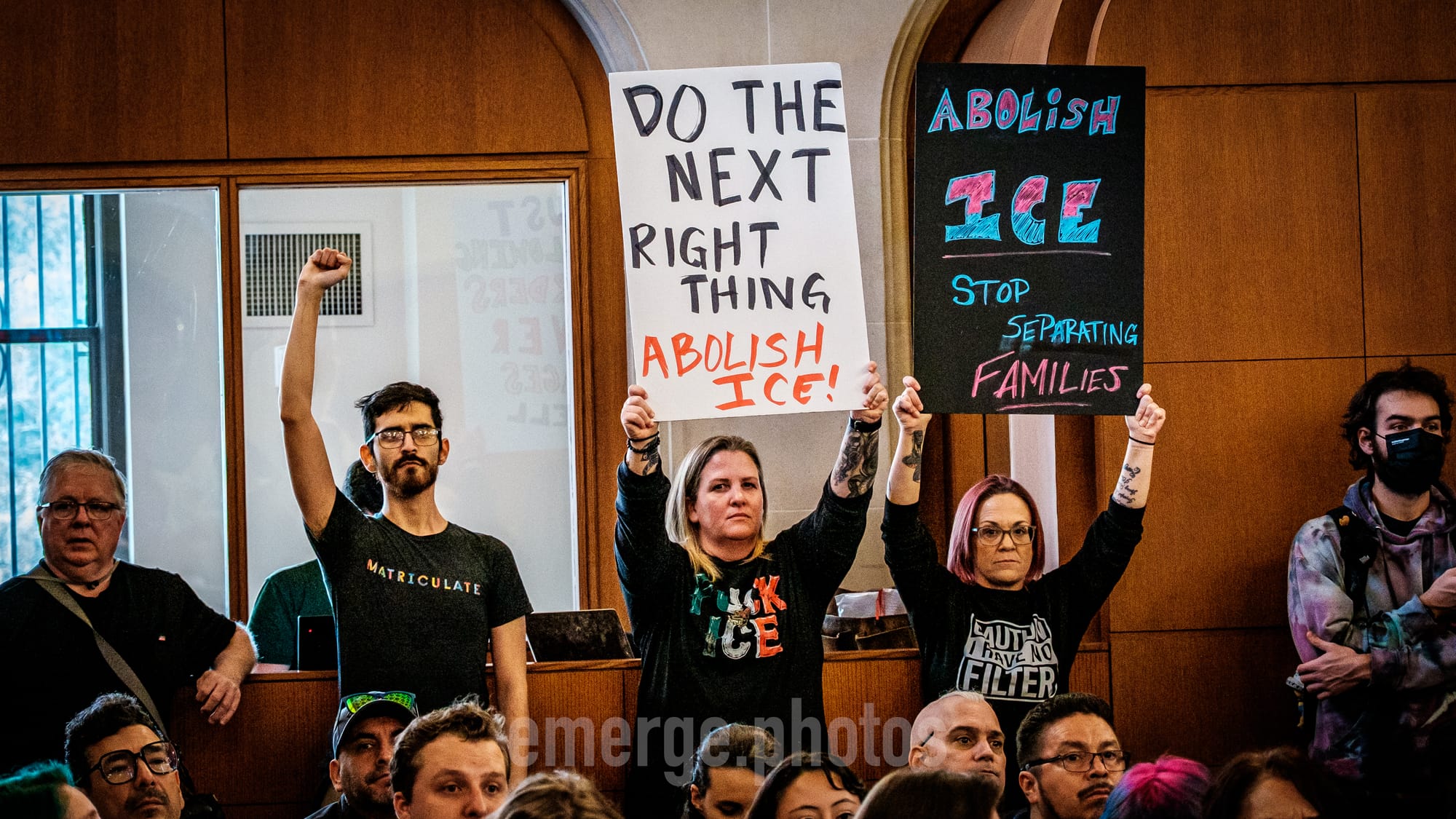
Hundreds of individuals have packed city hall sessions across the country expressing their disbelief that local leaders are delivering them a detention center before even a proper grocery store.
Lawsuits keep pouring in including one against a proposed facility in Socorro, Texas. Costs, both human and economic, related to enforcement and detention expansion are widely cited as going against the very values that most Americans hold dear. This is why it is particularly important for communities to continue to push back on existing and expanding detention capacity. One such campaign, supported by the likes of Stacey Abrams and Mychal “The Librarian” Threets, is Read them Home.
Launched on April 2, International Children’s Book Day, the Read them Home campaign led by several organizations including the 10 Steps Campaign, the National Domestic Workers Alliance, and the National Coalition to End Family and Child Detention kicked off with a full day read-a-thon and vigil in Dilley, Texas. Deceleration’s Founder and Managing Editor Greg Harman documented the reading of letters to and from detained children, calls to action by educators, activists, lawyers, and community leaders, and of course the denouncing of immigrant detention as sites of violation of rights and torture.

Noem Out, Contracts Under Review
Although a multi-million dollar ad fiasco cost former DHS Secretary Kristi Noem her job and gained her a new title fit for a comic book villain, her reassignment was only the tip of the iceberg. Contracts signed under her leadership were put under the microscope for a brief moment pausing the purchase and retrofitting of warehouses for detention. The partial government shutdown now on day 62 is cited as the reason why those investigations are now on hold removing any external barrier for no bid contracts for detention expansion to move forward at full speed again. However, we need to understand the ways they may try to fill the detention centers to ensure those billion-dollar contracts continue to be lucrative for Trump donors, erm, investors. CoreCivic and GEO executives cited concerns about not enough detentions on their February earnings calls, and it seems the Trump administration responded to quell the concerns. A new White House budget proposal released last Friday cites intentions to increase detention capacity by another 30,000 beds.
One source reported:
“[T]he proposal touts the plan to operate up to 100,000 beds for adult immigrant detention through the tax cut and spending package Trump signed last year. But it also includes a request to lock up tens of thousands of more parents and children.”
Asylum Seekers
Pressure from investors to keep the revolving door moving conflicts with a ruling by a federal judge in Massachusetts who found that protection from detention and deportation must be reinstated for tens of thousands of asylum seekers who had been vetted and legally admitted into the United States through the CBP One App program between May 2023 and January 2025. Approximately 900,000 individuals received a notification in April of 2025, that their status was revoked and that they needed to leave or face detention and subsequent deportation. The targeted individuals, like those affected by many other policy changes pushed by the administration (in some cases illegally) such as the limitation of DACA renewals, termination of Temporary Protected Status for many, etc., has created an increasingly expansive group of people that are now subject to detention and deportation, not because of crime, but by a whim and push of a button as was the case with the CBP One App users. It goes without saying that the Trump Administration is looking to respond to investor pressure by increasing the numbers of people considered deportable and, by definition, detainable.
ICE in Airports
With the federal and state administrations looking for every pressure point possible to terrorize communities into “compliance” we have seen immigration policing leach into every aspect of our lives: from the use of the National Guard for civilian control in cities around the U.S., into our doctor’s appointments through required legal status questions at hospitals and health care provider offices, into schools via surveillance cameras, and now even ICE presence in airports nationally under the pretext of quelling long wait times due to the partial government shutdown.
It is not clear how long ICE will remain in airports under this pretext, but it is difficult to roll back new policing/militarization after they’ve been deployed. We saw this with the National Guard in Minnesota and ICE’s patrols in sensitive locations such as schools, churches, hospitals, and courts. We can expect ICE presence in airports, in addition to the REAL ID requirement, to chill travel for mixed-status families, just as we have seen a chilling effect for people seeking healthcare or not reporting crime out of fear of being detained and deported. In the meantime, the partial government shutdown still put TSA in a pinch causing almost 500 agents to quit after a month of no pay. Yet, Republicans are once again eyeing a reconciliation bill to fund immigration enforcement, one initially to fund ICE and CBP and potentially another to fund the rest of DHS in the fall.
Metering Back On The Table
Meanwhile, as if this expanding hostile environment wasn’t enough, the Administration is seeking another deterrent to entry. The revival of “metering,” or turning back migrants before they are able to physically cross the border. The practice was initiated by the Obama Administration in 2016, formalized during the first Trump Administration, and rescinded during the Biden Administration. Arguments on the legality of metering are being heard by the Supreme Court and a decision is expected this summer. The concern aside from its legality is the inhumane nature of the policy that has caused thousands to be stranded in makeshift camps and shelters, subjected to violence, kidnapping and extortion.
The Fights Continue
Rapid response networks, mutual aid funds, local and national coalitions, immigrants rights organizations, legal service providers, and impacted families continue to work together to put pressure on further encroachment of ICE policing into our lives. Whether you’ve never set foot in city hall or on the streets to make your voice heard or you are a trusted community activist, all of us must resist in whatever capacity we can. There are many opportunities to connect with folks locally in your community and as usual you will see below some useful resources and relevant events to help you stay informed. So take action, stay deadly, and keep reading ICE Watch. Until next time.
FURTHER RESOURCES
Video
READ THEM HOME! Deceleration returned to Dilley, Texas, recently, site of CoreCivic's family detention center. Stacey Abrams, Mychal Threets (aka "the Librarian"/ Reading Rainbow), and an assortment of amazing writers (like Rafael Agustín of "Illegally Yours") and activists (including several from SA Stands coalition here in #SATX) directed our attention back to the children imprisoned, ill, and suffering at the facility—and put a spotlight on ongoing expansion efforts of the Deportation-Industrial Complex. "On International Children’s Book Day, children’s book authors, educators, pediatric healthcare workers, child care workers, educators, labor leaders, advocates, and grassroots organizers will gather for a national online vigil — calling on our country’s leaders to end the inhumane detention of children and families."
Events
 Deceleration Staff
On April 18 at 12pm CST, join the Blue Bunny Brigade, and communities all across Texas in a caravan converging at the Dilley Detention Center. We will decorate our cars, we will make noise, and we will show up to demand: 'Shut Down Dilley. End Family Detention. Release our kids and families by Mother’s Day!'
- April 20, 2026—Eyes on ICE: Train the Trainer- Immigrants’ Rights
- Virtual Session 8-9 PM EDT
- April 23 - MELT ICE Series: Environmental Justice and Detention Abolition
- Virtual Webinar 12pm-1:30pm PT/ 2pm-3:30pm CT/ 3pm-4:30pm ET
Tip Jar

Buy Roxana a Coffee
Show your appreciation for all the information and energy ICE Watch brings every month.
FURTHER READING
- ICE Has Detained 6,200+ Kids in Trump’s Second Term, Up 10x Since Biden Left Office
- ICE operates 170 unofficial detention sites around the country called "hold rooms"
- RAICES and Human Rights First publish new report on conditions in family detention, in depth interviews with families at Dilley
- DOJ targets anti-ICE demonstrators with conspiracy charges (video)
- FBI Files Counter Government Argument in Texas “Antifa” Trial that Indicted 9 for Prairieland Shooting
- Deportation Data Project
- Investigation into Noem era contracts puts pause on ICE Warehouses
- Trump Seeks Monumental Increase in Ability to Detain Immigrant Families