

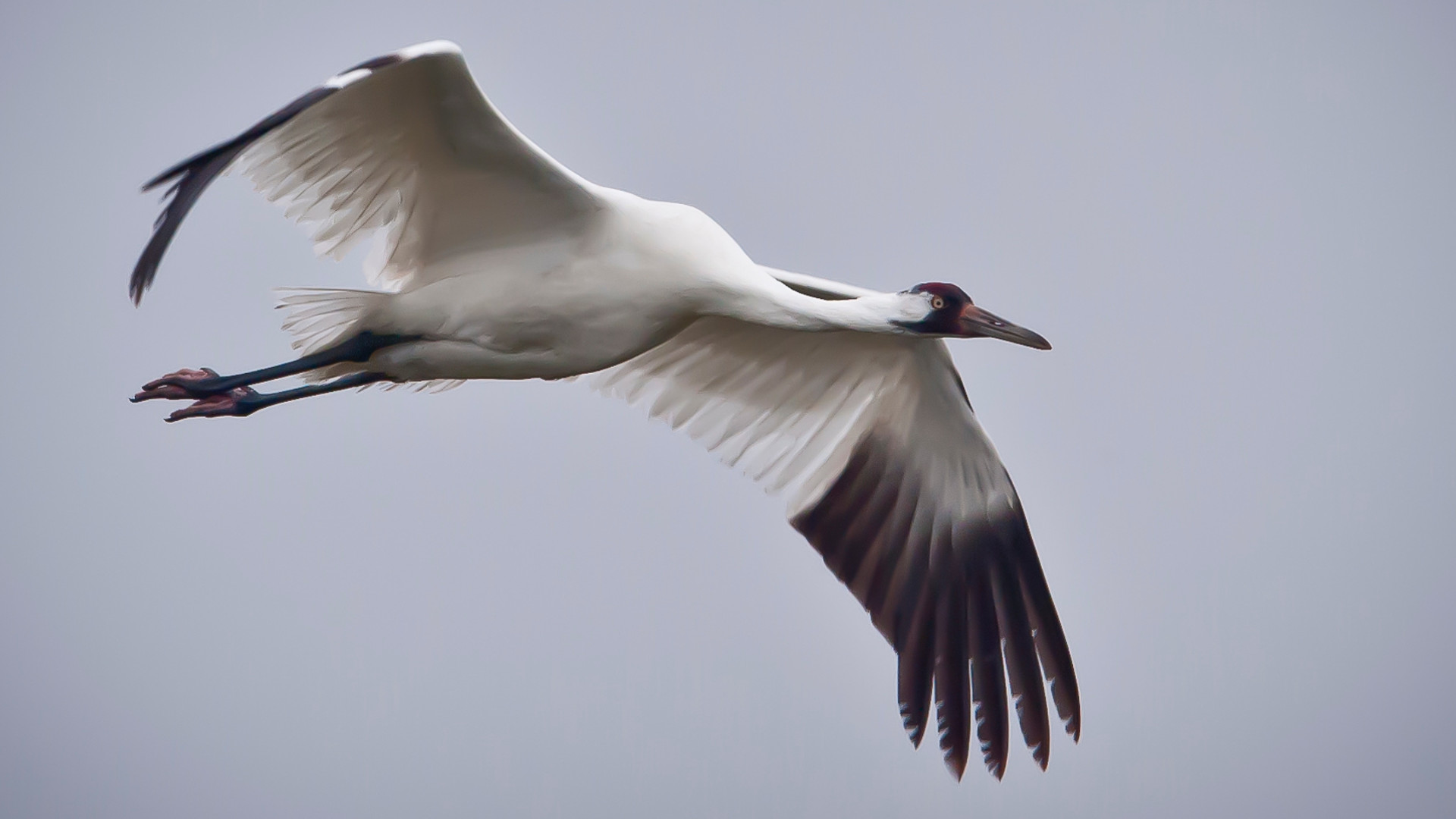
Endangered whooping cranes (Grus americana) are among North America’s rarest birds, but also one of its most well-known. This may be in part due to an impressive, continent-spanning migration by a population of the birds who breed during summer in Wood-Buffalo National Park, Canada, and spend winters on the Texas coast, some 2,500 miles away.
Since 2009 scientists have fitted dozens of the birds with tracking tags and placed leg bands on dozens more to monitor their movements between the two. This research has revealed some mysteries and new discoveries.
A December 2024 paper reports that tracking data began to show something surprising in 2011: Some cranes didn’t stay in their usual coastal bay and wetland habitats but moved inland for significant portions of the winter. During the winter of 2024-2025, at least 21 individuals made the move.
“These birds are not following the script,” says Carter Crouch, Ph.D., an author on the paper and director of Gulf Coast programs for the International Crane Foundation, which secures winter crane habitat and contributes to long-term monitoring of the population. “Until recently all conservation plans were coastal based. But now they are using habitat that we didn’t ever really consider. This affects how we work with these birds in the future.”
Whooper History
Snowy white birds standing five feet tall with seven-and-a-half foot wingspans, whooping cranes mate for life and may live for 30 years. Pairs typically have one chick each year, and families migrate south for the winter together.
More than 10,000 migratory whoopers (as they’re affectionately known) once spread across North America from the Rocky Mountains to the East Coast. The population began to decline drastically in the mid-1800s due to agricultural development, hunting, and egg collection.
The 1918 Migratory Bird Treaty Act made it illegal to hunt whooping cranes. They gained another key protection when Aransas National Wildlife Refugeabout 70 miles north of Corpus Christi, Texas, was established in 1937, providing a refuge for these and other migratory birds. But in 1941 only about 15 cranes wintered there.
In 1946 National Audubon Society ornithologist Robert Porter Allen ran a campaign to raise awareness of whoopers and reduce poaching. Allen also led efforts that first located their northern breeding grounds.
The whooper population lingered below 30 through the 1950s, then climbed into the 40s in the 1960s. The species was listed as threatened in 1967 and endangered in 1970 under the predecessor to the U.S. Endangered Species Act, with various nesting areas and migratory corridors designated as critical habitat during the 1970s and ’80s. The number of birds slowly but surely kept increasing, topping 100 in the winter of 1986-87.
The 2024-2025 U.S. Fish and Wildlife Service survey estimated a record 557 whooping cranes wintering in Texas.
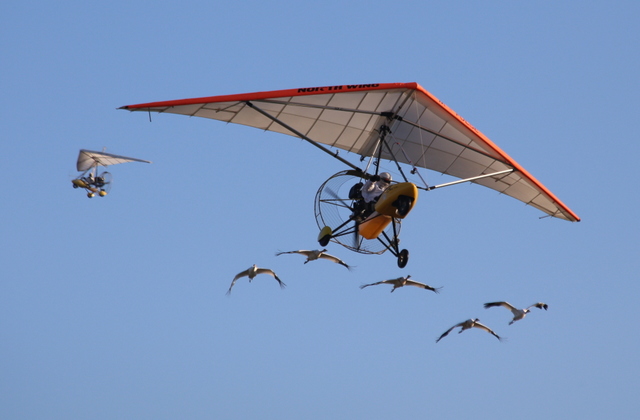
These migratory birds, the only self-sustaining wild population, are known as the Aransas-Wood Buffalo Population. But three other populations were established by introducing captive-reared birds. Birds released in Wisconsin starting in 2001 make up the Eastern Migratory Population, currently about 90 birds who move between that state and Florida on a route they learned by following ultralight aircraft between 2001 and 2015. An introduced, nonmigratory population in Louisiana currently numbers 70 birds and one in Florida about 14.
The birds represent a real conservation success story. But they aren’t out of the woods yet; threats still include agricultural and infrastructure development, shrinking freshwater coastal inflows, shootings, and avian flu. Going forward, Crouch stresses, it will remain critical to know where the birds are, and what they’re doing, in order to protect them.
Protecting Coastal Habitat
As the crane population grows, so does its need for habitat.
Several significant additions in 2025 include 1,100 acres bought by the International Crane Foundation and 2,200 by The Conservation Fund that a local nonprofit, Coastal Bend Bays and Estuaries Project, will manage. The Texas Parks and Wildlife Foundation picked up 17,000 acres funded in part by criminal penalties paid by BP and Transocean after the 2010 Deepwater Horizon oil spill.
The Foundation donated the land to the Texas Parks and Wildlife Department for a 15,000-acre wildlife-management area and a 2,000-acre state park. Calhoun County purchased another 6,400 acres using fundsawarded in a civil suit under the Clean Water Act brought by local shrimper Diane Wilson against Formosa Plastics Corp. for polluting this part of the coast with plastic pellets called nurdles.
These purchases bring the total protected habitat on the Texas coast to some 150,000 acres.
Buying the land is only the first step, though. That land needs to be managed, says Jake Herring, director of land conservation for CBBEP. For example, controlled burns are necessary to suppress growth of mesquite and live oak, a job once filled by natural wildfires on the coastal prairie.
It’s also important to respond to changes in crane habits. The birds that have recently wintered inland could represent an aberration or a return to their historic range, perhaps due in part to their increasing numbers. This would mean land in those areas needs protection as well.
The research shows that these inland birds move around more and use larger home ranges than their coastal brethren, which also has conservation implications. Some of the places the birds are using are managed for waterfowl hunting, says Crouch, and provide good crane habitat.
David Newstead, CBBEP Coastal Bird Program director, points out the presence of hunting can keep the birds moving, though, meaning they also need places that are not used for hunting so they can rest.
Ensuring Freshwater Inflows
Whooping cranes need adequate food, especially when it comes time to migrate.
“Migrations take a lot of energy, and the cranes need quality habitat and enough of it to get the calories they need,” Newstead says. “If a bird leaves with half a tank, it is not going to make it.”
Freshwater inflows into coastal marshes and bays keep them from becoming too salty for blue crabs, the cranes’ main food. This inflow also is critical for commercial and sport fisheries and recreation (including birding), major industries on the Texas coast.
The water comes from two roughly parallel rivers, the San Antonio and Guadalupe, which flow more than 200 miles from central Texas into San Antonio Bay near Aransas National Wildlife Refuge. Both waterways are subject to intense use upstream from San Antonio, the seventh largest U.S. city, and multiple communities along their routes.
In 2010, after 23 birds died during a drought, the Rockport-based nonprofit The Aransas Project sued the Texas Commission on Environmental Quality and Guadalupe-Blanco River Authority for withholding freshwater from the San Antonio Bay estuary. The group won the suit, but the ruling was overturned in 2014, with the court saying state water managers could not have foreseen that restricting water would result in bird deaths.
A silver lining to the outcome was that the state could only use that excuse once. Instead of heading back to court, the river authority and the Project began working together on conservation efforts.
In addition, the nonprofit Texas Water Trade, Texas Parks and Wildlife Department, International Crane Foundation, and the river authority have crafted a multiyear agreement for delivering water to flood 100 acres of wetlands in a wildlife management area just north of the Aransas refuge. A program called Wells and Water for Whoopers provides financial assistance to landowners for freshwater wetland projects like solar wells in whooping crane habitat, Crouch says.
Protecting the Route
During their migrations cranes also need safe places to rest and refuel.
Tracking data show that the birds travel within a defined corridor through the center of the country but don’t have specific stopover sites, instead selecting those literally on the fly. Researchers suggest that conservation efforts therefore need to consider landscape conditions such as the presence of water, rather than geographic location or prior use.
Other factors are the length of daily migratory flights and time spent at a stopover. Currently only about 10% of the places they use during migration are protected.
Summering in Texas
Tracking also recently revealed another plot twist: Some whoopers stay in Texas all summer. Historical records show that birds have done this for at least a century, Crouch says, but it may be occurring more frequently now.
“This past summer was at least the fifth year in a row that we had birds spend the entire summer here,” he says, although the reasons aren’t completely clear. “Sometimes not migrating is related to disease or injury. A bird or its mate simply couldn’t make the trip.”
Or birds that stay put may be waiting until they are ready to breed. The researchers documented individuals that remained in Texas one summer later migrating and successfully breeding. Taking a gap year could increase a crane’s survival and chances of breeding successfully in future years.
“Migration is always a tradeoff,” Crouch says. “Northern days are longer and there is a lot of food, which generally is thought to be the reason so many birds breed in northern latitudes. But going there uses a lot of energy.”
Whooping cranes seem to be figuring out how to survive in the face of ongoing challenges. Scientists and conservationists are working to learn how to help them.
-30-
Originally published by The Revelator. Republication made possible via Covering Climate Now climate news collaborative.


