

In América, all of us have something of indigenous blood. Some of us, in our veins. Others, on our hands. — Eduardo Galeano
Today, teams of heavily-armed, well-funded, and masked ICE units (1) are carrying out raids as part of the biggest mass-deportation operation in the U.S. since the 1950s. Its agents are invading people’s homes and snatching people off the street who look to them like they might be “illegals,” terrorizing immigrant communities around the country, including here in Texas. Although reliable figures are hard to come by, the vast majority of people being detained in today’s deportation campaign are Latinxs.
The Fourth Amendment prohibits unreasonable search and seizure, but ICE agents engage in racial profiling to stop, question, arrest, and detain persons until it can be determined whether they are “deportable.”
Rather than focus on arresting individuals known to have committed violent felonies, Homeland Security Secretary Kristi Noem and White House deputy chief of staff Stephen Miller have ordered ICE agents to round up as many potential “illegal aliens” as they can based on their physical appearance, geographic location, and perceived occupations.
In early January, Vice President J.D. Vance announced that ICE would be going door-to-door around the country in search of “illegal aliens.” In practice, this has meant conducting searches mainly in Latinx neighborhoods. Not surprisingly, U.S. citizens have been apprehended in these round-ups. Some have been released after producing their “papers,” while others have been disappeared for days or weeks into the fast-growing immigrant detention system.

Since 1975, the U.S. Supreme Court has allowed immigration agents on roving patrols in the Southwest border region to use “Mexican appearance,” along with other factors, to stop vehicles or pedestrians if agents have a “reasonable suspicion” that such persons are engaged in illegal activity, including having unlawfully entered the United States. In September 2025, the Supreme Court granted the same power to agents conducting raids in U.S. cities far from the border. (2) Immigrant advocates charge that the Court has effectively legalized racial profiling all over the country in support of the Trump administration’s mass deportation program.
Today, “looking Mexican” is still one of the main factors that ICE agents use to decide who to target for arrest, detention, and deportation. Of course, the Latinx population of the United States includes people tracing their ancestry to many other places, including the Caribbean, and Central and South America.
Nevertheless, Mexicans are more than 60 percent of all Latinxs in the United States and nearly 90 percent of all Latinxs in Texas. Mexicans are also three-quarters of the Latinx population of both Los Angeles County, Calif., and Chicago, Ill., two of the cities that have been subject to the most aggressive ICE operations targeting Latinx immigrants.
So, what makes a person “look Mexican” to ICE agents, whether they are Mexican or a member of some other Latinx group?
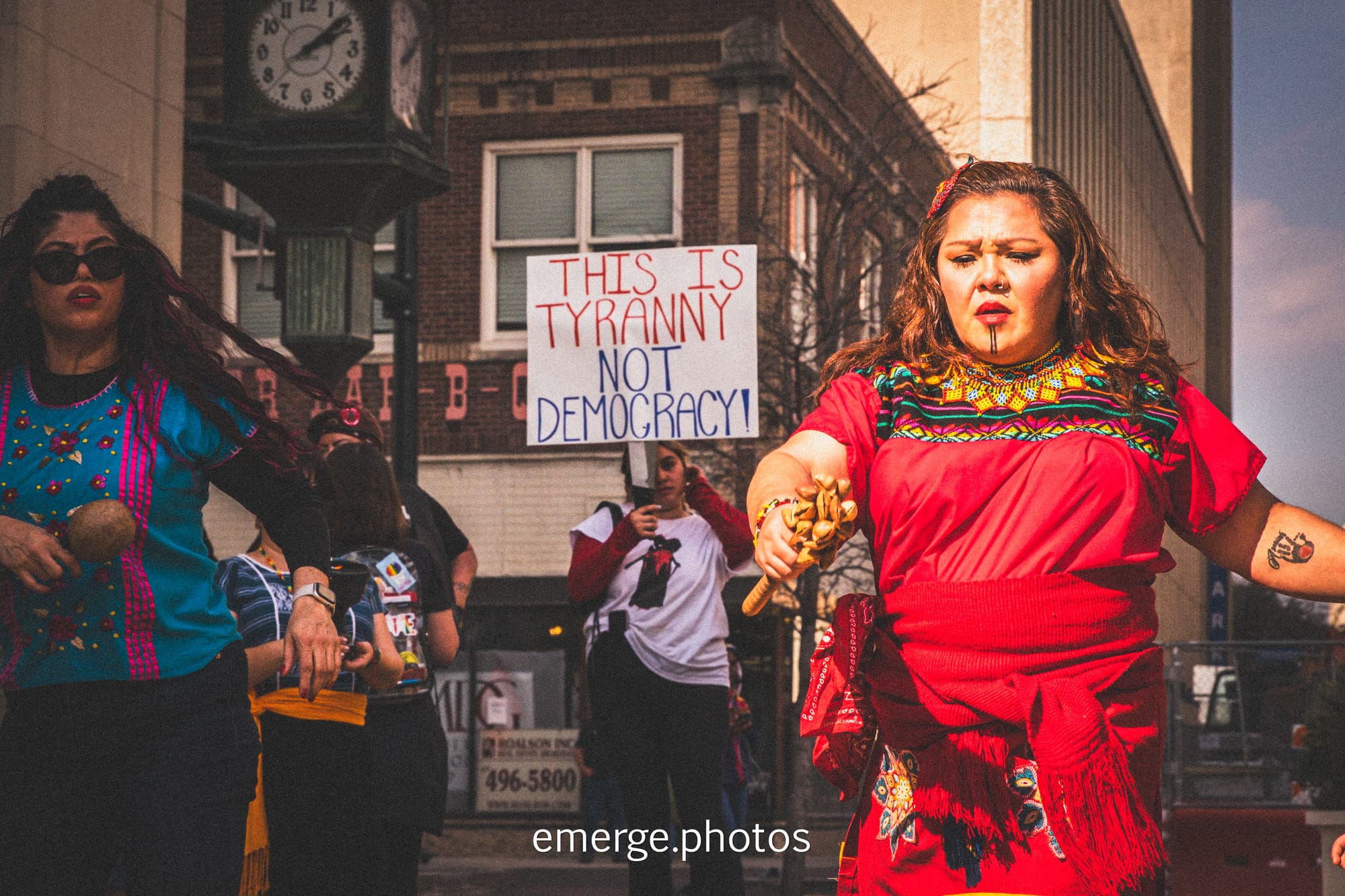
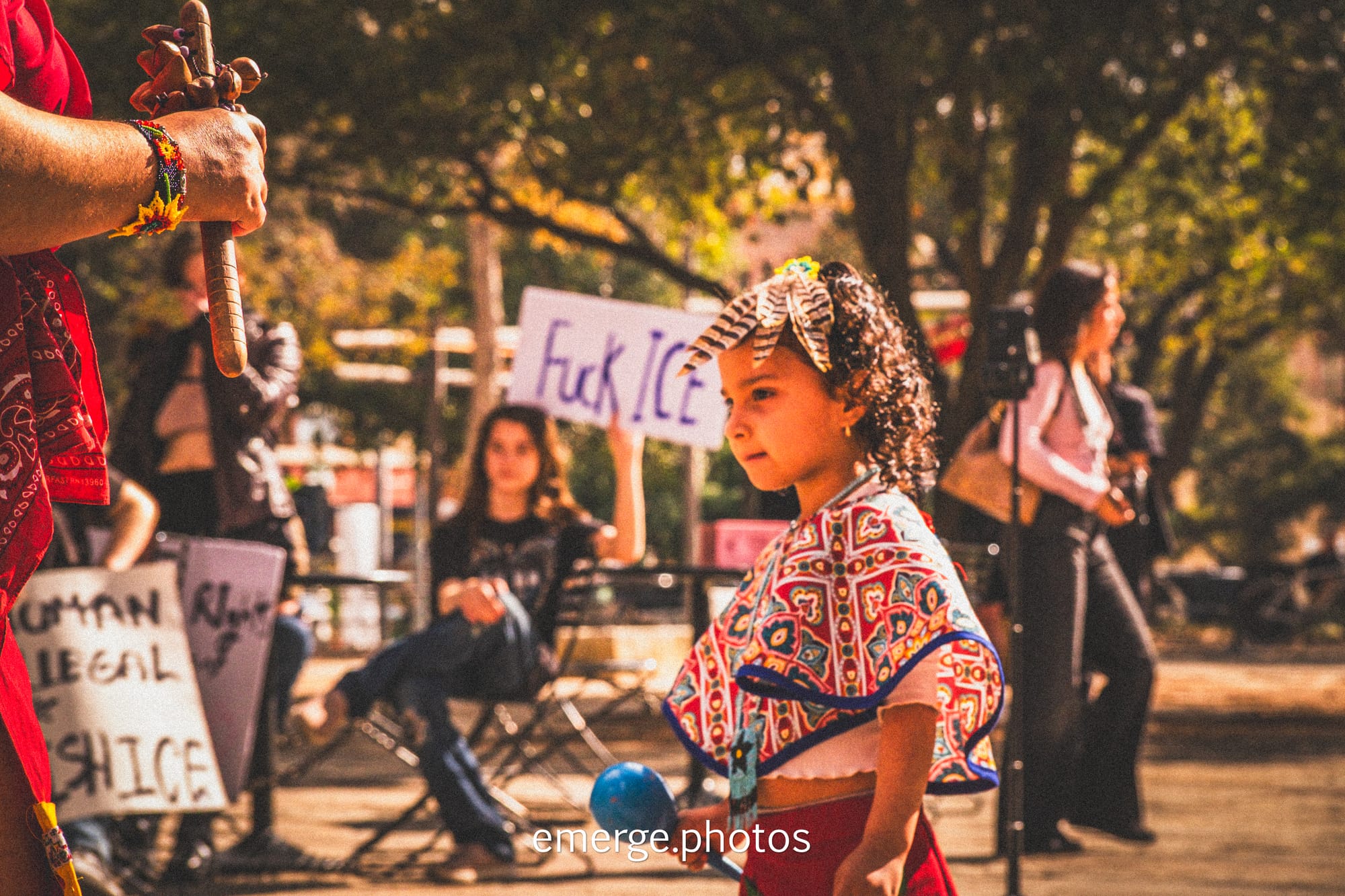
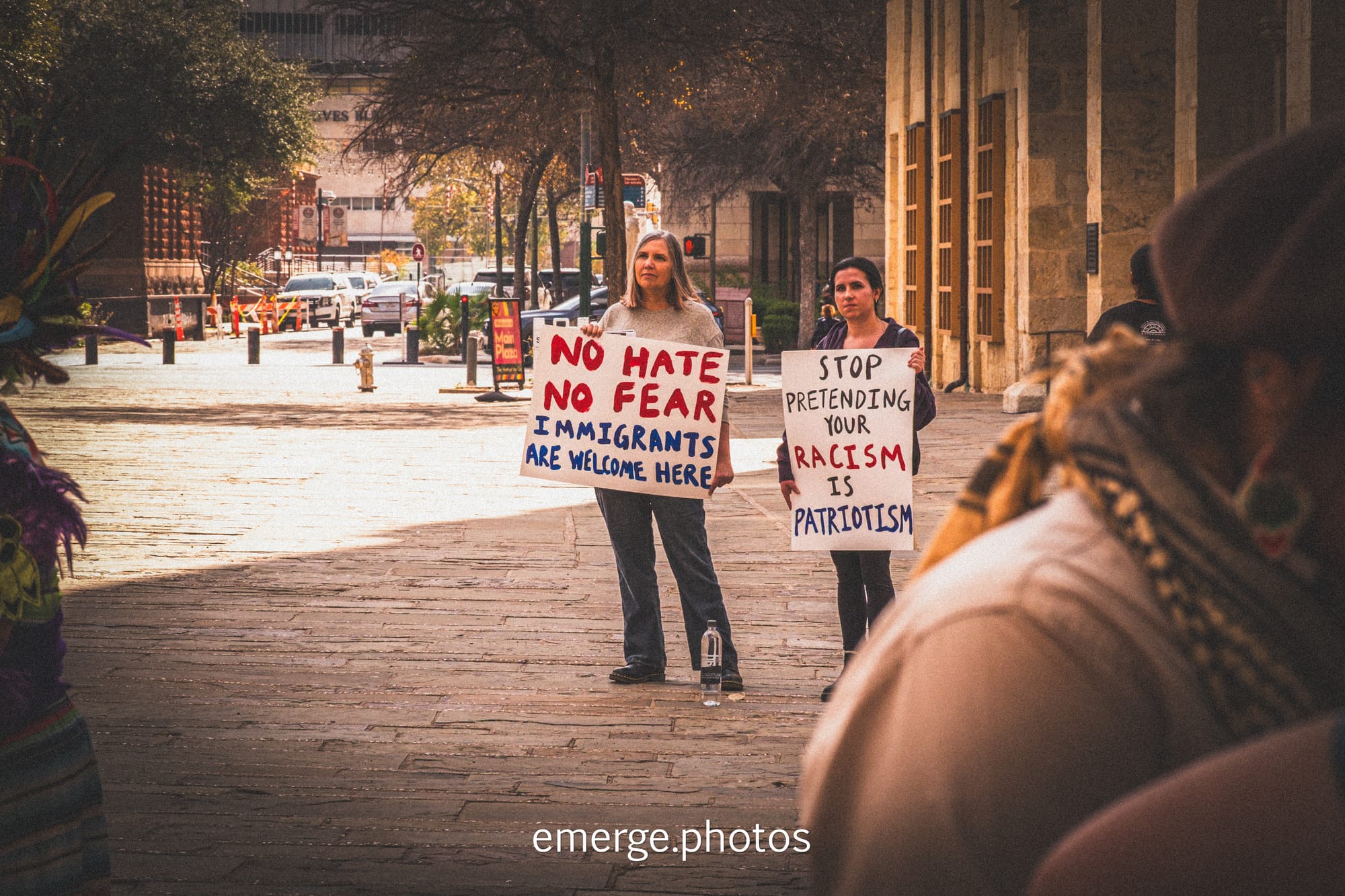
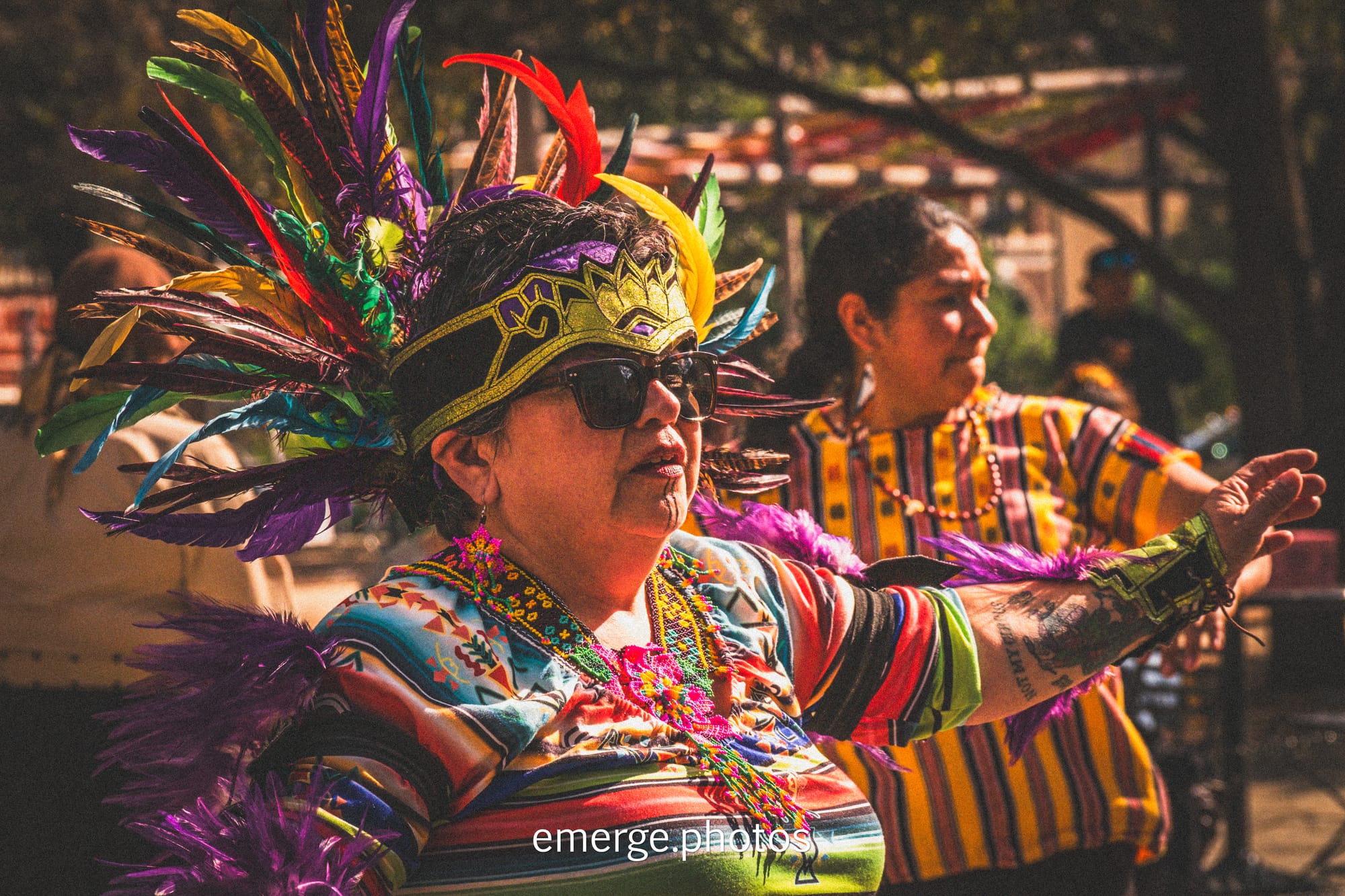
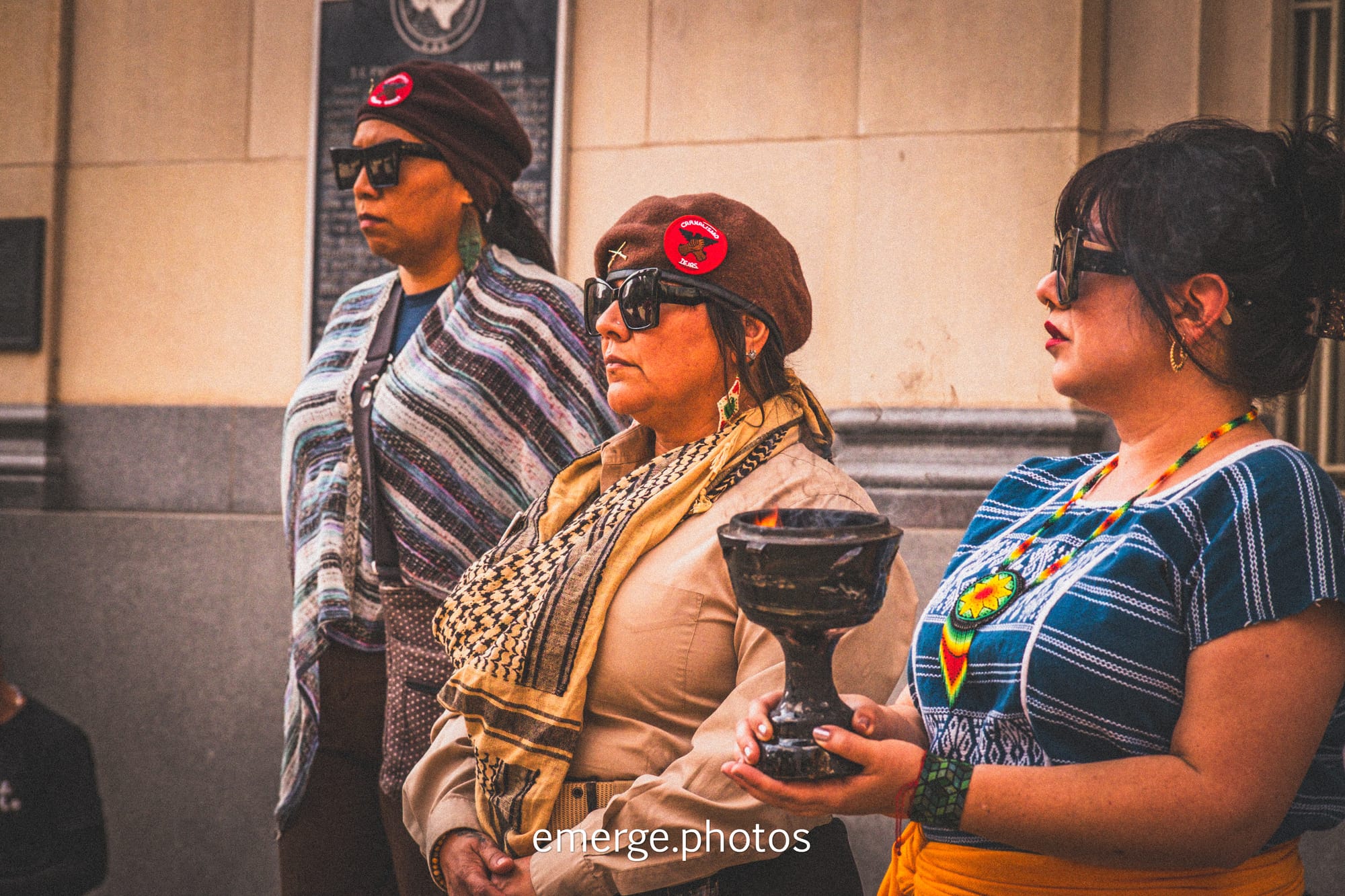
Members of the Autonomous Brown Berets chapter and danzantes with Danza Azteca Yanaguana and Kalpulli Ayolopaktzin demonstrate outside San Antonio City Hall while hundreds testify inside against local cooperation with ICE. Images: Greg Harman
The simplest answer is having brown skin, in combination with things like speaking Spanish and working in a manual occupation, or being perceived to do so.
Where does the brown skin of so many Mexican immigrants and U.S.-born Mexicans—who often are members of the same family living under the same roof—come from? (3) The answer is also simple: Mainly from their indigenous American elders and ancestors.
In other words:
The people who today are being surveilled, detained, and deported for being undesirable “invaders” of a supposedly soon-to-be great again “America” are the descendants not of invaders of this continent, but the heirs of its original inhabitants.
It is not surprising that U.S.-born members of American Indian tribes in Seattle and Minneapolis report that they have been harassed and arrested by ICE agents in these cities.
Today, few Latinxs identify as Indigenous in the U.S. Census. In 2020, of those who saw themselves as having only one race, just 2.4 percent of this country’s 62 million Latinxs identified as “American Indian” or “Native American,” while 20.3 percent identified as “white,” 1.9 percent as “Black” and 42.2 percent as members of “some other race.” At the same time 32.7 percent of Latinxs identified themselves as a mix of two or more races, mainly of white with “some other race.”
Thus, most Mexican and other Latinx persons do not seem to see themselves as related to Indigenous nations in the United States or connected to specific Indigenous communities in Mexico. This despite the fact that the bulk of the population in Mexico is either mestizo (a blend of European and Indigenous ancestry) or Indigenous. (4)
Why do so few Mexicans in the United States identify as Indigenous and so many identify as “some other race”?
As scholar Jongsoo Lee and others have shown, during the early 20th century, the concept of mestizaje (racial mixing) was promoted by Mexican intellectuals and political leaders to unify the nation after the turmoil of the Revolution. They conceptualized the new Mexican state as a blend of Hispanic and Indigenous peoples and their respective pasts into a single national mestizo culture. To be Mexican was to be mestizo, a member of what José Vasconcelos called a bronze “cosmic race” that he promoted as a fusion of the best qualities of European and Indigenous peoples.
The cosmic race ideology celebrated the Indigenous civilizations of pre-Hispanic Mexico while promoting the absorption of contemporary Indigenous communities into the mestizo majority. Soon after, however, these thought leaders were forced to adapt this vision to the context of a white supremacist international order.
Mexican intellectuals reshaped mestizaje into a form more acceptable to the elites of North American and European nations, whose ranks Mexico sought to join.
Intellectuals promoted mestizo as the national identity, but highlighted its Hispanic-European foundation. Spanish tradition, iconography, and Catholicism consequently dominated the self-image of Mexicans through the 20th century. The government’s promotion of the mestizo ideal was in effect, as anthropologist Guillermo Bonfil Batalla argued, a policy to “de-Indianize” the country.
In reality, of course, Mexico was a nation-state with a diverse population and Mexicans were its citizens, not members of a single national “race.”
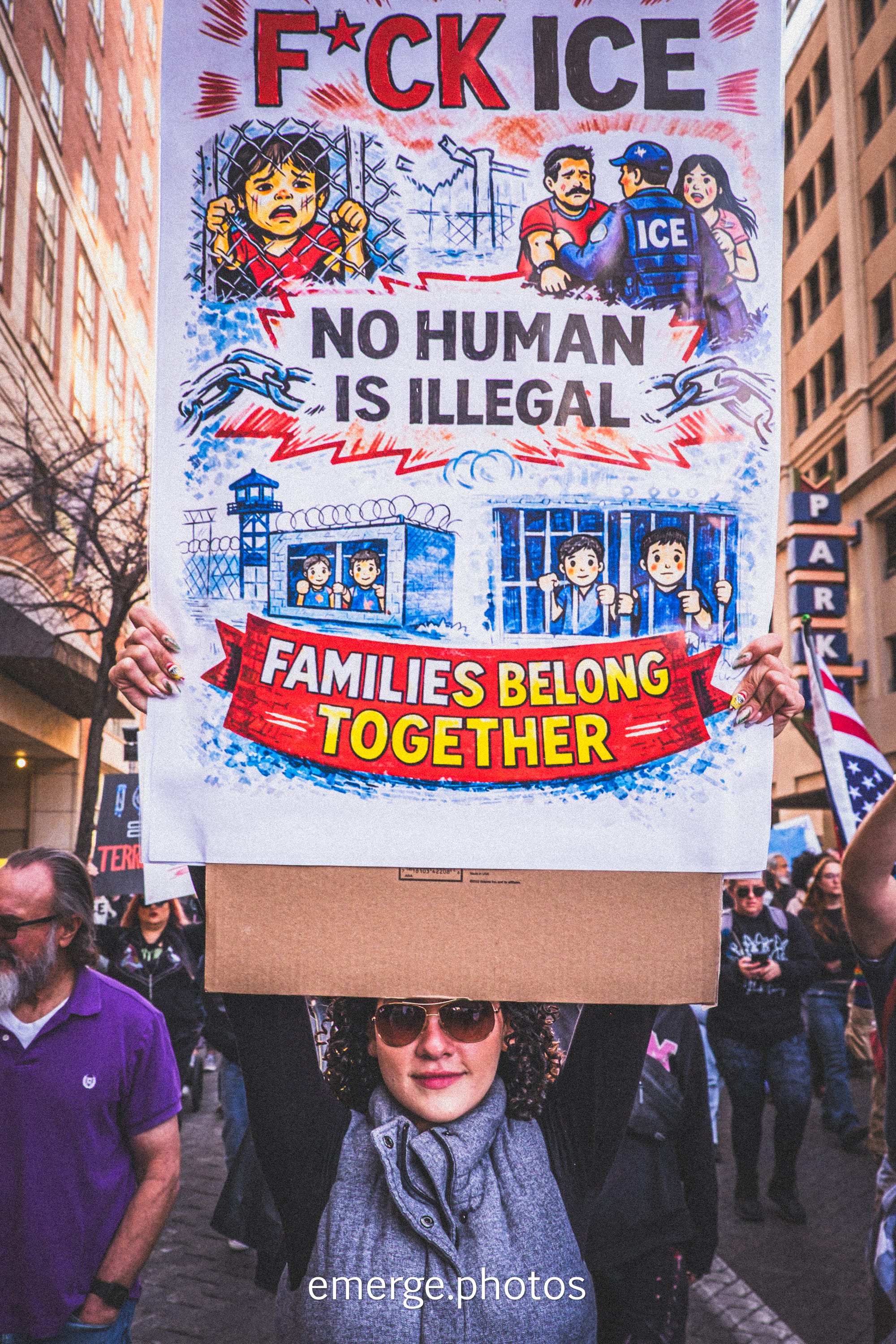
In the early 20th century U.S., anti-Mexican rhetoric, racist stereotypes, and state violence against Mexicans, including their extrajudicial killings by the Texas Rangers, prompted many Mexicans living north of the border to de-emphasize their Indigenous heritage.
Segregation and Jim Crow-era discrimination entrenched the pernicious linkages between race, ethnicity, class, and social status. This led many members of the U.S. Mexican community to emphasize their Spanish ancestry, i.e., their whiteness, as a strategy to gain acceptance and respect in the white-dominated society north of the border, leading to further disidentification with their Indigenous ancestry.
In the 1960s, participants in the Chicano Movement took pride in their Mexican heritage that Anglos in the United States had denigrated. They lay special claim to being descendants of the original Indigenous inhabitants of North America. The young members of the movement were often self-taught regarding their history and culture. Many uncritically adopted the racial ideology of the Mexican government, happy to be bronze members of the raza cósmica who could celebrate their historical connection to ancient Mesoamerican civilizations, while at the same time constructing a political identity for themselves as revolutionaries resisting colonialism and imperialism in the present.
“We didn’t cross the border, the border crossed us,” became a movement slogan, in the double sense of being Mexicans separated from their paisanos and as Indigenous-descended people deprived of the right to traverse the lands in which their ancestors had been the original inhabitants.
Some 21st century observers have criticized Chicano Movement participants’ claims to Indigenous identity, noting that most of them had little connection to contemporary Indigenous communities on either side of the border. Others went so far as to accuse them of being “Pretendians.” In this present moment of mass deportations, however, it is important to recognize that the Indigenous ancestors of Chicanxs were victims of European and US colonialism, suffering invasion, plunder, rape, enslavement, loss of lands, and suppression of their languages and cultural practices. This made it impossible for most Chicanxs to know their original native identities, a situation that in some respects is analogous to the experience of the descendants of enslaved Africans brought to the Americas.
In the late 20th century, a new term further added to this erasure of Indigenous identity. In 1976, the "Americans of Spanish Origins Social Statistics Act" mandated the U.S. government collect data about “Hispanics.” The term “Hispanic” is derived from “Hispania,” the ancient Roman name for the Iberian Peninsula. It strongly emphasizes a connection to Spain and association with it as a colonial power, rather than descent from the myriad Indigenous American groups that also characterized most of the people the government labeled as Hispanic.
As sociologist G. Cristina Mora said in an interview about the origins of this term in official discourse:
“There were, at the time, people in the Nixon and Johnson administrations that really liked the term Hispanic. They saw themselves as Hispanic. 'Hispano’ was the term in New Mexico that many families used to differentiate themselves from Anglos and some argued from the Indigenous population there as well.”
These days many San Antonio residents similarly identify as Hispanic rather than as Mexican. Here we might want to consider that the term Latinx, though favored by most civil rights advocates in the United States today, is no less Eurocentric than the term Hispanic.
Today in the United States, Mexican and other Latinx descendants of the Americas’ original inhabitants are being hunted down and deported by militarized police deployed by descendants of the white European colonizers that took their forebears’ land in the first place. A complex history of Spanish and U.S. colonialism has worked to keep them from identifying as Indigenous descendants whose birthright is to move about freely throughout the lands first populated by their ancestors.
How might it change the dynamic of debates about immigration in the ICE age if the Latinx peoples of the United States started thinking of themselves as the descendants of the original inhabitants of América?
- In recent months, increasing numbers of Border Patrol agents have been redeployed from the border with Mexico to participate alongside ICE agents in the round-up of migrants in cities in the U.S. interior. In fact, two of the killers of Alex Pretti on the streets of Minneapolis were Latinx Border Patrol agents who had been sent to Minnesota from their base in South Texas. For simplicity’s sake, we use the term ICE as a generic term to refer to any and all Department of Homeland Security personnel participating in the U.S. government’s mass deportation campaign as agents who detain and arrest migrants.
- Here it is important to note that law enforcement agents having a “reasonable suspicion” that a person may be engaging in illegal acts is a much lower evidentiary standard than them having “probable cause” to stop someone they believe has committed a crime. Indeed, the term “probable cause” is the term used in the 4th amendment to describe the evidence that law enforcement officers must have to justify a judicial warrant for searches and seizures; police may not obtain a warrant based solely on their “reasonable suspicion” that someone may have committed a crime. This distinction is all the more relevant today as internal ICE memos have given a green light to agents in the field to make warrantless arrests and to forcibly enter migrants’ homes with only an administrative warrant issued by the agency itself.
- We use the term “Mexican” to refer to persons of Mexican descent born in the United States and Mexican immigrants who migrated north across the border forcibly imposed on Mexico by the United States in 1848.
- The descendants of enslaved Africans also form part of the Mexican mestizo population on both sides of the border, though the number of Africans in the population of colonial Mexico was far smaller than the number of indigenous. For most of the 19th and 20th century, the presence of African heritage among Mexicans was largely erased.
-30-
An earlier version of this article was previously published in the December-January issue of La Voz de Esperanza.


