

When hurricanes Laura, Delta and Zeta struck Louisiana in 2020, Devin Davis was still in graduate school at Prescott College earning a master’s degree in social justice and community organizing. But by the time Hurricane Ida blew ashore as a Category 4 in 2021, he was back in New Orleans working as director of political operations for Voters Organized to Educate (VOTE), a nonprofit organization dedicated to building collective power while reforming the criminal legal system.
One of the toughest results of those tumultuous back-to-back storms was the loss of a dozen home insurance companies willing or able to serve residents in Louisiana. By 2022 even the state-run home insurer of last resort, Louisiana Citizens, had increased its average rates by 164 percent, or $2,800 a year, and 12 percent of Louisianans were uninsured. That ongoing crisis—increasingly recognized as a critical climate impact—was part of what propelled Davis last May to mount a primary race to unseat Troy Carter, the incumbent representing Louisiana’s 2nd Congressional District.
Electoral politics was the fastest route Davis could imagine to bring critically needed federal assistance to the insurance crisis.
“We’ve seen such a level of degradation and harm done that we need the federal government to step in and provide an assurance that we have a pathway to reestablish our communities,” Davis told Deceleration.
“[Florida’s Hurricane] Milton could have been us.”
Recent research by the First Street Foundation, a non-profit that studies climate risks in the United States, has found large areas of the country that are fast becoming “uninsurable” due to the ravages of climate change.
Davis announced his candidacy after a disappointing state legislative session where four “free-market” insurance bills were signed into law, all with generous inducements, including regulatory concessions, to lure companies back to Louisiana. At the same time, Insurify estimated the Louisiana homeowners would bear in 2024 the highest spike in insurance costs in the nation—a 23 percent increase.
Davis rolled out his “Insuring our Future” plan this summer to confront the home insurance juggernaut squarely. He’s included a crucial federal component that if enacted would be a boon to all the Gulfside states losing insurers in the face of intensifying storm seasons and rising sea level.
The 2nd District is a majority-Black part of Louisiana that connects New Orleans and Baton Rouge, with a heavily industrialized stretch known popularly as “Cancer Alley.” As Courthouse News Service wrote recently, residents of this area have a “95 percent greater chance of developing cancer than people in other regions.”
Now Davis is in a five-way race with three Republican and two Democratic candidates all running against each other in Louisiana’s “majority vote” system this Nov. 5. If no candidate receives a simple majority of over 50 percent, the top two contenders advance to a December runoff.
Should that come down to Davis and Carter, voters would choose between the candidate who will not accept insurance industry and fossil fuel donations and the one who already has.
“I think a lot about the optimism and the hope of what could actually happen if we got rid of this dangerous petrochemical industry,” Davis said. “If our people actually saw the power they have in their own communities to transform, not only their lived conditions, but the political landscape as a whole.”
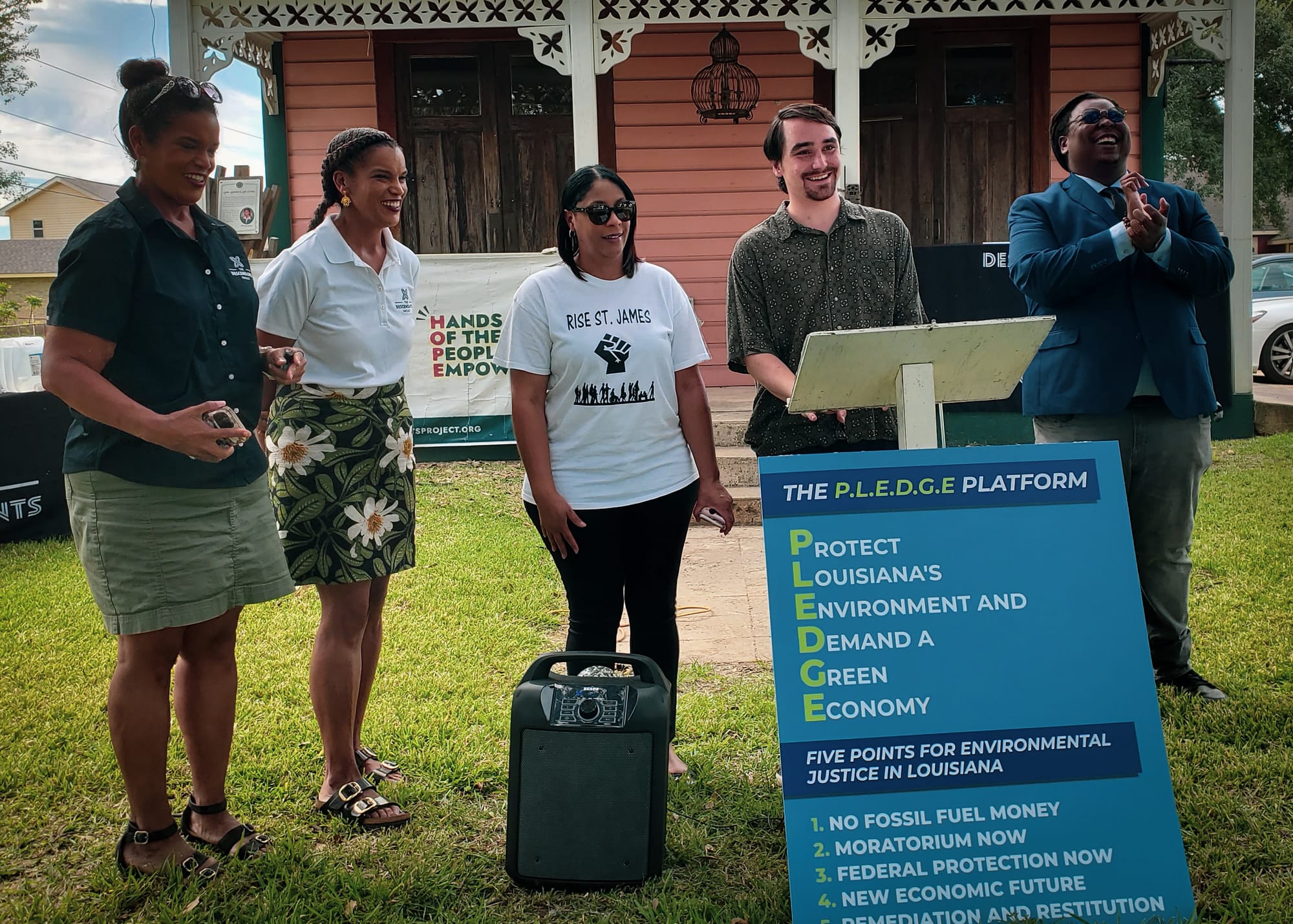
Davis is the only one in the race so far to commit to all five environmental justice planks of the Protect Louisiana’s Environment and Defend the Green Economy (PLEDGE) coalition platform. Three of PLEDGE’s members are based in the River Parishes of Cancer Alley where some homes aren’t yet repaired from damage in 2021; the other four are in New Orleans where they well remember how they stewed and baked without power for more than two weeks after Ida, then endured the shame and horror of seven abandoned nursing home patients perishing in an unsanitary warehouse where they’d been evacuated.
THE P.L.E.D.G.E. PLATFORM
1. NO FOSSIL FUEL MONEY
We ask all candidates to reject any and all contributions from fossil fuel companies, petrochemical companies, and private utilities that profit off of pollution and environmental destruction, as well as individual corporate executives in those sectors.
2. MORATORIUM NOW
We ask that candidates stand with Cancer Alley residents suffering decades of poor health outcomes as a direct result of environmental racism and corporate greed in opposing any and all new petrochemical and fossil fuel infrastructure in environmental justice communities, including infrastructure associated with false solutions like LNG, carbon capture, and blue or gray hydrogen and/or ammonia.
3. FEDERAL PROTECTION NOW
We ask that candidates act to ensure that federal agencies such as the Environmental Protection Agency, Federal Energy Regulatory Commission, and Army Corps of Engineers act with the interests of Cancer Alley residents in mind, rather than the interests of petrochemical profit.
4. NEW ECONOMIC FUTURE
We expect candidates to support renewable energy buildout, primarily wind and solar, to provide quality green energy jobs to area residents, and oppose the proliferation of ineffective and irresponsible projects like LNG expansion, carbon capture, and blue hydrogen that all still depend on fossil fuel usage.
5. REMEDIATION AND RESTITUTION
We expect candidates to support programs that can provide for the needs of those most affected, to defend the legacy and memory of the ancestors who maintained the land both in slavery and in freedom, and to repair any and all damage done to environmental justice communities by the petrochemical industry.
PLEDGE is an ennobling read, similar to the “Clean Slate” commitments further down the Gulf Coast in Corpus Christi, Texas, where a coalition of candidates seeking spots on the City Council have made promises to end tax breaks for big corporations and stop unpopular desalination projects.
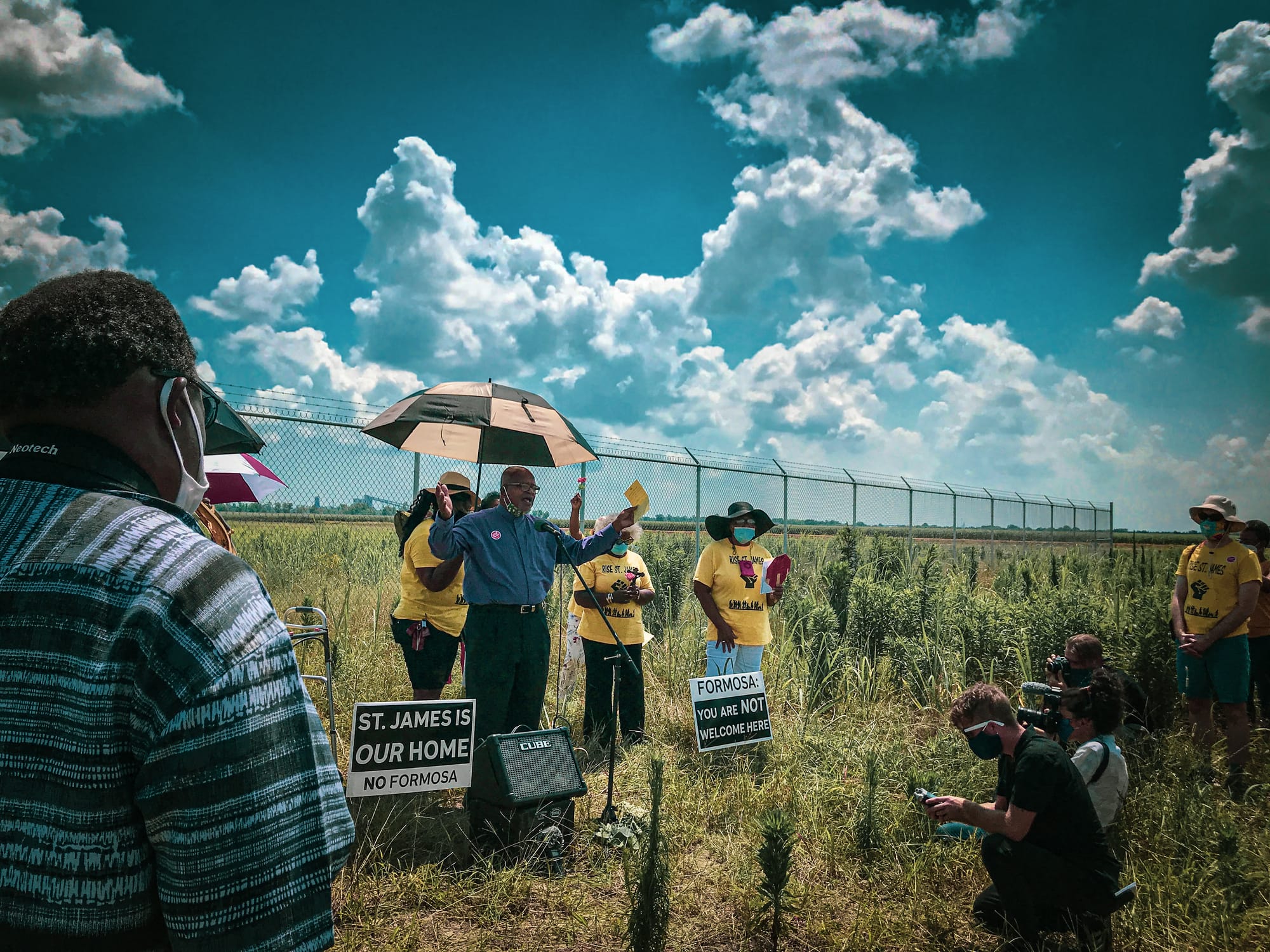
In PLEDGE’s “Remediation and Repair” plank, candidates are asked “to defend the legacy and memory of the ancestors who maintained the land both in slavery and in freedom.” The discovery of a burial ground for enslaved people on the proposed site of an infamous international plastics plant, vehemently resisted by RISE St. James in 2020, was a turning point in the environmental justice movement in Southern Louisiana.
“The platform as a whole is both beautiful in the sense of the demands,” Davis said, “but also that it comes from a community who has been treated like a second fiddle but is now rising in its political power.”
Jack Reno Sweeney, PLEDGE Platform coordinator, told Deceleration that he’s aware of the risks of Louisiana living but has no intention of ever leaving.
“I know all the sea rise projections, [but] even so, it’s worth staying for, it’s worth fighting for,” Sweeney said.
He admits frustration when public officials speak in terms of a brain drain, when their solutions are cutting income taxes or making it easier for the polluting plants to come in.
“People aren’t leaving because taxes are too high or because there aren’t enough plant jobs,” he said. “People are leaving because it’s hard to imagine having a future here.”
Of the 105 people in candidate Davis’s 2015 high school graduating class, only five or six still live in the greater New Orleans area. This terrible metric is a key to understanding both the depth of Davis’s political commitments to his home in Southern Louisiana and why he won’t indulge a politics of cynicism.
“We have to be getting an actual vision in place that the next generation can hold on to. A vision that shows a pathway to ensure we’re hardening our infrastructure and becoming a more resilient place to live for when storms hit,” he said.
The PLEDGE Platform represents the coalition’s collective wisdom on how to cohere the fault lines that have been revealed during this election season.
“Louisiana operates politically almost as an internal resource extraction colony,” Sweeney said. “It produces tons of wealth, but it doesn’t stay here. Or when it does, it doesn’t enrich the mass of people. There are a lot of similarities with the way American colonialism works abroad.”
The coalition is talking to candidates about the platform, but also to movement folks in their own audiences.
“We’re saying this is what you should expect from someone who represents you, and it’s not too much to ask. Your expectations are reasonable,” Sweeney said.
The point, Sweeney said, is to reset the narrative.
“Environmental justice isn’t some fringe belief that a small sliver of potential voters care about, but a broadly held priority for people who live in the district,” he said.
Davis talks to voters about cutting off subsidies to petrochemical plants to move money back into communities. While the goal is to eliminate the pollution industry entirely, he knows it’s no overnight endeavor.
Said Davis: “We may not enjoy the shade from this tree, but we’re definitely going to plant seeds to ensure that the next generation doesn’t have to deal with seeing a Denka plant or a Shell Refinery on their skyline.”


