

DALLAS, Texas—Over a thousand protesters crowded the sidewalks, streets, and green spaces outside Dallas’s Hilton Anatole hotel last week to decry the annual global conference of the Jewish National Fund. While conference attendees inside planned for the continued expansion of Israel’s illegal settlements, outside they were met with the broad-based student-led movement for Palestine. Activists marched, blocked traffic, prayed together, and attempted to disrupt the conference with noise, in an interfaith display of opposition to ongoing conquest of Palestinian lands.
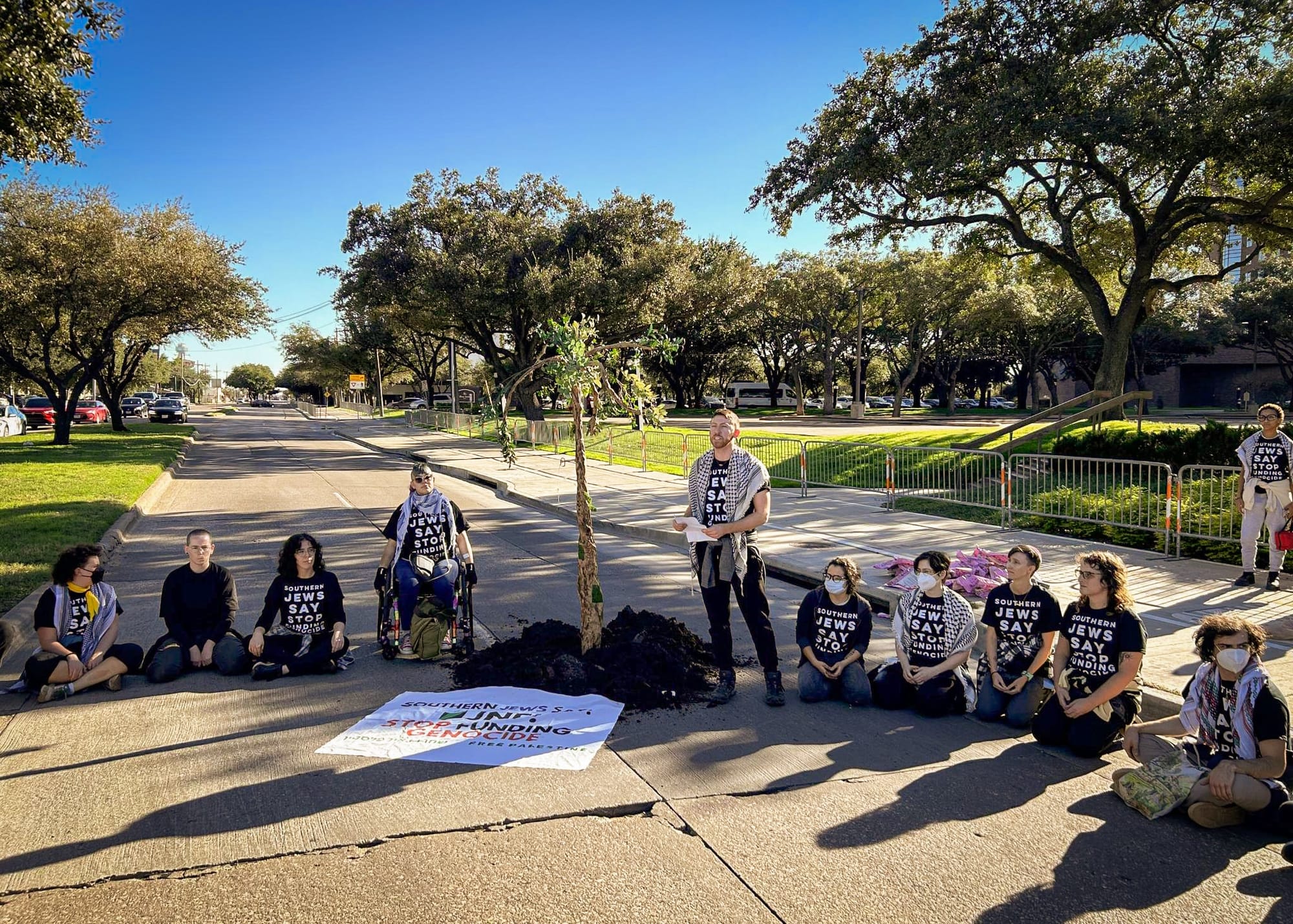
On Thursday, November 14, about two dozen members of Jewish Voice for Peace, which describes itself as “the largest progressive Jewish anti-Zionist organization in the world,” symbolically planted an olive tree in the road outside of the conference and temporarily prevented conference-goers from accessing the site. Olive trees are an ancient symbol of the Palestinian people and a key part of their diets often targeted by the Israeli military and illegal settlers. Participants in the blockade chanted a traditional Hebrew prayer in praise of the Tree of Life. Dallas Police arrested 12 people for obstructing traffic.
Judith Norman, a lead organizer with Jewish Voice for Peace San Antonio, told Deceleration that the event drew on Jewish Voice for Peace members from all across the U.S. South. Jewish people, including rabbis, kicked off the weekend’s events and participated throughout in order to show that opposition to the Jewish National Fund (JNF) is not antisemitic, but grounded in traditional Jewish respect for human rights, Norman said. She added that many Jews object to Israeli policy and military actions carried out in their name.
“Judaism all over, in all of its manifestations, has a deep-seated antithesis to Zionism: deep-seated sympathy for Palestinians,” Norman said. “[A sympathy] willing to take to the streets in order to be able to reclaim our beloved traditions from this desecration.”
Founded in 1901, the JNF’s original purpose was to purchase land in Palestine for Jewish-only resettlement, setting the groundwork for a future Israeli state. Although originally mostly Palestinians lived on and farmed the targeted lands, they were lands typically owned by the Ottomans. This allowed the fund to purchase it out from under the native inhabitants. In the aftermath of the violent founding of Israel in 1948, a time that Palestinians refer to as the Nakba or “catastrophe,” JNF planted pine forests in many areas that had once been Palestinian villages in order to erase signs of the previous inhabitants and discourage their return. Even today, non-Jews are forbidden from purchasing land controlled by the JNF, which owns a massive amount of property in modern-day Israel.
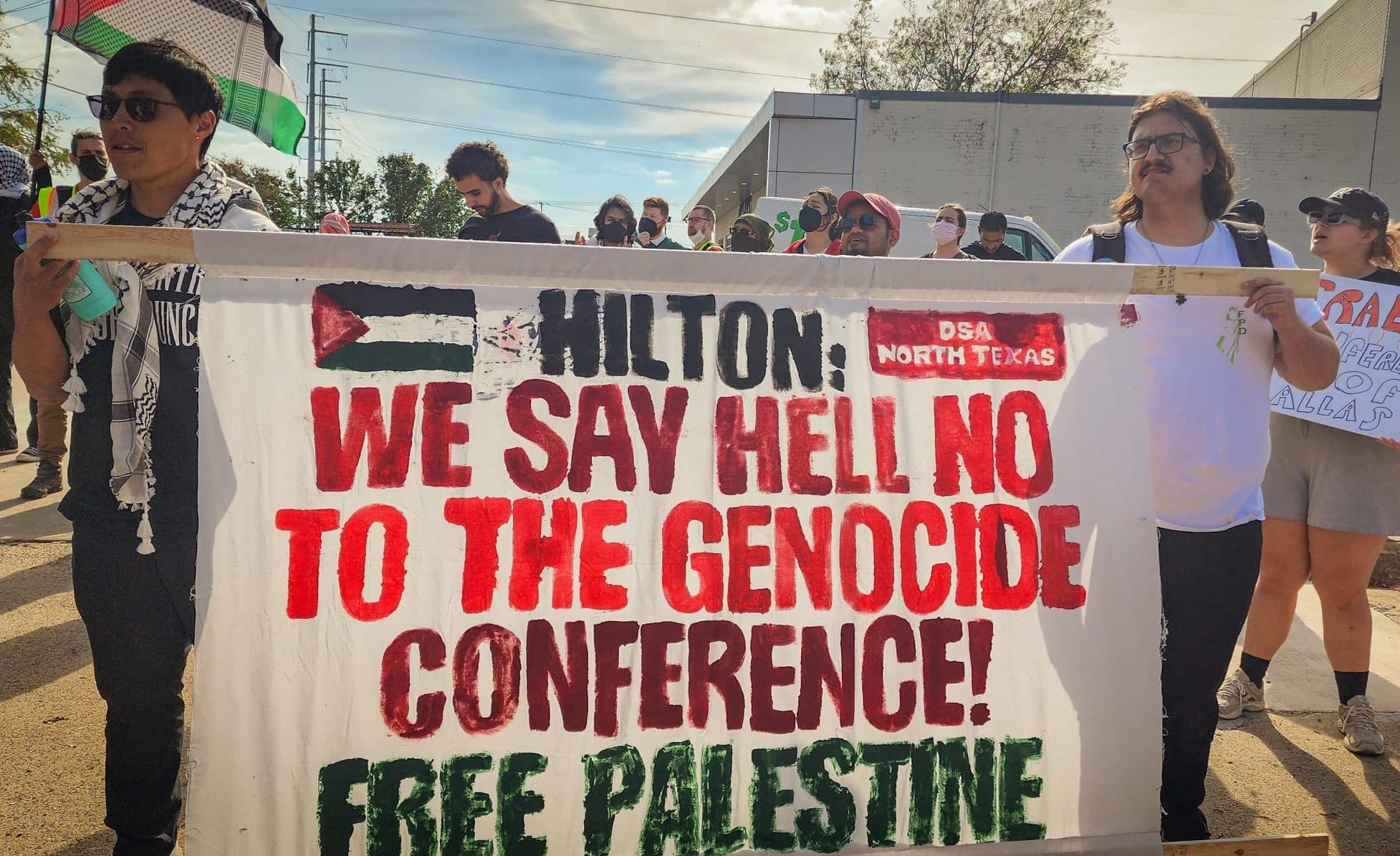
Critics of the organization say the JNF has been open about its agenda of ethnically cleansing the region since its early days. Joseph Weitz, director of lands development for the JNF, wrote in his diary in 1940: “There is no way besides transferring the Arabs from here to the neighboring countries, and to transfer all of them… . Not one village must be left, not one [Bedouin] tribe.” Niveen Abdelwahed, an organizer with the Dallas branch of the Palestinian Youth Movement, told Deceleration that the fund’s “genocidal train of thought was established early on, and it’s very much documented in its history.”
In addition to playing a foundational role in establishing Israel as a settler-colonial society, opponents of the JNF say that the fund now uses urban development—particularly building parks and tree planting—as a form of “greenwashing” that enables the continued expansion of Israel into illegal settlements in Palestinian territory. Abdelwahed said that the JNF funnels millions of dollars annually from U.S. donors into these parks and forests, which are filled with nonnative trees that can damage the local ecosystem. “These projects are typically carried out in land that was illegally stolen from Palestinian owners.”
After years of international protests, the organization’s tax-exempt status was recently revoked in Canada, where officials said that using donations to support the Israeli military violates that country’s tax codes. Protesters outside of the conference in Dallas also called on the United States government to follow suit.
In a phone conversation with Deceleration, Norman recalled how she raised money for the Jewish National Fund’s tree planting projects as a child. Going door-to-door with the so-called “blue boxes” (collection jars for JNF donations) was a commonplace volunteer project for young American Jews when she was growing up. Supporting the JNF, and by extension, the state of Israel, was seen as crucial to protecting the Jewish people, Norman said.
She was told that tree planting would “help the desert bloom,” adding, “this was both politically important and ecologically satisfying,” in ways she “found really appealing.” But crucial facts had been “left out of that story” she heard in her youth, she said. This included the fact that these lands already hosted “a thriving network of indigenous communities, that included Jewish communities, and that the landscapes were perfectly viable, beautiful and sustained by and themselves sustained the populations living there, the Palestinians,” she said.
Norman explained that the use of an olive tree at the protest was a symbolic rejection of the JNF’s “colonialist landscape and the ecocide that entails.”
“It was important for us as Jews … to be there at the beginning and to reject Zionism’s claim to be acting on behalf of Jews,” she told Deceleration.
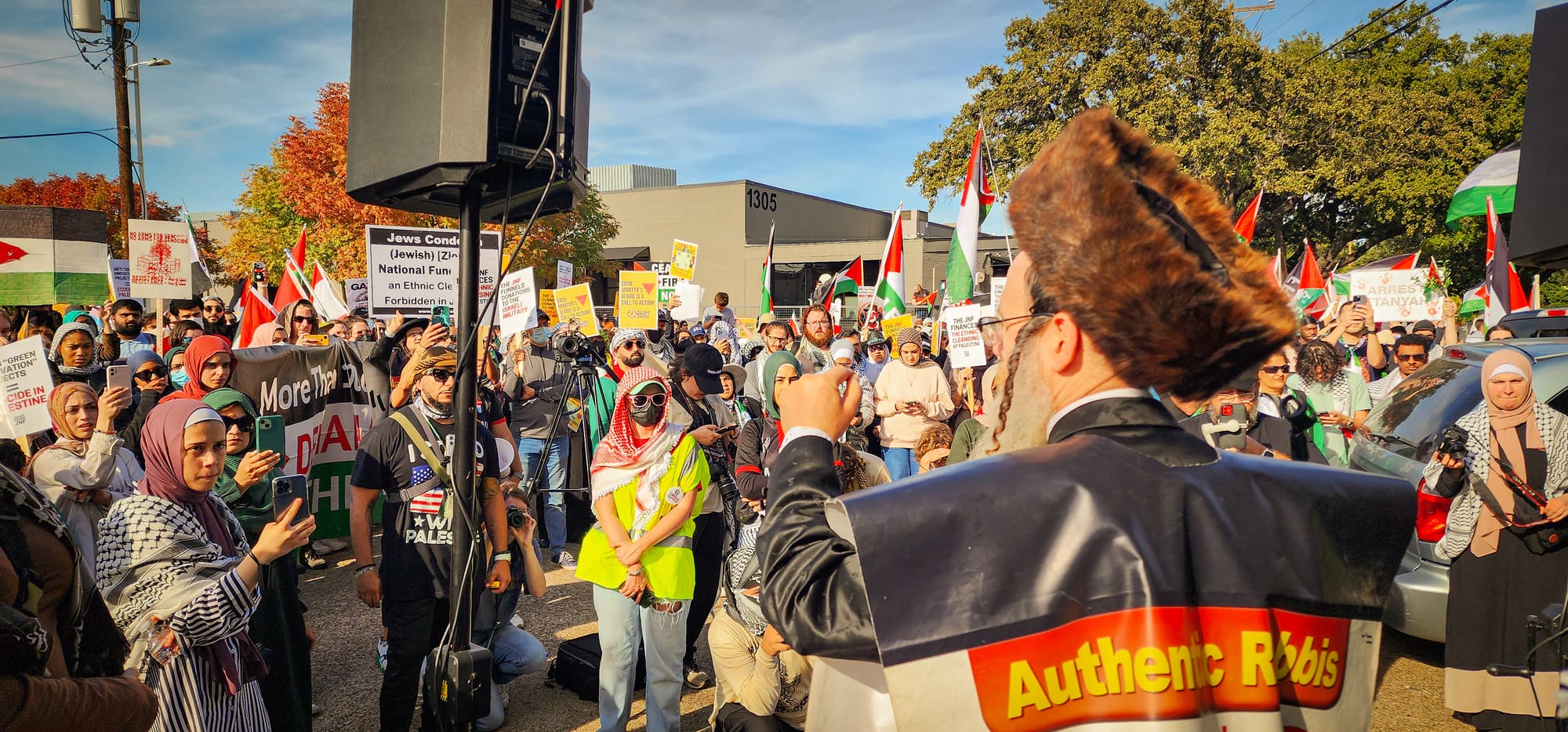
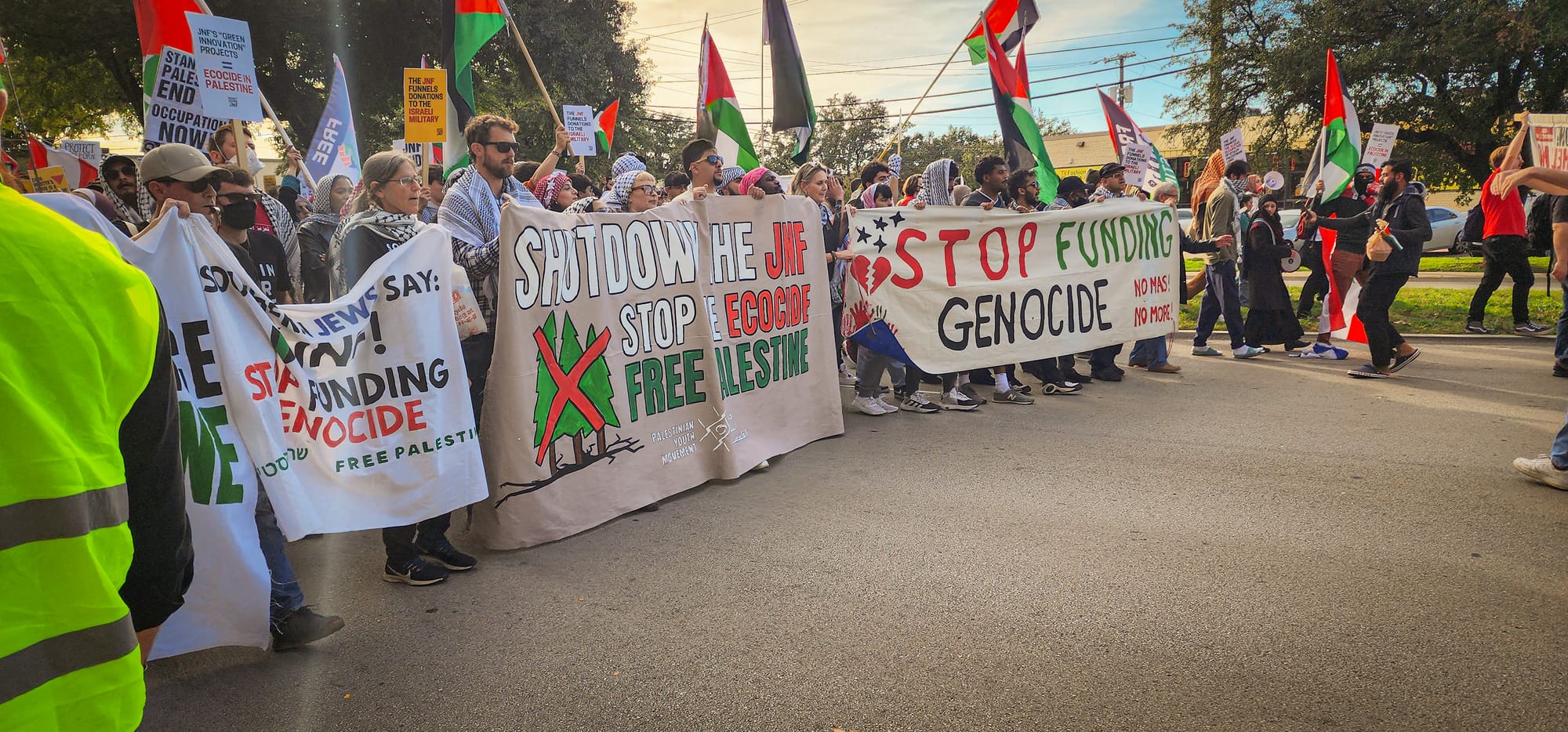
After the symbolic tree planting, protesters kept up a regular presence outside the Hilton Anatole, with nightly noise demonstrations. “We want to make sure they don’t feel that sense of comfort or that sense of ease,” Abdelwahed said. “There are people in this city, specifically, and all over the state and across the region who are actually so appalled by the way … that the City of Dallas has allowed for this conference to go on.” On the night of Friday, November 15, a protester was arrested for releasing helium balloons, with battery operated noise-making devices attached, under the glass-lined roof of the hotel atrium.
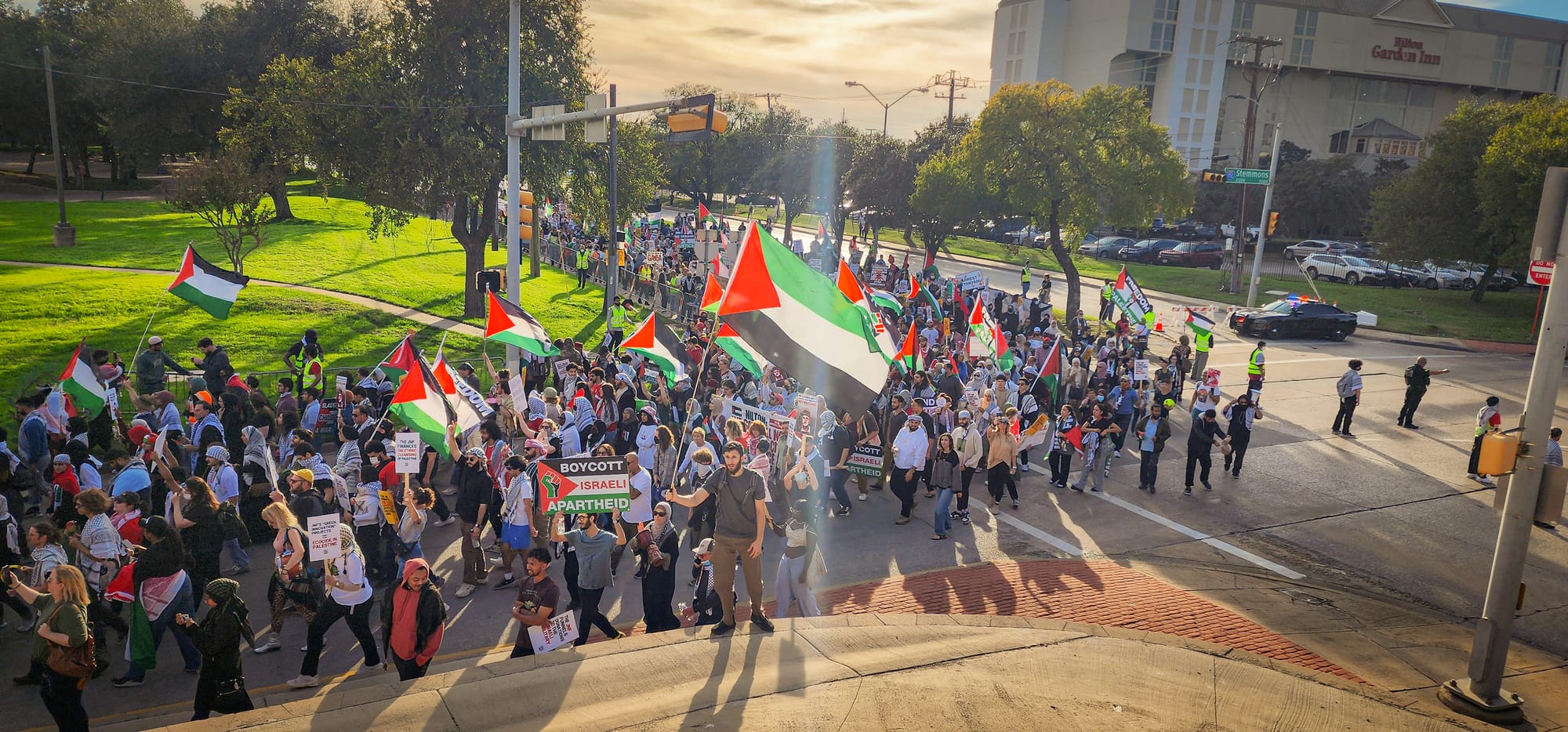
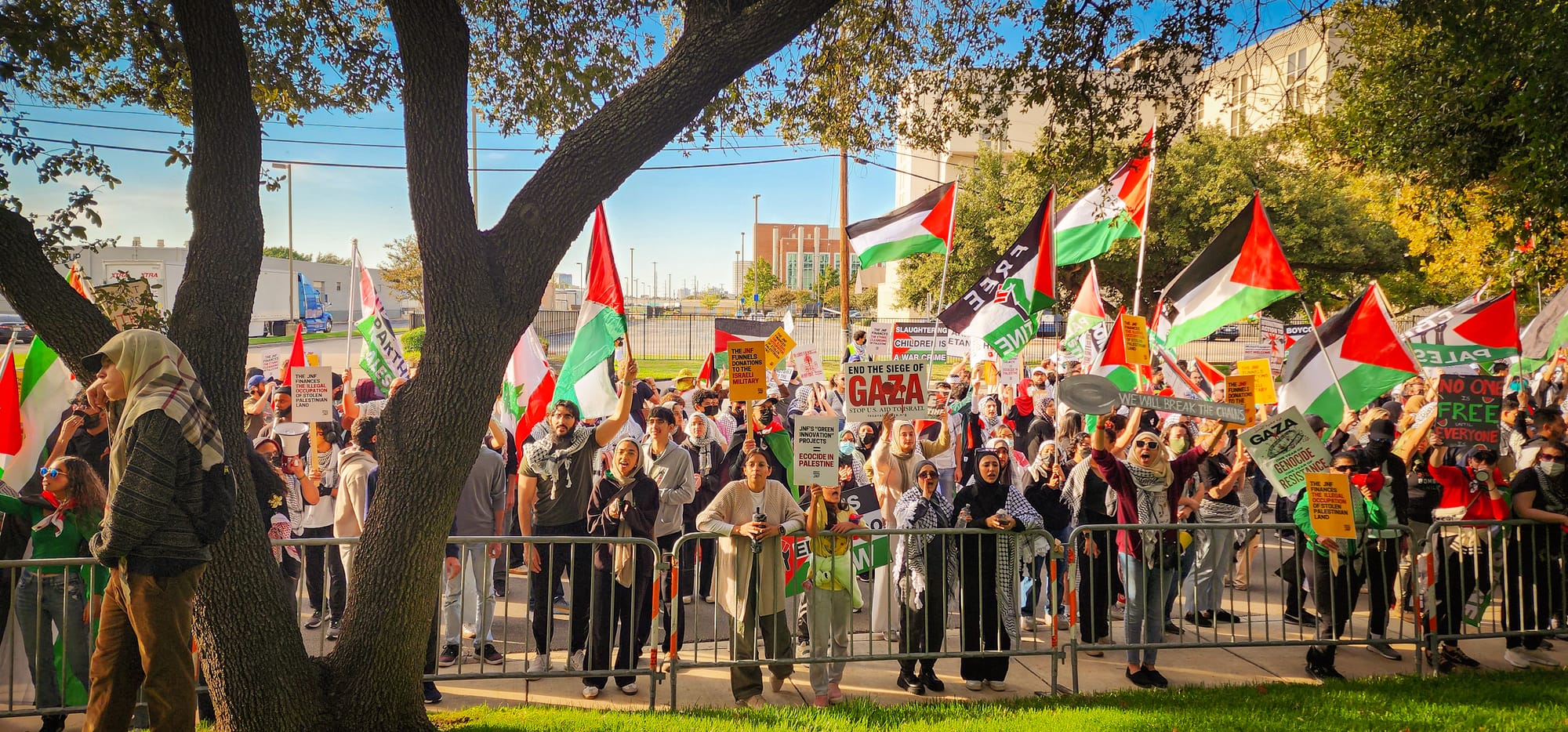
The weekend’s protests against the JNF reached their apex with a mass demonstration the next day, drawing over 1,000 protesters who traveled to Dallas from around Texas and neighboring states. Supporters of Palestine of all ages, from toddlers to elders, took part in the march. They chanted “1, 2, 3, 4: Occupation No More!” and “Free, Free Palestine!” as they marched around the perimeter of the Hilton’s massive parking lot. Mounted police blocked access to the hotel, while other officers redirected traffic, but did not attempt to interfere with the protest.
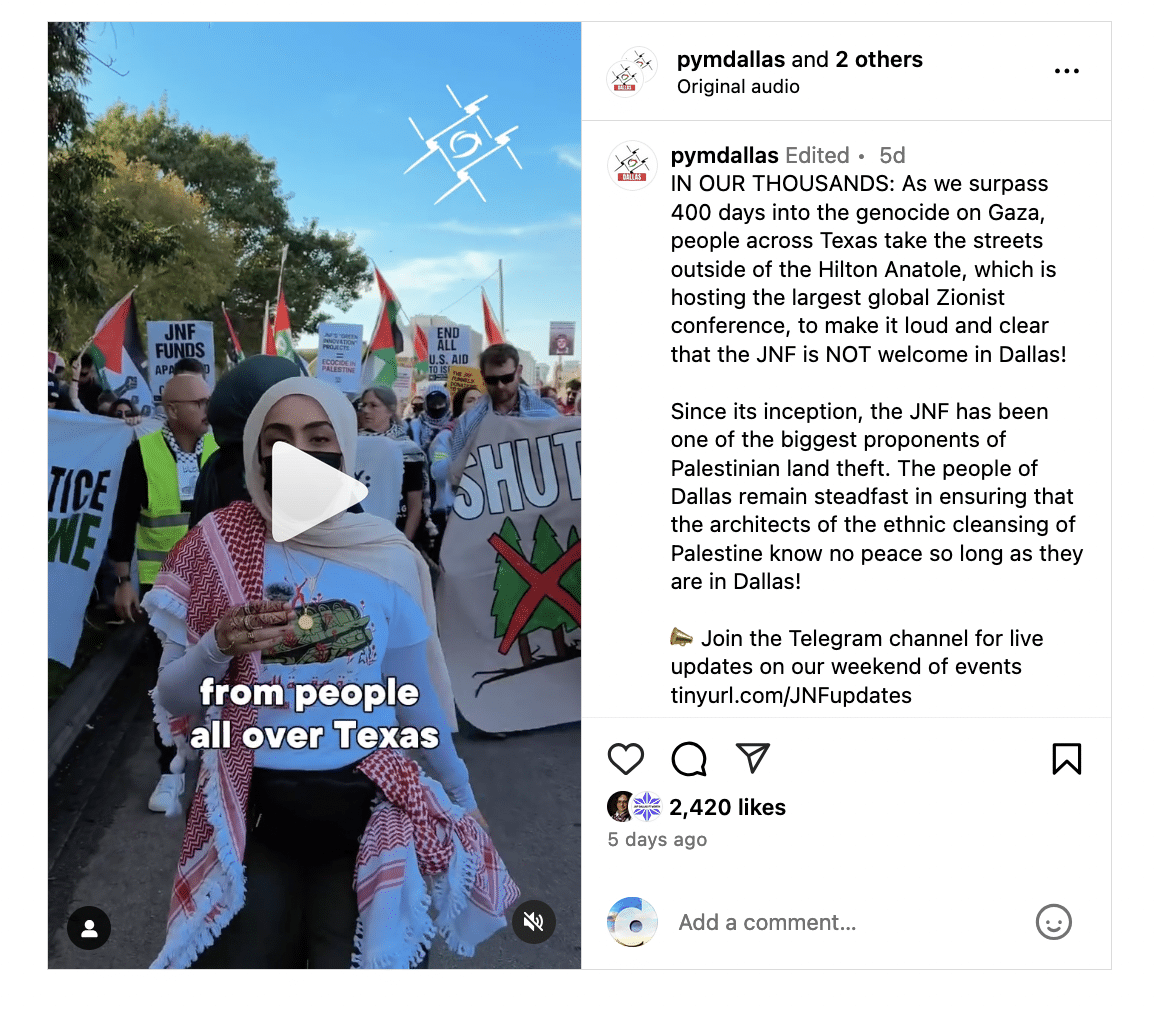
At one point, as the protest marched along the frontage road of Interstate Highway 35E, hundreds of Muslims gathered to pray in the street while the rest of the crowd surrounded them protectively. For Norman, this moment, along with the presence of both progressive and ultra-orthodox Jews at the march, symbolized the solidarity between Palestinians and anti-Zionist Jews. To see both Jewish and Muslim identities “drawn upon to help sustain resistance was just beautiful,” Norman said.
Cala, a representative of the University of Texas at Dallas chapter of Students for Justice in Palestine, was excited to see so many people turn up for the march. “They are coming out to demand that war criminals and illegal settlers get out of our city,” she told Deceleration.
(Deceleration agreed to use only Cala’s first name to protect her against the retaliation some students have faced for supporting Palestine.)
Cala pushed back against the myth that JNF projects were beneficial to the environment. “Palestinian land has always been inhabited by Palestinians,” she said. “It is our land that our people have grown our crops on as one of the main parts of our culture and history, and our animals have grazed on it.” After the JNF displaced the original Palestinians, she said, the pine forests they planted displaced native plants with European trees.
Zainab Haider, a representative of the Austin for Palestine coalition, which bused dozens of supporters to the march, also accused the JNF of practicing “ecocide” in the region, “because of the damage that’s being done to the native ecology and the incredibly nefarious reason they’re planting these forests, which is to prevent the return of Palestinians to that land and to essentially have a campaign of erasure of the numerous Palestinian villages that existed there before the JNF was part of depopulating and destroying.”
In the year since Israeli forces retaliated against a deadly Hamas attack with months of sustained bombing that has killed 10,000s of civilians and left countless more starving—actions which United Nations experts say meet the definition of genocide—American protesters have maintained near continuous protests in the streets and on college campuses. They’ve maintained, and grown, the U.S. movement for Palestine in the face of massive repression by police and other authorities. But that movement must now plan for the incoming administration, with President-elect Donald Trump promising to ramp up crackdowns on protests.
Organizers we spoke with are preparing for increased police and legal threats. “It’s certainly going to get a lot harder,” said Norman. “You don’t have to wait for Trump,” she said, pointing out that Republicans are “already working to strip away rights from nonprofits that do Palestinian rights organizing, and have been for ages.” On Thursday, the U.S. House of Representatives, with support of these 15 Democrats, passed HR 9495, or the “Stop Terror-Financing and Tax Penalties on American Hostages Act,” a bill that has been widely criticized by civil society groups, including the ACLU, which expressed “deep concerns about the bill’s potential to grant the executive branch extraordinary power to investigate, harass, and effectively dismantle any nonprofit organization.”
Many Deceleration spoke with were defiant in the face of these threats.
“When it comes to our activism, nothing is going to change our organizing, no matter what politician is in office,” said Cala of Students for Justice in Palestine. “No matter who is trying to repress us, we’re going to stay coming out, day after day, week after week, to show that we stand with our people in Palestine.”
Zainab Haider, of the Austin for Palestine Coalition, said that her allies are “very much clear-eyed about the fact that the next four years are going to have significant challenges. We’re going to be not only fighting for Palestinian freedom, we’re going to be fighting for our own rights, and it’s going to be a lot.”
Recalling the thousands of people who were inspired to become activists and community organizers during the first Trump administration, she said her coalition hopes to “cultivate revolutionary optimism.”
“We’re not going to give up, and at the end of the day change is going to come from us, from people, not from appeals to the ruling class,” Haider said. Only by “organizing our communities, and by continuing to build collective power, are we going to get to the kind of world that we want to see.”


