“Science is dangerous; we have to keep it most carefully chained and muzzled.”
—Aldous Huxley, 'Brave New World'
Twenty years ago, as a youngish and still-hopeful-about-the-world Ph.D. student, I trudged through a murky swamp in Davy Crockett National Forest, catching frogs. I’d first reported a story for Texas Parks & Wildlife Magazine in my article, "It’s Not Easy Being Green."
“It’s a sunny, blue-sky Texas day in late October and I’m about to go frogging with Dan Saenz, U.S. Forest Service wildlife biologist in Nacogdoches. A Gary Larson Far Side cartoon with a banjo-playing frog adorns his door. The frog is singing something to the effect of: ‘My baby’s left my lily pad, I’ve got the greeeens, oh baby, I’ve got the greeeens’.”
Mucking about in forests and swamps—this felt like a life I wanted. So I started studying frogs, catching them and recording their croaks and chirps on “frogloggers.” Though my short-lived project ended, dedicated U.S. Forest Service scientists based at the Research Station in Nacogdoches have carried out long-term ecological studies throughout more than 675,000 acres of national forests in east Texas: Angelina, Sam Houston, Sabine, plus the Stephen F. Austin Experimental Forest. These studies range from investigations into endangered red-cockaded woodpeckers and Louisiana pine snakes to understanding forest and wetland ecosystems, and how climate change, invasive species, timber harvesting, and oil and gas affect them.
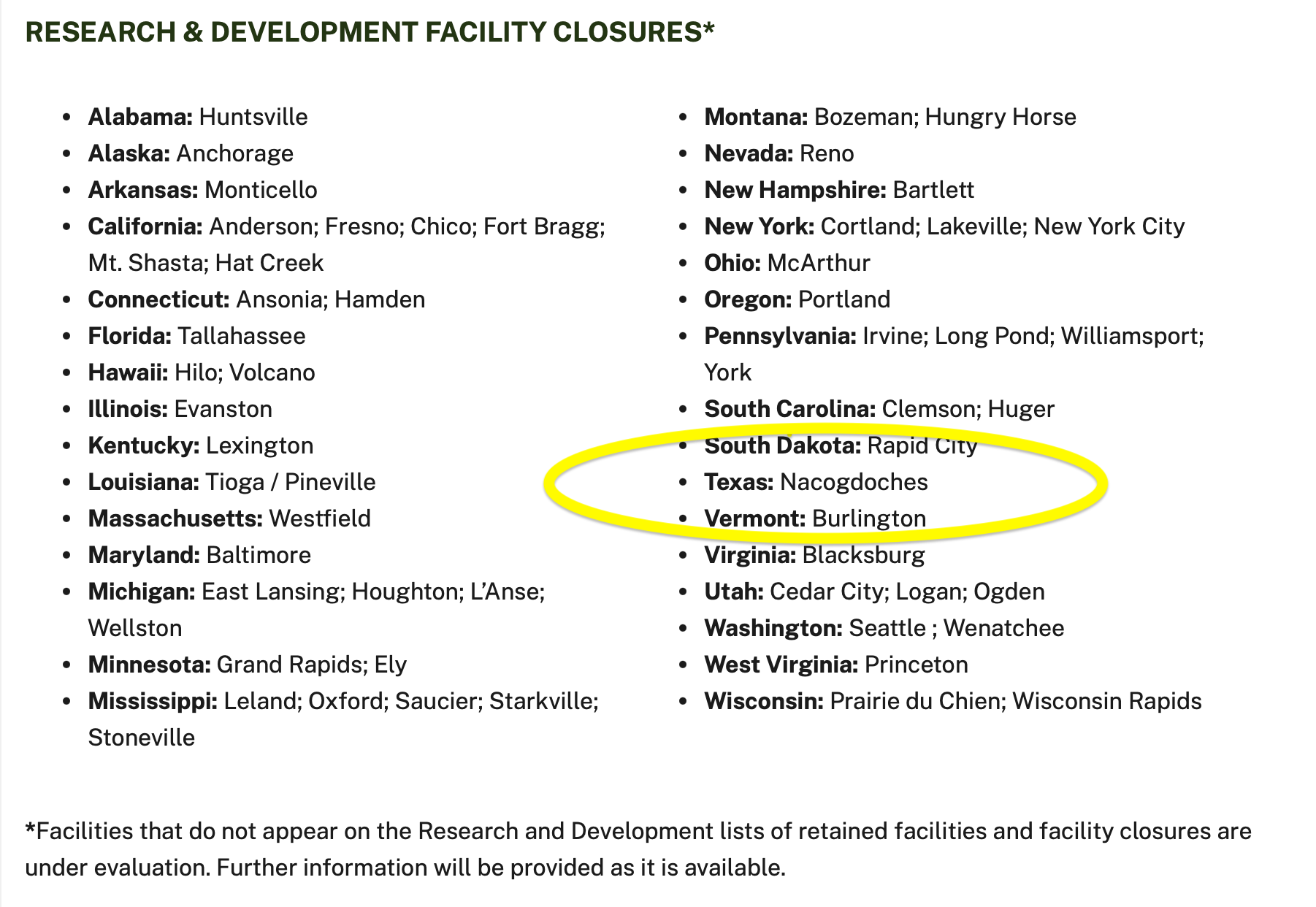
Much of the research may soon end.

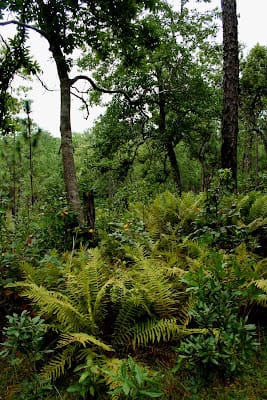
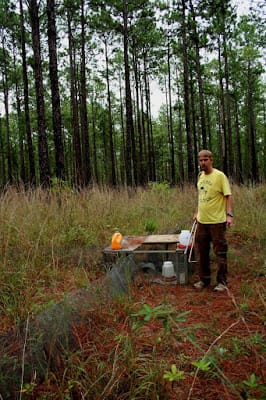
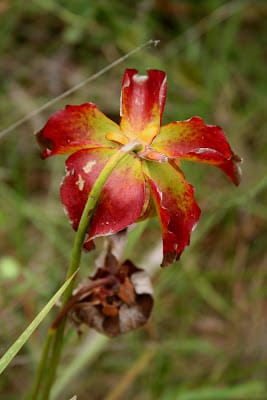
1. A green spider on a scarlet catch-fly, a rare flowering plant found in the longleaf pine savannah; 2. A pitcher plant bog in Angelina National Forest; 3. USFS Biologist Josh Pierce stands by a snake trap in 2008, which includes "drift fences.” The fences get the snakes to crawl toward the trap; 4. A dried pitcher plant flower (Sarracenia alata), a unique carnivorous plant found in east Texas national forests. Images: Wendee Nicole
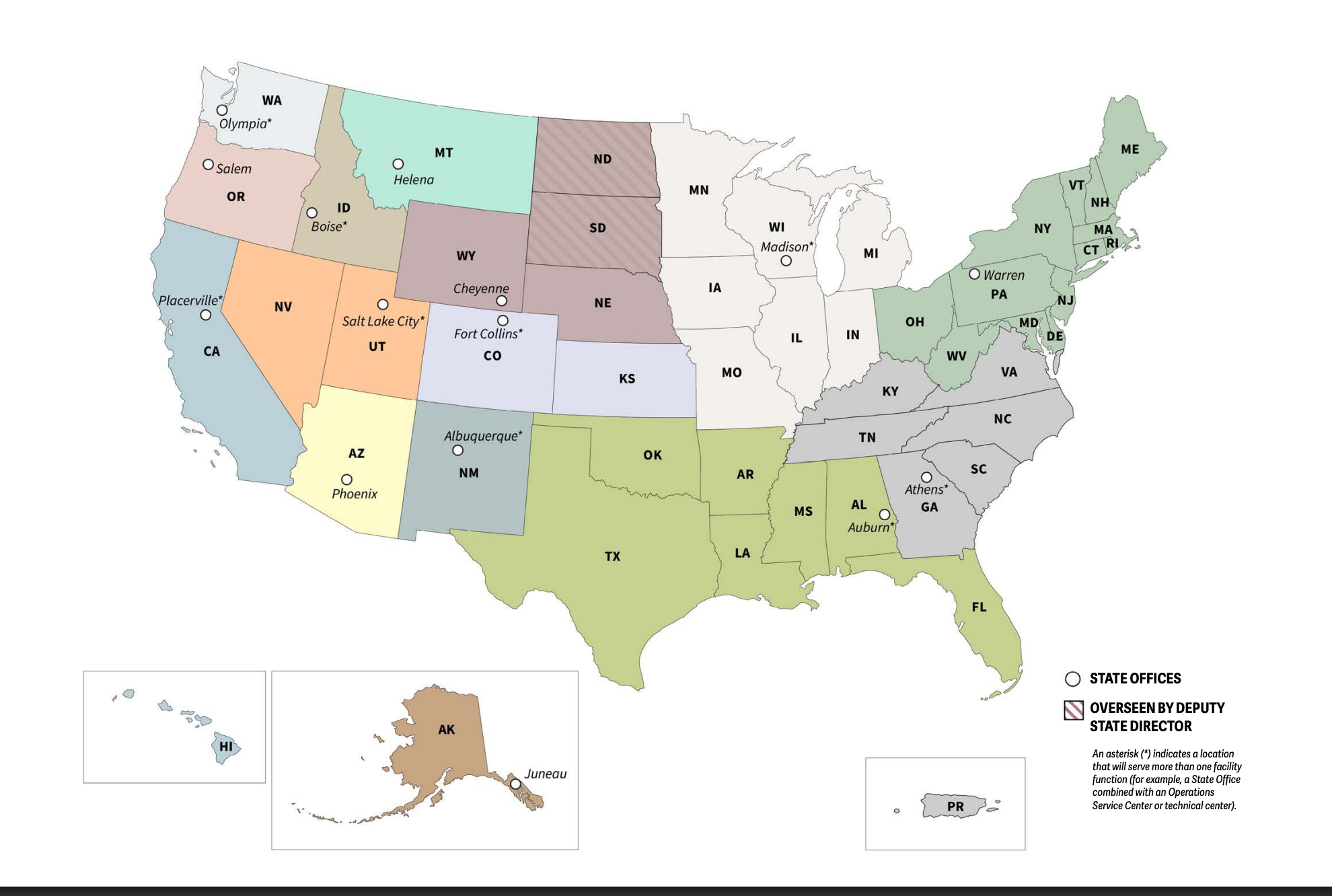
The U.S. Department of Agriculture (USDA) launched its “sweeping restructuring” of the U.S. Forest Service (USFS) on March 31st, despite 80 percent of public comments criticizing the decision. Reorganization includes the following changes:
- USFS headquarters will move from Washington, D.C. to Salt Lake City, Utah.
- 57 of 77 research stations in 31 states will close—including Texas’ only station in Nacogdoches. The national research headquarters will move to Fort Collins, Colorado.
- All regional offices will be replaced by 15 state offices; Texas falls under the new ‘Ozarks and the Gulf Coast office’ in Auburn, Alabama.
- The Fire and Aviation Management program, which manages wildfire response and comprises half of USFS’ staff, will remain intact—for now.

"State" offices will soon set regional priorities, coordinate with tribes, other state governments, citizens, and local interest groups. Presumably, this includes timber harvests, as well as oil, gas, and mineral leases common on USFS lands.
Many have expressed alarm.
“The …state-based organizational model concerns me. States focus on state priorities whereas national forests are a shared public trust governed by federal law,” emphasizes Kevin Hood, director of Forest Service Employees for Environmental Ethics (FSEE) and recent retiree from 31 years with USFS.
“I am skeptical that states will embrace the full suite of multiple use values, including watersheds, wilderness, fish and wildlife, as well as outdoor recreation, timber and range,” Hood told Deceleration.
Promises to Boost Timber Production
“It seems to me that they're reorganizing for reorganization's sake,” says Kathryn Conant, a former regional lands director for the USFS, who supervised many federal employees over her long career. “What problem are we trying to solve? Who asked for this reorganization?”
Press releases and official documents offer a variety of reasons, including: reducing bureaucracy, moving employees out of D.C., boosting employee recruitment, and moving decision-making “closer to the forests and communities it serves.”
Among reasons, two rise to the top: “supporting our timber growers across the country” and “promoting policies that boost timber production, lowering costs for consumers.” Though not explicitly stated (and the official USFS website denies this in a newly added “myths and facts” section), it’s clear in the shuttering of research facilities and laying off of scientists that the federal government’s priority has shifted from public-benefit science towards private-enterprise profits.
“The research branch is being gutted,” says Hood. “These drastic cuts reflect the administration’s hostility toward research and science.”
Attacks: An Intellectual Brain Drain
When Trump moved the Bureau of Land Management (BLM) headquarters from D.C. to Grand Junction, Colorado in his first term, 87% of reassigned staff left—a massive brain drain of highly skilled employees. Black and Asian staff were hit particularly hard. Though Biden moved the BLM headquarters back to D.C., a similar employee exodus will likely follow the USFS reorganization.
Thinly disguised in all the governmental restructuring, the president seems intent on removing intellectuals, scientists, and any “leftist” employee from the civil service. Trump has repeatedly voiced disrespect for the federal workforce, calling them crooked, dishonest, and corrupt, blaming them for "destroying the country,” and calling for vast cuts of the Department of the Interior’s “woke, weaponized and wasteful programs.”
According to an analysis in the prominent journal Science, more than 10,000 people with Ph.D.s in STEM (Science, Technology, Engineering, and Math) have left the U.S. government workforce since Trump took office a second time. Those who stay likely keep silent, and must follow orders they disagree with for the sake of keeping their jobs.
Conant, who supervised many federal employees over her long career, calls staffers “committed public servants” with highly technical, specialized training. The Forest Service has already been reduced by about 5,000 employees, adds Conant. But that’s not enough for Trump. “Last year and this year, [in] different budget requests, the President actually wanted to completely zero out research and development and Congress said no,” Conant said.
Another fear on many peoples’ minds, says Conant, still in touch with former colleagues: is this a move towards merging the Forest Service with BLM? Or, worse, “Is this step one of privatizing the national forests?,” she posits. “Utah is ground zero for a state takeover of federal land.” Utah, her home state, sued the federal government over claims they should have ownership over 18.5 million acres of BLM lands, though the Supreme Court declined to hear the case in January 2025. State leaders are regrouping to take up the fight again.
Project 2025 & the Giant (Sucking) Water Bug
Restructuring the government and disavowing science falls right in line with the conservative Heritage Foundation’s Project 2025. Though once disavowed by Trump, more than 50 percent of its agenda has been implemented since he took office again.
Watching the government axe long-term scientific research and shutter offices—ones I have personal history with—feels traumatizing, like an anti-intellectual, anti-Enlightenment shadow coming across the country, nay, the world. Science has become an enemy. Objective truth has become an enemy.
In Annie Dillard’s Pulitzer Prize winning Pilgrim at Tinker Creek, she tells of a giant water bug, a “monstrous and terrifying thing” that will grasp a living frog, inject it with paralyzing poison that liquifies its guts, then suck it dry, leaving a hollow shell. I saw one once, in Angelina National Forest, as I reported in my frog article. At the time, it delighted me. Today, it feels like a premonition; the guts of our nation, of science, of wildlife conservation, of citizen-led democracy, and even of truth itself, are being sucked dry.
Legal Challenges to USFS Reorganization
Lawsuits (such as this one from the Northeast Organic Farming Association of Vermont) will try to stop the USFS reorganization, and may succeed. But what’s being lost may not easily be replaced. Either way, “The impact on the ground is going to be huge,” Conant tells Deceleration. “We have research areas that we've been studying for 100 years. It’ll be so devastating to lose some of these research projects.”
I left my Ph.D. program before finishing. A divorce meant I needed to be available for my kids and support myself financially. My frog-catching days turned into a life reporting about wildlife, science, and justice issues around the world. Yet, those national forests still lay claim to some of my most cherished memories, camping and swimming and kayaking with my children, now grown.
Will these sacred places, these forest cathedrals, remain a generation to come? Will the frogs? Will all the morals and lessons of history remain to show us the way? Or will they, like the unlucky frog in Dillard’s true tale, end up a hollow shell of what once was. The answer may lie in how much we fight back, even as the poison starts to numb and paralyze.