


Members of the City of San Antonio’s Governance Committee on Wednesday unanimously overwhelmed a staff recommendation for “no action” on a proposal to track heat-related deaths in San Antonio. Originally filed in April, the Council Consideration Request will now be sent to the Community Health Committee (formerly Health and Equity) for further discussion and possible action. If passed out of the CHC, it will come to the full Council for discussion.
A key update for CHC members is expected to come from Metro Health Director Claude Jacob, who at Wednesday’s meeting said he is on his way to a gathering of public health professionals where best practices on heat tracking will be a topic of discussion.
“The national conundrum around this has to do with, actually here in Texas [too], not having a standardized way to track these heat-related deaths,” Jacob said. “We are a member of the Big Cities Health Coalition. And later this week I’ll be visiting that health department. We’ll be hearing best practices of what they offer and that we can apply to the coalition of health departments, the large urban health departments coast to coast. So our recommendation is to no further action here.”
Both Jacob and City Manager Erik Walsh cited this lack of “standardization” in tracking heat-related deaths as justification for steering the committee members toward “no action” on the request.
That didn’t satisfy CCR co-author Councilmember Teri Castillo, who was first to the mic.
“The CCR recognizes the current lack of standardization,” Castillo said, “which is why we ask for the City of San Antonio to work with relevant agencies to explore best practices which may lead to the identification and a tracking method which meets the spirit of the request. … Maricopa County’s Heat Illness and Death Dashboard illustrates this request can be accomplished through inter-agency collaboration.”
Maricopa County operates within a robust, inter-agency heat-tracking network, which year after year reports hundreds of heat-related deaths. According to state data reviewed by Deceleration, Bexar County most years reports fewer than 10. This is to be expected in the absence of a program to track heat-related deaths and a Bexar County Medical Examiner that apparently refuses to do so.
After recommending no action on the CCR, Jacob told committee members that his team could possibly work to increase awareness of how they educate the public around heat-related illnesses. (The department tracks and reports heat-related illnesses, but not heat-related deaths.)
That was not good enough for Councilmember Jalen McKee-Rodriguez.
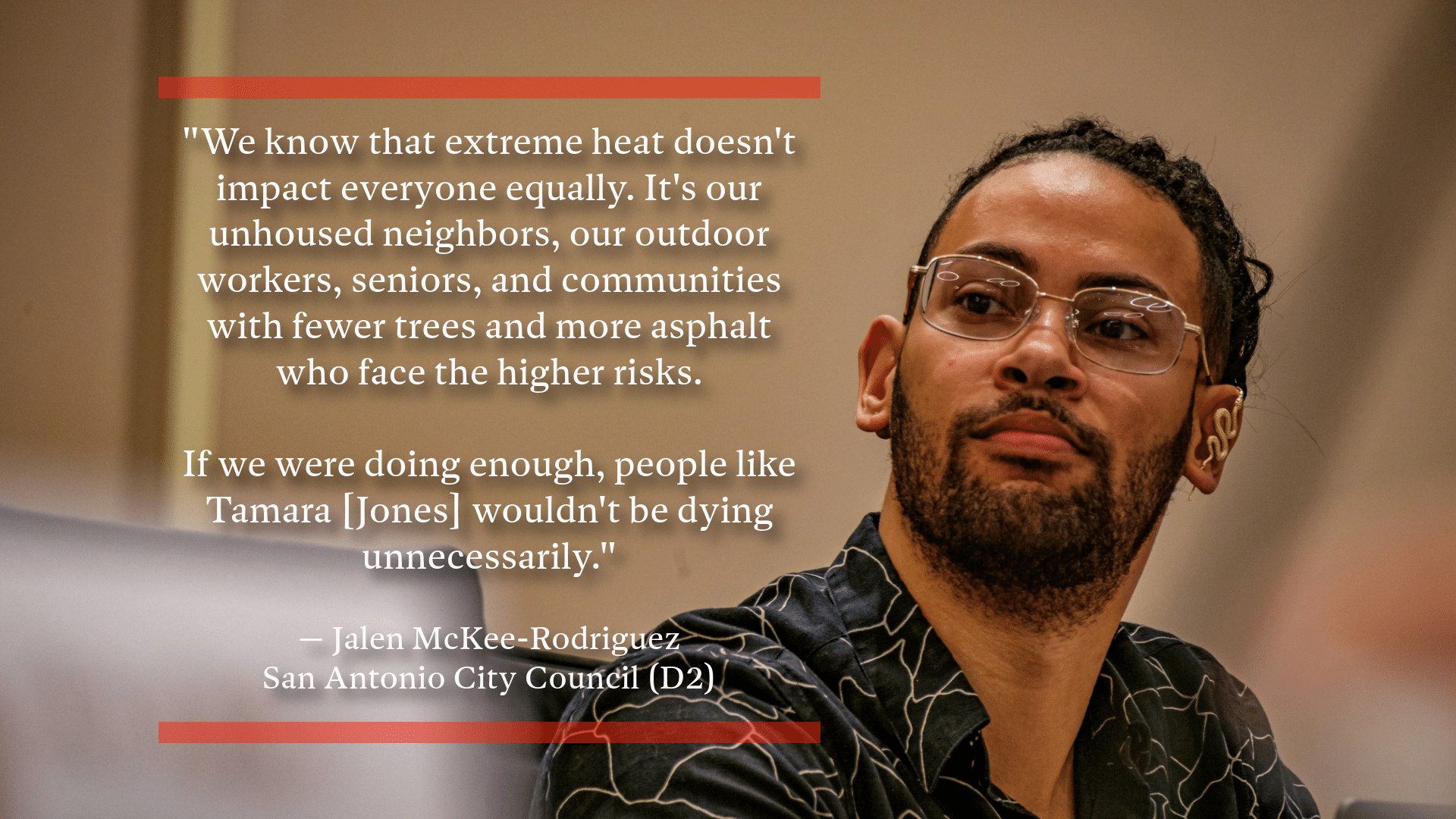
“We know that extreme heat doesn’t impact everyone equally. It’s our unhoused neighbors, our outdoor workers, seniors, and communities with fewer trees and more asphalt who face the higher risks. And if we’re doing enough, people like Tamara [Jones] wouldn’t be dying unnecessarily. We do need to do more.”
The San Antonio Express-News quoted “city officials” who attributed the death of the unhoused Eastside resident to cardiac arrest, with no mention of heat or high temperatures. Jones died in early September of this year, on a relatively cooler day with an official city temperature of 89 (meaning it was likely at least several degrees hotter due to urban heat island impact). However, this day followed a string of five consecutive triple-digit days in the week prior to her death and a month where 27 of the previous 34 days hit 100F or higher.
McKee-Rodriguez continued:
“We need standardized tracking of heat-related deaths as part of our Heat Island Mitigation and Adaptation plans to prevent future loss of life and to fully understand the scale of the issue so that we can continue to adapt and implement more solutions. So for all these reasons, I am willing to disagree with staff’s recommendation that we take no further official action as a body.”
Councilmember Edward Mungia (D4) said the absence of a reporting standard was not sufficient cause to resist exploring the creation of such a standard for local use.
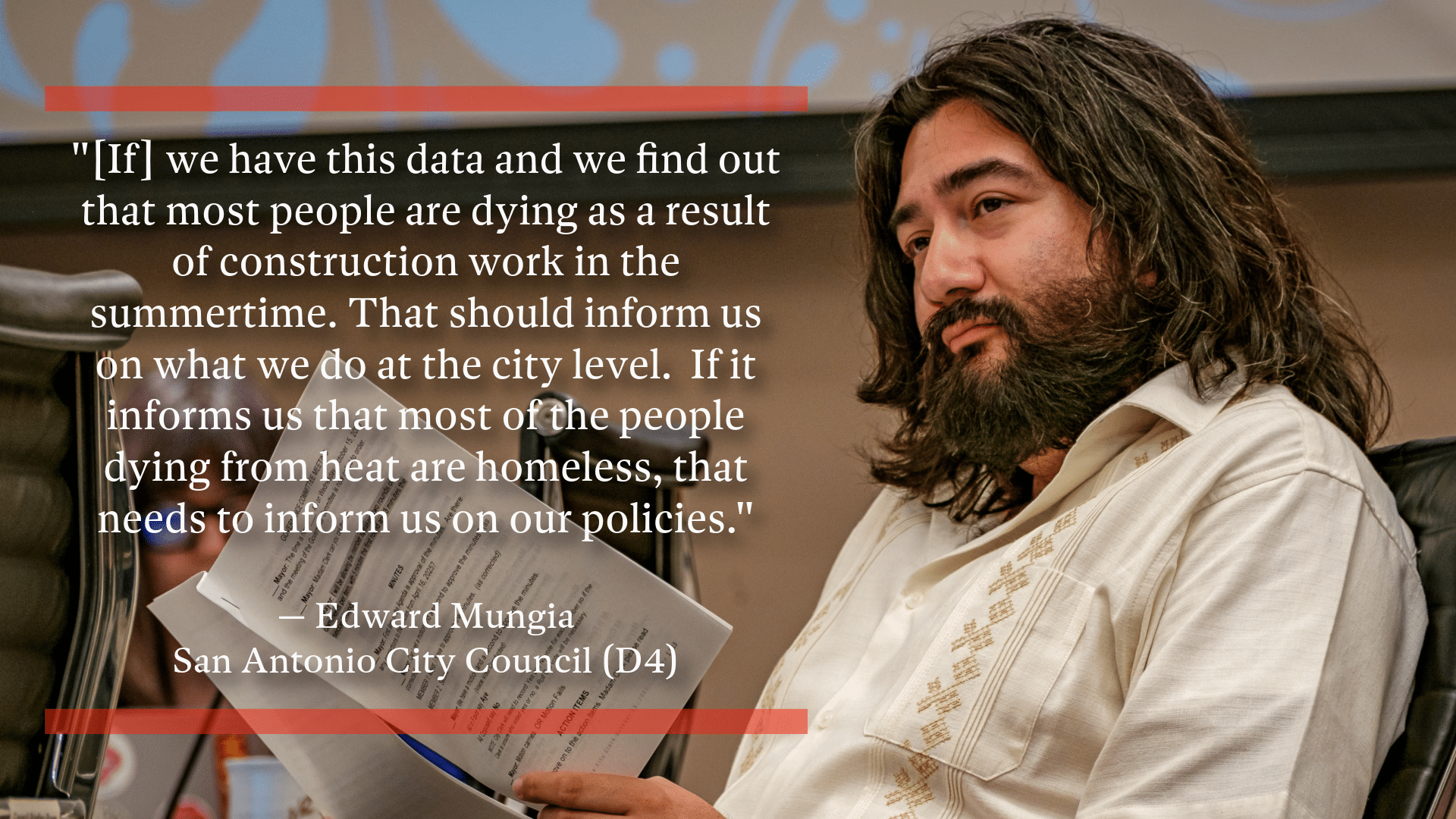
“It’s a small ask that people have to keep track of the number of people that have died,” Mungia said. “I think it can inform us on other things, right? We have this data and we find out that most people are dying as a result of construction work in the summertime, that should inform us on what we do at the city level, right? If it informs us that most of the people dying from heat are homeless, that needs to inform us on our policies.
“I think you can help us be better advocates at the state and federal level by saying this is what’s happening in San Antonio. The city may not have a standard, but maybe we can help create that standard for our own local government.”
Helping steamroll institutional resistance to tracking heat deaths in San Antonio, Councilmember Phyllis Viagran (D3) said:
“I would like to see this go into [Community Health] and see the committee have an opportunity to review this simply because as we talk about racism and poverty and the health care crisis that they create, we do need to consider who is out on the streets with these extreme temperatures, either working or living.”
Toward the close of discussion, City Manager Walsh again lamented that lack of what he and Jacob called “standardized” tracking methods.
“The CCR asks that Metro Health track heat-related deaths in San Antonio through intergovernmental collaboration, shared research, and best practices,” he said. “All of which, as Claude [Jacob] talked about, we have a [heat illness] dashboard we update every Wednesday. And the ‘no action’ part of this is that we can’t standardize for everybody else and track accurately.”
While it is true that the City doesn’t oversee data collection methods used to track heat-related deaths, it still has an important role to play in collaborating with those who do—such as the Bexar County Medical Examiner’s Office—so that public health agencies at all levels can learn from national best practices underway in Phoenix, Las Vegas, and other large cities.
While known for taking strong stances against the Council majority, in this case Mayor Jones concurred with her colleagues on this point.
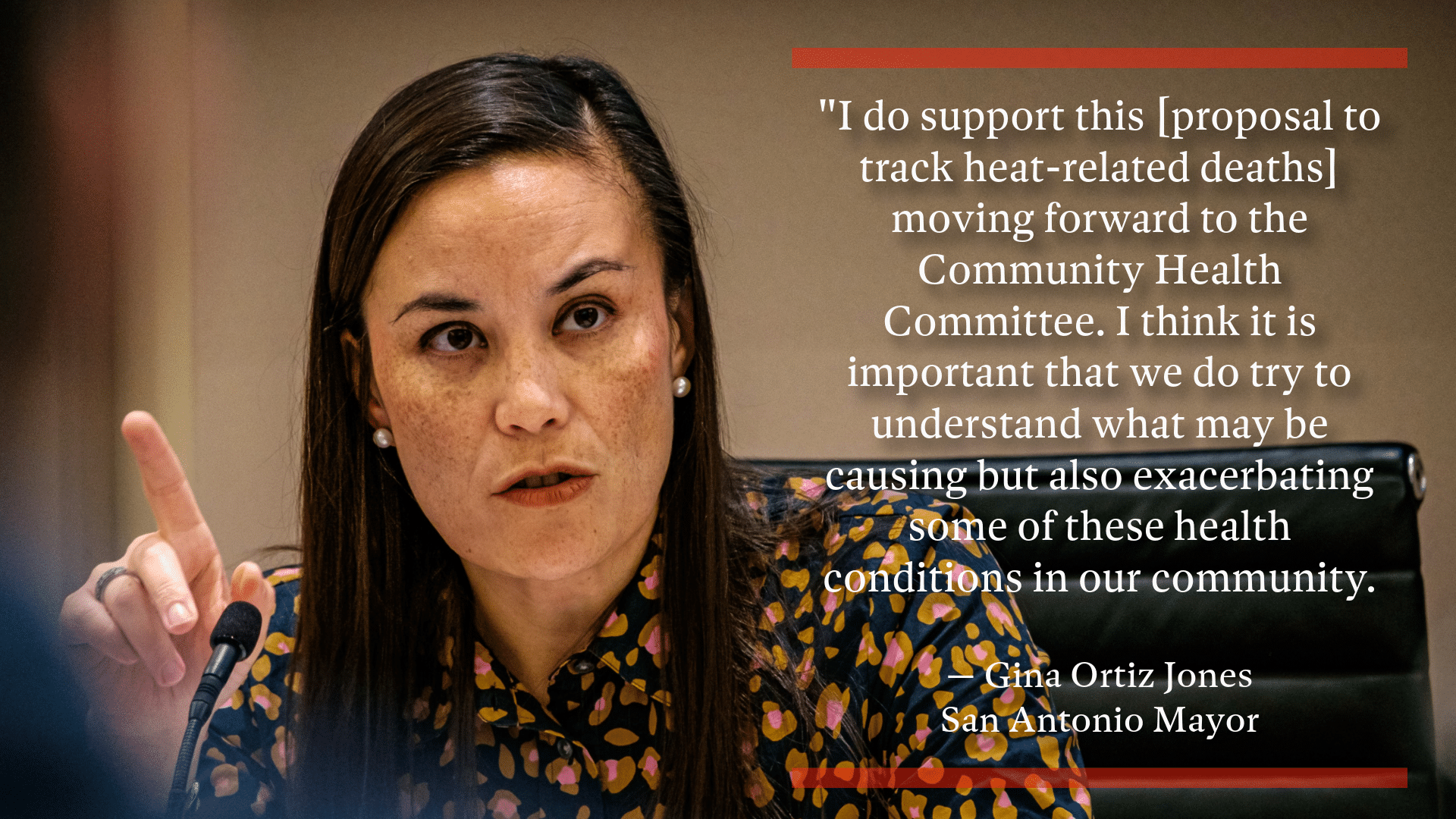
“I do support this moving forward to the Community Health Committee,” Jones said. “I think it is important that we do try to understand what may be causing but also exacerbating some of these health conditions in our community.”
Mayor Jones emphasized the potential for new practices and partnerships that the process could discover.
“I think there’s also some synergies that we might want to look at … that can help inform significant plans that we have in our community. … I know there’s already some thoughtful research that’s happening at UTSA, those that are monitoring the temperatures in someone’s house, how that can be higher than what it is outside. But then understanding those communities are probably facing a whole other range of challenges that we might need to account for at the city level.
“So I appreciate the feedback that you’re going to provide as we collaborate with others that are facing this, not unlike [the collaboration] in Phoenix, and then helping the School of Public Health at UTSA help us understand what’s in the realm of possible. It might not be perfect, but how can we get some better data to make some well-informed decisions?”
It’s unclear when this matter may be taken up by the Health Committee. Calls this morning to the office of committee chair Councilmember Rick Galvan were not immediately returned. We will update that as new information is available.


