“The cracks are showing,” a friend told me over the phone back in 2020 a few weeks into the first phase of the pandemic lockdown. As global shipping struggled to fulfill the needs of a “just-in-time” economy where businesses rarely kept more backroom inventory than needed for a few days of projected demand, the fragility of our global system of commerce was revealed for all to see.
When a container ship ran aground in the Suez Canal a year later, the same cracks were once again evident. Today, as Iran’s chokehold on the Strait of Hormuz begins to drive fuel and grocery prices towards untenable heights, we’re seeing once again how the global economy is set up for speed and efficiency but not resilience. When a crucial point of failure is triggered, poor people pay the price.
So much of this fragility comes as a result of our misplaced faith in, and our ill-fated addiction to, growth.
In today’s newsletter, I look at a book that breaks down this growth imperative and its consequences as well as an alternative that could promise to make the economy more resilient, sustainable, and equitable.
Happy Reading,
Syris Valentine
Shrinking the Economy to Save the Planet
Degrowth is both necessary to defeat the destructive hydra of the GDP while also restoring authentic community-led decisionmaking.
The Second World War devastated France's economy as it did for much of Europe. Then came the US Marshall Plan, which was designed to help prop up the shadowed ruins of Western Europe's enfeebled empires. From 1945 to the mid-70s, France experienced significant growth, particularly when measured by a newly invented metric: the Gross National Product, the precursor to today's Gross Domestic Product (GDP). The economic growth helped free many French people from a poverty they would have experienced even with the nation's resources evenly divided. But citizens still yearned for more than could be guaranteed by a climbing GNP.
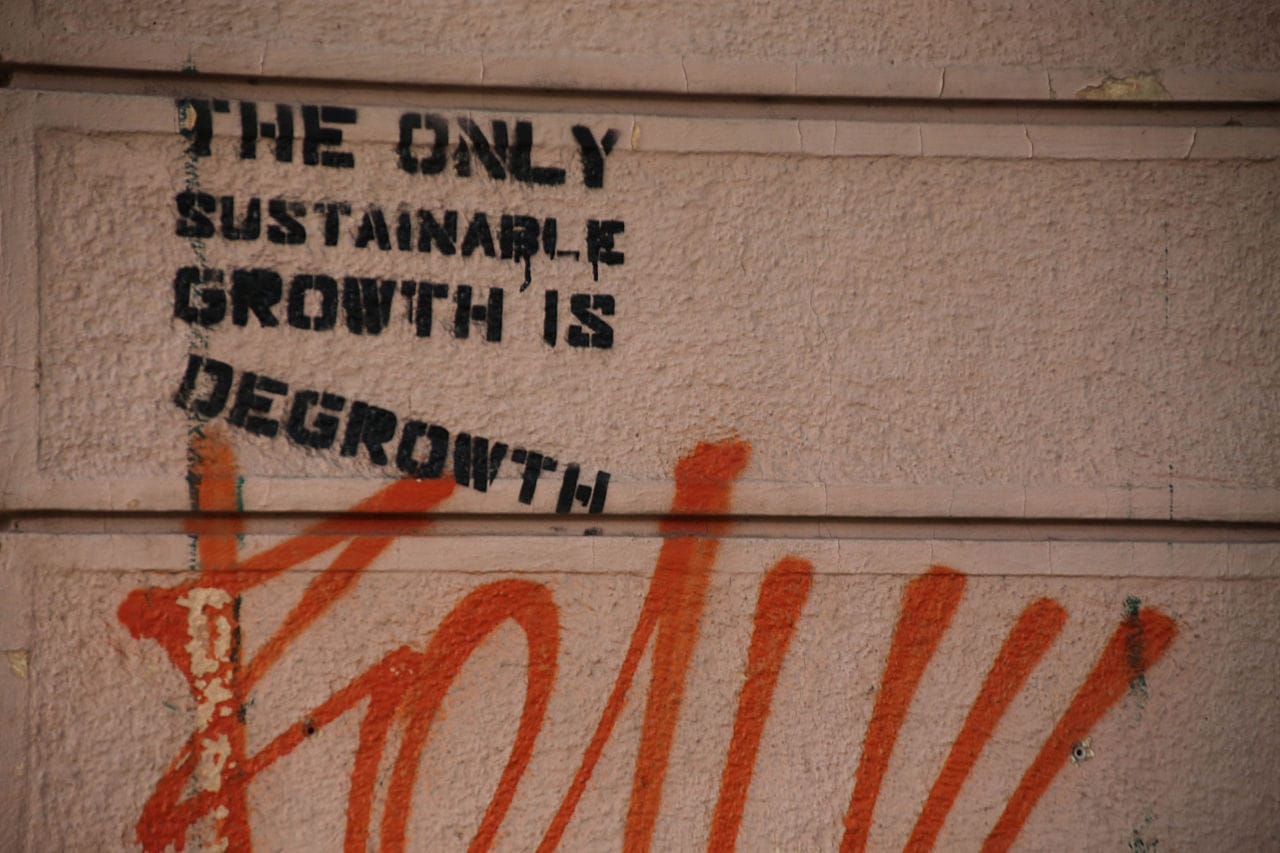
In May and June of 1968, as the “Thirty Glorious Years” of growth neared their end, widespread student protests and mass strikes coalesced around this social craving. One piece of graffiti from the era particularly captured the mood:
“You can't fall in love with a growth rate.”
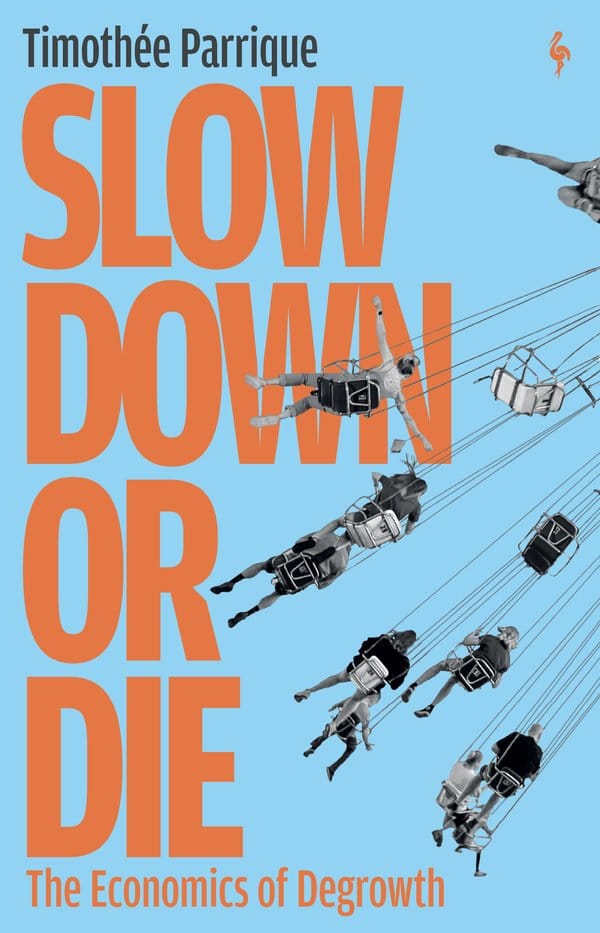
In his book Slow Down or Die, the English translation of which will christen its one-year anniversary next month, French economist Timothee Parrique points to the growth-skeptical sentiments of the May ‘68 rebellions as the earliest rumblings of the economic philosophy that his book elaborates: degrowth.
Parrique is culturally well-situated to elaborate the arguments surrounding degrowth given his native land germinated the earliest seeds of the idea and is still today the main nation in which the concept is frequently discussed and debated among politicians and the public. But, as he describes over the course of his short and comprehensive (if fairly abstract) book, those who argue against degrowth, whether in academia or the political arena, tend to misunderstand what it means. Instead they whip a straw man that bears only the faintest, caricatured resemblance to the philosophy’s true character.
“Explaining what degrowth is can be a tough job,” Parrique writes, “Not because it is a complicated idea but because the concept is constantly misrepresented by a handful of poorly informed commentators.”
Degrowth deniers tend to cast it as an intentional recession and a purposeful impoverishment. Or worse: they cast it as an “Amish model” of enforced austerity. But, as Parrique explains in the book's introduction, the core of degrowth is simple yet radical:
“Growth has become an existential crisis. From here on out, our survival depends on our ability, or inability, to change our economic model.”

Too often talk of the causes of climate change stops at the physics of the crisis: Greenhouse gas emissions accumulating in the atmosphere trap more heat, so the world warms and catastrophes compound. The slightly more radical stance adopted by a minority of politicians and climate communicators takes it one further step: Fossil fuel companies drive the bulk of these calamity-causing emissions and profit off destabilizing the planet.
Yet rarely, particularly in the American media, do people take the next, most fundamental step: The fossil fuel industry, and other polluting sectors, cannot be dismantled so long as the global economy continues to grow.
Constructing new solar farms is undeniably necessary. But it is incorrect to believe that every solar field that goes up means a coal plant comes down. In reality renewables add new infrastructure that complements existing capacity instead of replacing it, because for the economy to grow, the energy sector must as well. So unless the increased supply of low-carbon energy far exceeds the economy's increased energetic appetite — a prospect made more unlikely as power hungry data centers metastasize — little, if any, of the existing fossil-fueled infrastructure is likely to be finally forced offline
This struggle is a major challenge for those who believe we can decouple the GDP from greenhouse gases, and thus grow its profits while diminishing its ecological footprint. Such an intention is as foolish as a bodybuilder attempting to swell their biceps while cutting calories at every corner. Yet those obsessed with maintaining the economy’s upwardly trending total wealth are intent on convincing the world that such a trajectory is not only sane but ideal and essential: The only conceivable way, they argue, to solve the crisis without plunging the world into poverty is to continue to grow the economy.
The pervasiveness of this belief is why Parrique dedicates more than a tenth of his book to dispelling the myth of decoupling. After revisiting research on the subject he concludes, “No study today justifies the current faith in green growth.” Rather systematic investigations have found that decoupling is either nonexistent or far too slow to make a meaningful difference.
“Ecosystems don't give out points to those who ‘do their best’,” writes Parrique; “and they couldn't care less if we are ‘relatively more efficient.’”
Confronting this reality requires contracting certain sectors of our economy and reprioritizing a portion of the liberated wealth and materials towards undervalued and unvalorized activities that are beneficial to ecology and the human spirit. Parrique is far from the first to reach this conclusion. But, by engaging in the debate now after it has had a half century to develop, he uses his book to confront many other myths that surround society's growth addiction, including the belief that the only way we can continue to lift people out of poverty and expand social services is by growing the economy.
In countries long impoverished and exploited by Europe and the United States, continued growth is an undeniable necessity — as most, if not all, degrowth advocates acknowledge. But in the wealthiest nations, he writes, “an increase in GDP no longer translates into gains in well-being,” in particular “because it primarily benefits those who are already wealthy.”
We don't need more; we need to better distribute what we already have.
In fact, humanity currently consumes more than enough of the Earth’s animals, minerals, plants, and trees to provide everyone alive with a good quality of life if only we more evenly shared all that we extracted. One pair of researchers even showed that we could meet everyone’s needs while using just 30 percent of all the water, materials, and energy the present economy burns through each year.
Perhaps the most important question, then, is simply: What would degrowth look like?
First and foremost, the process would entail a transition where everyone collectively decides — through worker-owned cooperatives, neighborhood councils, participatory budgeting and the like — what we produce, and how much, instead of leaving those choices up to corporate boards focused on keeping their hockey stick graphs high and to the right. Parrique paints a simple portrait of this:
“The sectors made to shrink won't be cleaved and butchered; rather, picture a gradual reorientation of the economy, planned democratically, in which our resources, working time, energy, and materials would no longer be used to produce certain commodities (particularly those that pollute and contribute little or nothing to our well-being), and could therefore be partially remobilized to society's benefit.”
Throughout his book, Parrique explores at a high level how this reorientation would work, where it would take place, and what social, physical, psychological, and ecological benefits it would bring. And while there exist works that provide a deeper philosophical exploration of degrowth and others that explore more concrete examples of it in action, Slow Down or Die sits comfortably in the middle, making it a critical read for any activist, politician, or concerned citizen eager to understand the radical reformations necessary to save the world.
Thoughts?
While many of the policies that would support degrowth — capping fossil fuel consumption, instituting universal health care, expanding other social services, banning advertising, reducing work hours — are widely popular, the term itself remains somewhat contentious.
What do you think about the term “degrowth”?
And beyond that, what do you think about the idea that we need to shrink the economy to save the planet?
Let me know in the comments!
Video
News for the Future
- Sweden, Finland, and other Nordic nations have managed to build enough wind farms and hydropower plants that, when the conditions are right, electricity becomes entirely free — sometimes even, as Oliver Millman writes, “the price of electricity falls below $0.” (Atmos)
- Deep in the wilderness of Canada’s Northwest Territories, diamond mines have scarred the edges of the region’s lakes since the late-90s, and now one is readying to close after extracting 150 million carats of diamonds since 2003. As the mine closes, its operators intend to buck a trend and, instead of simply fleeing the devastated landscape, they’ll clean up pollutants, fill in the craters they carved, let the lake reclaim the remediated remains and, in the end, as Pat Kane writes, “essentially turn the mine back into a seemingly untouched landscape.” (The Walrus)
- “Deconstruction,” the idea of taking apart buildings one brick and board at a time, is picking up steam, and one business based in Vancouver, B.C., has already managed to keep over a million pounds of construction waste out of the landfill in just four years. (The Tyee)
- Faced with home insurance premiums that spike with every fire that torches a California forest, the state is seeking to pass a bill that would gift them the power to sue fossil fuel companies for the damages that climate-fueled disasters wreak and use the assets to cover the costs of recovery. (Inside Climate News)
- The building material of the future is … wood. Two types of wood-based building materials, cross-laminated and glue-laminated timber, are both strong-enough and light-weight enough that architects and builders are already designing and constructing buildings as tall as 25 stories. “The Hive,” a 10-story building recently completed in Vancouver, B.C., is a prime example of this advance. (Grist)
- In Hinesburg, Vermont, affordable housing developers have begun to build a small, neighborhood-scale geothermal project that will help heat and cool the 36 of the townhomes and apartments being built in a new affordable housing complex. The development follows in the footsteps of similar projects in Framingham, Massachusetts, and New Haven, Connecticut, that are using small-scale geothermal to power hundreds of nearby buildings and public infrastructure. (Canary Media)