

EDITOR’S NOTE: This story originally began taking shape in 2020, a few years before Tesla CEO Elon Musk would transform from a soft-jawed, balding South African techie enthusiast into a leading force for white supremacy, hyper nationalism, and global fascist movements. As such, this reflection on electric vehicles and DIY culture has also become a de facto treatise on non-Tesla options for battery-powered personal transportation. Deceleration remains firmly in favor of rewilding, depaving, mass transit, and the complete abandonment of fossil fuel extraction and combustion to allow the planet’s life support systems to rebalance and heal. But as Earth Justice lays out: If you need personal transport en route to the better cities that will make us less dependent on life-destroying energy infrastructure, EVs still win over gas- and diesel-powered cars and trucks by almost any measure. And though Tesla has made its name and fortune by turning EVs into high-end status symbols, this conversation with EV DIYer Jim Royston points to an alternative future for EVs: with enough interest, ingenuity, and neighbor-helping-neighbor solidarity, used EVs can be surprisingly affordable and accessible for working poor communities. In light of Trump’s total animosity to renewable energy sources like wind, “barrio renewables” as ethos and practice skirts both federal deregulation and the corporate Swasticar, becoming a bottom-up, localized movement for decarbonization. — Marisol Cortez & Greg Harman
“Do you have any of those charge pumps near you?”
It was the summer of 2019, and I was about to leave my parents’ house when I remembered I’d forgotten to share the news: I was going to sell my little Mazda stick shift and get a used electric vehicle! I’d buckled the baby into his car seat and somehow that had jogged my memory.
My dad was excited but curious: how I would I power it without the ubiquity of gas stations—without “charge pumps” around?
As I laughed at this awkward phrasing, my mom said, exasperated: “There are no pumps, honey, it’s an electric vehicle. They use—”
She fumbled for the proper term, as did my dad, speaking over my mom.
“I mean the—the—electric…pumps.”
Oh dad. I was forced to text this to my partner, still laughing on my way home.
Then it happened to me, sort of, one blessedly grey day when Jim Royston brought over his electric vehicle so I could test drive it, my first time ever in an EV. I turned the key and started: no sound. The car was on, but nothing turned over, nothing caught, nothing fired. It was uncanny.
For a second time, I reflected on how deeply colonized our cultural imaginary is—our mental constructs, our language—by the paradigm of the gas-powered engine and its pumps. Its internal combustion, its liquidized fossils, its oil wars and extraction fields, its globalized infrastructure of slabs and jacks and derricks for sucking the stuff out of the ground to burn it.
Jim was at our house that day because one of his hobbies at that time was helping people switch from one paradigm to another, one idiom to another. There was something truly transformative about what happened when we shifted in these ways, he told us—not just ecologically, but psychologically. For a time he was doing this on the side of his job. He didn’t get paid; he did it because he felt it was a useful thing to do, and he enjoyed it. Plus he was good at it—from his paid work, he knew a lot about the auto industry, especially sales and repair.
We had heard of Royston via word of mouth, through local environmentalist networks. Hearing we might want to find a used EV, someone from Sierra Club (where Greg was working at the time) had passed his number to us. So I’d texted him, and for a few months we engaged in back and forth as I researched various options and he tried to locate a vehicle on the Craigslist market that might meet our admittedly tight budgetary restrictions. I didn’t have any cash on hand; I’d have to sell my gas car first—I figured I could get about 5K—and then use the proceeds for the EV.
Jim was patient with us. He came out to the house a couple times, giving his recommendations. The important thing with a used EV, he said, was the number of battery bars it had left. You wanted a vehicle that still had most of its bars, meaning its range hadn’t been too diminished. As he kept his feelers out for a 11 or 12 bar EV under 5K, I got my own car all nice and clean and fresh smelling, put it up on Craiglist, and waited.
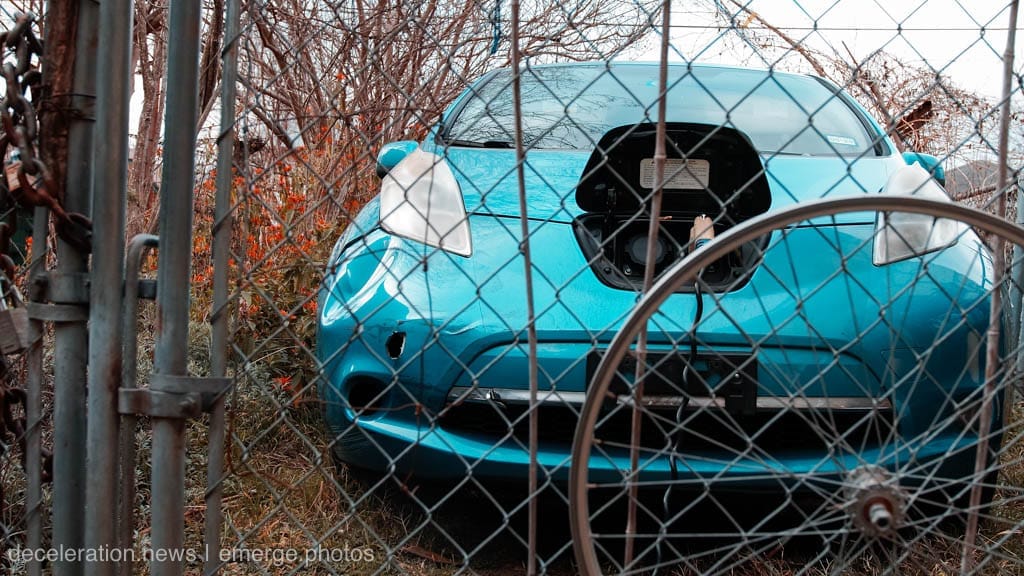
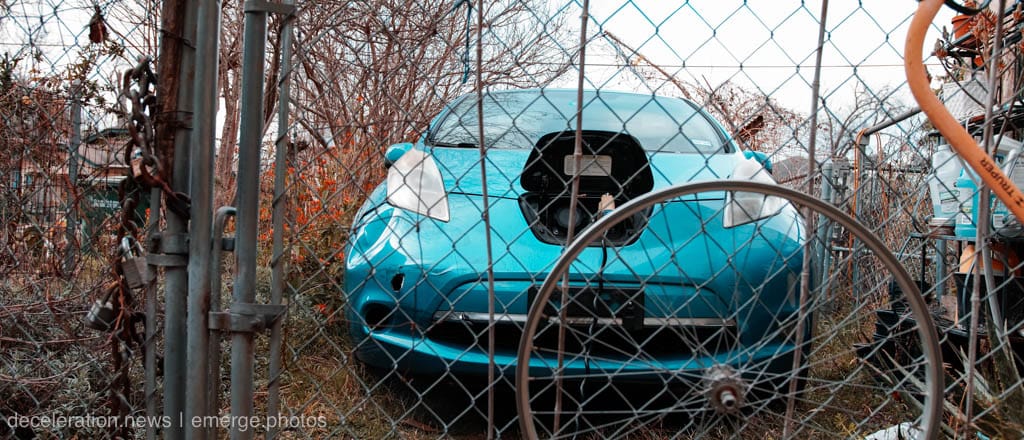
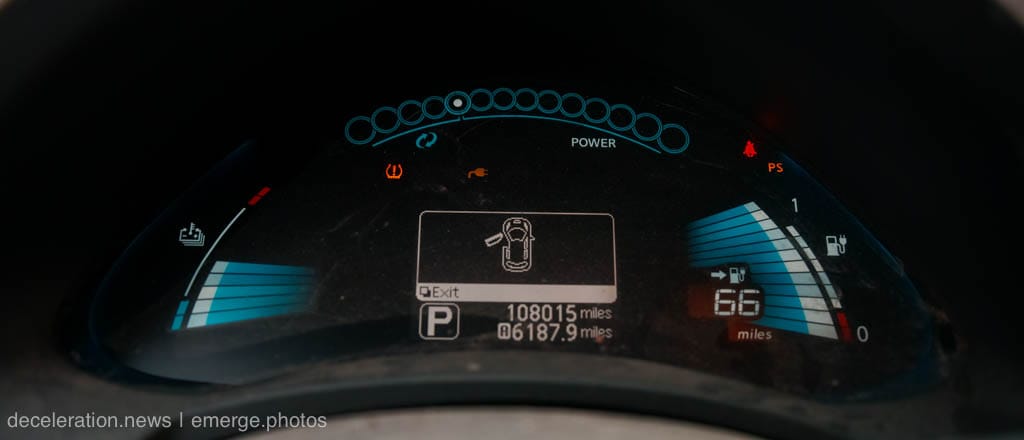
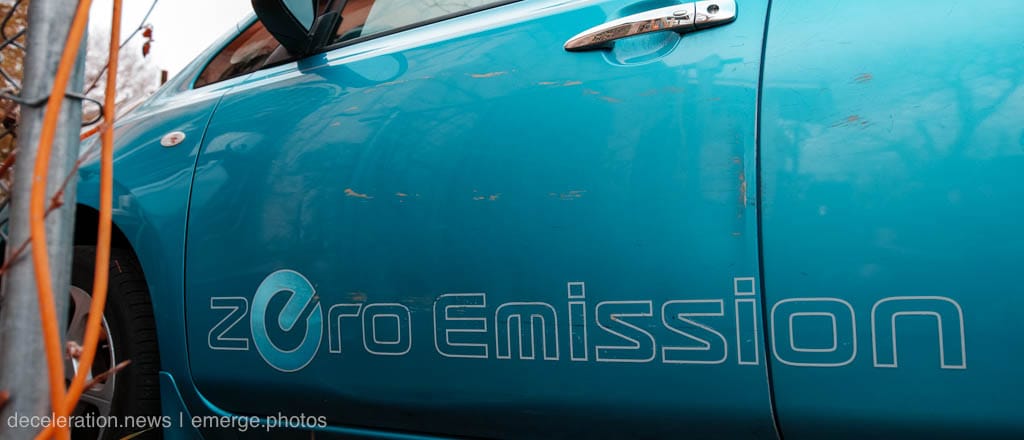
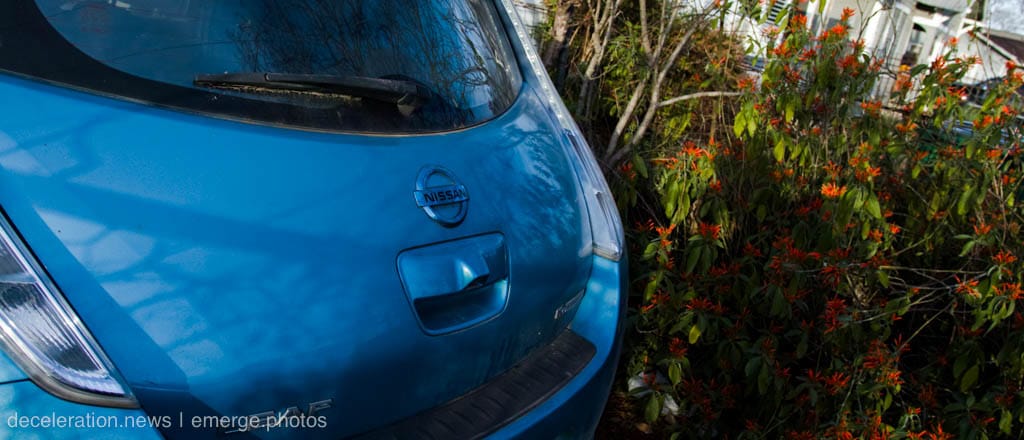
Then the pandemic hit, and the buyer’s market went kablooey. But possibly for the same reasons, Jim also in March 2020 located a seller up in Arlington, Texas, looking to let go of a beautiful blue 2011 Nissan Leaf for $4,000. As a first generation EV, it had a small range—about 75 miles—and looked like it may have at one time been part of a showroom fleet, with “Zero Emissions” obnoxiously decal’ed on both sides of the vehicle. That didn’t bother me so much though. Obviously it would become the Deceleration mobile! But it had 11 bars, low mileage for a ten-year-old vehicle, and came in under budget.
All I had to do was get my own damn car sold. On the promise that I would pay him as soon as I accomplished the task, Jim drove up to Arlington to front the money for the vehicle and tow it back to San Antonio, where like a total saint he kept it in his garage for three months as I desperately tried to locate a buyer for my car during a global pandemic.
About three months later, someone finally came through via Facebook posting. I got my $5K, turned around and gave it to Jim, and became the driver of a first generation Nissan Leaf with a range that was tiny but still ample enough to get me around town, so long as I stuck mostly inside Loop 410. I can get to 1604 and back, but I’m sweating and biting my nails the entire time, hoping I have enough mileage to make it back home.
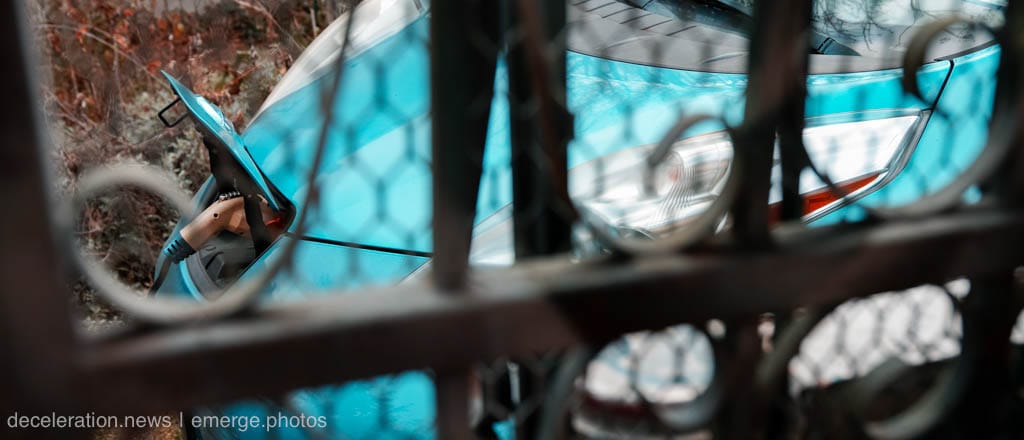
For several years we plugged the vehicle in via an orange extension cord that ran inside the house. Initially we got a quote from a company that advertised EV charger installation (“charge pumps,” heh), but because the wiring in our house is old, they said we’d need a brand new circuit which would be prohibitively expensive. So we just ran the extension cord inside. It wasn’t the smartest thing, but it worked for a long time, until it didn’t—eventually that outlet burned out. But when we got it replaced, this time from a quick-working indie contractor, he quoted us a really good cash price on a dedicated outside outlet that would be safe and grounded. I had Google translated all the technical terms in Spanish in advance so I would know how to ask what I needed to ask, only to learn that outlets is not enchufes but ploges, of course. Barrio renewables, man.
In the first few months of unlearning the internal combustion idiom, one of the things that struck me most was the way an EV undid my relationship to space and thus time. In a gas vehicle, I thought nothing of driving long distances to do this or that—I went wherever I wanted whenever I wanted. In an EV with a small range that charged at home, I had to be careful. Highway driving drew down the mileage quickly, unlike driving on back roads and city streets. So to extend the range, I quickly learned to navigate the city off its main highways. San Pedro or Blanco or Broadway instead of 281. Commerce instead of 10. I drove more slowly. Things took longer.
As underscored by the neo-Nazi pivot of Tesla CEO Elon Musk, not to mention the unsustainable and unjust forms of mining required to scale up EV production, electrification cannot be the solution to the polycrisis we face—the intertwined crises of climate, far right authoritarianism, and growing social inequality. Still, barrio renewables, technological practices from below whereby ordinary people try to figure out how to make renewables as accessible as possible to working poor people, is as fascinating as it is deeply urgent. It suggests that we don’t need Tesla or federal subsidies to transition to less harmful ways of getting ourselves around.
For all these reasons I wanted to talk more with Jim Royston about what he does and why he does it. As I learned, he’s moved on from finding used EV sales for folks to something even more interesting: refurbishing old EV batteries so they can be used again.
Interview is edited lightly for clarity and length.
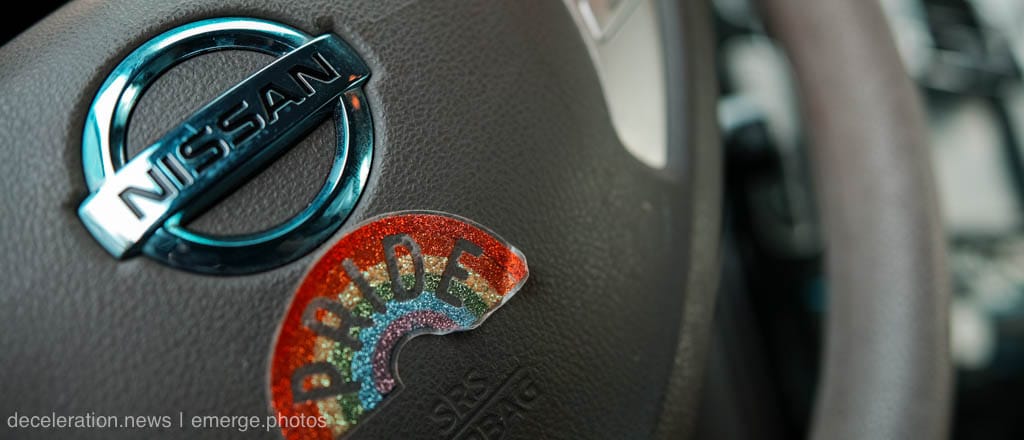
Our Leaf at Rest
Marisol Cortez/Deceleration: I just wanted to talk to you a little bit about your electric vehicle projects. I’m wondering if maybe you could start by sharing a little bit about how you got into EVs. Where did it all start for you?
Jim Royston: About 2008, I got interested in converting a gas car to an EV with lead acid batteries. It probably would have been a new Beetle, and I did investigations on it and found that it just wasn’t worth doing. The lead acid was too heavy, too expensive. I figured the commercial EVs were coming. I would just wait. And so that’s what I did. And as the Nissan Leaf came into being, I got more and more interested, started researching and decided that I would trade my internal combustion vehicle in for a Nissan Leaf. And when it became available, I bought a 2011 Nissan Leaf and I was off to the races.
Once you’ve driven an EV, if you are so lucky to have done so, you find that you really don’t want to go back. You drive a gas car and you realize, ‘Wow, what is all this noise and vibration?’ It just becomes annoying.
And when I like something a lot, I tend to like to get other people into it. And I also worked on cars for a long time and did the same jobs over and over again and saw there were many people who didn’t have a huge amount of money, who had a once-a-month outlay because their aging vehicle was breaking down regularly. And so an EV solves a lot of these problems, in that there are just so many fewer things to go wrong. So it became easy to promote, because [EVs are] a lot more reliable.
As it turned out, every vehicle has its issues, and it was just obviously too early to tell what issues there were with the the 1st wave of [electric] cars. [For instance,] I had also bought a Mitsubishi i-MiEV, which is a short range car. I still have that car, and it’s a perfect car—there’s almost nothing wrong. But the batteries are getting to the end of [their] life, and now I’m working on coming up with solutions to that issue.
It sounds like you already had a technical background. Can you tell me a little bit more about what you did that equipped you, way back in the early 2000s, even to be thinking about how to convert a gas engine to an electric? Tell me about some of what you did right before you got into EVs.
Well, right before I got into EVs, I wasn’t really working on cars at that point. I was making vehicle parts for Volkswagens. But you know, I’ve been in car-related fields for 30 years now. As an engineer, as a mechanic. As I worked on them, I [also] bought and sold cars. I sold used parts for them, and then I started making my own parts to get rid of the supply issues. And I just have always thought of what makes the perfect car. And that’s from the very beginning. My parents drilled into us, my brother and I, that the second most expensive thing we’ll ever deal with is our vehicle. So I was afraid of it in the beginning, before I got a car. I thought, am I up to this challenge? Is it going to break me? So I got my first car, and I studied, and I already had a proclivity for working on stuff.
And so I guess it began a lifelong study of just—what makes the perfect car, and how can you dial a car out of your everyday worry? I mean, you just turn it into something that either you want to do every day, or it’s something that you just don’t think about every day.
For most people, it should be something they don’t think about every day. They do the things that are important to them and they don’t have to worry about their car. And that’s kind of been the goal of most of my career, is—how do I make a car a carefree thing, you know?
So when we met you a few years ago, it was because there was this word-of-mouth informal network of people that you had helped connect with used electric vehicles. You started to talk a little bit about how, when you’re really into something, you like to get other people into it too. Can you say a little bit more about how that developed as a kind of side project for you, of being a finder or a connector?
Well, I have a pretty small social circle, but I met Alan Montemayor [from the Alamo Chapter of the Sierra Club] and helped him get a vehicle. I got him in a Mitsubishi just like mine up in Dallas and bought it for $4,000, which is screaming deal. And I had it transported down. He has a large social circle, and I asked him if he knew of any other people who were looking for EVs. I’m good at finding deals, and at the time it was very easy to find good deals on EVs, because it was still early on. This was probably 2014. And so he found people that were interested in EVs, and I tried to find them cars, and that’s what I did.
Yeah, I think that’s who we had heard about you from, from Alan. How many people would you say you you helped connect with EVs?
It’s somewhere just north of [Interstate] 20.
And can you walk me through what you would do when you were looking for those deals, or when you were trying to figure out the market for used EVs?
Well, the very first thing I would do when I was put in contact with somebody is have a phone interview with them to find out where their expectations were, what their needs were, what their living situation was for charging, and try to figure out the best solution, the best vehicle for what their needs were. Because there’s really no reason to find a car that just isn’t going to fit their needs. And then I tried to find that vehicle.
Where would you look?
Craigslist, mainly. I’m not on Facebook, so I just looked on Craigslist all over Texas, and found vehicles.
I remember we found ours in like Arlington or something.
Yes, it was. Yeah, somewhere up in Dallas.
And it’s still running strong. I had to replace the [smaller] 12-volt battery once, but that’s about it. It did drop 1 bar, but it still does what I need it to.
So I know historically the electric vehicle industry has tended towards the production of luxury cars, right? Like very high end vehicles. Do you feel like that’s been a mistake from the industry side? Has that made it hard for you to work with less affluent folks, in terms of locating affordable cars? It doesn’t sound like it. I mean, ours was also $4000. But yeah, has that shaped how easy it is to locate used vehicles that are within the price range of working class folks?
I call them super yachts. The current batch of EVs are expensive new, and they have very long ranges, and they don’t really appeal to me other than to rent. I’ve been renting them on Hertz to go on trips because I don’t have a long range EV, only a 130 mile range EV. But the super yachts, it’s kind of a buzzkill, but it’s what the manufacturers needed to do to make them profitable, or to make them justifiable. They need to make enough money to justify doing it. We’re all looking for the cheap EV, but the cheap EV actually exists now, [though] it depends on what your definition of cheap is. I mean, you can get a [new] Chevy Volt for under $10,000 with the tax credit. I have lately not really gotten into putting people with cars. I’ve had some misses and it’s been a little frustrating.
I think most people are holding off buying anything because of what’s going on politically. And there’s a lot of inflation just in general, and people are holding off making any sort of purchase, and a lot of people are upside down on their current vehicles. So I’ve not placed anybody with cars lately.
When we worked with you, I got the sense it took longer because our budget was so limited. Would you say that was the typical experience, or we were like the poorest people you’ve worked with—or did you have success locating cars for folks with more limited budgets?
The Leaf that I found for you was an anomaly. I think the person I bought it from, there was just a combination of factors where, I think he could see that COVID was about to happen.
So we just got kind of lucky.
The hardest part isn’t finding a car that meets your needs. The hardest part has been for me having a person that is committed to buying a car. I find mostly people have reasons why not [to buy] and it’s been frustrating. And in general it takes a few months for me to recharge after a frustrating period of not finding something for somebody because they weren’t really ready for it. They thought they were, but they weren’t.
Yeah, you were solidly committed to buying a car which made all the difference in the world. All it took was enough time to find the car.
I was pretty dead set, yeah! Have you seen the growth of a more kind of DIY culture, you know, along the lines of how you’ve tended to operate? Just kind of doing things on your own, trying to figure out how to build things or how to hack markets. Have you seen a growth in that among other folks in recent years, like a culture around making renewable tech like EVs or electric bikes more accessible to more people?
Well, there’s always a culture of people surrounding a certain vehicle or transportation type. And they get together in forums on online. I have not had an issue finding other people of like mind with certain vehicles. Most of the user groups, when you really get into the nitty gritty, most people aren’t super sophisticated. They know kind of what’s going on, but not a lot of people take the risk to buy something and take it apart and really figure out how it works. And so, when I start doing something—I’ve had a couple times where I took something apart and did something that wasn’t really expected to work, but I did it anyway. And it did work. And I guess I pushed the envelope a little bit.
Electric cars are not difficult. There’s very little about them that makes them special. They’re just big batteries. Now I focus mainly on the battery end of it on the smaller-range early cars, because those are the cars that are starting to get to their batteries’ end of life.
People are looking for solutions—either putting in newer batteries from newer model years, or finding replacement cells from other places to put in the original cells. And that’s kind of where my focus of study is right now.
So what have you figured out so far? When the main battery of the car becomes non-functioning, is it possible to restore it?
Yeah, like for a Nissan Leaf, for example, what people are doing is they’re putting newer model year Leaf batteries in. For certain [model] years, batteries can go into other years without any electronic aids whatsoever. And sometimes you have to use a spoofer, to fool the battery computer, engine computer, that this bigger battery you put in is a valid input. There are people online, there’s a guy in Finland who’s made it easy for people to to retrofit Leaf batteries. So you can put any Leaf battery into any Leaf as long as you’re willing to do some electronic spoofing.
Well, when our battery goes, I’ll be happy to let you experiment. And fix it.
Yeah, it won’t really be experimenting. It’ll be just getting caught up on the, you know, state-of-the-art and obtaining the parts and doing the swap. The physical swap, physically taking the old battery out, putting a new battery in, is the easy part.
[The harder part is] just, you know, the interfacing of a newer battery with the the control modules on the car. Nissan didn’t make it super easy to retrofit batteries, which is unfortunate.
So what happens to the old batteries then?
Old batteries are generally used for static storage. They’re just, you know, there’s always a hobbyist somewhere who wants inexpensive storage, and there is a thriving secondary market for batteries that have been rendered not useful for automotive purposes.
I’m using a Chevy Volt battery currently that I pulled out of my daughter’s car about five years ago. I use it to store energy to charge my hobby batteries. And I also run, believe it or not, a television off of it, and my stereo amplifier.
So there’s always somebody who has a secondary use for these batteries. They have usefulness far beyond their automotive use. You can continue to charge them, they just have less capacity than they used to.
That’s cool! So on a macro level, since Deceleration is focused on climate issues, right—climate justice, environmental justice—can you talk a little bit about what role you think transportation plays in climate solutions? Should we be trading our cars for electric vehicles or bikes? Or, I’ll put it this way: should we be trading our cars for EVs, or should we be moving away from cars altogether, towards bikes, electric bikes, rail, depaving roads, re-greening cities? Just your thoughts on that, since you’re so heavily into thinking about vehicles?
Well, ideally, if you have to drive and you have the finances to move to an electric car, you should as a first step. Like I said before, the opportunities for an inexpensive EV are astounding.
There are many, many good deals on Chevy Volts. You just have to start looking for them. As far as switching to transportation that’s not car-based—ideally, yes, that’s where we should go. But I don’t think it’s realistic in a hot city where there are four months out of the year where it’s really too hot. Even if you had, you know, an electric bike or an electric motorcycle, it’s almost too hot.
The other problem I found with electric bikes and electric motorcycles, since I’ve used both, is that if you don’t have a way to park them inside, they’re a major target for theft and constant worry if you own one, leaving it outside, even locked up. So I don’t know.
Obviously, the fewer cars that are on the road, the better. But from a safety standpoint, there are certain places in our city at least where it’s not safe to ride a bike. And so driving, which costs pennies in an EV, is the only real solution in the short term.
Got you. Anything else you didn’t get to talk about that you feel is really important, or any questions for me?
I would say for anybody who’s EV curious, or thinks maybe someday when the infrastructure is right—if you have a garage, if you have a place to charge at your home, just sell your gas car. Just take the lead and do it, because it’s better. It’s just better. And there are some shortcomings, but so few that there’s no reason to wait. The other thing is—one of the things that I like to do in putting new cells or used cells into a battery pack for Mitsubishi Electric car, I’m kind of tapping into what the state-of-the-art is. And the people who are doing it are doing it without good CAD [computer assisted design] drawings. And so I’m learning CAD right now. It’s basically drawing something technically on the computer. So it’s there for posterity. You know, dimensions are made permanent in the record, which helps everybody around the world. These cars that I’m working on are sold around the world.
I want to get as many people on board as possible to start tackling this problem, so that it can be easy for people when it comes time for them to make a change on their battery packs. Anytime I’m working on a project and I see a deficiency in the process, if it’s something that I can improve on or fill in, then that’s what I’ll do. And make a contribution in some way.
Then after I do that, I usually lose interest and I’m off to something else. But I enjoy trying to fill in the blanks. If there’s something missing and, and that missing thing is something that I can do. Then I like to do it and put it out there and then move on.


