Trump’s unprovoked war with Iran has so far proved to be an unmitigated disaster with one, largely unfortunate, upside: It’s revealed the inherent instability of an economy entirely dependent on fossil fuels.
The economic shockwaves emanating from the Middle East as Iran maintains its pressure on a major artery in the global circulation of oil have woken the world up. Now, people and their governments around the world understand, for reasons entirely unrelated to climate change, the urgency of abandoning oil in favor of solar and wind and those renewable sources of energy that can guarantee stable and affordable electricity.
So, this month, we’re looking back at an international conference with somewhat serendipitous timing, the first-ever Transitioning Away from Fossil Fuels meeting, which took place at the end of April in Santa Marta, Colombia, and throughout which the war in the Middle East was a constant topic of conversation.
Happy Reading,
Syris Valentine
The Fossil Fuels Phaseout Has Begun
Picture a beach on the Caribbean coast of Colombia, and images of aquamarine waves sloshing onto sun-washed beaches as jungle-covered hills roll behind them will likely dominate your cerebral landscape. Nowhere in your mental picture will you likely find a deepwater port where millions of tons of coal tumble into cargo ships bound for Europe. In Santa Marta, however, idyllic oceanside scenery and a planet-threatening export meet.
Given the city serves as a main terminal through which coal leaves Colombia, the country’s Minister of Environment and Sustainability, Irene Vélez Torres, felt that Santa Marta would be an ideal location for the first-ever Conference for Transitioning Away from Fossil Fuels, which brought together at the end of April ministers and diplomats from 57 different countries from around the world to begin the search for a way to free the world from an economy chained to fossil fuels. The city and its surrounding region shows all that we have to save in that quest and the challenges that come with it.
“When COVID hit, the second largest coal company in the region decided to close [two mines] overnight and left us a hole,” Vélez Torres said during a press briefing at the opening of the conference. “We currently have enormous mining pits and an environmental damage that we still don’t know how we are going to repair.”
The damage wrought by these open pit mines is immediately evident in satellite imagery where the verdant landscape is otherwise only interrupted by mountain folds, farm tracts, and the occasional town — many of which sit a short walk from a mine’s edge.

Despite the harms to global and public health that coal extraction causes, communities depend upon them for jobs, and when those mines closed without notice, thousands of people were left without livelihoods and had no bridge to help them cross the gap to a new career. As environment minister, Vélez Torres feels that this situation reveals how coal mines represent not only an ecological debt but also a social debt that must be repaid as the fossil fuel phase-out occurs. Identifying schemes to address those debts was a key objective of the Santa Marta meeting.
Globally, only three treaties have been adopted by nearly every nation around the world that directly address the problem of climate change: the United Nations Framework Convention on Climate Change (UNFCCC) in 1992, the Kyoto Protocol in 1997, and the Paris Agreement in 2015. Each speaks to the need to reduce greenhouse gas emissions, and the latter two set specific, associated targets. Despite the ambitions of these international accords to limit global warming, not a single one includes the term “fossil fuels.” Nor do they mention coal, oil, or gas. This is about as effective as a doctor asking a smoker to improve their lung health without mentioning cigarettes.
“If we’re not turning off the tap on fossil fuels, we’re not addressing the problem of climate change,” Kumi Naidoo, the president of the Fossil Fuel Treaty Initiative, said an interview with the climate news platform We Don’t Have Time.
But the consensus-based nature of universal treaties like the UNFCCC, which are negotiated through lengthy processes where all parties must agree to every aspect of the text, down to the placement of commas and semi-colons, means that individual nations can wield veto power that constrains the ambitions of the treaty’s most courageous signatories.
It wasn’t until the 28th Conference of Parties to the UNFCCC (COP) in Dubai in 2023 that the world even for once agreed that transitioning off fossil fuels was a necessity, but no means yet exist to put that agreement into practice on a global scale nor is there a clear item on the agenda for COP31 later this year in Türkiye.
During COP30 last year in Brazil, many countries wanted to bring the discussion back to the table but were met with ardent opposition, in particular by Russia and 22 Arab nations. In response, Colombia rallied more than 80 countries during the conference to make their own demand for a future free of foss il fuels, and eventually partnered with the Netherlands to co-host the recent conference in Santa Marta to begin mapping out that campaign with 57 of those 80 nations who first joined the call.
“What we are seeing here is a new coalition, a new alignment,” Velez Torres said in a broadcast from the conference, “and we don’t have to all be together and all be onboard, just yet.”
This coalitional approach, where a small, dedicated band of countries commit to establishing a new norm, has the potential to nudge the whole world in a new direction even if the biggest polluters aren’t participating. The Fossil Fuel Treaty Initiative argues that coalitions like the one that emerged in Santa Marta can “shift international norms and create political conditions for broader engagement over time,” and a treaty among these ambitious nations would not only define what those norms are, it could “create political and reputational pressure on non-party states.”
“The more we are, the stronger we are,” said Stientje van Veldhoven-van der Meer, the Dutch minister of climate and green growth, in a broadcasted interview from Santa Marta.
In Santa Marta, however, even though Colombia is a member of the Fossil Fuel Treaty Initiative, the goal was not to emerge with a treaty, or even a draft. It was a space to exchange ideas, build relationships, and envision the future together. “This is not about negotiations,” van der Meer added. “This is about dialogue and about jointly looking at what we can do and how we can use our creativity, our collaboration, [and] the science to find new opportunities and new ways to do more.”
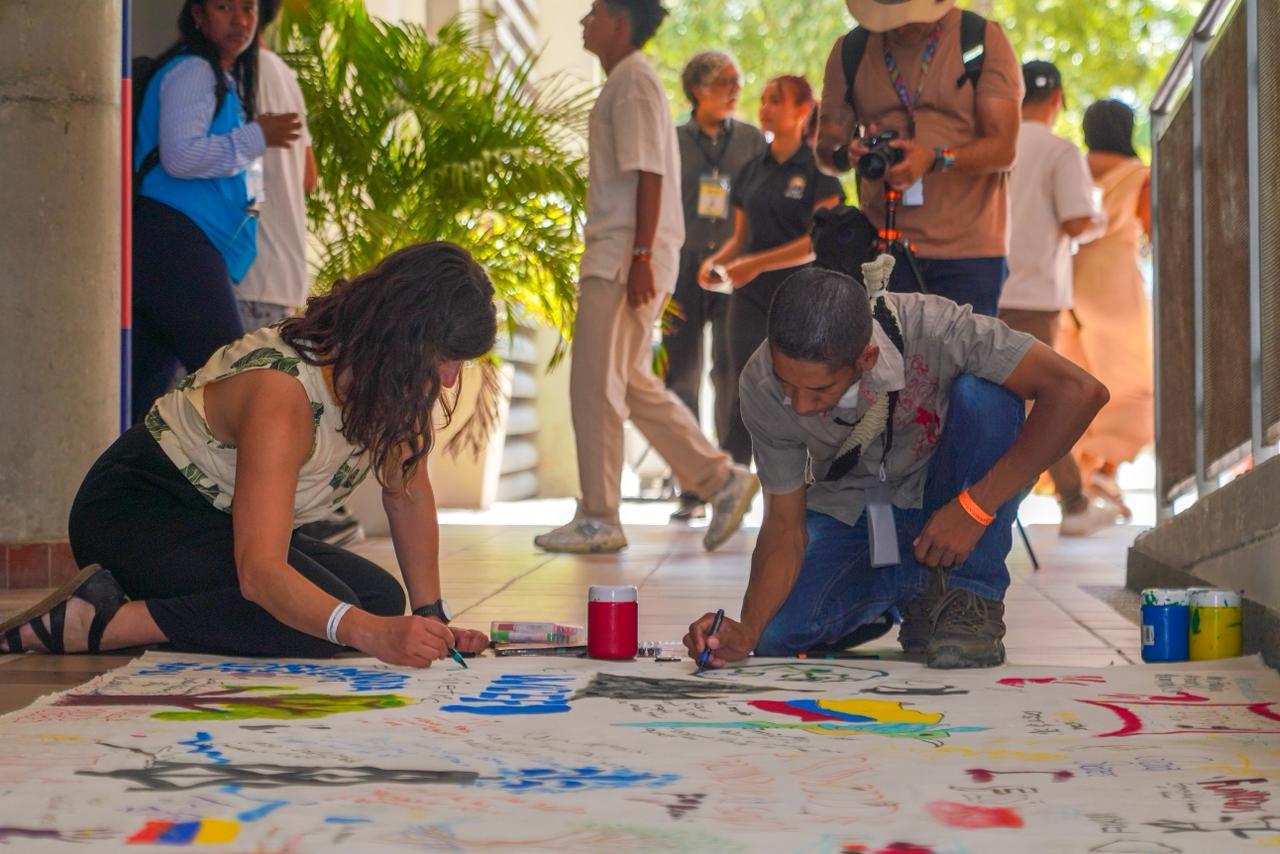
This dialogue was not centered solely around ministers and diplomats, however. Assemblies of Indigenous peoples, women, children, and youth, Afro-descendent peoples, academics, trade unions, peasant communities, and more met throughout the Santa Marta conference to discuss the issues that mattered to them and contribute their own voices to shape how the transition unfolds to ensure that it benefits everyone without placing undue burden on those who have been most harmed by the fossil fuel economy and the logics that have guided it.
Across many of those contributions, there was a common call to orchestrate a transition that included reparations to those who have been harmed by fossil fuel extraction while ensuring that the mass adoption of green energy doesn’t continue to reproduce those dynamics as it currently does in places like Bolivia and the Congo. The feminist vision for the transition also explicitly called for investments into “decentralized, democratized, community-centered energy solutions” — a call that the statements by Afro-descendents and Indigenous peoples echoed.
Luckily, these solutions are already underway. In 2025, the community-based organization UPROSE installed Sunset Park Solar in Brooklyn, which became New York’s first cooperatively-owned community solar project. And around the world, similar solar power efforts are helping to alleviate problems that impoverished communities face.
“In Pakistan, a people-led initiative on solar energy has actually brought a lot of relief to communities,” Nafisa Shah, a member of Pakistan’s National Assembly, told a reporter during the conference. “It offers a cheap, practical, doable solution.”
Of course, though current community-led solar projects are making a meaningful impact, they cannot solve the scale of the problem on their own — especially given the financial obstacles involved, which many groups seek government support to surmount. But as more and more countries come together through the process started in Santa Marta, which will continue next year in Tuvalu, solutions will begin to be found that keep fossil fuels in the ground and make renewables bountiful.
“We can do it,” Maina Talia, Tuvalu’s environment minister told reporters. “We just need a platform, a platform that really provides the freedom for people to collaborate; to share their minds [and] their hearts; to share their stories, their challenges, [and] their experiences; and define what does it mean for all of us to transition away from fossil fuels.”
Thoughts and Feedback
If you take a moment and think about the pathways the world will need to follow to get free of fossil fuels, what do you think will be most important to prioritize in that process?
And what speed bumps and potholes do you hope we avoid along the way?
I’d love to hear your thoughts. Drop a comment below!
Video
Follow Deceleration on YouTube for the latest videos.
Events

As part of the June 21 World Localization Day effort to promote solutions to social, economic, and ecological crises created by a system that alienates us from our communities and surrounding environments, the Right Livelihood Center at UC Santa Cruz will be launching their “California Localization Project.”
You can visit the World Localization Day website to check out events happening that you might be able to attend.
But if you’re looking for something specific to learn about how we can fund climate solutions in ways that give people control, you can attend a webinar focused on how public banking can promote just solutions.
More at Deceleration's Bioregional Events Calendar.
Tip Jar

Buy Sirus a Coffee
Show your appreciation for all the positive energy and actionable intelligence that Alternative Futures brings every month.
News for the Future
- To combat blackouts caused by the U.S. oil embargo of Cuba, a local business owner opened the country’s first “solinera,” allowing Cubans to charge cars, phones, scooters, battery packs, and anything else electric—entirely for free. (Associated Press)
- For decades, home gardeners have had a habitat of tending the same rotation of vegetables regardless of where they live: tomatoes, cucumbers, green beans, and the like. But now, attention has turned to native plants because they’re more likely to hold up to the harsh weather extremes exacerbated by climate change. (Grist)
- No one likes a billboard, especially when they’re pushing fossil fuels. So Amsterdam banned all public ad campaigns for gas-powered cars, airlines, burgers, and just about anything to do with promoting meat or fossil fueled products — stripping them from billboards, bus stops, and train stations. (BBC)
- A standard solar farm can take up acres of space, so an effort is underway to deploy systems that float atop lakes, seas, and rivers. And new research shows that not only does this save space, they generate more power than a similar system on land. (American Institute of Physics)
- A dedicated group of Berlin residents want to rid their city of cars. When other cities have taken measures to reduce street traffic, it cleans up air, reduces neighborhood noise, promotes walking and biking, and creates space for benches, greenways, and street trees that beautify communities while cooling them down. (Deutsche Welle)