

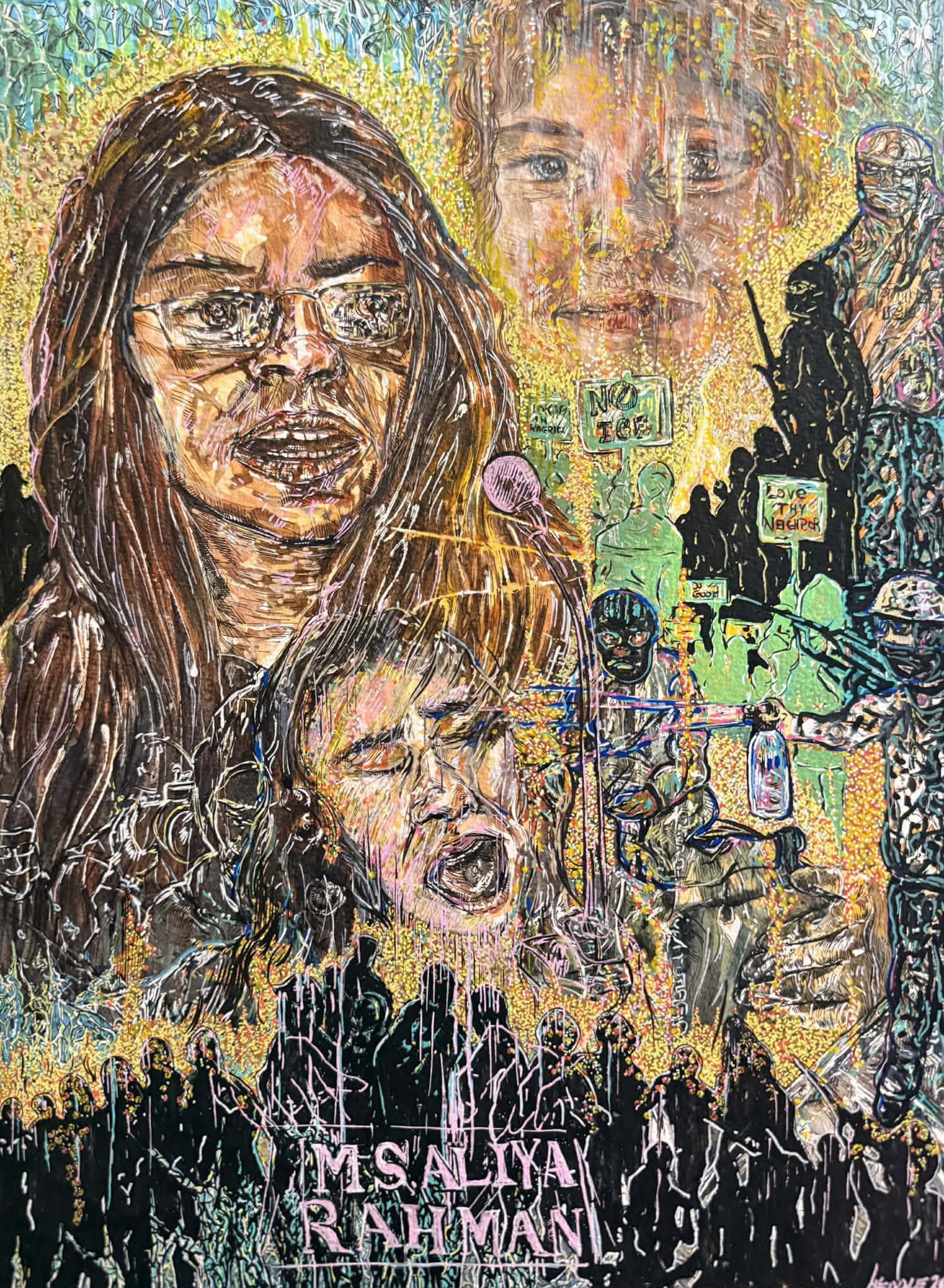
Aliya Rahman, an autistic U.S. citizen, recovering from a traumatic brain injury on the way to her doctor, was dragged from her vehicle by ICE agents.
Watching the video and Rahman’s testimony, I felt my stomach twist in knots as white-hot rage rose in my chest. My legs were both heavy and numb. I kept thinking: this could be me.
Then I tried to read the comments. Some were most likely bots: no photos; almost no followers. Others were unfortunately real.
She’s an agitator.
She should have complied.
Officers ran out of patience.
She could have moved.
She’s a paid protestor.
If she were actually disabled, she wouldn’t be protesting.
Like many people, I have watched these kinds of violations for years, the violence against disabled people, against autistic people, against people of color, and queer and trans communities. None of this is new.
But this felt different. Rahman and I share neurological differences, being autistic, and physical vulnerabilities. There is something profoundly unsettling about seeing yourself reflected in the mirror of harm done to another.
I looked down at my hands and thought of hers.
What happened to Rahman is not an isolated incident. It sits within a broader pattern, one rooted in a long history of eugenics, ableism, racism, and systemic violence. A pattern that makes clear: This is a war on disabled people.
That war is being carried out not only through state violence, intimidation, and terror sweeping through our cities and communities. It is also trauma engineered by policy and cuts to our most vital services and infrastructure:
The One Big Beautiful Bill Act (OBBB), signed into law on July 4, 2025, cuts over $1 trillion from Medicaid and the Children’s Health Insurance Program by 2034.
Hospital funding is expected to be reduced by nearly $665 billion—an 18.2 percent cut. An estimated 8.7 million people are projected to lose Medicaid coverage over the next decade.
Medicaid is often dismissed as “low-income” insurance. It is not. It is the infrastructure that allows disabled people to live in their homes, access equipment, receive care, and survive.
As Texas-based disability rights activist Bob Kafka, who passed away in December, warned:
“They always say they’re not going to cut defense, Medicare, Social Security. What you don’t hear then is that Medicaid is on the table, and Medicaid is what provides the vast majority of home- and community-based services, durable medical equipment, all types of things for people.”
It also allows disabled children to receive care.
New requirements will force enrollees to prove eligibility every six months, alongside mandates to work, attend school, or volunteer for 80 hours per month.
SNAP benefits could be reduced by an average of nearly $1,600 annually.
Rural hospitals and clinics are already closing. Healthcare access is narrowing. The forcing of more people into emergency rooms will only increase. As higher ed is further hollowed out, creating a “brain drain,” will affect healthcare in multiple other ways—not only for those working in healthcare and science, but through programs that support disabled people in daily life.
As disability rights advocates have warned: These attacks do not only worsen medical outcomes and increase the social, emotional, and economic toll of caregiving—which primarily falls to women—but also strip away avenues for maintaining and enforcing the civil rights of disabled people.
Programs supporting disabled students are being cut under anti-DEI initiatives. Students like Annie Garner who is deafblind, have lost essential support systems.
A five-year, $918,000 program in Wisconsin that supports Garner and other students like her was cut in September of 2025. A $10.5 million grant to aid in the recruitment and retention of the state’s special education teachers was also terminated, part of a broader pattern documented in reporting on students with disabilities.
Approximately 10,000 children in the United States are deafblind.
The Department of Education and the Office for Civil Rights have been weakened, putting 7.5 million children who rely on special education services at risk.
Health insurance premiums are another area under attack. Government shutdowns and political battles over whether to extend premium tax credits from the Obama administration have already more than doubled premium payments as tax credits expire.
Care work, the labor that makes living in community possible for many disabled and elderly people, and often a part of health insurance struggles, is also under attack.
The Trump administration is proposing rescinding wage protections for more than three million in-home care workers by rolling back Fair Labor Standards Act coverage.
These protections guarantee minimum wage and overtime pay. Without them, the floor drops out.
The caregiving workforce is already in crisis, with an annual turnover rate of 80 percent. Eighty-five percent of caregivers are women. Two-thirds are people of color.
Bob Kafka, ADAPT, and the Personal Attendants’ Coalition of Texas fought for $20 an hour.
In a sign of incremental progress, the Texas Legislature raised caregiver pay to $13 an hour in the 2026–2027 General Appropriations Act. But the difference between $13 and $20 is the difference between greater stability or more precarity, for both caregivers and those who rely on them. So the fight for a living wage and better protections for caregivers, disabled people, and their families continues.
In thinking back to Rahman’s testimony, I also think of how often women, BIPOC people, disabled and autistic people, are discredited.
I saw her praised for her bravery and simultaneously subjected to the familiar Catch-22 of being “too articulate” to be believed as disabled.
The same qualities used to validate her experience are weaponized to dismiss it. Disabled people know that ableism is real and harmful. It is also an ever present weapon being used in this war against us. One that we must continually fight in all its guises and dimensions.
When the most vulnerable people among us are targeted, they are also often the ones expected to take the greatest risks.
To protest.
To endure.
To be visible.
To become symbols.
Visibility does not guarantee safety, as we’ve learned from recent gutting of Veteran’s Affairs medical staff. Recognition does not undo harm. Although being disabled, being a part of marginalized groups does not exempt one from this fight; survival should not be predicated on martyrdom.
The ICE murder of VA intensive care nurse Alex Pretti illustrates this point, as VA officials attempted to block a memorial service in his memory.
I wondered what kinds of support Rahman would have after the passing of the news cycle. What infrastructure exists for those who survive ICE encounters with injuries that may never fully heal?
Since the passing of disability rights activist Bob Kafka in December 2025, the conditions he spent decades fighting against have intensified.
Kafka organized with ADAPT for more than 40 years. He understood that policy is never neutral; that politics are personal: as they either reflect our values and commitment to human life, or seek to deny our common humanity and agency.
He understood that disability rights are inseparable from healthcare, housing, and labor protections. That disability rights are civil rights.
What happened to Aliya Rahman is not an exception.
It is a direction; one given not only through tyranny, but also reversed through the fight against oppression.
As ICE continues expanding detention infrastructure through new detention centers and converted warehouses, the most vulnerable remain the proverbial canary in the coal mine.
Bob Kafka’s encouragement continue to challenge us since his passing:
“Don’t mourn, organize.”


