

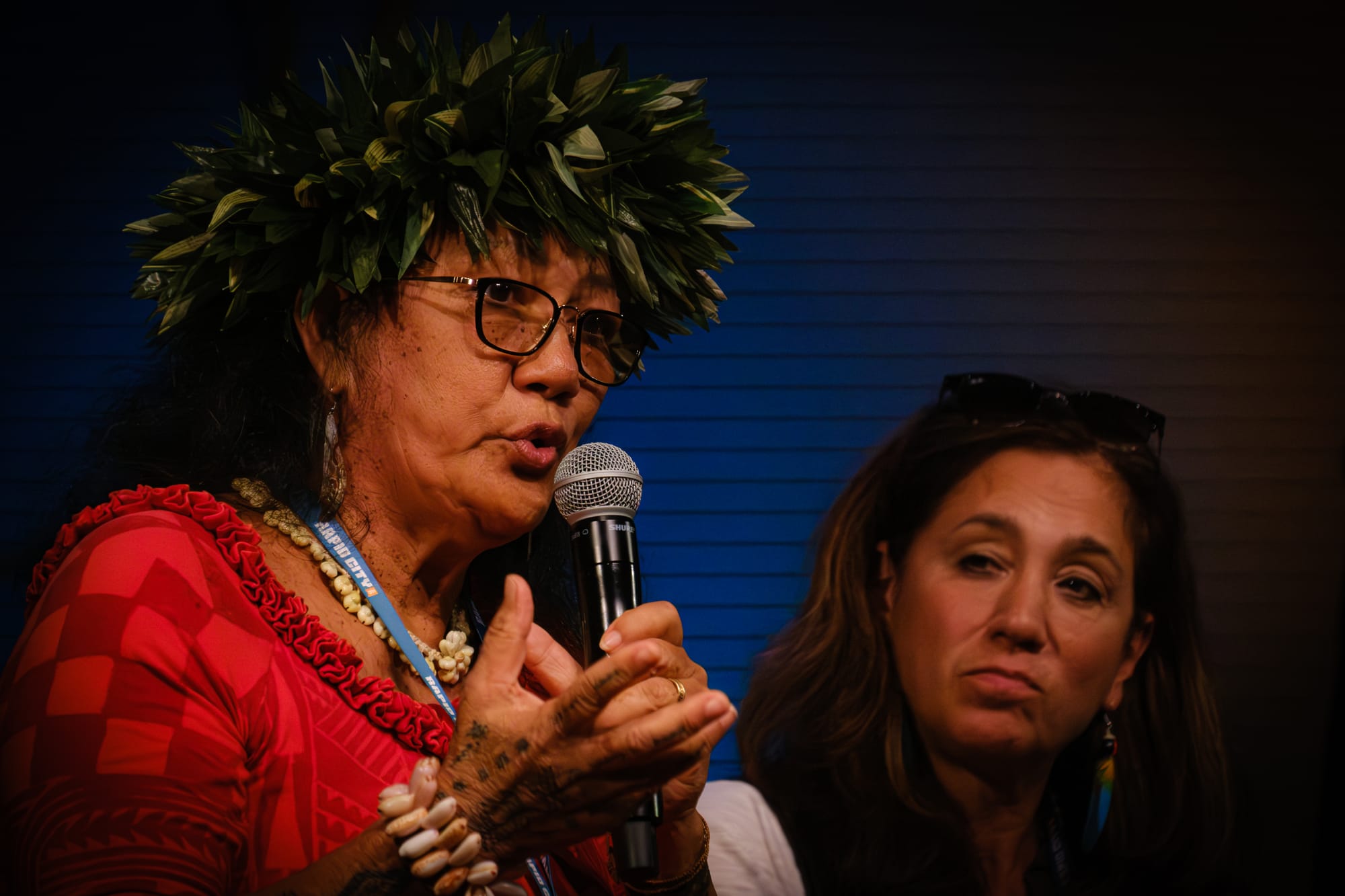
World Wilderness Congress attendees encouraged to advance legal claims in defense of all life on Earth. ‘There is no time to equivocate,’ says Ponca Nation environmental justice leader.
“The colonizers came here under the Doctrine of Discovery, right? I have a right to your land. I can kill you. They came with a piece of paper. They wrote it. I write mine. That’s where I come from. I believe that just assuming the power of what we have to do.”” —Casey Camp-Horinek
Greg Harman
Nature will soon be earning royalties. By bringing the sounds of a variety of species to streaming platforms like Spotify and Apple Music, the Sounds Right music initiative expects to raise $40 million over the next four years and funnel those funds back to creators of that music in the form of wilderness conservation projects. This idea that nature has—or should have—commercial rights is a new one, though the idea that nature has personhood or agency is rooted in many Indigenous cultures the world over.
In recent years, there has been a growing effort within Western cultures as well to advance the idea that humans are not the only beings on Earth with inherent rights–and thus legal standing–but that this should be extended to animals, plants, and even constellations of species and elements like rivers as well.
All week at the 12th convening of the World Wilderness Congress, this has been a frequent refrain among speakers and organizers: that non-human species and forces that are responsible for collectively sustaining life on this planet are “relatives, not resources.”
The Western legal framework for a “rights of nature” entered global dialogue after Ecuador became the first nation to recognize such a right in its constitution. With a preamble celebrating a “new form of public coexistence, in diversity and in harmony with nature,” the newly approved constitution asserted that:
Nature, or Pacha Mama, where life is reproduced and occurs, has the right to integral respect for its existence and for the maintenance and regeneration of its life cycles, structure, functions and evolutionary processes.
Attempting to restore Indigenous cosmovisions by translating them into the idiom of Western legal jurisprudenceis not without controversy, especially among those Indigneous nations, tribes, and bands who have been directly targeted for removal and genocide through the treaty—and treaty-breaking—process enforced by the Western legal system.
The Ponca Tribe of Indians of Oklahoma, however, has been at the vanguard of this emerging movement that has resulted in concrete legal action taken around the world to protect water and land as well as plant and animal species.
In 2017, the Ponca Nation passed a resolution on the rights of nature, which states that not only does nature have the right to exist, but human beings have responsibilities to care for and protect wild nature. The Ponca decided not to advance their resolution in federal U.S. courts, but rather prepare the ground for the day when their full rights and sovereignty are reestablished. A violation of the resolution could one day bring felony charges in Ponca courts “if the crime poses a substantial threat to the continued existence of a population of beings,” the resolution states.
In 2022, partly in response to the damages tribal lands and waters have suffered from fracking in Oklahoma, the Ponca Nation adopted a statute recognizing the “immutable rights” of waters flowing through their territory, including the Arkansas River (Ní’skà) and the Salt Fork River (Ni’ží’dè).
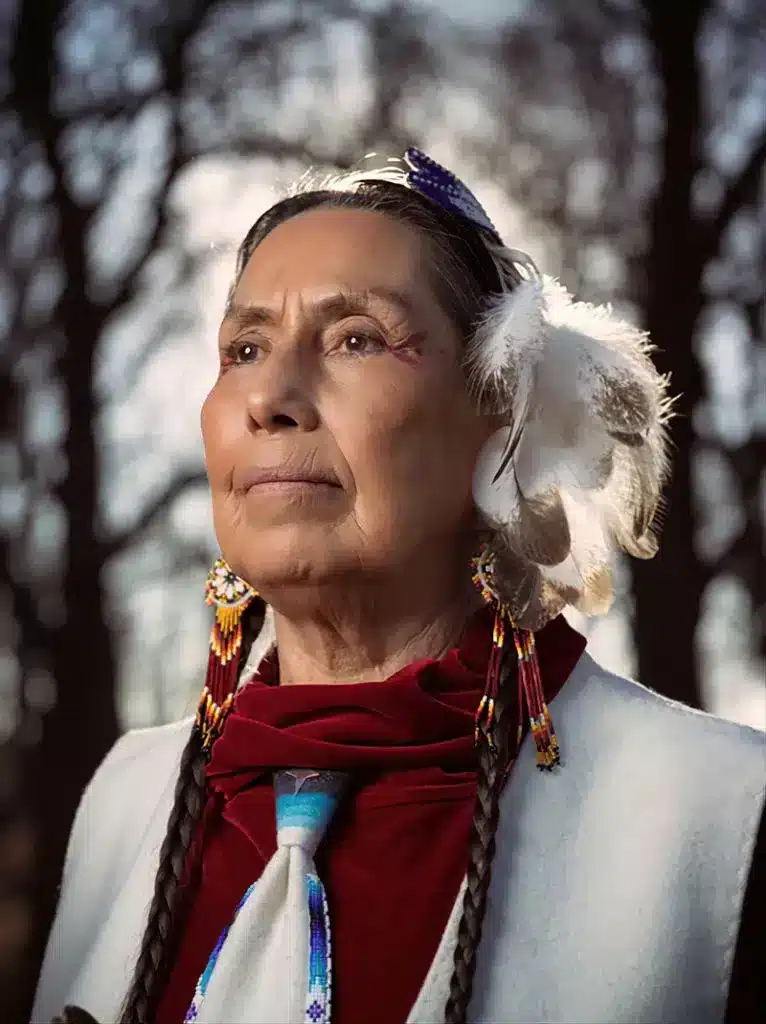
These efforts were inspired by years of prophecies calling on Ponca people to step into more leadership spaces, including within legal frameworks, according to Casey Camp-Horinek, a councilwoman and Hereditary Drumkeeper of the Women’s Scalp Dance Society of the Ponca Nation of Oklahoma, speaking to audiences at the World Wilderness Congress.
“Prophecy was told to us again and again and again. There will come a day in the purification of Mother Earth that we will have to rise and to teach,” Camp-Horinek said. “So at this day and this time we come to the forefront of what is called the environmental movement, which in reality is us realigning the human law with natural law.”
The act of anchoring Indigenous conceptions of natural law to “a piece of paper,” she said, has the potential to check the forces responsible for destabilizing Earth’s life systems.
“It is something that travels through the forces of humanity [that are] making these roadblocks to life itself,” Camp-Horinek said. “It is taking the cosmology that the Creator gave to us that we have clung to in song, in spirit, and thought, and putting it in a place of understanding. We’re using the very sovereignty that Creator gave us [to] create a boundary on their behavior within the territories that we presently live in.”
Of course, it is the individual’s right to property that constitutes the core essence of the current legal system in the United States and other nations around the world built upon similarly colonial worldviews, said the panel’s moderator, Britt Gondolfi.
Gondolfi is the Rights of Nature Project Coordinator for Bioneers, a nonprofit organization dedicated to “solutions for restoring people and planet.”
“Under the U.S. legal system, property rights are paramount,” Gondolfi said, “And when you own property you have the right to do with it what you desire within the confines of the law. … It’s about how much you can get away with, not necessarily how much you can conserve.”
Panelist Kelsey Leonard, a water scientist and legal scholar whose research focuses on Indigenous water justice, advocates for the legal rights for lakes and rivers. In her presentation, she described the rights of nature movement as one branch on a living tree.
“Right now there are many branches on this tree that make up this emerging body of law called Earth Law. One of those branches is rights of nature,” Leonard said.
Other aspects of Earth Law include the human right to a healthy environment, which has been embraced by the Inter-American Court of Human Rights, and the rights of future generations. The latter just scored a victory in South Korea, where the nation’s constitutional court found that the country’s failure to embed mandatory greenhouse reduction targets in its climate law doesn’t adequate protect future generations.
Camp-Horinek said the decision to share Ponca prophecy and pursue legal rights for non-human nature came slowly over many years of prayer and reflection:
“For me that came over a series of years, thousands of prayers, and inner direction, because I listen to the Earth and the waters and the airs. I listen to the voices of my ancestors that still live within me. And I listen to the great great great grandchildren of my great grandchildren and what is necessary for them,” she said.
At its core, such efforts are not people organizing to protect nature, she said, but the Earth itself working through human nature, or “nature protecting itself,” she said.
“We’re at the very brink of extinction as a species because of our behavior. There’s a natural law that lives. Some folks calls it climate change. Some folks call it earthquakes, tornadoes, wildfires, volcanoes, tidal waves. But it is natural law and it is part of the process of purification that our Mother Earth has to do in order for all species on Earth to be able to thrive and live within the natural world. To be called Nature.”
Gondolfi has described the work as “indigenizing” the law. On Thursday, she said such efforts involve “carrying nature’s damages and carrying nature’s burdens into the court system.”
As a Western legal concept inspired by millennia of Indigenous thought, rights of nature is not a panacea, nor is it a quick fix. Rather, it is one effort among many that must be pursued in this time of great disruption, Gondolfi said.
“Oftentimes in these environmental worlds we can get into debates over which strategy is the best. And I would just humbly say that we should try all strategies because the dominant legal system does not want people to be able to go to court on behalf of an ecosystem.”
Opening the panel at WILD12 was Hinano Teavai-Murphy, a Polynesian leader and cultural expert, who warned about the consequences of treating the ocean and its remarkable networks of ecosystems as a resource rather than a relative.
“Our oceans have been overfished and polluted. Our islands have been used for nuclear testing with devastating effects on the natural world and of course on our community and our people,” Murphy said. “As bad as it has been, the future looks even more bleak if we cannot make changes very soon.”
She urged attendees to sign on to a campaign to reject deep seafloor mining efforts, such as Deceleration wrote about earlier this year, which has seen companies beginning to locate to the Houston area.
Camp-Horinek reminded attendees at the panel that the colliding ecological crises at work on Earth are simply a manifestation of natural law in action—the result of extractive and colonial systems that like the rights of nature movement seeks to correct by attempting to reform Western legal thought.
The question for humankind, as Lakota spiritual leader Arvol Looking Horse suggested at the Congress’s convening on Sunday, is whether we will endeavor to align with natural law to preserve room for our species on this Earth or continue to wage war against it.
“We do not have time to equivocate about whether we have the right to do something,” Camp-Horinek continued. “Or whether we should do something. Or how we should do something.”
She urged everyone in the room to take similar action.
“You can do things and then say, ‘Challenge me! Challenge me!’ Camp-Horinek said. “‘I’m telling you this is how we believe. This is what our law is. ‘Challenge me.’ I challenge you to do the same.”


