

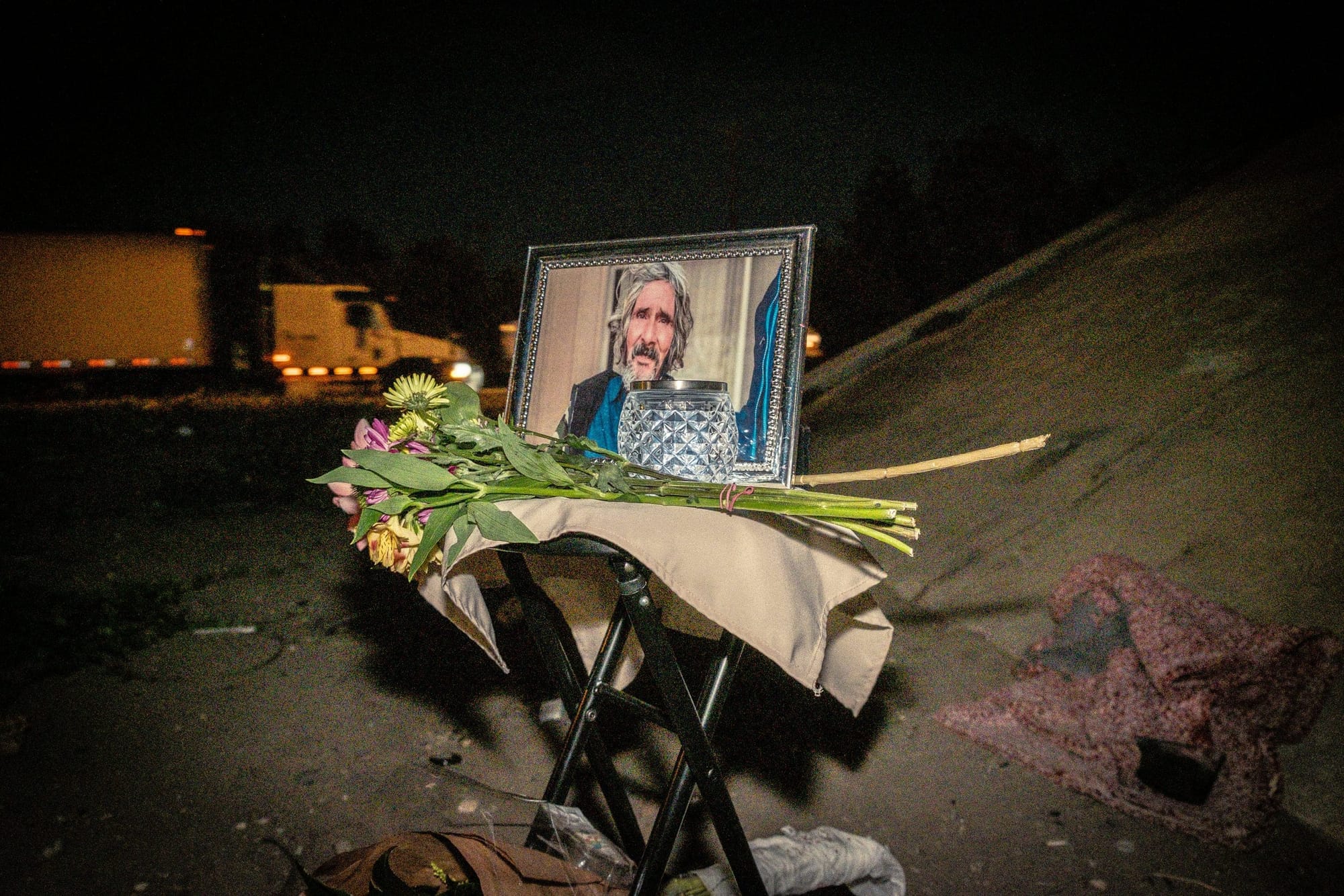
Albert Garcia died beneath a highway offramp after living unsheltered for nearly a month during San Antonio’s hottest summer on record. A decision not to include heat as a contributing factor has sparked debate.
Greg Harman
Albert Garcia, the subject of a long-running Deceleration investigation, died due to “intoxication with methamphetamine and heroin,” according to the Bexar County Medical Examiner’s office. There were no listed contributing causes of death, though the paperwork noted the ambient temperature hours after Garcia’s death to be 94.4F when measured around 2:15 a.m. the morning of August 12, 2023.
Garcia’s autopsy and related case notes were released to Deceleration last month in response to a state open records request. A previous Deceleration records request in September of 2023 requested “copies of all documents maintained by the Bexar County Medical Examiner’s Office related to the death of Albert Garcia.” However, it was rejected by Bexar County on September 12, 2023, with a claim that “There are no records responsive to your request.”
Deceleration’s January appeal was returned with an investigative report dated August 12, 2023, an autopsy dated August 13, 2023; a toxicology report dated September 13, 2023; and several pages of case notes and release forms.
Donate to DecelerationGarcia died on August 12, 2023, at a campsite beneath a I-35 highway off-ramp on the west side of San Antonio after enduring nearly a month of almost daily triple-digit temperatures. Deceleration has highlighted Garcia’s story for what it reveals about the impact of extreme weather on the unhoused population and cracks in the City of San Antonoio’s social services—particularly for those with complicating medical conditions, including disability and drug addiction.
Garcia’s campmate Mark Moutos said he personally passed out twice on the sidewalk near the underpass during the 2023 summer and required EMS attention both times. He added that Garcia regularly passed out from the heat in the dirt beneath the offramp where the two stayed. Garcia lost both of his feet and part of one leg in 2021 during Winter Storm Uri. After being successfully housed for a year after a year-long effort by multiple parties, including Deceleration, Garcia left a care home alleging abuse by the caregiver and returned to life on the streets—and a previous drug addiction—during San Antonio’s hottest summer on record.

Christina VandePol, a physician and former coroner who has written in detail on the impacts of heat on public health, reviewed the autopsy and toxicology reports for Deceleration.
“People who are unhoused are really going to be the tip of the iceberg, the sentinel for what’s going on with climate and health. That’s going to be where we’ll see the impact first. Not last, but first,” she said.
Generally, VandePol said it appeared the the Bexar ME is “doing everything right with the resources they have, which are probably inadequate.”
“I looked at ambient temperatures the week of his death because often heat-related deaths occur toward the end of a heatwave. It’s a cumulative effect. And it was over 100 degrees high all week that week,” she said.
“With the data that they had, if I had had that and I looked at the heat that week, I might have put something in part two under contributing factors: ‘Probable exposure to excessive heat,'” VandePol said.
The Medical Examiner’s office has been chronically underfunded and the paperwork released to Deceleration suggests that it took the office two hours to reach Garcia. So having emergency personnel prepared to do temperature checks—including core body temperature—would improve local heat surveillance, VandePol said.
Read the Albert Garcia autopsy, toxicology report, and related case notes.
As Deceleration reported in October of 2023, Bexar County Medical Examiner Kimberley Molina does not believe she has the ability to determine when heat may be a factor.
“I cannot say this was hyperthermia unless I was right there or I was there within a half hour,’” said Tom Peine, a former Bexar County public information officer speaking on Molina’s behalf at the time.
“So they don’t know what the temperature was at that moment [of death]. They obviously document at the time of the autopsy everything that they find.”
Rose Jones, a Dallas-based medical anthropologist well versed in the public health impact of extreme heat, said that heat should have been included in case notes somewhere “given the circumstances and data.”
Jones added that a key factor in heat being listed as the cause of death for a Dallas postal worker last summer were the interviews with witnesses who said they heard the mail carrier complain about the heat before he succumbed and died.
“Why was this subjective information not collected from Garcia’s friend?” she wrote Deceleration.
RELATED: “Uncovering Extreme Heat’s Hidden Impacts with Rose Jones“
Mark Moutos, Garcia’s former campmate, told Deceleration after Garcia’s death, and, on the night of Garcia’s death, city emergency personnel, that Garcia last used drugs earlier that morning, at least 10 hours before he found Garcia unresponsive. The vast majority of heroin overdoses occur within minutes as the user “peaks,” according to the San Antonio Recovery Center. Garcia wasn’t found unresponsive by Moutos until after midnight. Garcia was pronounced dead by a member of the San Antonio Fire Department at 12:56 a.m. the morning of August 12, 2023.
According to records provided by the Medical Examiner’s office, the temperature at Garcia’s camp was 94.4F when measured around 2:15 a.m. the morning of August 12, 2023. Garcia’s body temperature was listed as 92.1F. Deceleration recorded day-time temperatures at the campsite that were regularly 10 degrees higher than what was being recorded at the San Antonio International Airport as San Antonio’s official temperature.
VandePol advocates for changes to death certificates, which are not available to the public but are critical to state and federal agencies tracking causes of death, have check boxes for contributing factors. These could include if a person had been incarcerated, a victim of domestic violence, whether they were unhoused, and if they had been exposed to extreme heat.
“The only way [heat] eventually gets captured at the CDC [U.S. Centers for Disease Control and Prevention] is if coroners and medical examiners make comments in something called the injury section [of death certificates],” VandePol said.
Death certificates are used by state and federal agencies to track mortality data over time. They are sealed by law in Texas for 25 years after a death.
Monica Ramos, public information officer for Bexar County firmly supported the ME’s decision not to list heat as a factor.
“If the autopsy report and the cause and manner sheet does not list contributing causes, then there are no contributing causes,” Ramos said. “ME cannot state, without any clear indication, that it is in fact, a contributing factor. To do so otherwise, would be inaccurate.”
Heat is the leading cause of weather-related deaths in the United States.
In Phoenix, more than 300 heat-related deaths were logged in 2023*, largely among the unhoused community. In San Antonio, zero such cases were recorded, in spite of a spike in deaths numbering over 320 among the unhoused last year. As Deceleration observed previously, no special committees or task forces have been empaneled to understand the impact of the summer heat on the public health as there were after the 2021 winter storm that claimed around 16 lives in Bexar County.
-30-
* More recent data lists 579 confirmed heat-related deaths in Maricopa County, Arizona, and 56 still being investigated as of November 4, 2023.

Like What You’re Seeing? Become a patron for as little as $1 per month. Explore ways to support our mission. Sign up for our newsletter (for nothing!). Subscribe to our podcast at iTunes. Share this story with others.


