

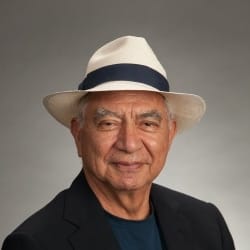
Editor’s Note: I recently received this call to action from Dr. Arturo Madrid, preeminent Latinx Studies scholar and professor emeritus at Trinity University. It resonated strongly, having recently finished George Takei’s graphic memoir They Called Us Enemy, which details his family’s relocation to internment camps during World War II. In 1942, when Takei was four years old, the U.S. government responded to the Japanese attack on Pearl Harbor by designating all adults of Japanese descent on the West Coast—regardless of citizenship status—“alien enemies” of the nation, subject to forced removal from their homes and incarceration behind barbed wire.
We saw this same slippage between legal status (the pretext that internment only targets “criminals” or “enemies”) and race (the construction of an entire group of people as “alien”), race and the state’s suspension of civil and human rights, when MAGA influencer Laura Loomer recently commented on X that the “alligators” outside the migrant internment facility opened in the Florida Everglades would be “guaranteed at least 65 million meals.” It did not escape notice that while this number far exceeds the population of undocumented people in the United States (11M), it roughly captures its number of Latines—of all legal statuses, colors, national origins, genders, educational statuses, primary languages, and political affiliations. Others have noted that MAGA’s quest to end birthright citizenship, originally established by the 14th amendment post-Civil War to ensure full citizenship for the formerly enslaved, equally undermines the basis for Black civil and human rights. As historian Tad Stoermer argues, the “heritage citizenship” recently articulated by JD Vance ultimately seeks to rewind the constitutional basis for national belonging to pre-Civil War days, “building a legal framework that redefines Americanness through whiteness and through nostalgia for a time when it was official policy backed up by the arm of the state.” And, of course, we have also seen Trump threaten to strip citizenship from anyone (NYC mayoral candidate Zohran Mamdani, queer comic Rosie O’Donnell) who criticizes him.
In this current moment, when would-be kings use citizenship as proxy for race and race to dehumanize and disappear, we must insist—as Madrid urges below—on solidarity across lines of legal status, color, language, education, and class. In the white nationalist imaginary, it doesn’t matter that you’re a third-generation “no sabo” kid or that you’ve attained the privileges of a PhD or professional middle class standing or that you have light skin or a white mom or bear the name of the conquistador himself. In the logic of race I learned in rural Central Texas—where our high school mascot was and still is a white vigilante—you’re still a Mexican, no matter when you crossed or where you crossed from, no matter if the border crossed you or you never crossed at all because your ancestors are original to this continent. And while Madrid is speaking most directly to his colleagues—the writers and artists and teachers and thinkers of his community—his call for solidarity exempts none of us. All of us must do something, knowing they intend to come not only for some of us, but for all of us. —Marisol Cortez
On the Responsibility of Latin@ Academics, Artists, and Cultural Workers
The Trump administration and several state governments have in effect declared war against certain sectors of the U.S. population. Many of the most most bellicose policies and actions they are advancing and carrying out are specific to Latin@ populations, particularly those of Mexican origin: detention and deportation of immigrants, deeming them “illegal” or criminal; suspension of the citizenship or permanent resident status of anyone who is deemed not “American;” elimination of the policies and programs that have made possible our participation in the institutions of U.S. society; and the eradication of academic, artistic, cultural, institutional, intellectual and political spaces for addressing exclusion over the past 175 years.
Our ethnic-racial hybridity, our cultural vitality, and most especially our electoral potential are now being constructed as a threat to U.S. society. Thus we see the virulent resurgence of a narrative that holds that we do not belong.
This narrative seeks to subvert our own, which is that we have always had, and continue to have, a central role in the development of this country, that we have a legitimate claim to the rights and protections enshrined in the Constitution and the Bill of Rights of the United States, and that we constitute an essential part of the fabric of this society.
In 1967, at the height of the debate over the war against Vietnam, the renowned linguist and MIT Professor Noam Chomsky took to task the authors of and apologists for U.S. policy in Southeast Asia in an essay titled “The Responsibility of Intellectuals.” “It is the responsibility of intellectuals,” he stated, “to speak the truth and to expose lies.” The current administration’s policies, discourse and actions, at their base racist, sexist, xenophobic and homo/transphobic, call for action by those of us who have the capability, the preparation, and the will to challenge them. The political moment calls for us to transcend our status as academics, artists and cultural workers and become public activists.
This is not an easy role to assume. Most of us feel we do not have much to offer, since these matters are not in our fields of engagement or expertise. Many of us do not consider ourselves activists. Some of us are intimidated. Others of us have family members, friends, and colleagues who support said policies and actions. Many in our respective communities believe that citizenship, permanent resident status, the blankets of assimilation and acculturation, of class status or of light skin, will protect them.
Let us not be naïve. The U.S. has a long history of incarcerating and deporting people deemed to be a threat, like Japanese Americans in WWII and Mexican Americans and Mexicans during both the Depression and Operation Wetback in the 1950s.
Xenophobes, racists and bigots construct all Mexican@s and Latin@s as undocumented immigrants and criminals. As such, all of us are vulnerable to assault, whether by state-sanctioned entities—sheriffs, police, agents, marshals, ICE, the military—or by individuals and militias.
Given the situation, let us be hyper-mindful of the German pastor’s belated expression of regret for his failure to act during the early stages of the Nazi regime: “First they came for ….”
Our responsibility, our obligation, and our task is to use our intelligence, knowledge, and abilities to counter the narratives and discourses that vilify and reject us, to challenge misrepresentations and misinformation, and to continue to advance a counternarrative in whatever modes and platforms are available to us. That task will require us to develop a deeper understanding of the struggles our communities have waged to claim standing in this society and its institutions, and of the threats to that standing.
To be effective, we must seek out and act in concert with other like-minded individuals and provide support to organizations on the frontlines of the struggle. Of fundamental importance is to take issue with public officials who are setting, implementing, supporting or going along with policies inimical to our wellbeing, and supporting those who are challenging those policies and actions.
They need to hear from us personally, directly, and frequently, by whatever means are at our disposal. Our people have struggled against oppressive forces that have warred against us. They were not silent then. We must not be silent or allow ourselves to be silenced now.
In summary, the tasks before us are:
- To educate ourselves about our rights and protections as citizens or residents;
- To assert them and publicize them when they are violated;
- To share information on the threats to our personal or collective status or wellbeing to alert each other to what is happening at our respective institutions, organizations and localities;
- To call public attention to actions by institutional officers that seek to delimit or eliminate policies and programs that serve our interests;
- To defend, in public forums, policies or programs we value and to reject actions that seek to curtail or eliminate them;
- To challenge misinformation and misrepresentation advanced by public officials, political operatives, media representatives or so-called experts;
- To act in solidarity with individuals and entities who are under attack;
- To support individuals and organizations who advocate or act on our behalf;
- To make our voices heard by elected and appointed officials frequently and in a timely fashion;
- To identify private and public entities, locally, regionally, and nationally, that can be of help in addressing the threats we face as a community;
- To provide financial and other support to those organizations that are engaged defending our communities.
***
Editor’s Coda: These actions can mean very different things in different contexts. Are you witnessing ICE activity? Report it on ICEBlock or to your local mutual aid networks. Seeing Patriot Front riding through town? Call 911 to report “armed men riding in a van with no seatbelts.” You can create an important paper trail for antifascist researchers to exploit.
-30-
Community Voices provides detailed report backs and opinion from people at the frontlines of community work at the intersection of environment and justice.


