

Over the last decade, Corpus Christi has become an enigma.
The city is a tourist destination for Texans near and far. Its bay is a unique mix of ecological wealth that is the heart of Corpus Christi’s tourism industry. Like so many coastal cities, boosters sell the quality of the area’s fishing, beaches, and seafood in a way that highlights their increasing scarcity across the vastness of Texas.
These are all accepted, well-known facets of the “Sparkling City by the Sea.” But another lesser-known fact is that the Port of Corpus Christi is the largest daily exporter of crude oil in the United States. Its bay is today so salty from century-old dams limiting freshwater mixing that oysters and shrimp struggle to reproduce.
Much of the city’s sparkle these days, as drivers passing through the intersection of Highways 37 and 69E in the evening can attest, come from Corpus’s massive industrial plants. The last decade of development in Corpus Christi has turned the city into a rising counterweight to Harris County’s hazard-laden petrochemical corridor far up the coast.
Critics consider what they call the City’s abiding hyperfocus on courting heavy industry as threatening the very reasons why so many people come to Corpus in the first place.
“The city government’s been acting in the interest of a few at the expense of the many,” Jim Klein, an at-large Corpus Christi council member now seeking reelection, told Deceleration. “That’s part of the reason that our infrastructure is in such poor shape here. Because it’s just not a priority for the city government.”
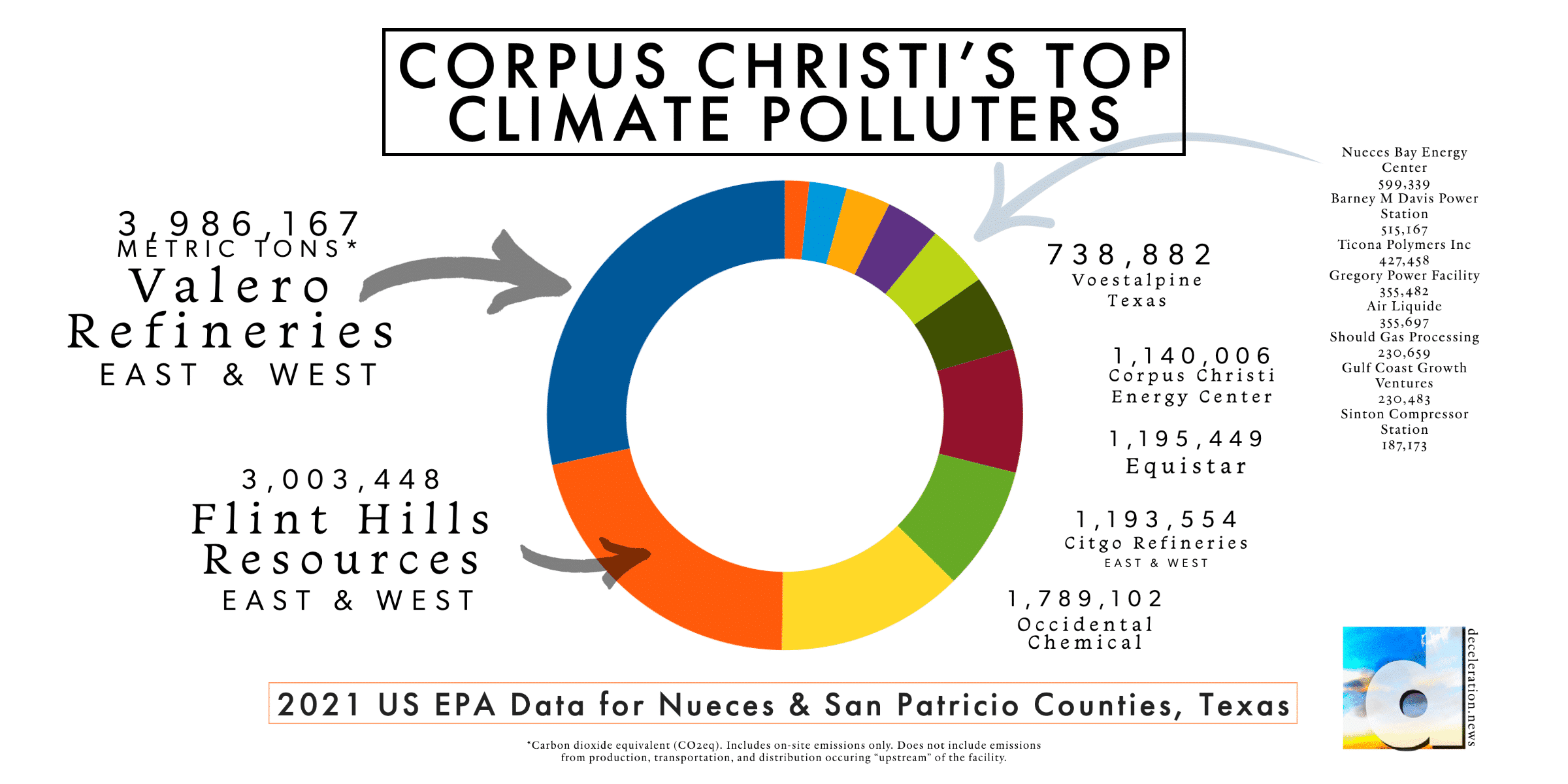
The federal government’s 2015 lifting of a previous ban on crude oil exports and rampant fracking across the Eagle Ford and Permian Basin have helped fuel the development, largely because the region had the room for it. Successive Corpus Christi City Council administrations, county leaders in San Patricio and Nueces counties—even area school districts—all took that opportunity in stride, even handing tax breaks out to companies who subsequently built massive facilities that proceeded to become some of their top polluters, as Inside Climate News has reported.
Increased tanker ship traffic in the Corpus Christi channel, going to and from Cheniere LNG, for example, threatening some Ingleside sea-facing homes. The city’s water authority sold water rights to ExxonMobil and Steel Dynamics for their respective plants, shrinking a water supply for the city, portions of Nueces, San Patricio, and Kleberg counties, and for communities west and south of Corpus. Now a slew of desalination plants threatens to further displace the residents of the Hillcrest neighborhood, already punished by more than their share of pollution and heat.
Two years ago, residents organized and got two environmental justice-minded people elected to office: Klein, a history professor at Del Mar College, and Sylvia Campos, an organizer with For the Greater Good, an environmental justice-focused grassroots group, who now represents District 2, one of the most disadvantaged and hottest areas in the city. (See: “Corpus Christi ‘Clean Slate’ Council Candidates Target Industrial Misbehavior on Gulf Coast“)
Both Klein and Campos are running again this year as part of a ‘Clean Slate’ campaign. Additional aligned candidates seeking office via Clean Slate who seek to hold the line on desalination efforts include Eli McKay, a consultant running for District 1 (homw to both Hillcrest and “Refinery Row”); Isabel Araiza, a sociology professor at Del Mar College running for mayor; and Eric Magnusson IV, a Driscoll Children’s Hospital business analyst and pharmacy technician, seeking a seat in District 4. Klein has been joined on the Clean Slate ticket in his run for the at-large seat by Rachel Caballero, a community activist who works in accounting, and Jennifer Gracia, a disability advocate who works in marketing and advertising.
The Clean Slate campaign is aiming for a cultural overhaul of Corpus Christi’s priorities, perhaps chiefly in resisting the buildout of the desalination plants, aiding the city’s unhoused population, and breaking what they see as undue influence inside City Hall by industrial interests.
The Clean Slate candidates are running against several industry-backed candidates, most of whom are Council incumbents. Those candidates have received nearly half a million dollars in campaign contributions through the Coastal Bend Coalition Committee (CBCC), a pro-business group, which claims the Clean Slate candidates are being funded by “outside special interests.”
However the contributions funneled through the CBCC group are from the region’s wealthiest people, petrochemical industries, property developers and Koch industries, a Kansas-based company which owns refineries in Corpus. By comparison, most donations to the Clean Slate candidates reviewed by Deceleration are small-dollar donations originating from Corpus Christi residents.
Desalination plants are the core electoral issue of Corpus’s 2024 election season as City leaders continues to push the project claiming they will help meet regional water demands with so much existing supply locked up by industry. While it is the industries that use most of the water, these candidates object to residents being continually asked to reduce their use.
Recently, the U.S. Department of Housing and Urban Development closed a civil rights complaint against a planned desalination plant in Hillcrest. A few days ago, officials at the U.S. Environmental Protection Agency said they wouldn’t contest the Texas Commission on Environmental Quality’s approval of the same plant. The city has already picked a builder.
Securing desalination critics in D1 and D4 would get opponents closer to blocking the desalination plans, particularly if Klein and Campos, or one of their ready replacements, return to office. A fifth and majority vote could potentially come from Gil Hernandez, a project booster who voted against the plans in January because of a ballooning price tag of nearly $760 million at the time.
At the center of the contest are competing visions of water. Critics point to past deals struck as emblematic of a leadership that considers water primarily as a tool of development and private profit as opposed to the source of life for residents and all coastal species.
The water struggle is playing out as the City contemplates cutting library and other services during a budget shortfall, even as City Manager Peter Zanoni receives a raise and staff are investigated for spending thousands of dollars of City money on sushi (and over $25,000 at Corpus Christi Hooks games, according to KRIS 6 News).
On Friday, community organizers and many of the Clean Slate candidates will be protesting in Hillcrest against desalination efforts. “Hillcrest residents deserve a right to safe living conditions, which means no further industrial buildout,” the event description reads.
“We are the ones we are waiting for,” Araiza wrote on Facebook promoting the event. “No one is going to save us but ourselves. It is so important that we don’t give up. Hillcrest is ground zero, but Corpus Christi Bay and the broader Coastal Bend are in the sacrifice zone.”
Early voting opens October 21, 2024.


