

Welcome to the Coastlines/Faultlines Newsletter, where I’ll be writing about what harms and flourishes the coastal communities of Texas and northern Mexico. These will come monthly to your inbox if you subscribe. Paid subscribers can comment on all of Deceleration’s newsletters. What are the stories not told on Texas and Mexico’s coasts?
Become a paying supporter for $5/month when you set up your account at Deceleration.news and post on this newsletter or write me directly at gaige@deceleration.news.
—Gaige Davila
Growing together beyond the 'growth orthodoxy'...
Most of my life was spent in what is now called South Texas, nearly all of that time along the Laguna Madre bay. That water came from melted glaciers first, and the barrier island that would form its eastern border came after. Padre Island’s width came from river sediment and offshore sand deposits, carried by longshore currents, its height from wind and storms. I am most familiar with the island’s southern end, the mostly-developed side of a formation that stretches to Corpus Christi.
Most of its length is parallel to some of the most desolate land in the state, save for windmills. It largely looks like it always has—other than the shoreline eroding—and, if we are so lucky, it will stay that way.
I cannot say the same for where I come from and where many before me lived, when these places had names in languages that I’ll never know. My own “before” was already a much-changed place, something that I’m just beginning to understand as I ask my parents and the oldest people of these communities what the before-before was.
There were already chain stores and fast food in Port Isabel and on the island by the time I could form memories.
The twin towers had not fallen yet, nor had the Causeway, but the life people knew was beginning to, in that the hospitality industry became more and more the societal orientation everyone had to abide.
The oil boom of the 1980s had bust, then the peso collapsed, then the towers, then the Causeway and the party was over.
Those days are beyond my cognition. Even more so when I think that the people of Port Isabel used to get their fresh water from wells not far from where the Rio Grande LNG project is, on the outer edge of town. In the lomas are bones and stories, priceless and now destroyed twice-over from the original sin of this land against the first peoples. My reporting on this facility began years before this second destruction, though, and continues now through this newsletter and elsewhere.
I’m doing so because the growth coalitions of the Rio Grande Valley and all along the coast want to party again, reinvigorated by industrial buildout that sees the coast for the taking and the people that live there as expendable or disposable.
More so it is guided by a mythic past, an honest-to-God belief that boomtowns can last forever if you can just get the people to keep remembering. But not everyone can remember what isn’t theirs to remember, when their choices were made before they knew there was one. For the Laguna Madre, at least, those jobs were few then and will be few forever. A school district often employs just as many people, if not more.
It’s not just SpaceX or liquified natural gas, even though these are the physically largest facilities that threaten the human and nonhuman lifeways of the Southern Texas and Northern Mexican coast. It is every form of development done for the sake of growth: this includes the spate of chains coming to the Laguna Madre, Corpus Christi, Galveston and Port Arthur and more as local cultural institutions die.
It includes the expansions to the petrochemical facilities that already inundate these communities and their political imagination. And it especially includes the ports wanting more international commerce, where companies will offshore the consequences of their operations onto communities with political leadership happily willing to accept them—for “growth,” of course.
This newsletter will be my attempt to interpret these movements for the collective moment we’re in. It is not a paper of record so much as it is a distillation of how the coast is consumed, largely outside of the scope of local power, whether elected or otherwise. Frontline communities—and that term is especially apt for all those along the coast—are unwitting participants in geopolitical posturing and capital maneuvering by states and transnational corporations.
For local political machines and the business class it is a cancerous pursuit of the growth orthodoxy, with the odd chance that they may profit.
Even if, most of the time, it is just to exist on the periphery of something larger than themselves. But people in these communities defy these entities anyway.
Last month I published a story in the Texas Observer, the first of a two-part series on liquified natural gas (LNG) development. I wanted to see how these facilities change the communities they’re in and whether they made their promises, after self-ordaining as solvents of regional poverty.
I spoke to people who lived in Freeport, Texas, where Freeport LNG is, and Cameron Parish, Louisiana, where several LNG plants are. They all came from different backgrounds and had different stakes, but all were united in their love for their communities and the natural world around them, both of which were being reduced to extensions of the industries metastasizing into their lives.
There are many more people along the coast like them, in Texas and in Mexico, and I’ll be writing about them here. I’ll also try to update how petrochemical and other extractive industries are moving in Texas and Mexico, plus whatever legal fights they’re in, and anything else interesting on the environmental justice front that shows people fighting for their communities.
In the Laguna Madre area, Rio Grande LNG is expanding despite not having finished its first “train”—the machinery that chills gas into a liquid. NextDecade, the Houston-based company behind Rio Grande LNG, plans to expand to eight of these machines, 10 if they can get the financing to do so. Trains 4 and 5 just recently got contracts with Japanese and Saudi Arabian companies, and the company is now asking federal regulators to approve its 6th. They will most certainly get the political backing.
FERC was sued again by the City of Port Isabel, Earthjustice, and the South Texas Environmental Justice Network for approving Rio Grande LNG for the third time. It’ll be up to a year before we know how the D.C. Circuit Court will rule on it.
Texas LNG, which hasn’t started construction but is much closer to Port Isabel, is trying to get another tax abatement from Point Isabel ISD, which serves all the Laguna Madre area communities. The school district rejected the company’s first attempt almost 10 years ago, but it’s not clear what could happen this time.
NextDecade has spent the last few years orchestrating a PR campaign that spreads Rio Grande LNG’s name in damn-near every event in the area, especially if it’s one organized by the local chambers of commerce.
Next month, I’ll be writing to you from Tokyo, Japan, where most of the banks that fund and handle the finances of the LNG facilities in Texas and Louisiana are.
Until then, keep scrolling. Below you'll find a longer introduction to my previous work and plans for Coastlines. Below that are some things I’ve read recently about the coast—and not—holding impact for us all.
Deceleration Video
Deceleration Correspondent Gaige Davila, lifting off his new newsletter 'Coastlines/Faultlines,' discusses growing up in Laguna Madre and working as a journalist in Port Isabel and across the Rio Grande Valley—and his plans for the newsletter. Excerpted from Deceleration Podcast #40.
Event
 Deceleration Staff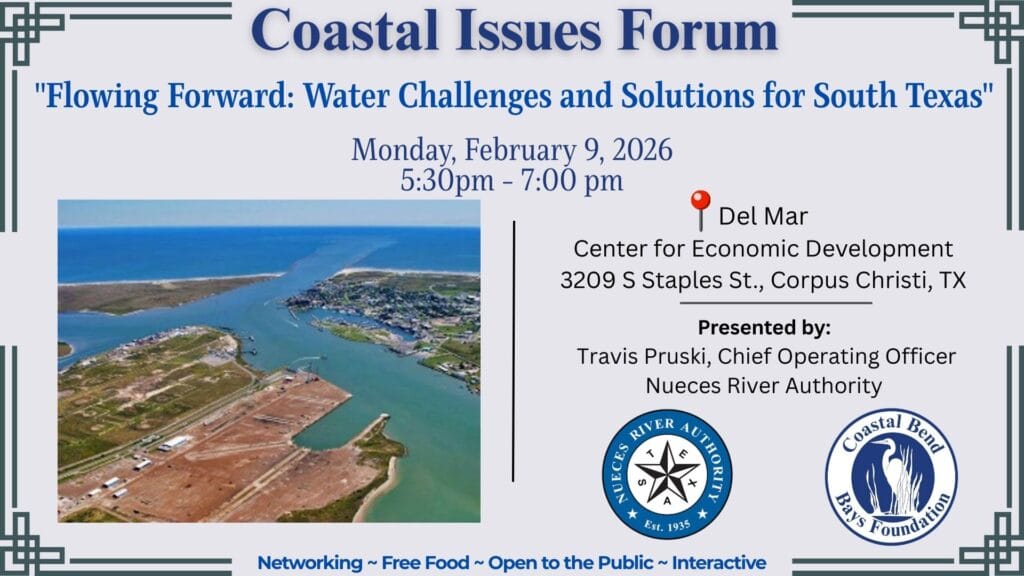
Travis Pruski, Chief Operations Officer at Nueces River Authority, discusses the overall water needs of South Texas, including current and future demand across municipal, industrial, and environmental sectors. His presentation will also examine stream flows from headwaters through downstream systems and their role in sustaining regional water supplies and ecosystems. The discussion will conclude with an overview of new water supply solutions for South Texas, highlighting the Harbor Island Desalination Project and its potential to support long-term water security.
News Roundup
The Rio Grande Was Once an Inviting River. It’s Now a Militarized Border.
This feature from Capital & Main highlights a truth that locals know but is not necessarily common knowledge: that the Rio Grande River, which separates Texas from Mexico, empties into the gulf. Specifically, it empties into Boca Chica Beach, the coastline spread across the countries. The Rio Grande River and the Rio Grande Valley is a militarized place and is becoming more so at the river’s end, despite it being one of the most less-traveled spaces along the border. This article explores the Trump administration waiving laws to build more border wall and to put buoys in the river near Boca Chica Beach, just like the ones in Eagle Pass, Texas, and the environmental and humanitarian issues that come from both.
Caught between Trump and Musk’s rockets, a Mexican village despairs
Up until debris from SpaceX’s Starships started falling onto the Mexican side of the Rio Grande River’s exit, there was not much reporting coming out of Playa Bagdad. It’s a trek to get to the small village there, which requires a trip to Brownsville, then crossing to Matamoros,Tamaulipas, then east towards the coast. This article documents the people who make their living from fishing from the coast, some of whom live there. They allege that the Starships have scared the fish off and are having a harder time making due. It’s one of the few features on this community ever written and worth a read.
Indigenous Groups Fight to Save Rediscovered Settlement Site on an Industrial Waterfront in Texas
Donnell Point in Corpus Christi Bay has one of, if not the last, shell midden sites in the area. They are stacks of discarded conch, oyster and other shells from the tribes that fished along the shores of the bay. The descendants of the Karankawa and Carrizo-Comecrudo tribes are now trying to save this site from the fate of similar settlements, which have been destroyed for petrochemical plants and the city’s sprawl.
An undercover investigation—from two years ago—into Saudi Arabia’s attempt to keep its oil market going for as long as possible, even as the world attempts to transition to renewable energy. The country’s strategies include fixing roads in developing countries in Asia and Africa, then deploying diesel vehicles on them, making those countries dependent on the transportation infrastructure. Saudi Arabia also wants to invest in bringing back supersonic flight for commercial airlines because those planes—which haven’t been used commercially since 2003—use more jet fuel. The country also plans to lobby against government subsidies for electric vehicles globally.


