

Inside the chambers of a Westside San Antonio church they gathered. They learned about one another’s fights against data centers. Some of the facilities discussed were on the smaller side, some globally significant. Some of the projects they discussed expected to tap into local power lines, others propose building their own power plants, even large-scale nuclear plants. Most expect to use a lot of water and require sizable amounts of land.
However, those inside the Texas Data Center Rebellion two-day convening weren’t just fretting the land, water, or power. Many were more broadly concerned about the what the data centers—and the artificial intelligence many of them are intended to incubate—are intended to produce. It was only a few years ago that many who are now profiting off of AI were warning about the existential risk the technology poised to humans on Earth.
They discussed AI-powered autonomous weapons systems, such as those behind the recent double-tap strike in Iran that killed an estimated 165 school children, domestic surveillance activities under an increasingly authoritarian government, and the widely expected mass displacement of entire categories of human workers.
Organizer DeeDee Belmares describes the purpose of the convening.
Community organizer DeeDee Belmares, with Public Citizen, described for Deceleration the purpose of the convening, ways individuals and organizations across the state will likely continue to collaborate, and her hope to impact rulemaking at the Texas Legislature when the state's elected leadership reconvenes in 2027.
Last week, Deceleration published an overview of the gathering for our Water & Power newsletter. Today we want to share some of the key voices assembled in San Antonio and highlight some of the fights they represent.
Mass Community Organizing as Our Only Hope
Speeding the development of crypto currencies and AI data centers has been a centerpiece of Trump's MAGA movement. Campaigning for reelection, Trump vowed to make the U.S. “the crypto capital of the planet and bitcoin superpower of the world.” To beat China in the race for AI he pledged to "we will blast through every bureaucratic hurdle to issue rapid approvals for new drilling, new pipelines, new refineries, new power plants, new electric plants and reactors of all types."
After reelection, Trump penned several executive orders intended to speed AI's development, slash regulation, and made sure to deal himself in—setting himself up as a "crypto tycoon." Texas, under a largely MAGA-styled Republican Party leadership, has followed the same script, even losing out on billions in potential tax revenue by offering exemptions for data centers. And AI-aligned super PACs are continuing to funnel millions into the state to make sure their interests continue to prevail in the state.
All of this makes local resistance extremely challenging, as the opening speaker at Texas Data Center Rebellion made clear. Ric Galvan, who previously worked as a community organizer, now represents District 6 as a city council member in San Antonio. That district has the largest concentration of data centers in the city limits.
"From the urban core to the rural areas, we need all of us in this to make sure we are pushing our local leaders and our state leaders too to effect change all the way to the federal level," Galvan said. "And we come together to push on them to remind them that it’s our communities that come first here. We have to make sure that industries don’t grow…without any thought to how them impact surrounding areas, how they impact our resources. Those are things we have to be able to push on, so we’re organizing this quilt of incredible communities across the state. I’m eager and excited to see what things we can do and glad to be on your side as well.”
As we write below, Galvan has endeavored to bring San Antonio's Council on board to steer—as best as they are able—this local wave of new projects.
Below is a collection of interviews and reflections about some of the data center fights centered at the 'Rebellion,' starting with El Paso, but including efforts in Taylor, Amarillo, San Antonio, and Dallas-Fort Worth.

El Paso, Texas
Fighting Meta AI & Project Jupiter
Meta Platforms is leading the development of an anticipated $10B AI data center on a 1,000-acre campus in El Paso proper and expects to be powered by more than 800 small gas-fired generators, while Project Jupiter (a partnership of Oracle and OpenAI) would require 1,400 acres in rural New Mexico just outside El Paso and is expected to be powered by gas power plants, renewables, and batteries. Project Jupiter recently pledged to use a “closed-loop, non-evaporative cooling system” that would that would limit water use to what is typical for a traditional office building (ie. bathrooms, kitchen, etc.). However: Meta's center is expected to use around 400,000 gallons per day of water. It is permitted for up to 1.5M gallons per day.
“The thing that’s really been upsetting people is the energy use. There’s been a bunch of outdated infrastructure [in El Paso], just broken water pipes, blackouts, or brownouts. So seeing the amount of energy Meta is taking for 50 jobs, and the fact that they are getting tax abatements for 30 years, that’s really showing it’s not for the people of El Paso; it’s for a small group of people who are going to benefit from it.”
— Matthew Rodriguez, Amanecer People’s Project
UPDATE: Secretary of the Army Dan Driscoll recently announced a new project at Fort Bliss in El Paso as “the first hyper-scale data center that the Pentagon has ever done," prompting a letter of concern from Mayor Renard Johnson requesting "all appropriate environmental reviews."
Taylor, Texas
A Promised Park for the People
Blueprint Data Centers is seeking quick realization of a 60MW data center near Samsung’s $44B chip factory in Taylor (ie. Taylor DC), but got caught up in questionable deed restrictions over historical promises to the local community for parkland. Meanwhile, the planned 360MW KDC Project Comal received local Council approval last month but has not released a construction timeline. Taylor DC is expected to limit its water use with a “closed loop” system, though residents are skeptical.
“There’s a deed restriction and it has to be honored. It’s a very simple case. There’s a deed. In Texas deed is very holy and sacred. So we’re asking them to honor the deed. Or their other choice is to go with the data center and honor big business."
—Carri D’Anna, HALT Taylor Data Centers
Dallas-Fort Worth
Data Centers Trapping South Dallas Residents in Poverty
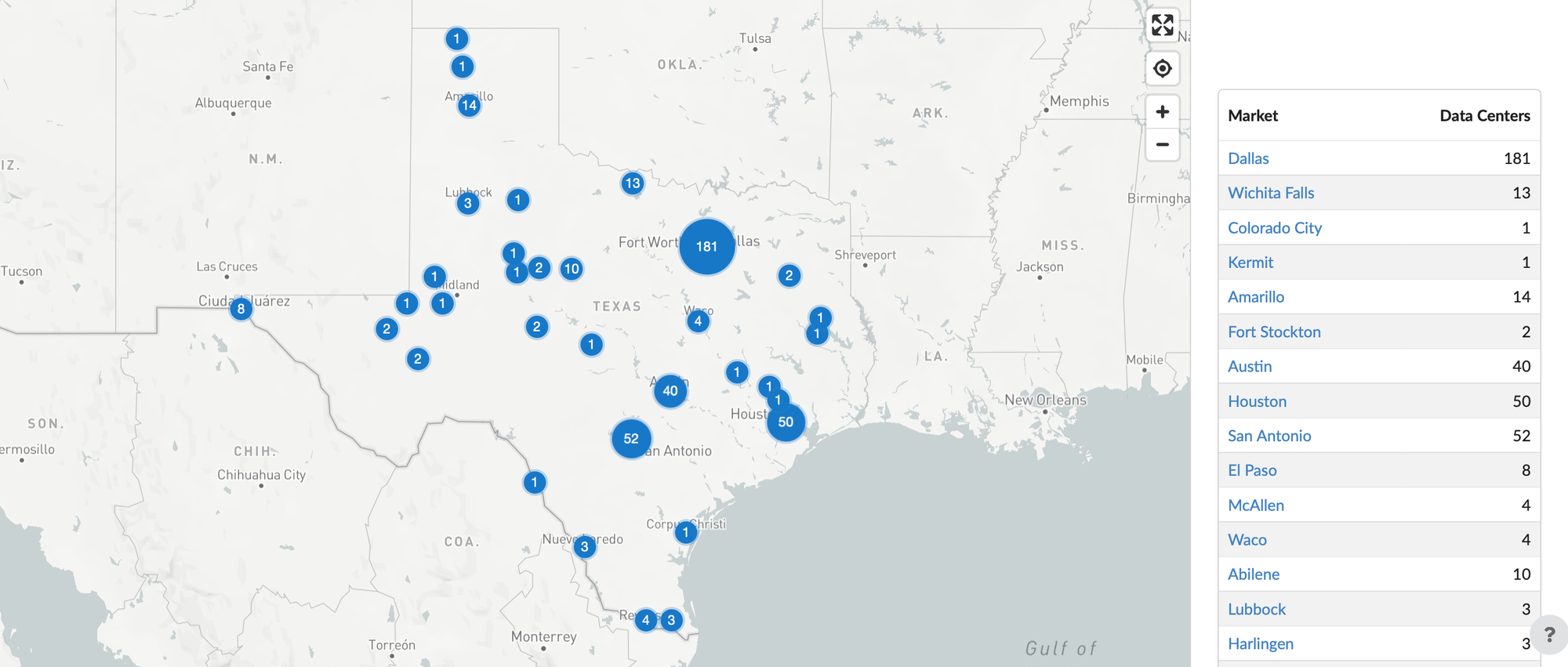
Dallas-Fort Worth currently as the highest concentration of data centers in the state of Texas. Property values overall in DFW have softened, but those living adjacent to the facilities suffer the most: "Despite their economic perks, data centers may pose challenges for homeowners living nearby," according to LandApp.
"Electricity is going up. There's noise pollution, things like that. So no one actually wants to buy a home there. And people who have spent years paying off their mortgage for a home in South Dallas, their house prices are plummeting. Furthermore, other companies don't want to invest in jobs in South Dallas because it's data centers, which is causing an impact to the environment. And those people will never be able to get out of poverty because the data centers are being built there."
—Sanjay Ravigopal, AI Engineer & Activist
San Antonio, Texas
Council Seeks Influence as Utilities Make Room
San Antonio already has an estimated 66 operating data centers, with Microsoft operating 22 of those, with some dating all the way back to 2005. Eleven more are listed as under construction.
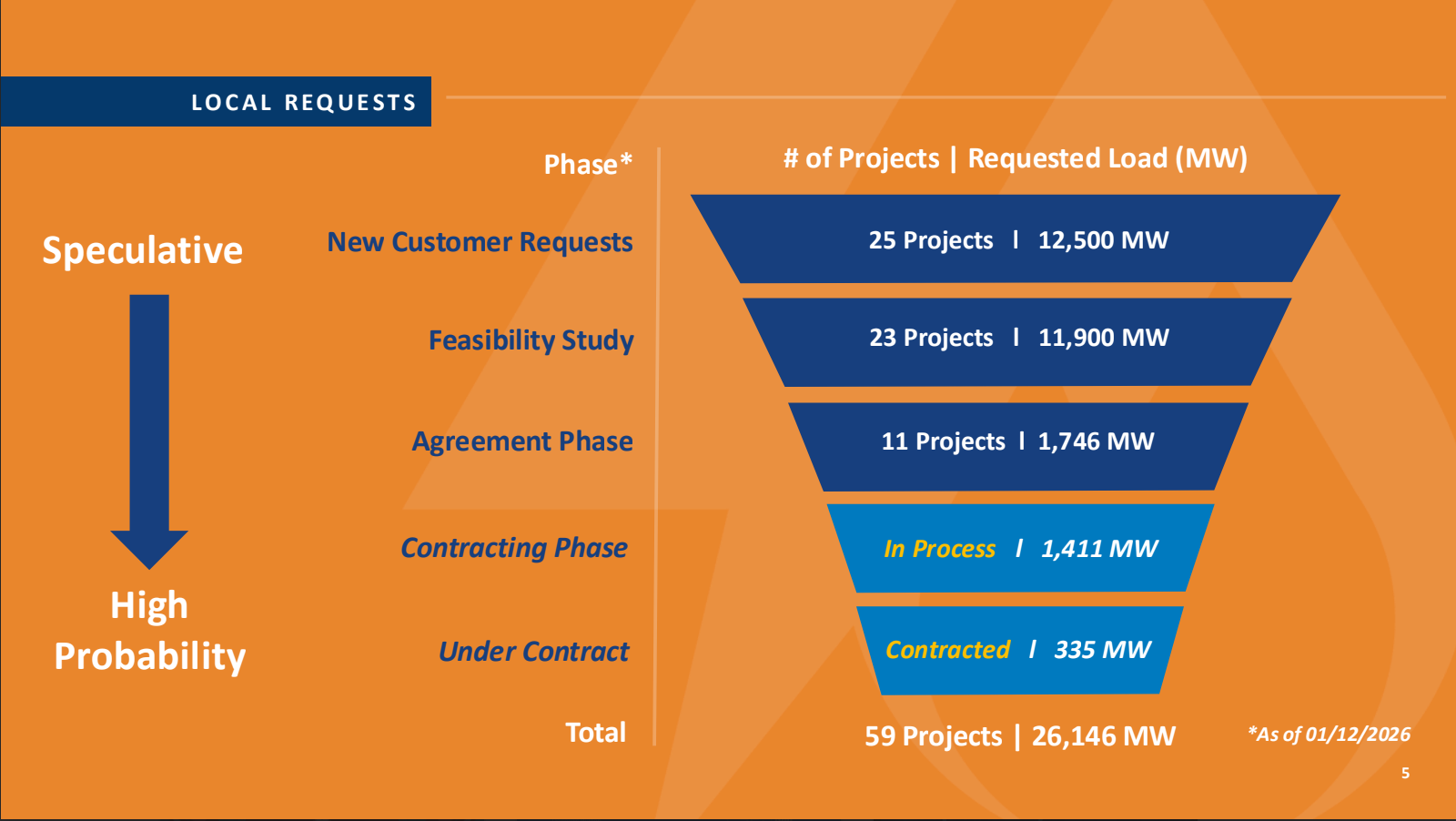
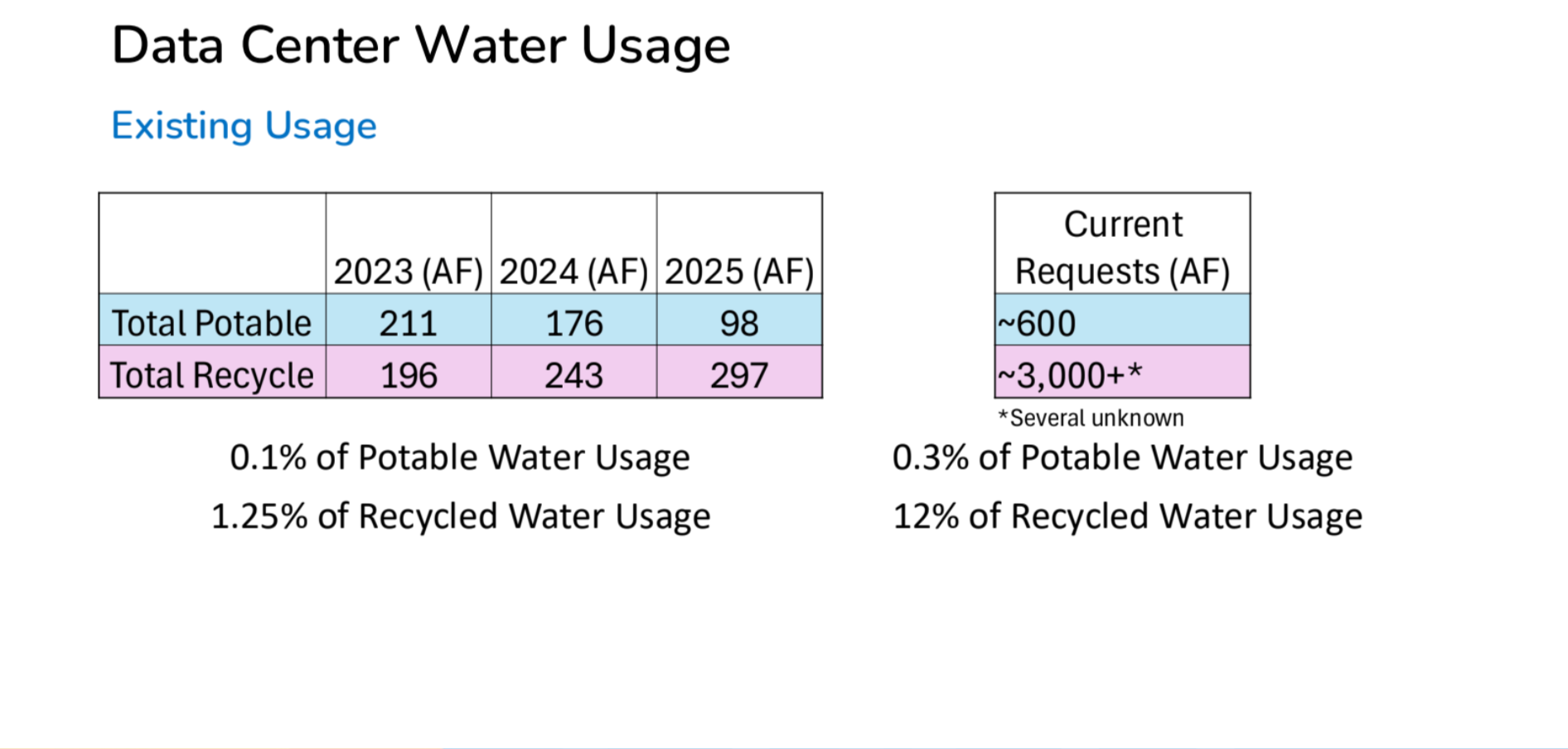
Recent presentations from City-owned CPS Energy (left) and San Antonio Water System (right) reflect the growth of data centers in greater San Antonio.
As we wrote last week, Belmares informed attendees of how San Antonio's local utilities are making room for data centers—even inviting them to build their own power plants when local supplies are insufficient.
Meanwhile, Councilmember Galvan has headed up an effort to steer their development. A recent Council Consideration Request filed by Galvan to put the matter into discussion states:
“…[T]he average mid-sized data center uses 300,000 gallons of water a day, roughly the use of a thousand homes. Data centers in Texas will consume 46 billion gallons of water in 2025. By 2030, the number could rise to 399 billion gallons, or about 7% of the total water use in Texas. When quantifying the impacts of data centers, large loads like these could increase electricity demand by up to 360% by 2035, potentially leading to an electricity shortage. ... Without proactive planning, unchecked data center expansions could put a strain on San Antonio's resources.”
He got support from fellow Council members Edward Mungia, Jalen McKee-Rodriguez, Ivalis Mesa-Gonzales, and Teri Castillo. But it’s still unclear how much influence local elected leaders can excert.
One proposal has been to update the city's Unified Development Code (UDC) to create a standalone “data center” category. As a recent presentation on the subject, the head of Development Services confessed: "Existing regs are likely too permissive."
Amarillo, Texas
Project Matador (AKA The President Donald J. Trump Advanced Energy and Intelligence Campus)
“Project Matador” outside of Amarillo is advancing in partnership between Fermi America and the Texas Tech University System seeks to build out a pod of “hyperscale data centers and AI infrastructure” behind the meter (ie. on a private electric grid). The facility will need a total of 11 GW to maintain the 15 data centers. The campus will span nearly 6,000 acres. Gas-fired power plants and a mix of commercial-scale and modular nuclear reactors are expected to deliver the bulk of the power, though there will be a smattering of solar. It’s unclear who Fermi’s tenants will be. Funding has also come into question, as a clutch of class-action lawsuits (including this one) have emphasized. The water demand is sitting around 900M gallons per year…atop one of the world’s fastest retreating major aquifers, projected to possibly go dry within 20 years.
"All of the things that are being touted about this campus, it's grandiose. It’s the most data centers and it’s the highest technology and the biggest investors and the most money. And the way they speak about it is just a smoke screen for how exploitative and how extractive it is for the people that actually live here and have made this area what it is. ...
"Before Silicon Valley popped in here and started land grabbing, this has been generations of sustainable life: this is farming that produces for the whole country. It’s something that can’t co-exist with this type of acceleration of technology. [Fermi] needs too much water. It needs too much land. It needs our fresh and clean air. It needs too much of what we are also in need of to create life.
"And there’s nothing you can get from a data center that would be worth trading all of this in."
—Kendra Seawright, Women's March organizer
-30-


