Welcome to Water and Power, a monthly newsletter about the elements of our survival—and those who seek to profit off them. Water & Power delivers unique reporting to prepare you to engage on the issues dear to your heart, including notices of upcoming events and highlights from across the media landscape. This members-only newsletter will increasing fold in benefits exclusively for paying subscribers.
If you know someone who would appreciate this research and analysis, pass it along. Subscribe to this and our growing roster of Deceleration newsletters. Paying supports from the $5/month level up may leave a comment below. Your support makes this work possible. — Greg Harman
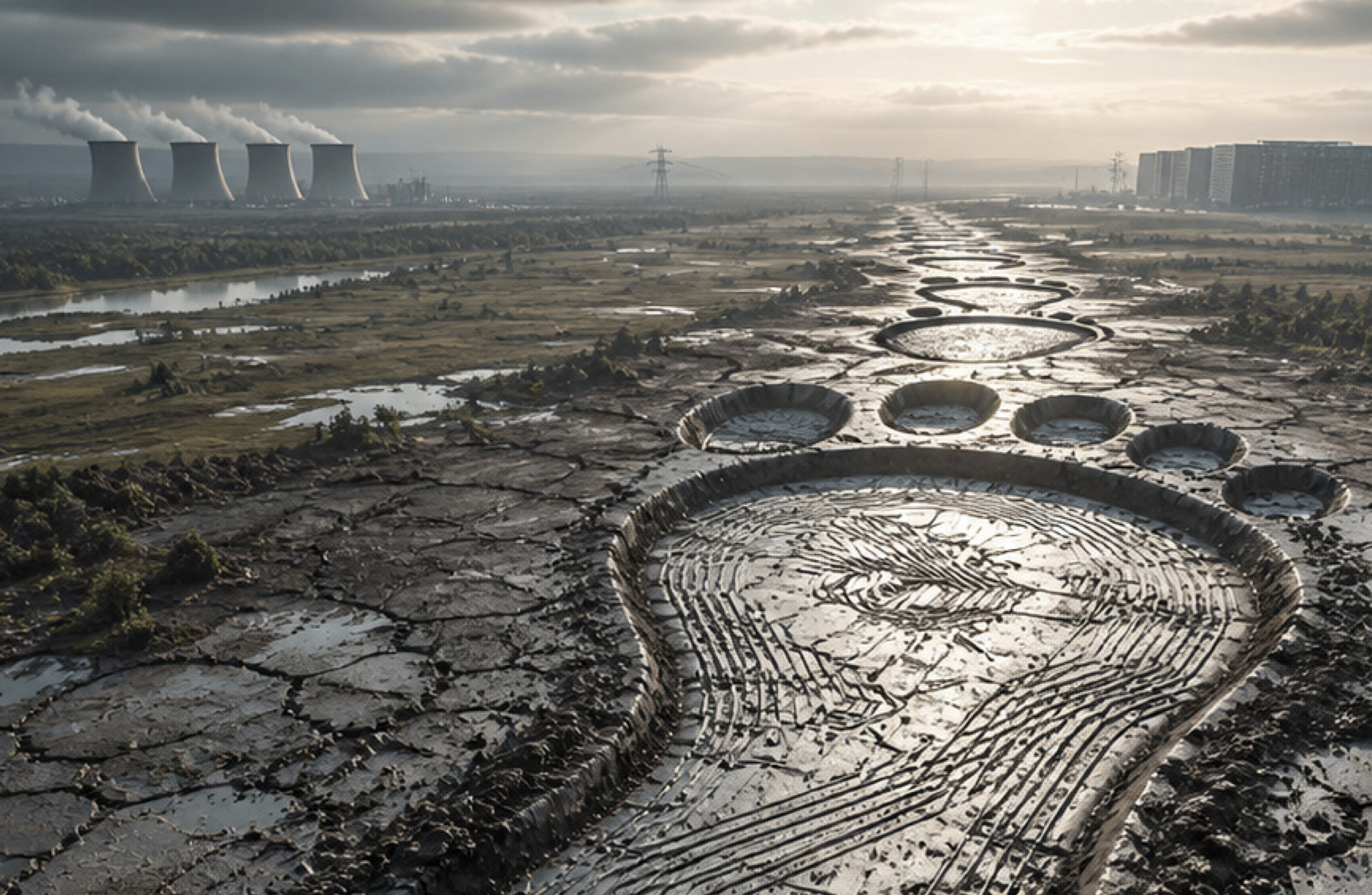
Data Centers Will Pave Over Land 10X Mexico City's Footprint—Largely in the United States
Yet Trump Refuses to Temper the AI Fury He Unleashed.
President Trump has made crypto and AI data centers a centerpiece of his agenda. As I wrote back in April, Trump has worked consistently to speed AI's development, smash regulation, all while dealing himself in as a "crypto tycoon." But as data centers roll out over physical and economic landscapes across the United States at a clip many can’t help but equate to a modern-day plague, even his political instincts have begun to nag that perhaps he should tone it down. Just a little.
Pathways to actual reform have been mapped out, particularly by Independent Congress member Bernie Sanders, who is advancing both a desired moratorium on AI (a "reasonable pause to ensure the safety of humanity") and a plan to then nationalize it. Or half of it.
But Trump prefers to strike a pose as a reformer while his family cashes in.
For all of us the stakes are too high to ignore. We learned a few days ago that if data centers were a country they would already rank as the eleventh largest consumer of energy on planet Earth.
And they are on their way to the six spot by 2030.
Water? 2030 projections suggest they will require a 2.5-trillion-gallon drawdown annually, enough water to provide for 1.3 billion people in Sub-Saharan Africa.
This is according to a startling new report from the United Nations University Institute for Water, Environment and Health (UNU-INWEH).
And land? Data centers are on course to gobble up 10 times the footprint of Mexico City by 2030.
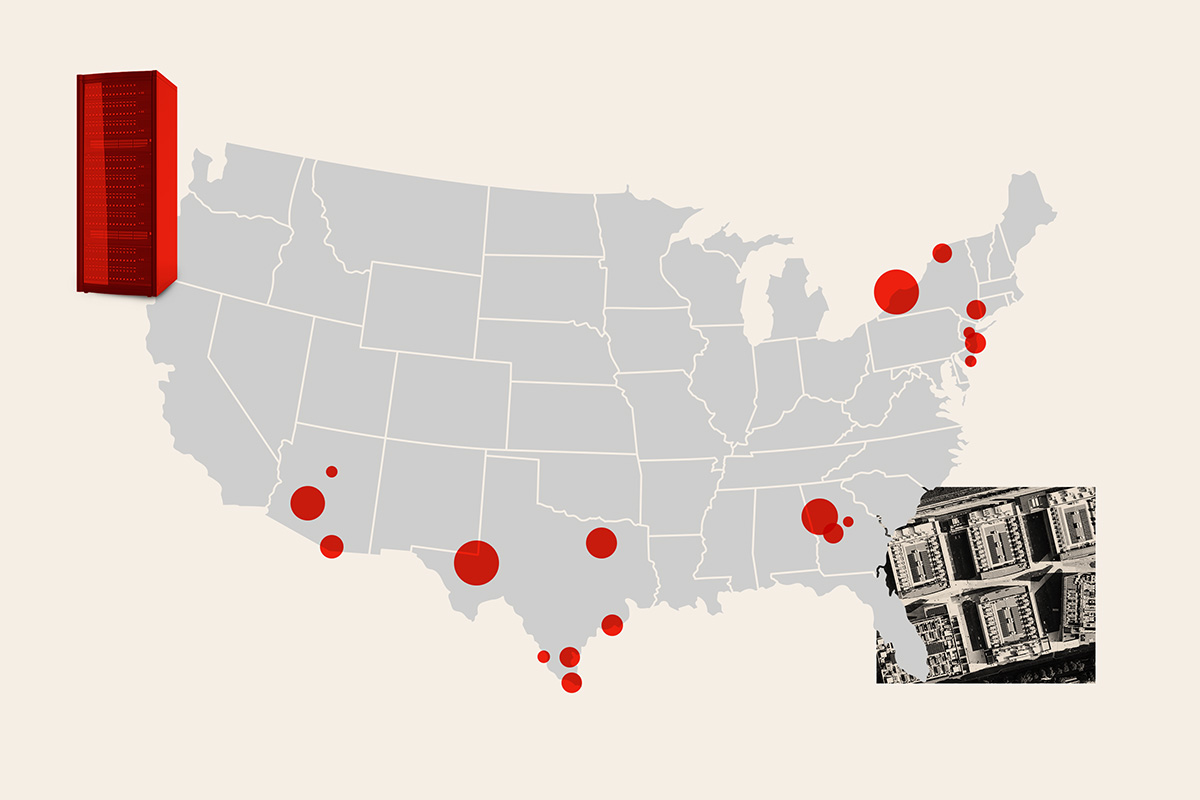
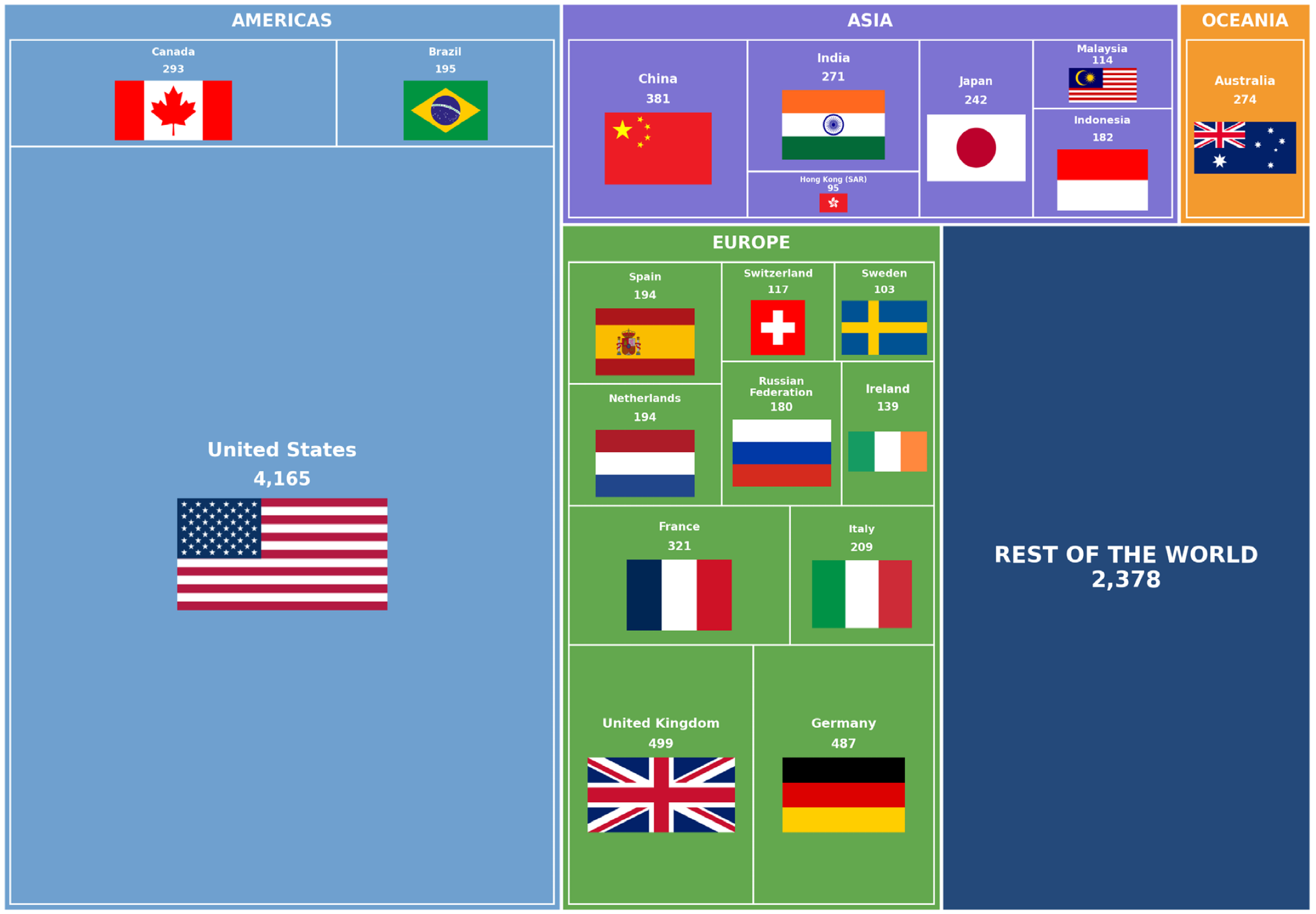
And where is this gobbling happening the fastest? Not Mexico. It's here in the United States, where we already have more than 4,150 data centers operating. Compared to China’s 381.
But Trump hasn’t veered from national security argument even as many in the base have started breaking ranks on the issue. But he's at least worried about his image.
Trump's June 2 executive order (signed, uncharacteristically for Trump, in a private ceremony) appears designed to look like oversight, but, after scrapping a previous version after heavy lobbying by Big Techies and his own AI czar, David Sacks, it has proven to be so weak that it’s “on the verge of meaningless.”
It is, as Politico summarizes, “the AI industry’s latest victory in its push to avert heavier federal oversight.”
There is nothing in the EO about paving over fertile farmland. Nothing about depleting aquifers or poisoning groundwater. Nothing about energy use or polluting communities. Nothing about protecting workers from engineered obsolesence.
As the Climate Justice Alliance framed it:
❌ No mandatory environmental review.
❌ No energy or water use disclosures.
❌ No legal protections for communities.
❌ No Tribal consultation. No cumulative impact analysis.
Nothing about the downstream impacts, in other words. It’s not even regulation. The order makes that explicit.
The EO reads:
“Nothing in this section shall be construed to authorize the creation of a mandatory governmental licensing, preclearance, or permitting requirement for the development, publication, release, or distribution of new AI models.”
It merely invites companies to voluntarily submit for review models that could, you know, melt down the world as we know it. It invites companies into an emerging federal AI cybersecurity clearinghouse “in voluntary collaboration with the AI industry and operators of critical infrastructure... .”
And we're doing all of this...to beat China? Really?
Really-really?
Global Distribution of Data Centers
Here’s the EO, FWIW (and it ain't much).
Action Corner
Pumping brakes on EPA fast tracking data centers + Support Bernie and AOC’s AI Data Center Moratorium Act.
 Madison Herber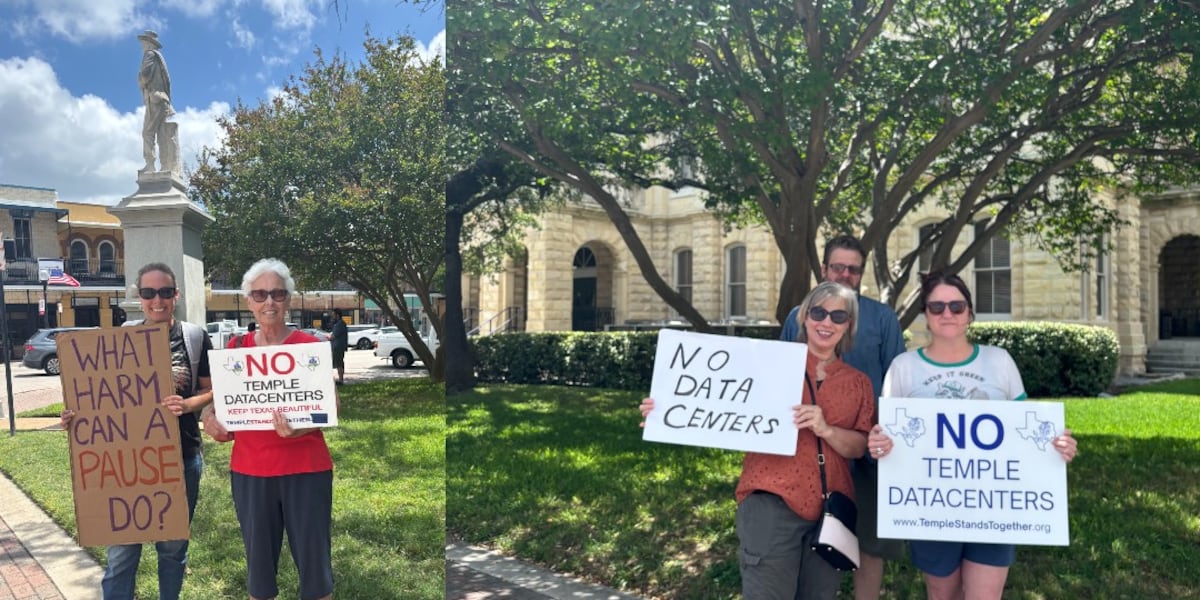
Bell County Commissioners to vote on June 15.
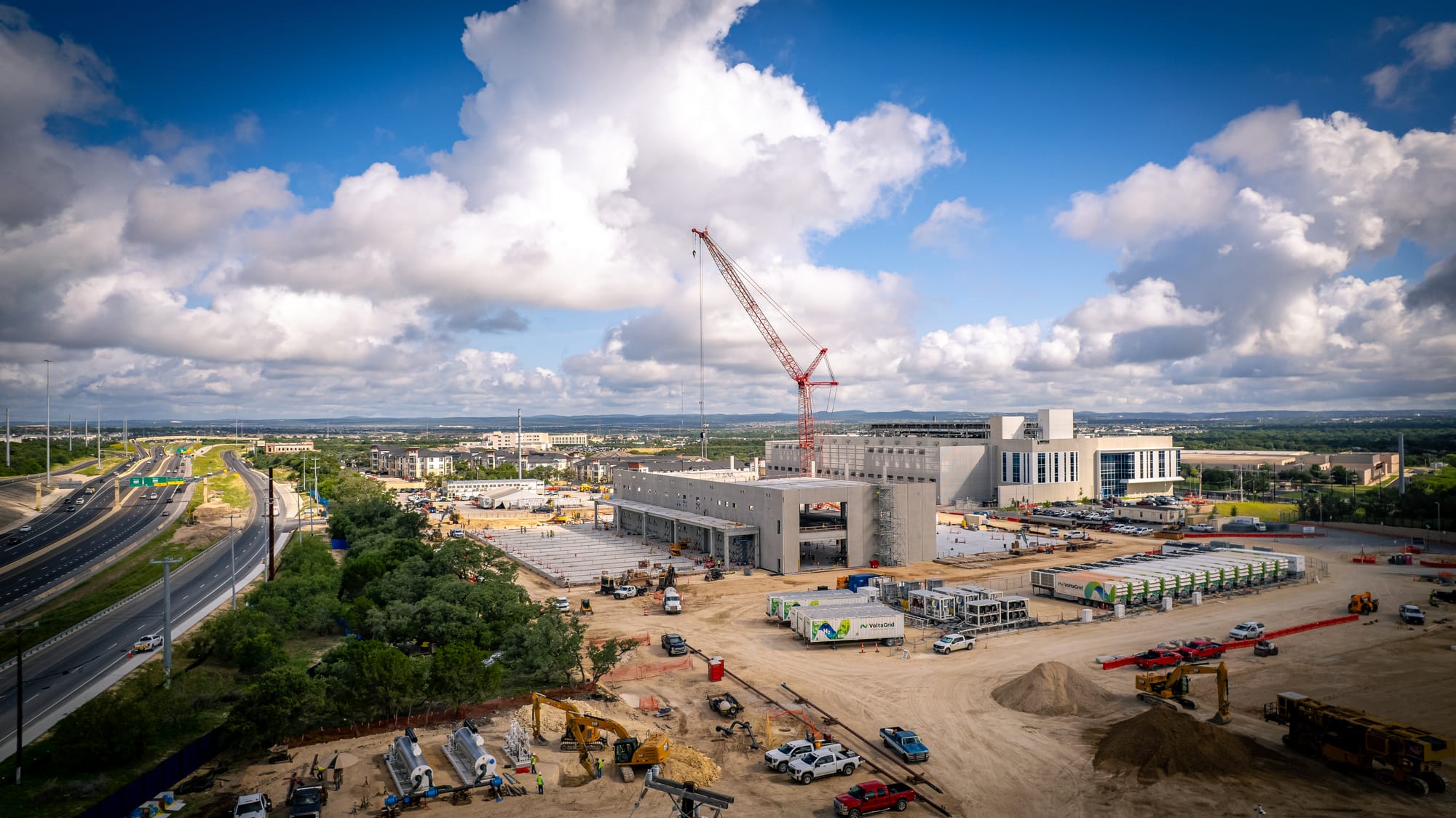
Data Centers Bringing Major New Pollution Sources to San Antonio’s West Side
Frustration marked public hearing for Vantage Data Center’s TX2 expansion plans at Highway 151 and Wiseman.
Greg Harman | Deceleration
Close to 100 anxious area residents gathered a week and a half ago inside a plush Marriott hotel meeting room a short hike from SeaWorld on San Antonio’s Far West Side to voice their concern about a massive AI data center going up blocks away.
They complained about noise and dust and loss of tree canopy from area data center construction (and there’s a lot of it these days) only to be told that the company up for review, Vantage Data Centers LLC, is complying with all existing local ordinances.
One woman, who said she was part of a military family recently relocated to San Antonio, said bright lights at night were disrupting her sleep. She got little sympathy from company representatives or regulators from the Texas Commission on Environmental Quality (TCEQ) at the front of the room.
Others complained about water use and potential contaminated water discharge from Vantage Data Center’s expanding footprint only to be told that the facility’s “closed-loop” cooling system made water a non-issue. When challenged, the TCEQ reps admitted that they didn’t actually bring any members of their water team to the meeting so they couldn’t, in fact, answer any water-related questions.
There were no fact sheets or maps provided for residents. And at times it was unclear what facility was being discussed.
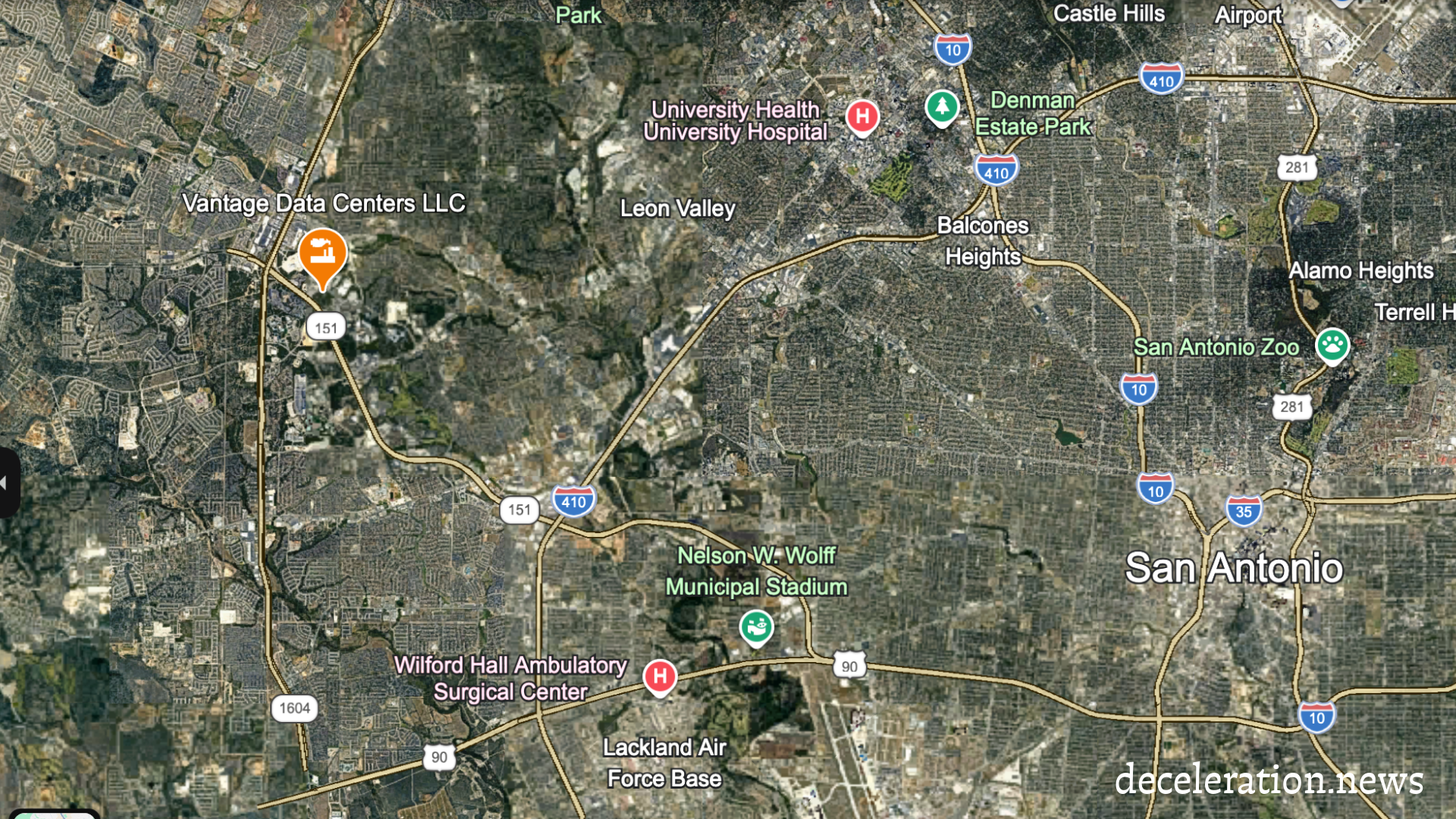
Simmering tensions grew increasingly strained as the night wore on and panelists deflected most questions that fell outside of the parameters of the permit in question: a federal Title V operating permit for Vantage’s TX2 facility at 5207 Rogers Road, a two-story, 215,000 square-foot data center expansion being built just blocks away. It is the second major facility on the 30-some-acre lot. A three-story data center is already operating—at least partially.
Vantage's Rogers Road operations lifted off without a hearing or local input. A letter filed by opponents in February states that the TCEQ approved the original air permit the same day it was filed by the company.
The federal permit in question is required now, however, due to the area’s poor air quality and Vantage’s desire to now more than double its existing 32 diesel generators approved for the location to 65.
Residents were outraged at the lack of consultation and how advanced operations are already.
“What pisses me off is seeing Third World infrastructure fricking being developed and [people] being forced to deal with low air quality issues,” said a resident of the Alamo Ranch community, who described himself as a combat veteran and cancer survivor.
"I was in Kuwait where they don't care to have standards, you know, fumes, toxic dust, everything floating around. … Why are we knocking in so many of these data centers in such a small area that's already zoned for residential?"
Vantage’s TX2 facility would join a larger Vantage facility with an associated gas-fired power plant and dozens of generators capable of firing up anytime that power is threatened by brownouts or blackouts or during summertime peak demand hours when the state grid operator, the Electric Reliability Council of Texas, requests heavy users—like data centers—to stop drawing power from the grid.
SEE: Water & Power drone tour of the Rogers Road site below!
Unsurprisingly, the company representatives at the hearing took a broad view of what would quality as an emergency triggering the need for backup power.
“Vantage doesn’t necessary have insight into all of the end uses of all their customer-tenants on the racks,” said Emily Weissinger, of the global engineering group, Ramboll, on behalf of Vantage Data Centers.
“I will say that data center industry in general serves a broad variety of uses including emergency call centers and driverless cars, so I think in that sense it very much would be an emergency when a lot of these data centers do lose their power.”
Vantage is building another facility farther to the west—this one at 14720 Omicron Drive, nearby other operating centers, including Microsoft—that could have as many as 84 diesel generators. Few in the audience could have been aware that Vantage also plans for gas-fired power plants at both locations that would run constantly—a fact not included in the federal operating permit that prompted this hearing or volunteered by any of the panelists.
Questions off that veered from the specific permit were frequently swatted down by the panelists.
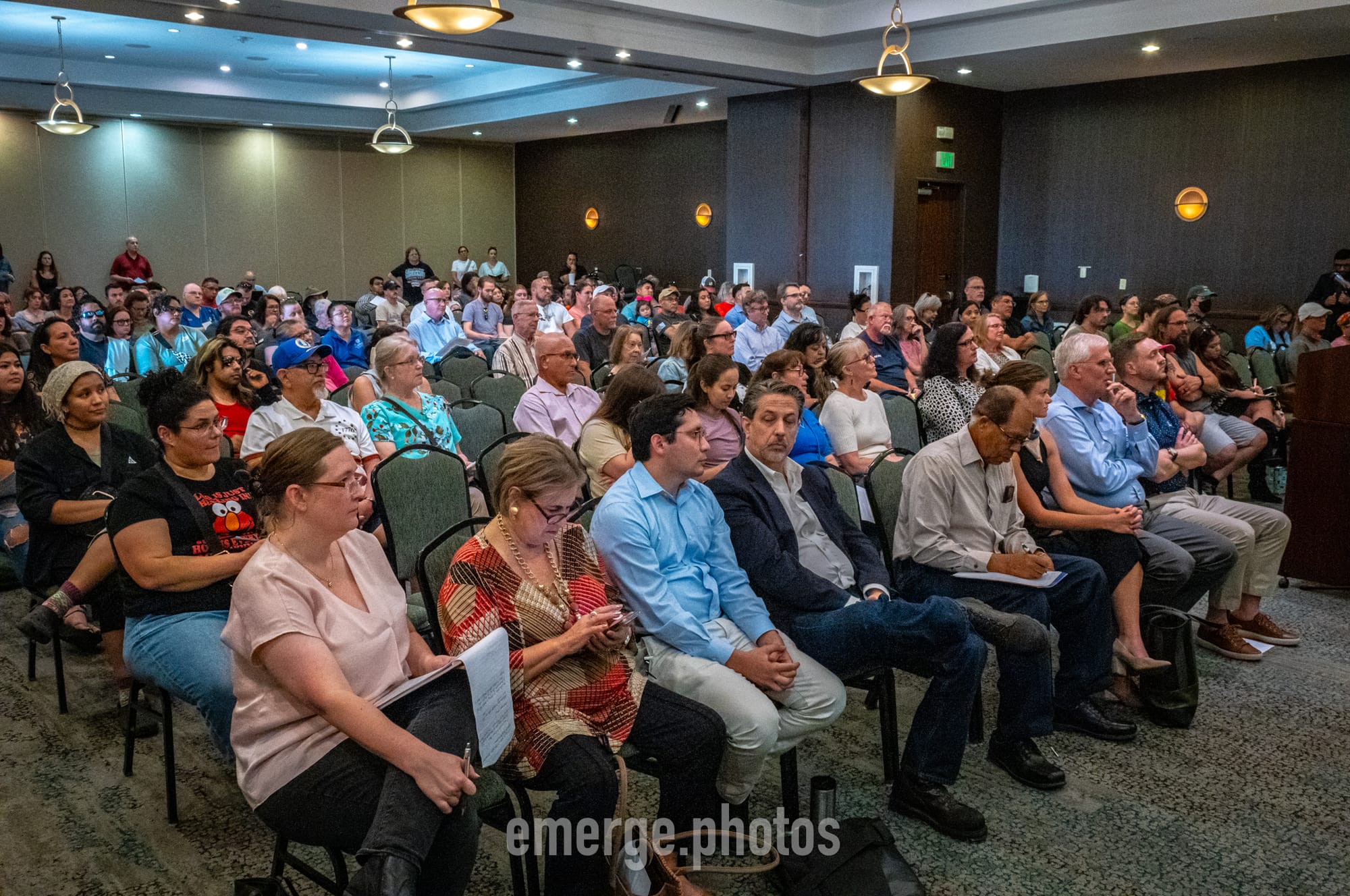
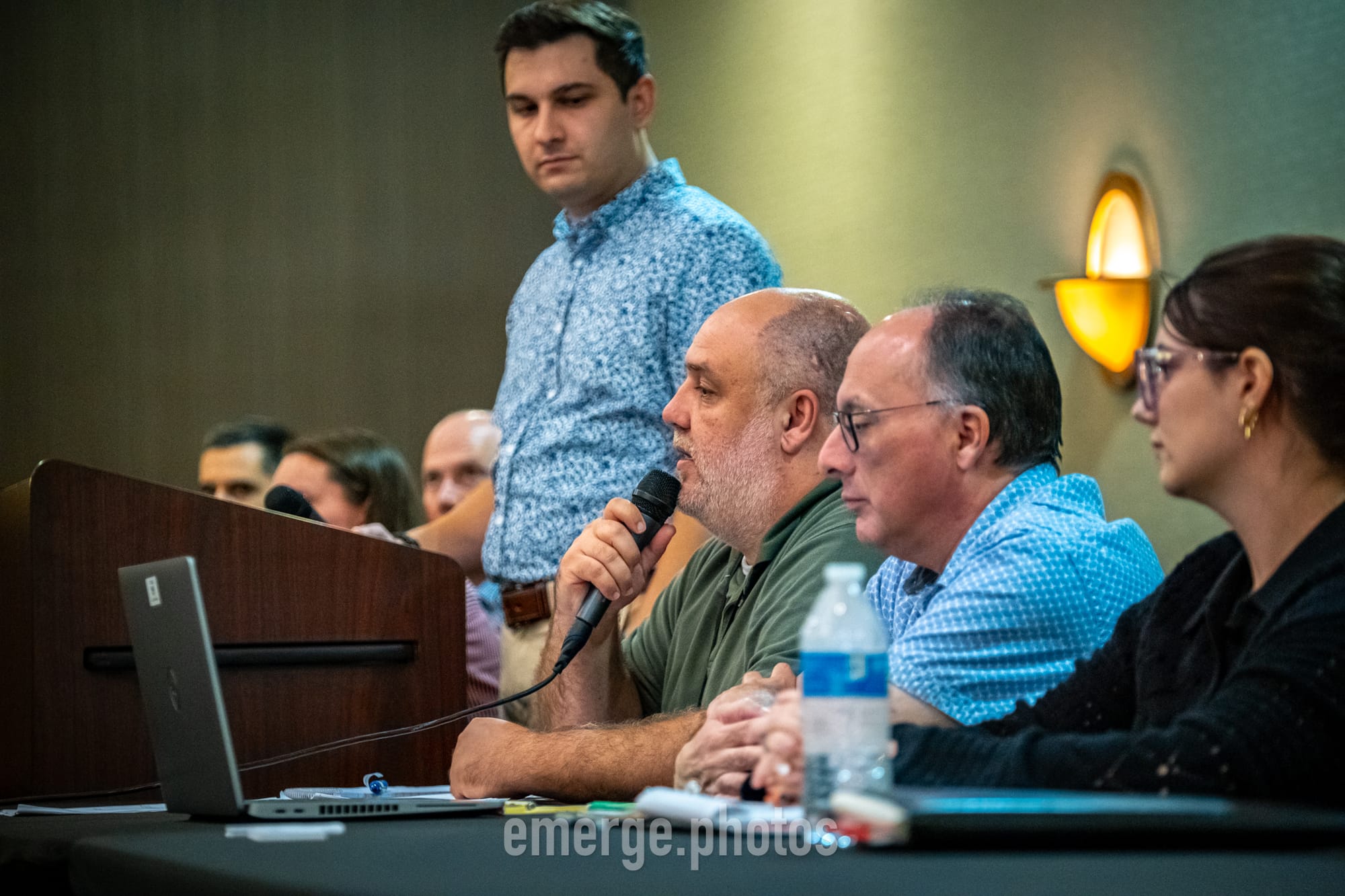
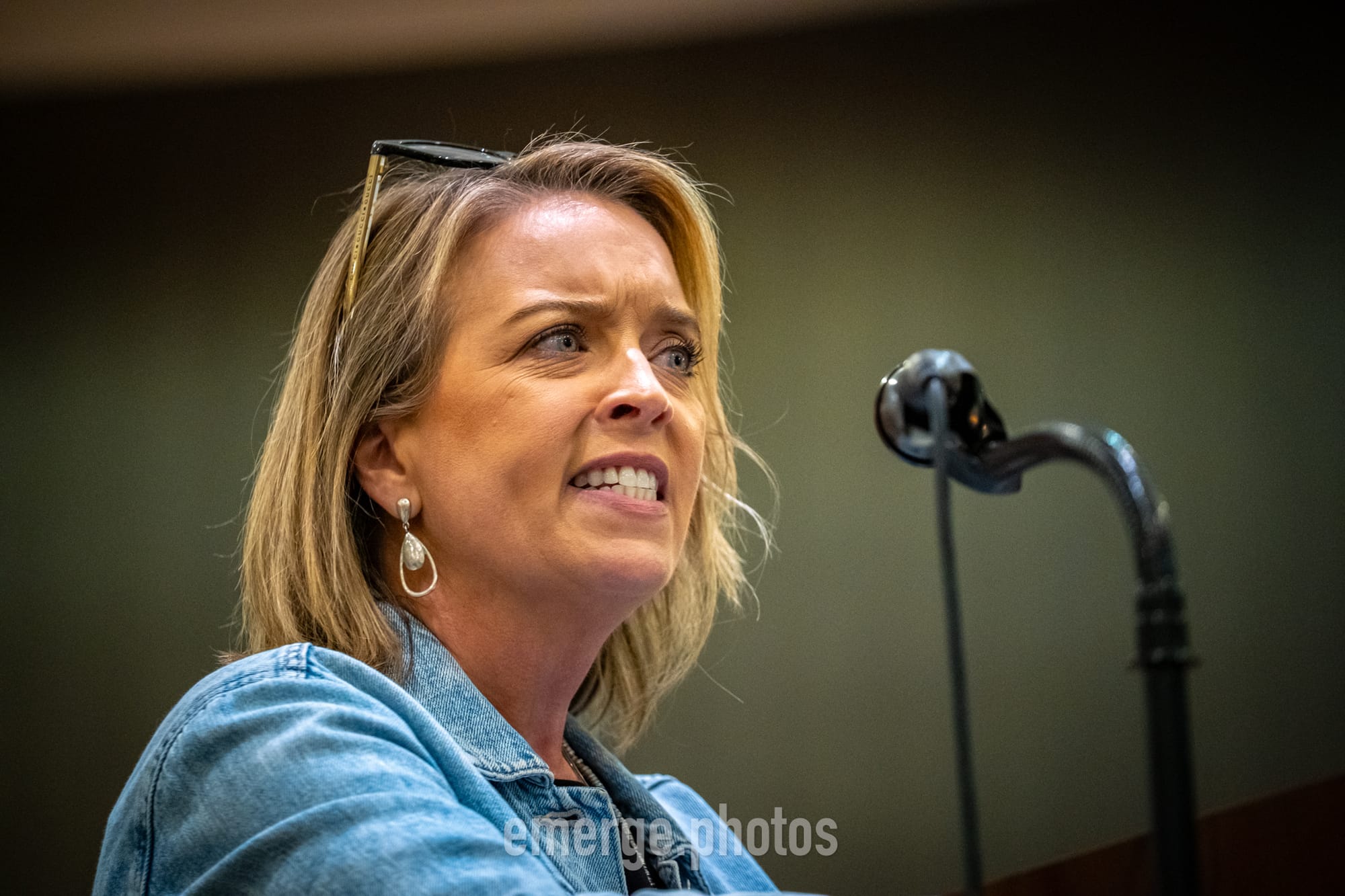
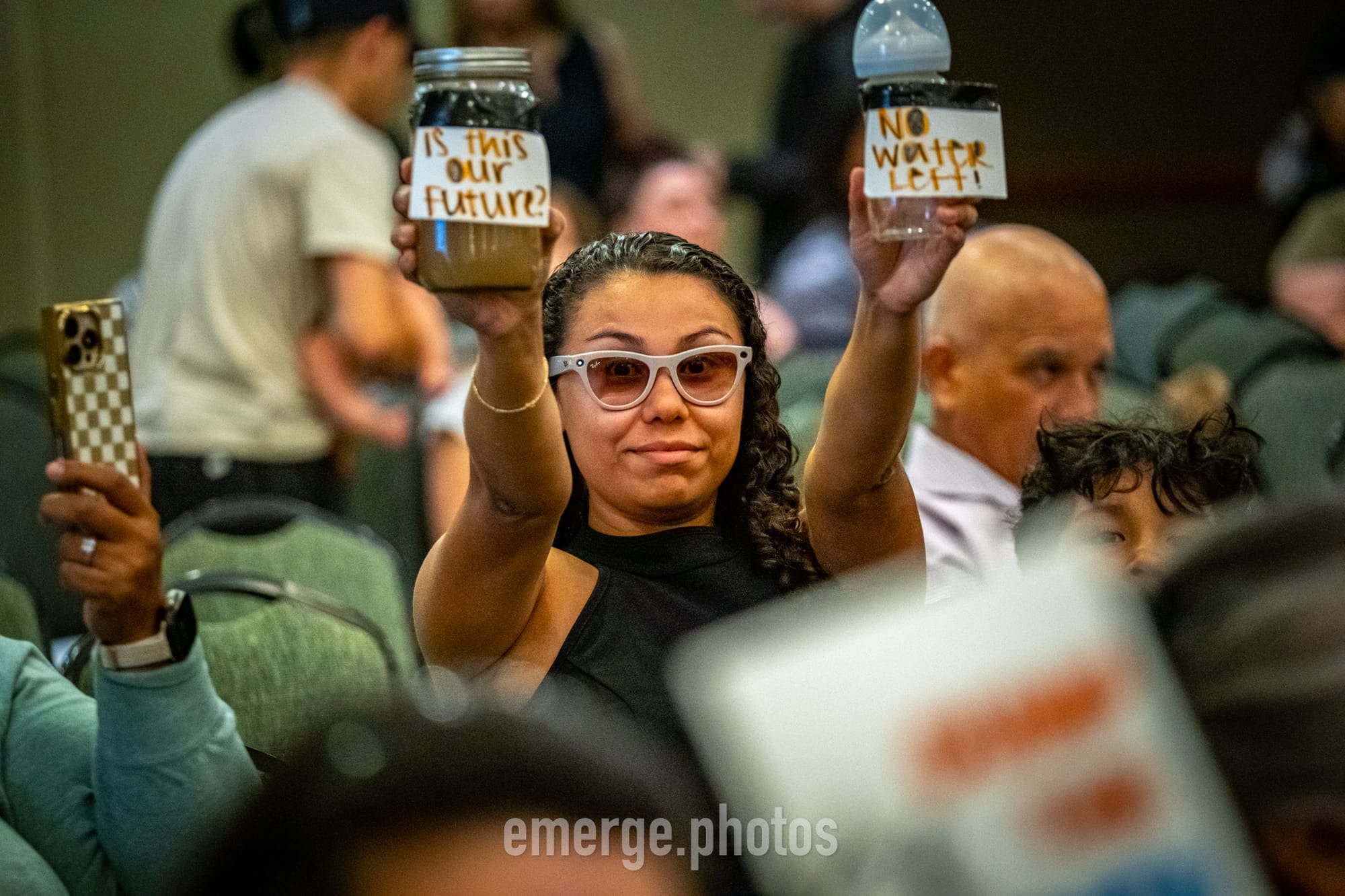

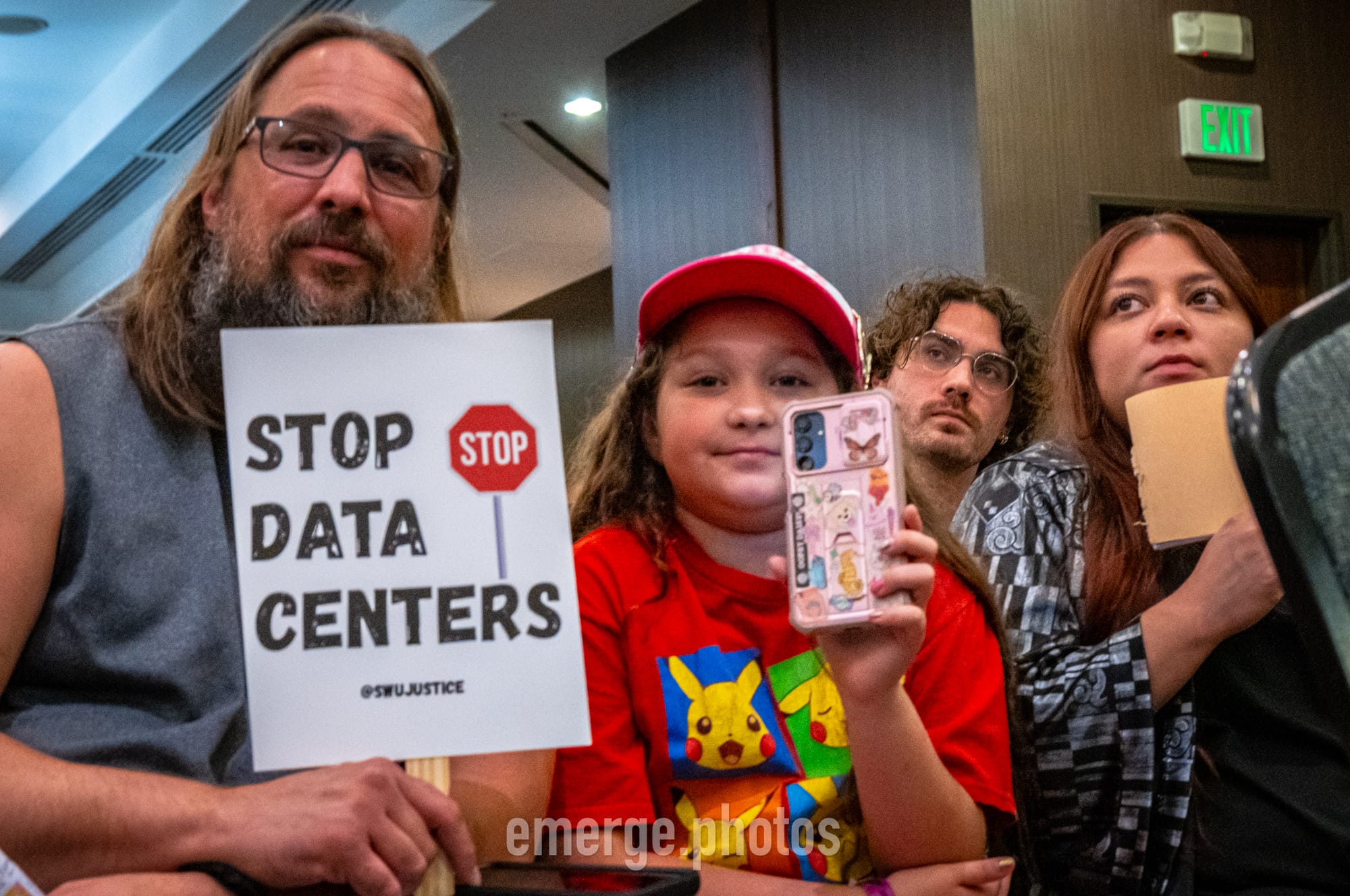
Images from TCEQ's May 28, 2026, public hearing. Images: Greg Harman/Water & Power
“Is anybody going to monitor the air quality [during construction]?” asked a woman named Mattie who said that Vantage’s operations would be 500 feet behind her home. “I already have three air purifiers for my home from when they cleared the land. … There was no dust abatement.”
“There may be other elements in the TCEQ that monitor air quality, such as ambient air quality, however we are not that,” said Alfredo Mendoza, of TCEQ’s Air Permits Division. “We are the Title V operating program.”
What about informing the public and media about future permits when water is discussed?
“That’s operating under the assumption that they are going to have a water permit,” said Katelyn Ding, a TCEQ staff attorney within the Environmental Law Division. “That’s not what we’re here for today.”
While the Houston Advanced Research Center expects Texas-based data centers could be sucking up 160 billion gallons per year by 2030, Michael Duplantis, vice president of environmental health and safety for Vantage’s North American operations, said by using a “closed loop” cooling system with a 25-percent glycol mixture the company could limit TX2's total water use to approximate that of a 30-room hotel.
Another speaker describing her concerns as ranging from water to air quality to energy urged a more comprehensive discussion.
From the TCEQ she received mostly incoherent bureaucratese in response.
“I can’t speak on behalf of New Source Review, that’s an entirely different section of TCEQ,” said Mendoza. “We are a Title V, the federal permits operation program, and we incorporate New Source Review by reference. We don’t issue them.”
“So this meeting is about air quality, but it’s not really,” the frustrated questioner concluded before stepping away from the mic.
The boos from attendees only grew louder as the night progressed.
It was Vantage’s Duplantis who sought to break out of TCEQ’s administrative jargon in an attempt to calm the waters.
He described the permitting process as “two-step,” whereby the state issues some permits, but that the increasing scale of desired operations have kicked some aspects up to federal regulators. This hearing allowed TCEQ to collect community concerns that they will summarize and deliver to EPA. The feds will use that information to help determine if they will grant the required federal air operating permit.
“[TX2] is of a size and a magnitude that they need to put more controls on top of us to make sure we do the things we should do,” said Duplantis.
This fact was seized upon by Adrian Shelley, director of the nonprofit Public Citizen’s Texas operations, who accused the TCEQ of “reverse engineering” the amount of anticipated pollution recorded in the draft permit to assist the company secure its objective.
For instance, Shelley said, the TCEQ regulators calculated the company’s existing batch of generators at 113 hours of expected annual use per unit. However, for TX2 they reduced the hours for proposed new generators to 57 annual hours. This helped keep the total expected pollution below 100 tons per year, a threshold that would have otherwise triggered a need for pre-construction permits.
“[Vantage] adds another 32 generators and [the TCEQ] just halved the number of hours of operation in order to stay under that threshold,” Shelley said. “They’re just reverse engineering the math,” Shelley said. “That’s not the way it’s done. … As a result, we’ve got a sham permit. We have a permit that’s not based on actual emissions calculations.”
Those emissions matter, as one child in attendance testified on the mic, especially for residents living with asthma.
Diesel generators and gas-fired power plants, after all, release a range of pollutants that are directly harmful or assist in the generation of unhealthy air quality, including ground-level ozone.
But it wasn’t until hours into the meeting that the elephant in the room emerged when Shelley, followed by a staff attorney for the Environmental Integrity Project, raised the issue of the power plant.
“Vantage cannot obtain power for the data center from the utility,” said Gabriel Clark-Leach, a senior attorney with the Environmental Integrity Project. “So it has arranged to have a power plant constructed on the same site as the data center. This power plant is designed to run at maximum capacity every hour, every single day. It will also emit ozone-forming pollutants as well as hazardous air pollutants like formaldehyde.”
It is unclear if the power plant at the Rogers Road location is already operational. Vantage did not answer Deceleration's question on the matter.
Many of those attending applauded Shelley’s complaint that a comprehensive hearing should have been convened to allow the community to discuss the power plant plus the data center plus the dozens upon dozens of diesel generators as one permit.
“The EPA has determined in other facilities, the Stargate facility in Abilene, that a co-located data center and power plant should be treated as a single source,” Shelley said. “And that should be done here.”
However, the power plant was yet another element of the company’s operations the panelists weren’t discussing.
Mark Freeman, Vantage Data Center’s Vice President of Global Marketing, provided Deceleration the following statement:
“Vantage Data Centers appreciates everyone who took the time to participate in the TX2 hearing and share their views. While the hearing focused on a specific air permit, we understand that community members raised broader questions about growth, environmental impacts and how projects like this fit into the future of San Antonio. We take those concerns seriously. Our approach is to continue listening, provide clear and factual information, and work in good faith with regulators and the community as the process moves forward. We are committed to operating responsibly and being a constructive long-term partner in the communities where we build and operate.”
As frustrating as the hearing was for most residents in attendance, it would not have happened at all without the intervention of two state electeds—Texas state Rep. Philip Cortez (District 117) and Texas state Senator Roland Gutierrez (District 19)—who requested a hearing from TCEQ.
The only elected official we spotted in the room was Texas state Rep. Josey Garcia (D-124). But, yeah, the TCEQ did schedule it on a Spurs game night.
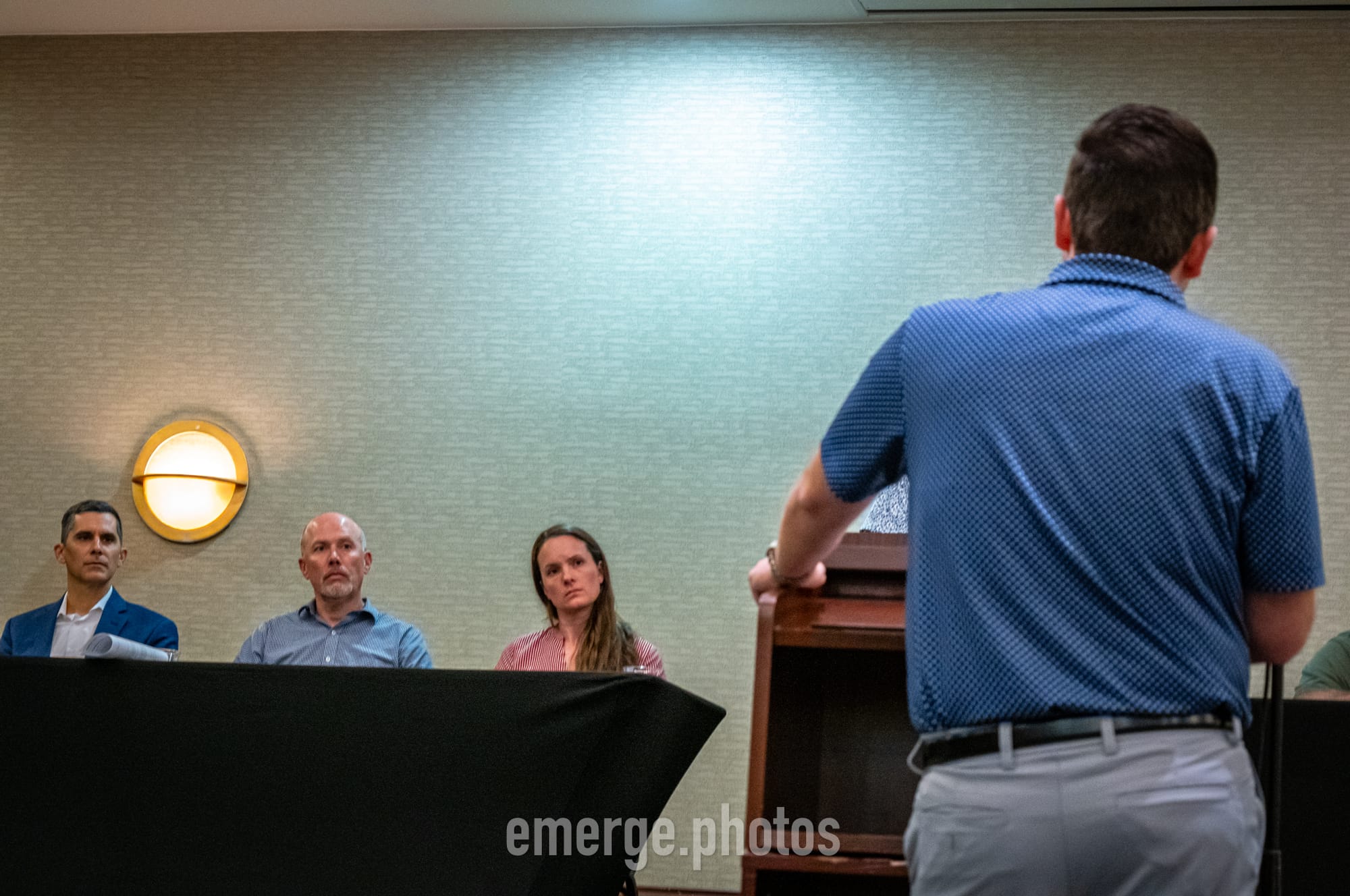

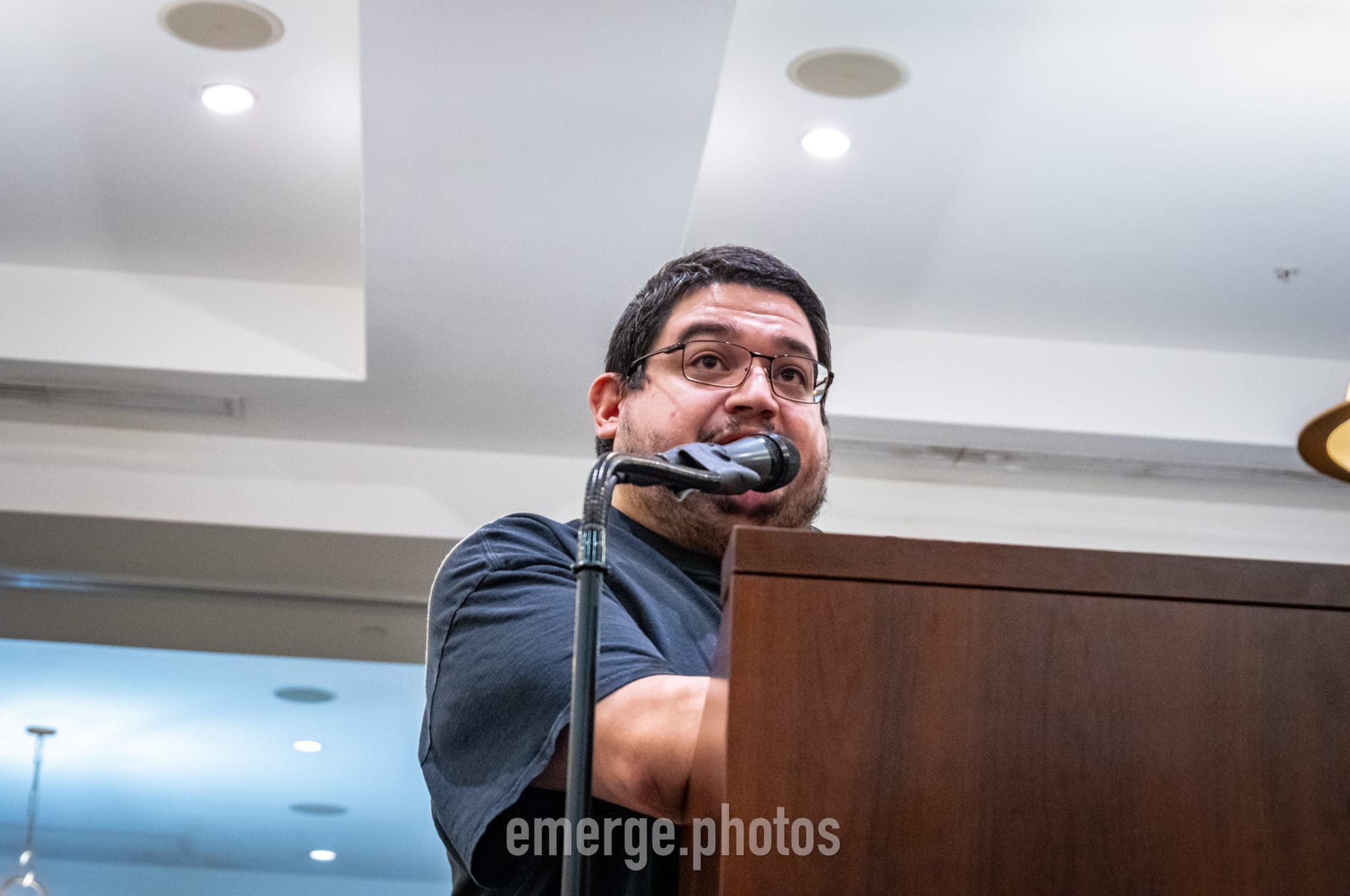
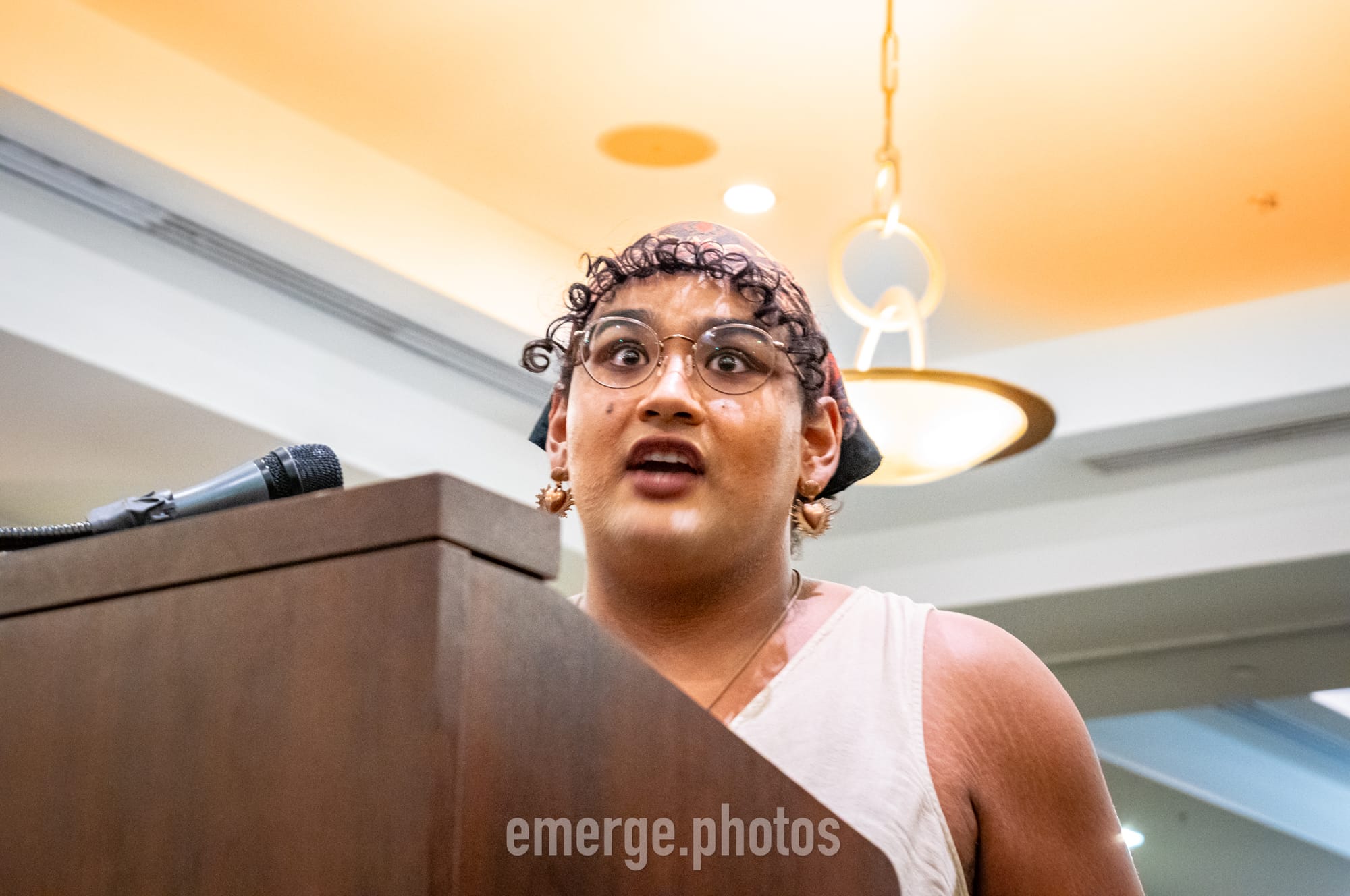
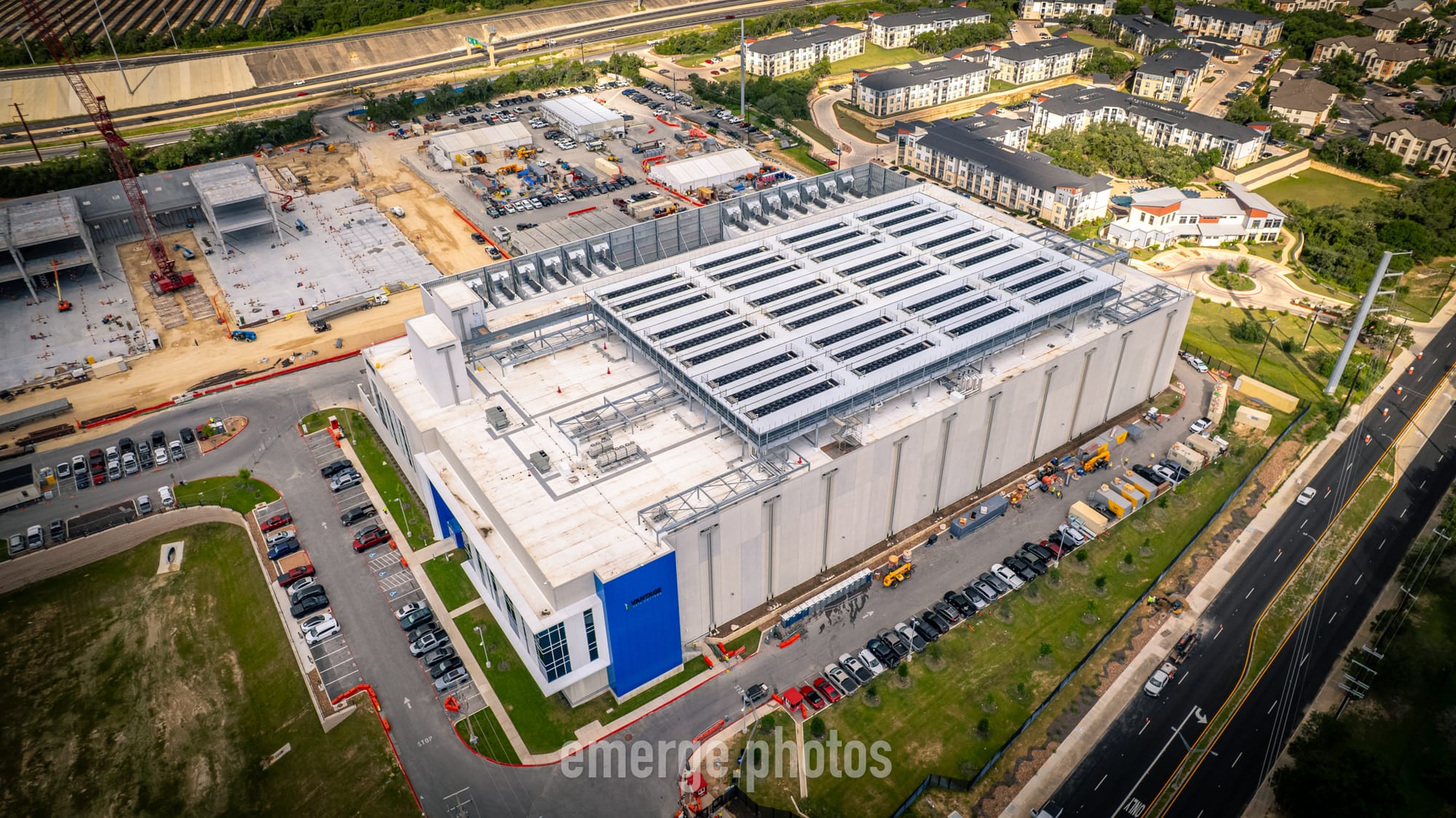
Images from TCEQ's May 28, 2026, public hearing and a drone pic of the facility. Images: Greg Harman/Water & Power
Eric Cavazos, director of policy for San Antonio Councilmember Ric Galvan (D6) wrote Water & Power:
Our goal has always been to ensure that the City of San Antonio has policies and development standards in place that protect residents and address community concerns regarding data centers. We appreciate residents continuing to stay engaged, attend meetings, and share feedback as that input helps inform the policy discussions taking place at City Hall. Our office has attended multiple HOA and neighborhood association meetings in District 6, shared on social media, hosted neighborhood office hours in multiple District 6 neighborhoods, and co-hosted a town hall with Mayor Jones to solicit feedback on this matter, and other issues our residents our experiencing. District 6 residents are welcome to contact our office on this issue or other City related issues by phone (210-207-3749), in person, or with our contact form.
We also shared information about this state-led TCEQ meeting on social media and with more than 3,000 District 6 residents who are subscribed to our weekly e-blasts, and we are thankful to see so many community members participating and making their voices heard.
On the city side, our Development Services Department is holding stakeholder meetings to discuss future zoning efforts. They have already held one meeting, with the next meeting scheduled later in June.
Meanwhile, members of San Antonio's City Council have expressed mixed feelings about how much reform may be required, as was displayed in a May 2026 public discussion with some praising the jobs-creation potential of the centers as others leaned into misgivings. Cities with stringent zoning rules have the most influence on a process that is still largely beyond their ability to control, limits revealing themselves in Hill County, which recently rescinded its first-in-the-state moratorium on data center development.
-30-
What Comes Next?
Water & Power will be updating this story to publish at Deceleration in the days ahead responding to some of the questions and feedback we've received on our social channels. But we see no public hearings within the City of San Antonio being advertised where residents can help drive zoning reforms that could help slow the build out. Not to say they aren't coming, just that we haven't found evidence of them prior to our Sunday afternoon deadline. We'll also be looking for notice of a public hearing for the Vantage Omicron facility.
How Many Data Centers are in San Antonio?
Accounting differs on how many data centers are operating in San Antonio. While the water utility reported just over 20 at a May 2026 public meeting, Stream Data Centers maps today show more than 50 data centers in the city of San Antonio (while Baxtel lists 69). January 2026 CPS Energy data showed 59 new data centers somewhere in their pipeline between those already contracted for power and those pending review. If Water & Power finds the time and resources, we'll build our own map—including those who haven't broken ground yet and are most vulnerable to public pressure. If you have a better resource, please send it along!
More to come.

Data Center Resistance is Growing...and Increasingly Surveilled
A national movement against data centers has coalesced in 39 U.S. states—even as the feds work to discredit and criminalize it.
When the public hearing over a massive AI data center on San Antonio’s Westside drew toward a close last week (story above), a young woman who hadn’t signed up to speak originally wound up rocking the room with her spirited testimony and deft use of props.
“Everybody's gonna be sick with cancer, poisoned. Big Pharma's gonna have all this money. What about us?” the woman in tan Meta glasses enthused, waving a bottle of dirty water. “And y'all think that these tech billionaires are gonna protect y'all? They're trying to go to Mars. They're gonna be hiding in the caves like the Bible says in Revelation."
Walking away from the podium to whoops and cheers, the woman was called back the front by TCEQ moderator Daniel Schroeder, who urged her to provide her name.
“I’m going to refuse to sign a form just because I heard that we’re being labeled as terrorists if we are against data. We’re not against data or big tech; we want them to be safe for the environment.”
Correct.
As of May 2026, there are at least 345 local organizations opposing data center development, representing roughly 428,000 members, according to a recent report created by members of Coalition for Responsible Data Center Development, Evitable, and Together Against AI.
But rather than consider the arguments sparking that resistance and potentially modify their posture on the subject, the administration and its core enablers are instead demonizing and turning the surveillance state against its own citizens.
Wired recently published a bombshell report highlighting growing surveillance of U.S. citizens based on the claim of emerging “anti-tech violent extremism.” The agencies don’t appear interested in the thousands of recent unmasked card-carrying members of Patriot Front. (You know, the folks actually out doing violence and stoking conflict.)
Instead, they’re pursuing data center opponents.
As Daniel Boguslaw writes at Wired:
More than 1,000 pages of unpublished reports from the Department of Homeland Security, FBI, and fusion centers obtained by WIRED show a national shift taking place to surveil this new and worryingly broad category of people and activities deemed an emerging threat.
This new effort follows President Donald Trump's National Security Presidential Memo 7, which instructs the Department of Justice to target anyone holding “anti-American,” “anti-Christian,” and "anti-capitalism” beliefs. Earlier this month, Trump's counterterrorism czar, Sebastian Gorka, released a public counterterrorism strategy claiming that left-wing extremists are one of the three top counterterrorism priorities facing the United States.
Taken together, these Trump administration directives have commandeered the domestic surveillance apparatus to surveil and criminalize speech and assembly that challenges the ideology of the White House.
 Daniel Boguslaw
Water & Power would offer the same disclaimer as that hearing testifier. While we also rely on digital technologies to produce and disseminate our research and documentation. To the degree we come out hard on data centers, it’s over questions of how the industry is or is not being guided to ensure their products are actually life-affirming…and not the opposite. A reasonable critique of the failure to regulate means the sector has been left to its very worst devices, producing both tremendous corporate profit and immense (and growing) social, political, and ecological harm.
Deceleration Video
Water & Power pops up a drone over Vantage Data Center TX2 near Sea World to examine what's happening at this already permitted massive data center with plans to dramatically expand operations (and pollution) on the Far West Side of San Antonio. Follow Deceleration on YouTube.
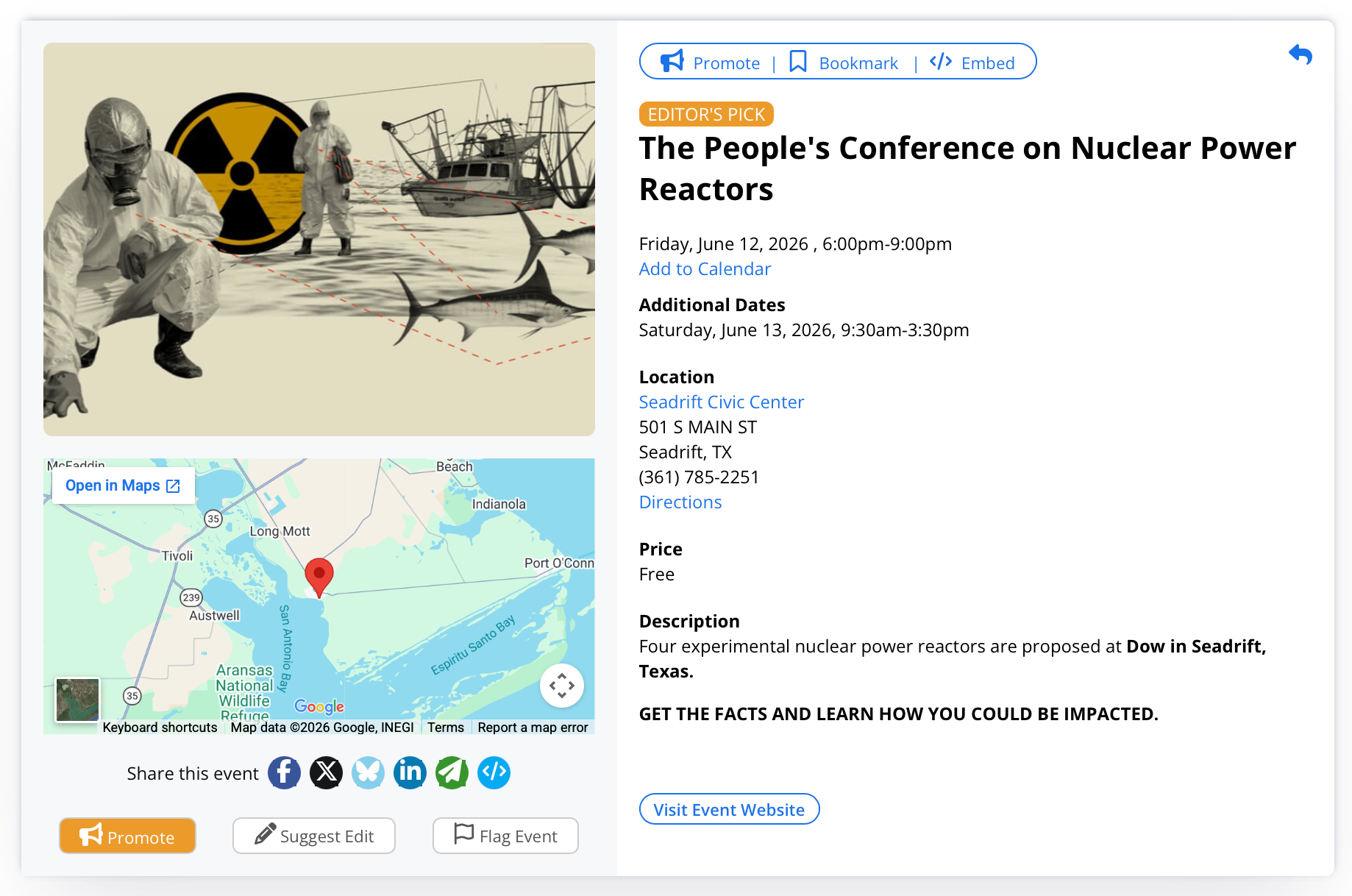
Event
People's Conference on Nuclear Power Reactors (Seadrift, Texas)
Tip Jar

Water & Power News
 Taylor Goldenstein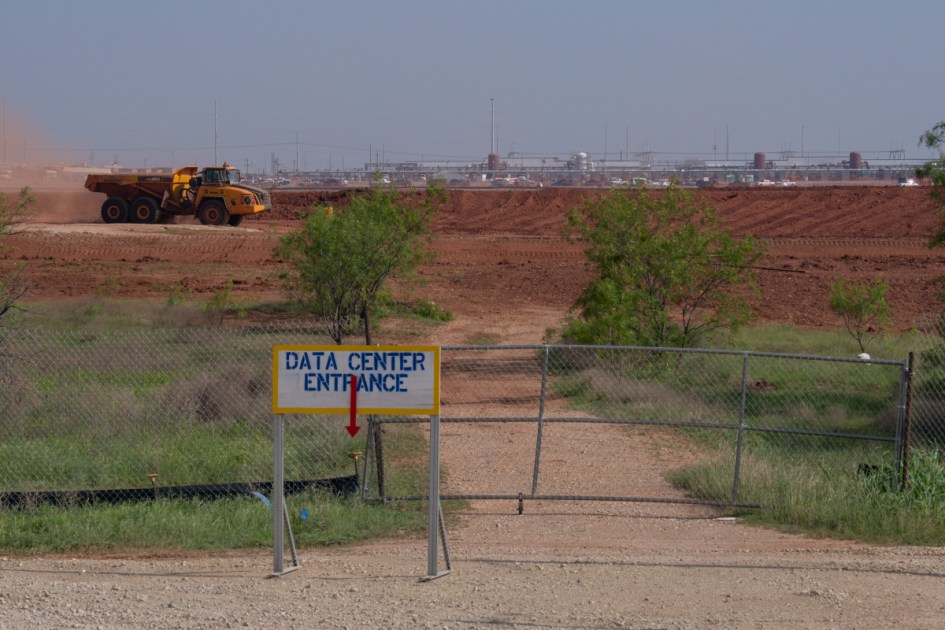
 Shelby Webb
 Texas Tribune and Colleen Deguzman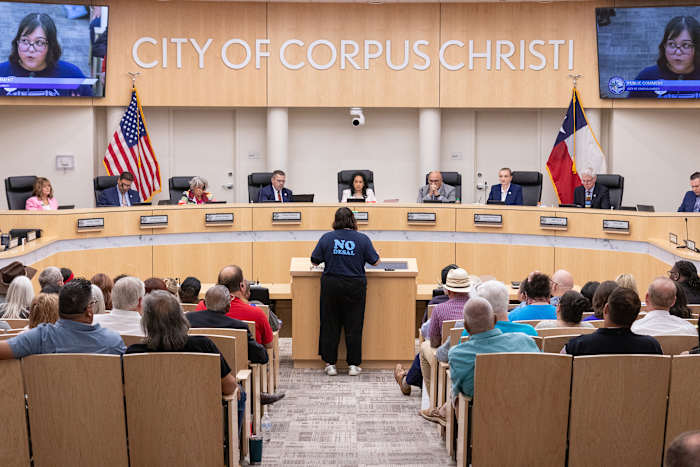
 David Blackmon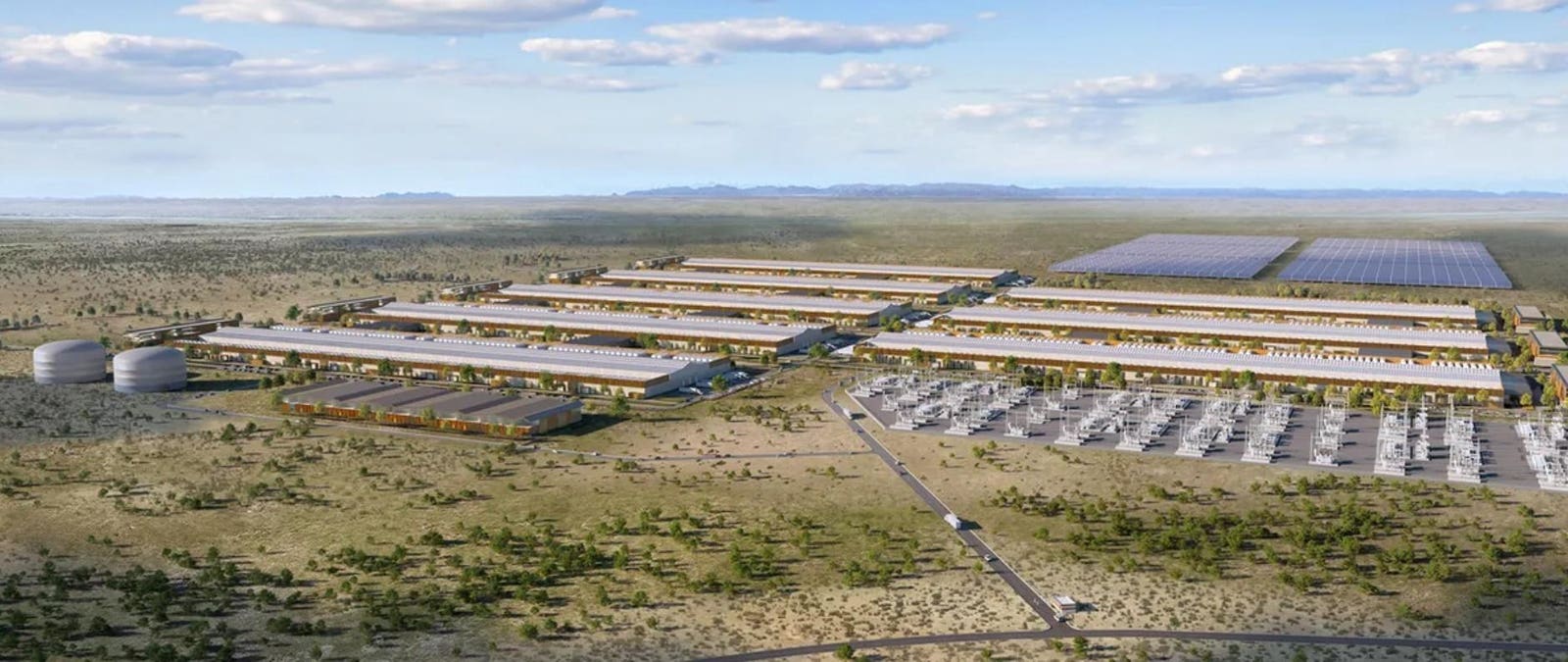
 Alejandra Martinez and Alex Ford and Apurva Mahajan and Shelby Tauber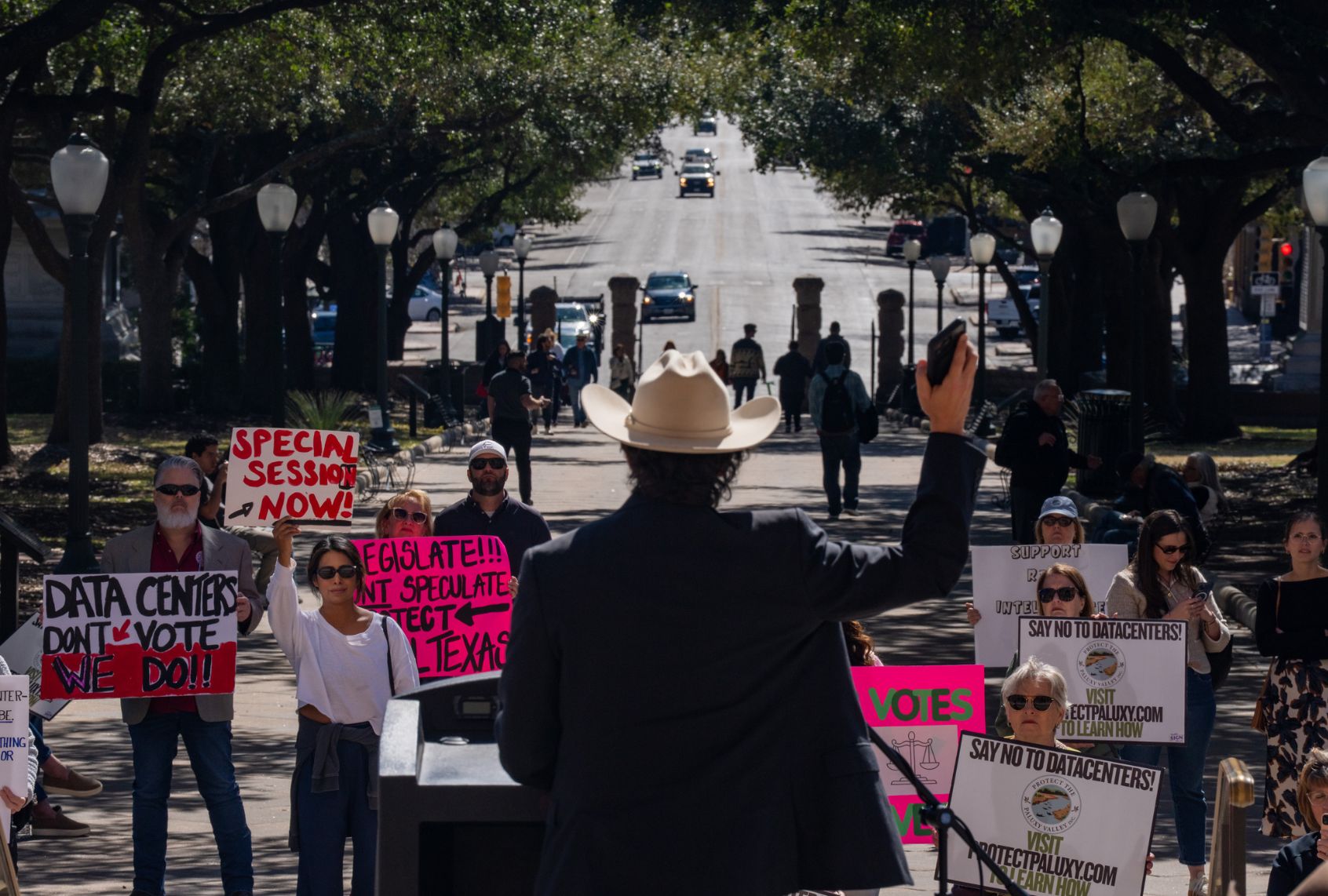
 Brooklyn Smith
 Derek Harrison
 , USA TODAY
 Joe Edwards