

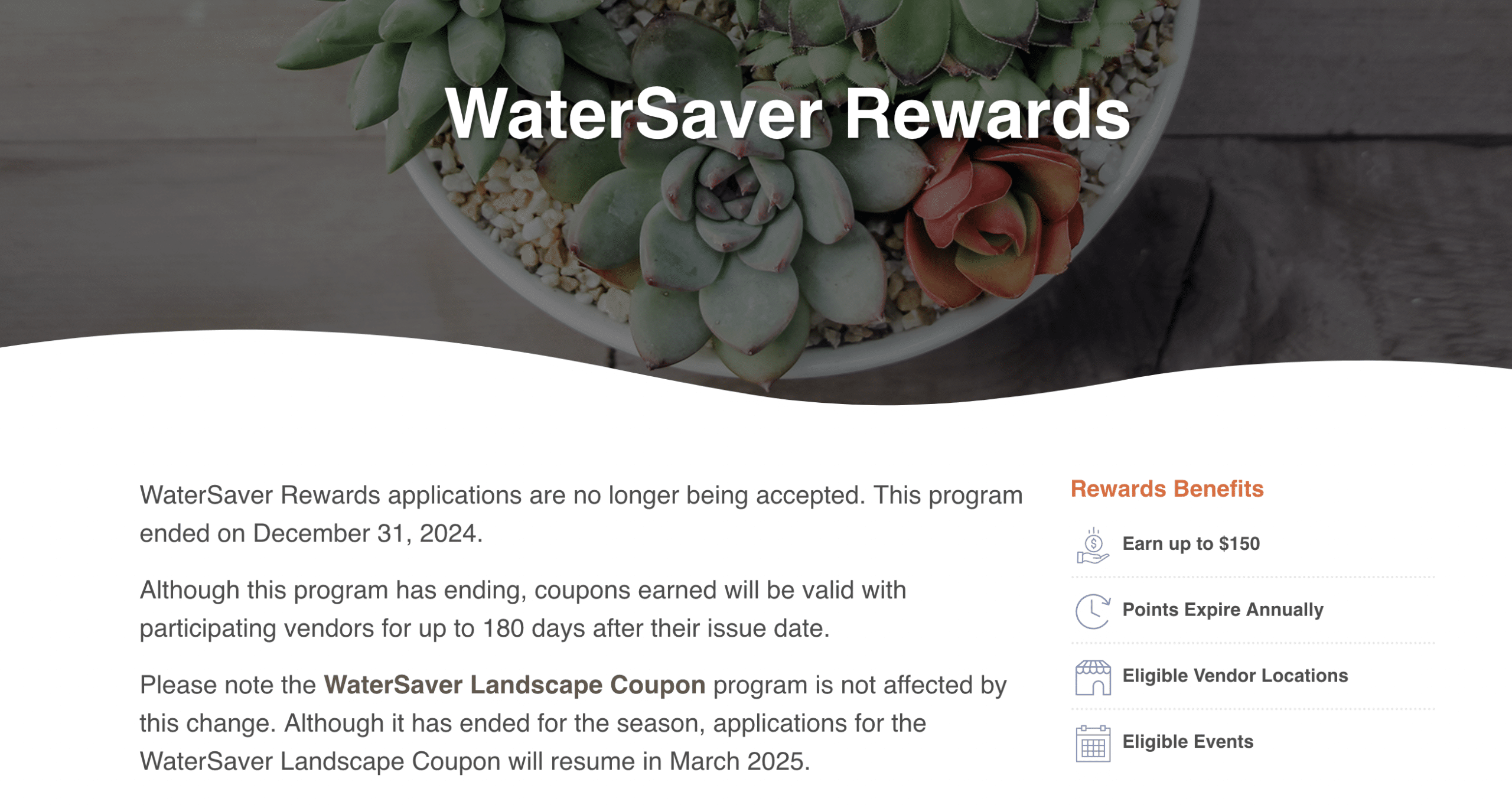
As 2024 ends and a new year begins, San Antonio Water System (SAWS) has ended its WaterSaver Rewards program. An outgrowth of the public utility’s long-standing commitments to conservation, this program allowed residential customers to earn up to $150 every year toward purchase of garden supplies through participation in conservation education programs provided by local organizations.
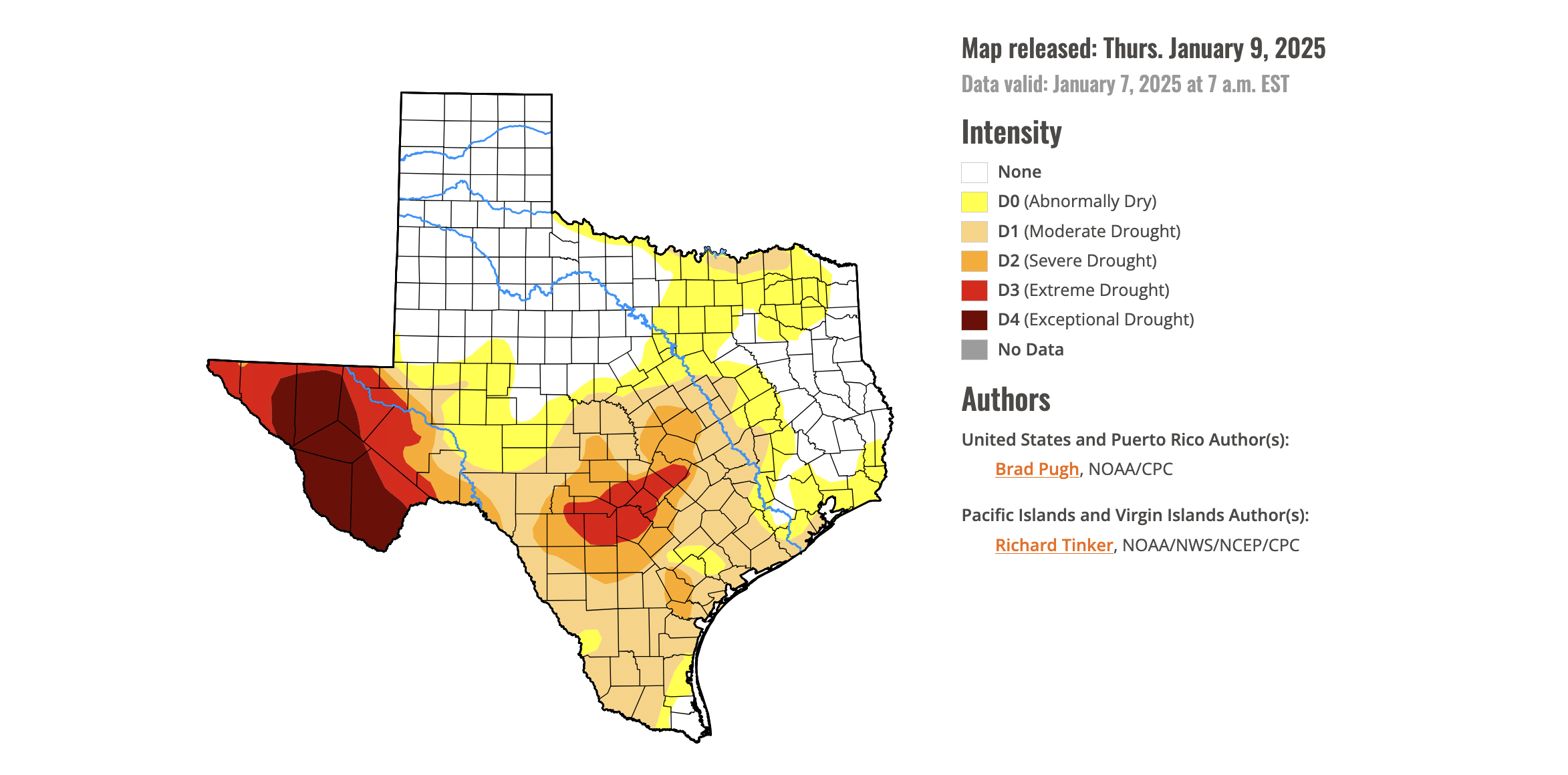
The need for education and water conservation seems evident in the face of ongoing drought, with the U.S. Drought Monitor designating 91% of Bexar County in extreme drought at the close of 2024; and the National Oceanic and Atmospheric Administration predicting the drought will persist through March. In November 2024, the Edward Aquifer Authority noted that aquifer levels were the lowest ever recorded.
Allison Tarter, Research Specialist in the Office of the Texas State Climatologist, made links between drought and climate change more explicit: “This past year of 2024 was the hottest year on record, and the hottest one before that was 2023,” Tarter wrote Deceleration. “Climate change is only going to increase drought, and flooding when it does rain.”
This dreary drought forecast was also the lead news shared by SAWS Conservation Planner Brad Wier in a WaterSaver Rewards newsletter emailed to program participants on October 17, 2024. Tucked below that update was another:
“With the changing seasons come other changes that we want to share,” Wier wrote. “This will be the last year for WaterSaver Rewards as the program is wrapping up at the end of 2024.”
But the loss of WaterSavers Rewards is by no means the end of residential-facing conservation activity at SAWS. Related programs, including the WaterSaver Landscape Coupon, Outdoor Living Rebate, and WaterSaver Irrigation Consultation will continue uninterrupted.
“Over the years when we track the fundamental question of staff time and partner time, we just weren’t getting the result we hoped for,” SAWS Vice President of Conservation Karen Guz told Deceleration.
Wier and Guz initially announced the closing of WaterSavers Rewards during the October 9, 2024, meeting of the SAWS Community Conservation Committee (CCC) a few months after educational partners were notified. Guz told Deceleration that the program was closing in part due to the comparatively few number of customers participating.
For more than 20 years, SAWS has experimented with incentive programs to decrease residential water consumption, giving away free low-flow toilets, showerhead aerators, plastic rain gauges, and toilet tank dye, all aimed at encouraging customers to save water at home.
SAWS was pushed into the world of conservation by a blind salamander and federal regulators, as Forrest Wilder chronicled recently at Texas Monthly. But today it operates the largest water conservation effort in the United States, second only to Las Vegas, Nevada, Guz told Deceleration.
The Rewards program grew out of these efforts to improve residential conservation and sought to integrate lessons learned along the way. After SAWS and local nonprofit organizations gave away in 2017 nearly 6,000 rain barrels to over 3,000 SAWS customers at Alamo Stadium, Guz recalled subsequent findings that rain barrel recipients, who were concentrated in north central San Antonio, actually increased rather than decreased potable water use after receiving the barrels. For Guz it was a personal epiphany that conservation tools would never be effective without community education, as she explained to CCC members in October.
The resulting WaterSaver Rewards program was announced six months later as an incentive program for customers to learn more about native plants and xeriscaping as a means of saving water. Responding to a list of questions emailed to her and Wier, Guz said their hope was that the program would “engage customers new to gardening in understanding principles of watersaver gardening,” with program success measured annually in “customers new to conservation.”
Competing Tensions and Internal Contradictions
Seven years later, the discontinuation of this program highlights competing tensions within San Antonio’s public water utility between its stated conservation priorities and the access and equity required of public utilities by Texas statute. While the program did see steady participant growth (from 1,105 in 2017 to 13,183 in 2024), according to data provided by Wier by email, a much smaller share of these (around 10 percent) were active participants—earning points by taking community classes on conservation. Even fewer “maximized their rewards by earning all 3 coupons” (about 3 percent of 2023’s participants). While the WaterSavers program served the public well in its willingness to innovate and build a loyal user base, it ultimately failed to expand access to “customers new to conservation,” he wrote.
This was complicated by the fact that SAWS did not collect program data until 2021, according to Wier, or for the first four years of the program. This made it hard to capture some of the program benefits even for those participants who did not earn monetary rewards. For Vanessa Jimenez, a member of SAWS CCC who participated in the program, WaterSavers “served as a motivation to participate in water conservation efforts. I changed my yard to no grass, [and] used the resources to plant items that were drought tolerant that require little to no watering. [It] also made me fall in love with gardening.”
Especially in light of this lack of program growth, Guz and Wier cited the administrative burden on SAWS staff as a key reason for ending the Rewards program. Yet the Rewards program largely relied on external organizations to provide community education, all of which were required to meet SAWS deadlines for advance approval of their curriculum, to record confidential data about customers who attended their classes and workshops, and to immediately report attendance to SAWS. Organizations offering online programs additionally were required to develop and administer quizzes as a condition for participants receiving their coupons.
In outsourcing most of the programmatic work, SAWS was in this way able to avoid hiring additional staff at much greater cost, even as it missed opportunities to expand the program to more diverse participants.
In terms of widening accessibility, community organizations and area nonprofits obviously lack the same reach as a municipal utility like SAWS. In a county where 669,100 residents speak Spanish at home, 84,400 cannot hear, and 66,300 cannot see, providing the language access needed so that all ratepayers might have equal opportunity to become “customers new to conservation” and receive the same monetary payoff would require much more investment. Specifically, it would require hiring outreach workers more representative of those they serve. Like its parent City of San Antonio workforce, SAWS lacks staff who can give a presentation in American Sign Language, according to responses provided by Guz at CCC meetings. Only two Conservation employees speak Spanish fluently, and doing so is not among their primary responsibilities.
But organizations that do serve diverse communities, and which may have helped widen access to the Rewards program, also found the program’s administrative burden too onerous to be practical. Gardopia Gardens, a local catalyst of urban farming on San Antonio’s Eastside, at one point was in discussion with SAWS about becoming a community conservation partner, according to Chief Operating Officer Dominic Dominguez, who also serves on the CCC. But as a community-based organization with its own programming and curriculum, Gardopia ultimately could not align its daily operations to fit SAWS requirements.
‘More than a Program—A Celebration’
As the WaterSaver Rewards program comes to an end, many participants expressed disappointment alongside the vital need to continue its emphasis on community education.
Anh Tran, who moved to San Antonio in 2022 and immediately enrolled, asked:
“What benefit is there to eliminate the WaterSaver Rewards program? The Rewards program helps businesses and residents conserve water [and] grow native plants around the community; and [it] helps the local garden centers’ business.”
Beyond just economic support, the local businesses mentioned by Tran likewise homed in on the benefits of the program’s unique emphasis on community education.
As a vendor for SAWS conservation programs since late 2023, Pollinatives co-owner Donald Gerber observed that “the customers who were redeeming Rewards are more informed as to the benefits of native plants. Other SAWS programs aren’t as strong on the education component.”
Similarly, Nectar Bar owner Drake White said that of all the programs offered by SAWS Conservation, “the Rewards program definitely has a higher educational impact on the community.” White said that ending the program “will affect the education of the public more than anything, and this is the most important [thing]. The more you know, the more you grow.” Her native plant retail center has participated in the SAWS Rewards program for more than a year and will continue to offer classes.
Irene Gonzales of Barrels for Sale said participating in the Rewards program “was a joy,” and that she will miss the level of community engagement it fostered.
“Every WaterSaver event was more than a program—it was a celebration; it brought the community together.” In that way, the program “wasn’t just about saving water; it was about fostering a culture of conservation.”
Mark Fanick, manager of Fanick’s Garden Center, said the most important aspect of the Rewards program was giving financially struggling families opportunities to earn points and redeem them. “When someone gives you $100 to go shopping to be used as a discount, it causes excitement and takes a financial burden away for many.”
Area not-for-profit groups that provided educational classes to SAWS customers also lauded the educational aspects of the Rewards program, especially around native plants. Eco Centro’s Flores described how “Workshop attendees [would] report back to us their photos and stories of transforming lawns into beautiful pollinator spaces. It is exciting to see how just changing one garden space leads them to wanting to transform their entire yards!”
The WaterSaver Rewards, ultimately, was a small initiative—roughly $20,000 out of a $6M SAWS conservation budget, Guz told Deceleration—and had marginal returns in direct conservation. However, it was beloved.
For participants, community organizations, and local businesses alike, this community vision of conservation at the heart of the WaterSaver Rewards program was more than just a $150 gift certificate redeemed at a garden center. Especially in the face of climate-intensifying drought, this culture of excitement about working toward a common good—transforming the space one occupies for the betterment of Earth, others and one’s own spirit—was the real gift WaterSaver Rewards presented in plain wrapping.


