

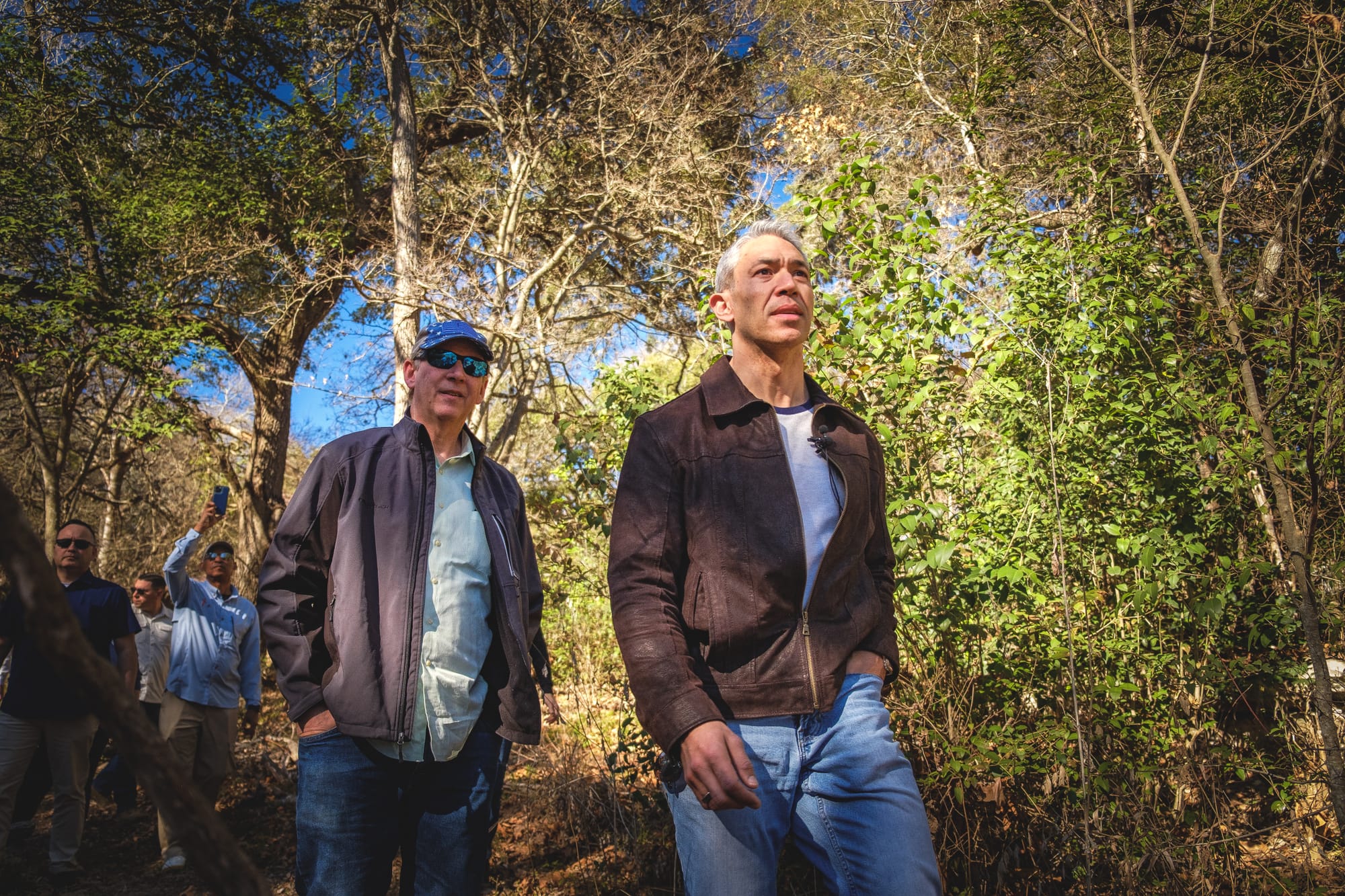
GREY FOREST, Texas—On Sunday, a dozen Grey Forest area residents in Northwest Bexar County hosted San Antonio Mayor Ron Nirenberg on a half-day tour of the headwaters of Helotes Creek. They shared recent histories of these still largely undeveloped lands, lesser-known archeological features, and—a point of trivia that has increasingly alarmed city dwellers to the east in recent months—facts about the area’s geology that could soon nprove quickly detrimental to the millions reliant on the Edwards Aquifer as their primary drinking water source.
Related: “‘Million Gallon March’ Decries Lennar’s Guajolote Ranch Development Plans”
A hearing before the Texas State Office of Administrative Hearings (SOAH) contesting a permit to operate a wastewater facility for a proposed 2,900-home development just above the Helotes Creek headwaters opened on Tuesday, February 18, 2025, and is ongoing this week. Residents are decrying the anticipated million gallons per day the facility is expected to discharge above Helotes Creek daily. A researcher who worked on a study published in 2020 suggested water contamination from the planned development known as Guajolote Ranch would reach local water wells in a matter of hours and the greater Edwards Aquifer within days.
It is at the SOAH that disputes between governmental entities must first be heard. In this case, the city of Grey Forest has been joined in their complaint by the San Antonio Metropolitan Health District, Greater Edwards Aquifer Alliance, and impacted property owner Ann Toepperwein.
While local residents have organized and raised funds for a lawsuit if they can’t get the result they seek at SOAH, San Antonio Mayor Ron Nirenberg told Deceleration that he would also consider advocating to purchase the property from under Lennar or sue the stop its development entirely.

“I am committed as mayor of the residents who depend on this water to exhaust every option that we have to prevent this development from happening,” Nirenberg said during the headwater tour. “That is what I think common sense requires and what my residents would expect.”
“We’re not interested in making enemies out of anyone but it requires people to sit down and talk and work out a fair solution. We think we have tools to make that happen,” he said.
Lennar, for its part, has failed to take Nirenberg up on his offer of a meeting.
“There is thousands and thousands of acres to develop homes and to put properties on that would not be such a detrimental and potentially catastrophic effect on our water supply. We want to have a fair chance to make a solution on behalf of the public—and that requires Lennar to come to the table.”
And legal action?
“That’s on the table, as far as I’m concerned.”
Annalisa Peace, executive director of the Greater Edwards Aquifer Alliance, a regional nonprofit dedicated to the “protection and preservation of the Edwards Aquifer, its springs, watersheds, and the Texas Hill Country that sustains it,” said that she reached out to the property owner to recommend discussing a conservation easement with the City of San Antonio but did not hear anything back.
She added that “Lennar hasn’t purchased the property yet, it’s an option to buy,” meaning that the company could be waiting to see if it can get the permits lined up first.
Although staff at the Texas Commission on Environmental Quality have signaled they are predisposed to approve the project, Peace recommended concerned residents “respectfully” message the Governor-appointed commissioners of the TCEQ, who will ultimately grant or deny the necessary permits. She also urged residents to be watchful for proposed legislation before the Texas Legislature that could help tighten controls for this proposal and others like it across the increasingly paved Hill County.
State Senator José Menéndez attempted to carry one such bill last session, Peace said, but failed to get it a hearing in the Republican-controlled process.
“They spent the last two weeks arguing about the bathroom bill,” Peace said. “It’s very frustrating. We’re just saying in this case let’s just get this done once and for all. These hill country water resources are something we should treasure and protect.”
Legislation seeking to further erode the lives and livelihoods of trans Texans seem only to be ratcheting up. So it’s unlikely that lawmakers will turn their attention away from who is using the bathrooms this session than making sure there is water available to flush when they are done.


