

Texas officials are undercounting heat-related deaths every year, missing thousands of deaths, according to a trio of models run by a Texas A&M-based climate scientist—deaths that may otherwise motivate policymakers to respond to a long neglected (and accelerating) public health crisis.
“Official Texas records captured only about one-sixth of the statistically estimated heat deaths, though this undercounting has improved over time,” concludes a new paper by Andrew Dessler published earlier this month in the journal GeoHealth.
“These findings highlight the need for better heat death tracking systems and expanded protection programs for both extreme heat waves and routine hot weather as climate change brings more frequent and intense heat to Texas,” writes Dessler.
Researchers have struggled in the face of poor record-keeping to accurately track heat deaths even as temps have been rising for decades.
A previous Research Letter published in 2024 by the Journal of the American Medical Association found that annual heat-related deaths in the United States rose from 1,069 in 1999 to 2,325 in 2023—a 117 percent increase. It’s a trend “likely to continue,” the authors wrote, as climate change continues to drive up global temps.

In Texas, heat-related deaths also surged from 2020 to 2023, , according to official tallies, as Deceleration wrote in 2024. It was a response to a surge in global heat that hasn't been experienced on the planet since modern humans began streaming out of Africa more than 100,000 years ago.
Deceleration has also reported on the chronic undercounting of such deaths, which the Occupational Safety and Health Administration under the Biden Administration described as a “vast undercount.”
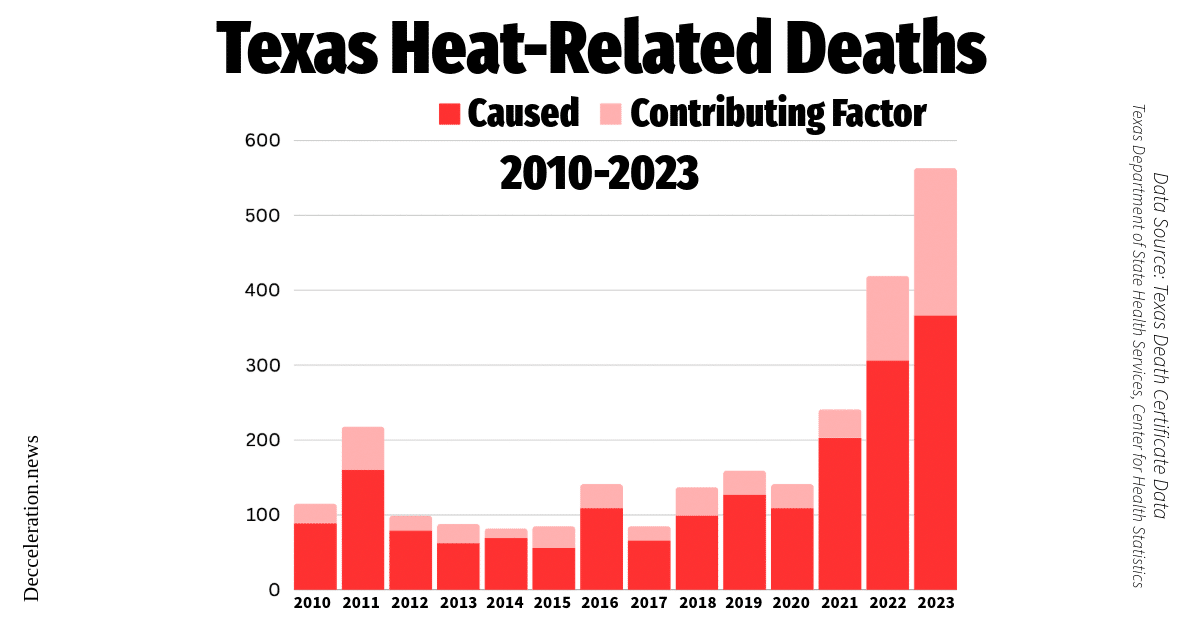
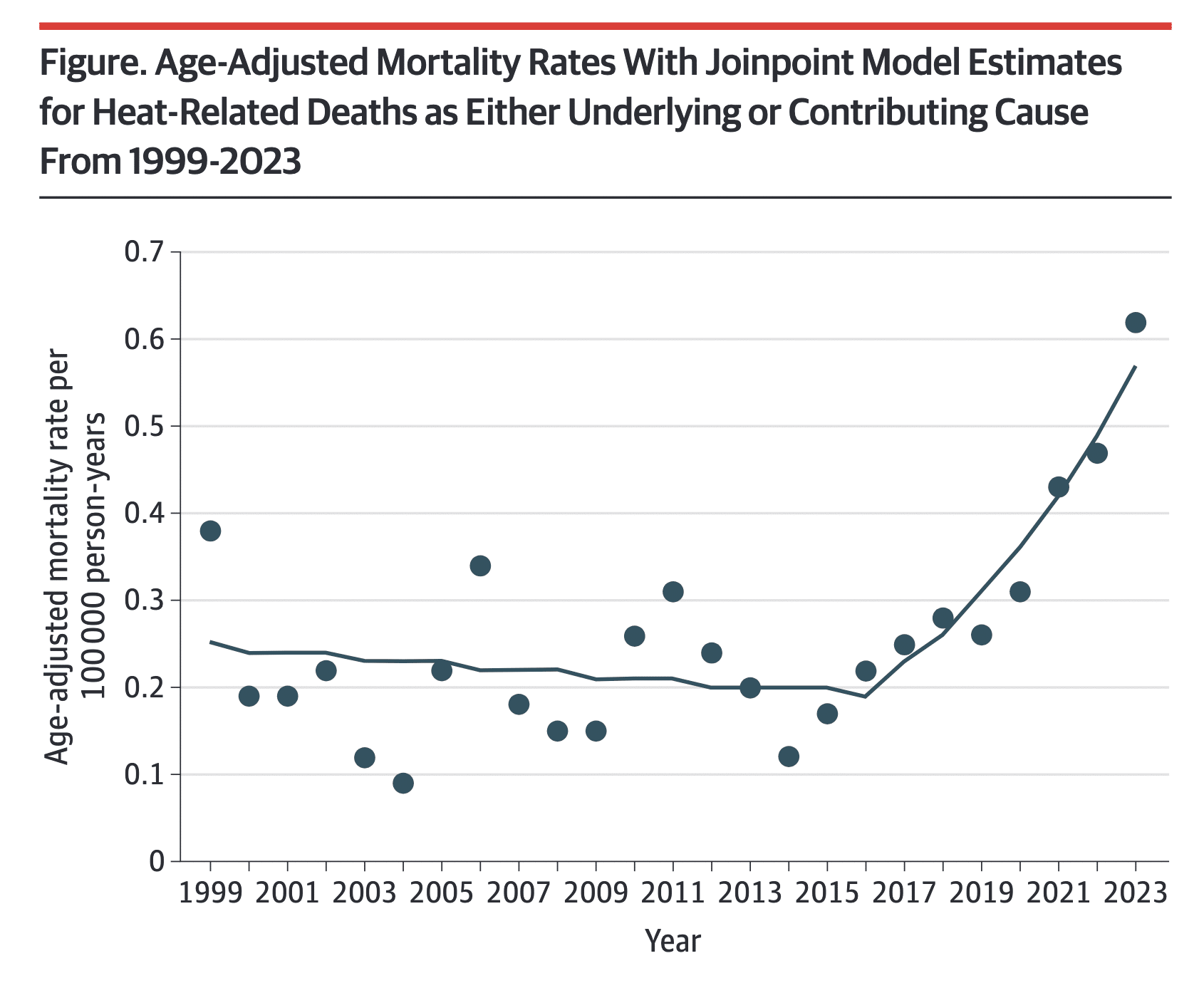
Trends in Texas and U.S. heat-related deaths.
While the state of Texas logged 563 heat-related deaths in 2023, according to data released to Deceleration by the Texas Department of State Health Services via open-records request, this new report suggests there are huge gaps in reporting.
To get his results, Dessler, aided by a graduate assistant Jesse Rutt, ran three models to understand the likely range of heat-related deaths, as captured in their paper, “The True Cost of Heat: Evaluating Heat-Related Mortality Estimation Methods in Texas.”
They focused on summer months during the years 2010 to 2023.
All three methods suggested official numbers are significantly lower than the reality on the ground.
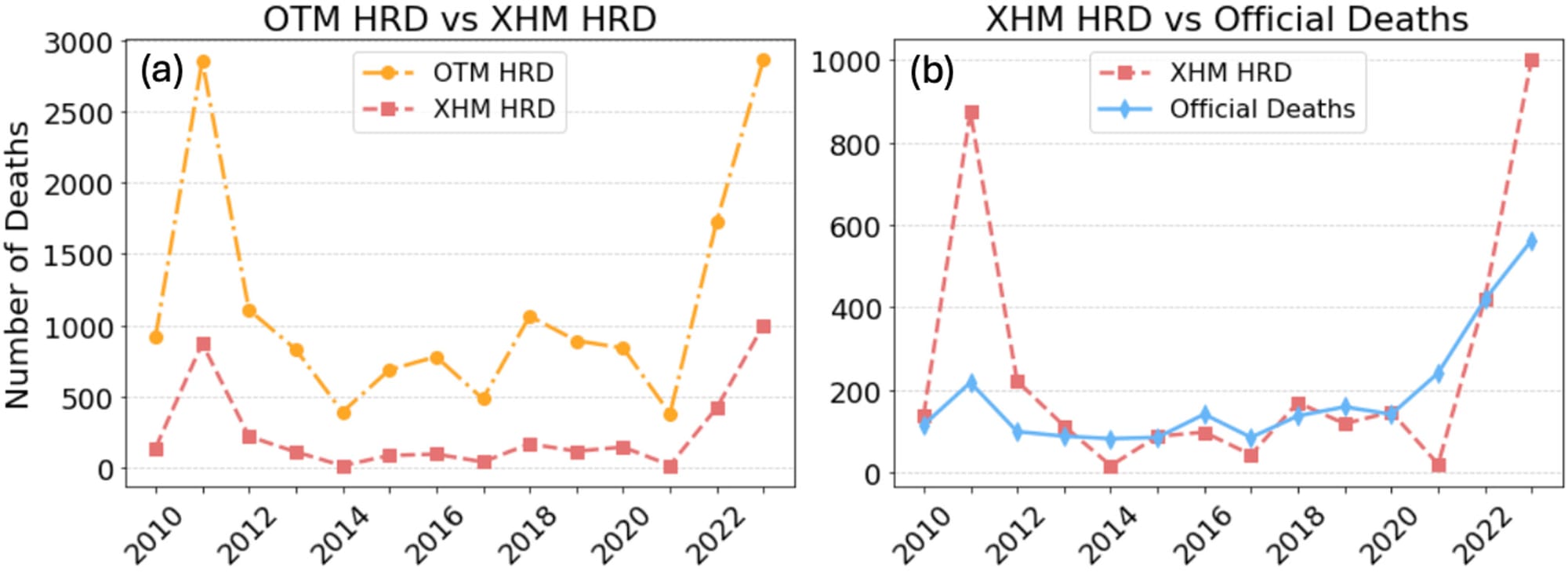
The pair found the bulk of unreported deaths likely occurred during periods of fairly typical summer heat. Using the common Optimal Temperature Method (OTM) of discovering heat-related deaths, they found that as many as 77 percent of all heat-related deaths occurred during periods of “moderate” heat, or 15,826 summertime deaths, roughly 1,130 summertime deaths per year.
Using a different model focused on extreme heat, the Extreme Heat Method (XHM), showed where deaths begin to surge. This model suggests 3,470 summertime heat-related deaths in Texas, or an average of 248 deaths per year. The spikes appear most clearly during the hottest years studied, 2011 and 2023, for example, where 873 deaths and 1,002 deaths manifest in the data, respectively.
“This means,” the pair write, “that 2.2% of all summer deaths were caused by moderate and extreme heat.”
That’s considerably more than the high of 563 deaths reported by the state in 2023.
The third model—the Excess Death Method (EDM)—explores increases in mortality over baseline, finding a 1.7 percent rise over what was seen during the middle 20th century.
Inhabitants of planet Earth have endured the consequences of what has amounted to a global experiment by profit-minded industrial interests. Year after year, an ever-growing accumulation of millions of tons of heat-trapping gases have been pumped into our atmosphere—primarily by engines, large and small, burning carbon-dense fossil fuels—while planet-cooling forests and natural spaces have been slashed and plundered.
While local, state, and federal governments in the United States were slowly cobbling together policies to reverse this trend, the Trump administration, riding a perhaps unprecedented financial campaign boost from fossil fuel interests, has chosen not to war against the climate crisis, but rather climate science.
Meanwhile, the climate crisis continues gathering strength.
The result has been a predictable corresponding global rise in heat, drought, and storms. Measuring that heat has been perhaps the simple part of the equation. Less straightforward has been calculating the harms, heat-related deaths in particular.
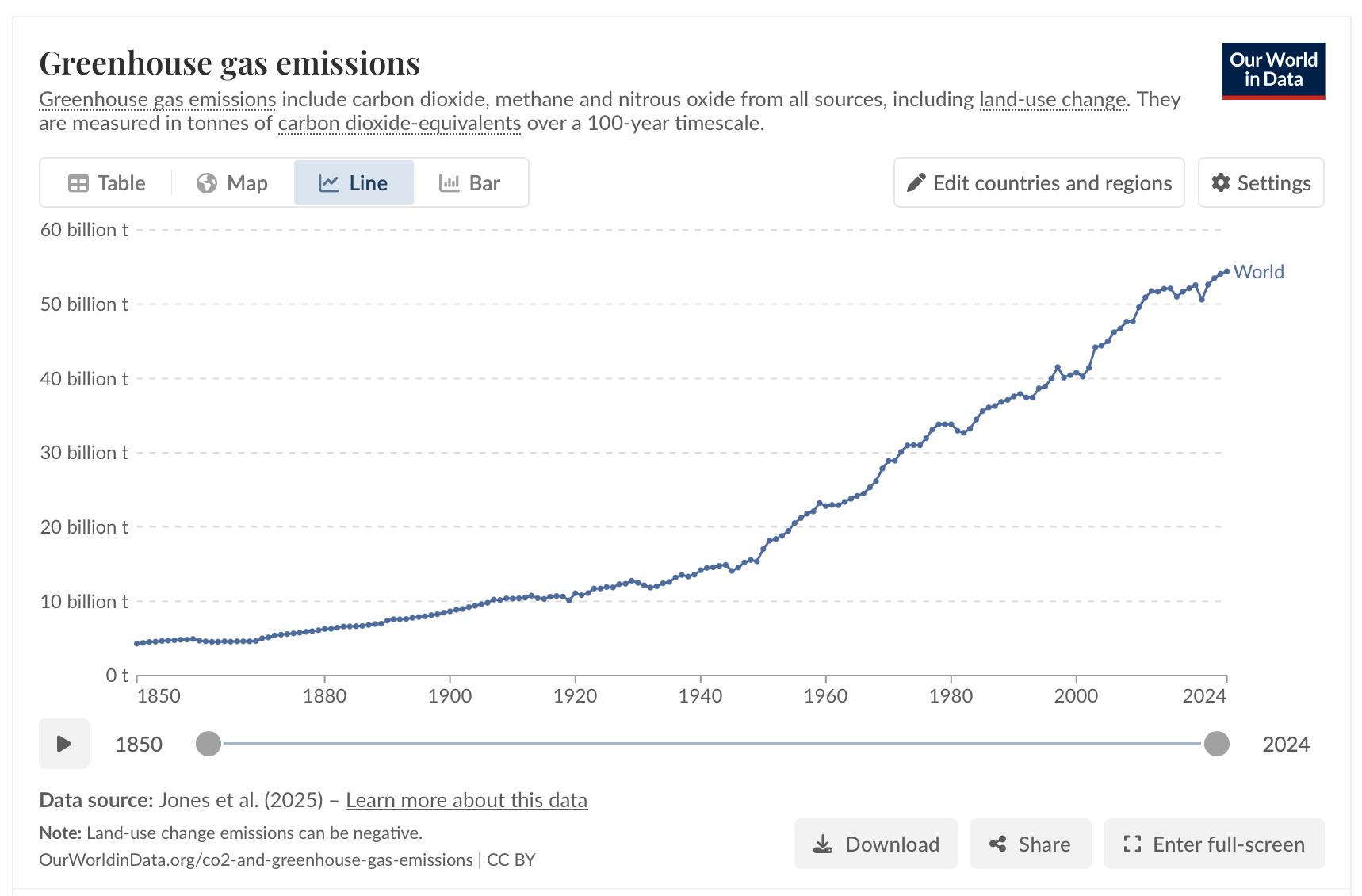
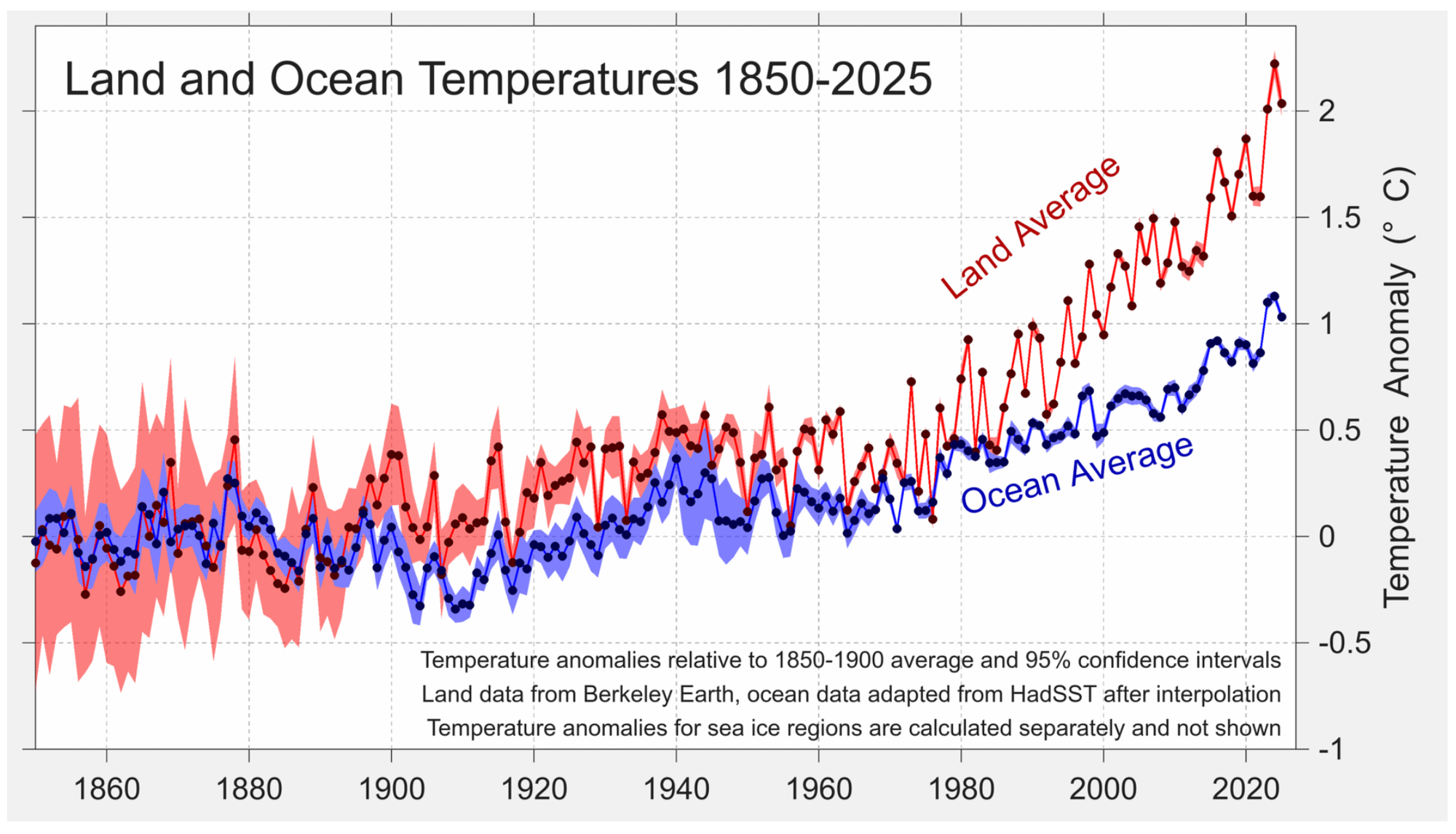
Today, research is uncovering millions of deaths per year due to climate impacts, with heat-related deaths surging since the 1990s to "an average of 546,000 a year between 2012 and 2021," the Guardian wrote recently.
"The destruction to lives and livelihoods will continue to escalate until we end our fossil fuel addiction," said Marina Romanello of University College London (UCL).
With his early career in the 1980s spent on Wall Street (in the fossil fuel sector, no less), Dessler said he learned quickly what actually motivated him--and it wasn’t profit.
“Money doesn't motivate me,” Dessler told Deceleration this week. “But interesting problems do motivate me. And so I got some advice at the time that I should go into the environment.”
Dessler’s first project involved the expanding ozone hole, a gash in the upper atmosphere caused by ozone-depleting chemicals that was exposing more of the global population to cancer-causing ultraviolet radiation. (Ground-level ozone, or “smog,” is harmful to human health; in the stratosphere it protects life on Earth.) Ultimately a combination of rigorous research and an international policy response helped constrain those chemicals and reverse the damages.
A study published in the journal Nature last year confirmed those benefits were the primary reason for the restoration of the ozone layer observed in recent years.
“It shows we can actually solve environmental problems,” said Susan Solomon, professor of environmental studies and chemistry at MIT, last year.
Dessler had a hand in that research.
With the technical resolution of the ozone hole crisis (science nearly always precedes policy responses), Dessler had to find a new nut to crack. His next interests took him slightly lower down in the atmosphere, from the stratosphere to the troposphere, where most observable weather occurs. He had previously worked on understanding how water vapor behaves higher up , but with rising concerns over global warming, he lowered his sights.
“I could apply what I knew about water vapor,” Dessler said, “to the climate problem. Because water vapor is a big player in climate change.”
These days one of his key questions concerns how growing heat caused by global warming is impacting people.
“In the last couple of years, I've looked at mortality. I've looked at the electricity grid. I have a student who's looking at real estate after Harvey in Houston,” Dessler told Deceleration.
“As an academic, you should always be looking for the next important problem. And what you've been working on in the past, you have to be ready to abandon it. And I've done that several times in my career and always for the betterment of my work.”
While Texas is one of the most heat-impacted U.S. states, most counties—where unattended deaths are often logged by justices of the peace with very limited medical training—still don’t have reliable ways of tracking heat’s impact on the public health.
The Dessler paper speaks to that, as well.
“These findings highlight the need for better heat death tracking systems and expanded protection programs for both extreme heat waves and routine hot weather as climate change brings more frequent and intense heat to Texas.”
The most dangerous climate-related fiction in the state may be that "Texas has always been hot." This reflects a cultural attitude more than historical reality. Not only are human thoughts on the weather clouded by "expectations, memory limitations, and cognitive biases," according to one recent paper on the topic, but extreme weather shocks are moved from "unusual" to "normal" by most people within the span of just a few years.
The reality is that this is not your parent's or grandparent's heat or humidity. It's worse. And it's a trend bring reinforced by our extractive energy and land-management decisions and therefore show no signs of slowing.
"I grew up in Texas. I remember Texas in the '70s. It wasn't that hot. It was much cooler in the summers in the '70s. But people's memories are terrible," Dessler said. "That's a big problem. And then you layer on top of that kind of the polluted media environment we live in where much of what people hear is misinformation."
"People are given the option today of kind of believing what they want to believe, what fits with their worldview, as opposed to what's actually correct."


