
What can you do to address climate change? Start by supporting local Indigenous nations and orgs and their efforts to shift how we think about and relate to land.
RELATED: On Land: Restoring Right Relations | Community Gardens & Farmer’s Markets | Permaculture Skills
Contemporary environmental crises like climate change and biodiversity collapse may seem recent, but they are centuries in the making. Their deepest historical roots lie in processes that reach back to the 15th century, when European settlers sought to claim and colonize lands beyond their own historic geographies. To do so, they needed to cast Indigenous lands wherever they landed—the Caribbean, North and South America, Africa—as empty of inhabitants. Just as significantly, they needed to shift the meaning of land from a living being to a commodity—a thing they could own, sell, and accumulate as property.
Settler-colonial thinking also needed to imagine humans as separate from nature so that white European men could be placed above it as fully human, civilized, and enlightened—in the process relegating those whose lands they colonized to the bottom of a manufactured racial caste system. In this way, the idea of “race” emerged alongside, and as justification for, the idea of nature as a dead thing to possess as property and develop for profit.
The European quest to dominate land and nature thus emerged from the same historical processes of enslavement, land theft, and dispossession whose ongoing legacy we today understand as global systems of white supremacy, racial capitalism, and settler colonialism. And those same interlinked legacies (nature as thing to exploit for profit, “race” as technology of land and labor theft) have been the (literal) internal combustion engine of the economic shifts that have led today to what John Bellamy Foster calls an “ecological rift.” Climate change is the most visible manifestation of this rift, but biodiversity loss, ocean acidification, ozone depletion, chemical pollution, and other ecological breaches are equally critical.
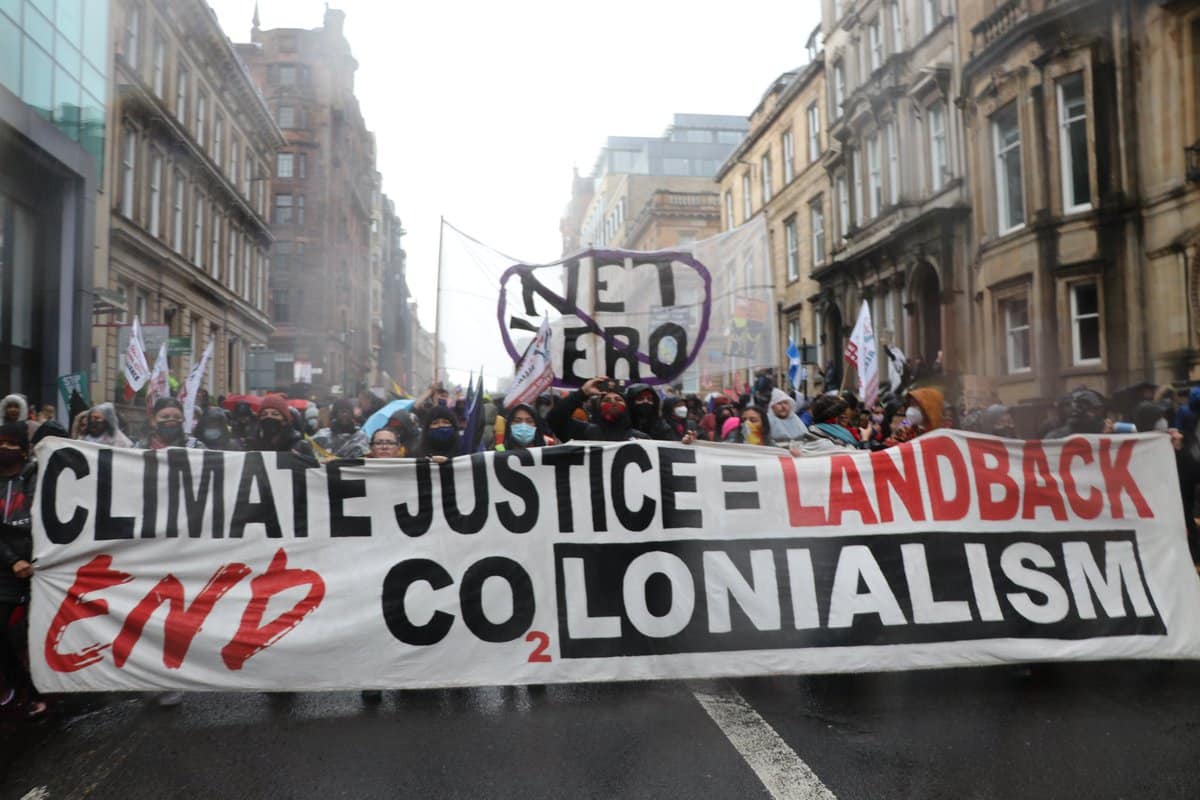
Beginning to address these multiple disruptions to ecological life-support systems, then, means dismantling global systems of domination, beginning with how we think about and relate to land. But how do we do that? Well, by joining or supporting local efforts to decolonize and decommodify land! It is important to point out here that “decolonization” here is not metaphorical: it means supporting local movements for landback, Indigenous sovereignty, and sacred site protection.
Toward that end, we’ve assembled this regional map of land decolonization efforts throughout the watersheds of Somi S’ek (South Texas, in the language of the Esto’k Gna), beginning with those that are tribally or Indigenous-led. Relatedly, we have assembled a list of organizations allied with Indigenous land ethics in their efforts to teach people how to relate to land in ways that work with rather than against nature (See: Permaculture: Skills for Living Land Care).
Among those active in anti-extraction work are the Carrizo/Comecrudo Tribe of Texas and the pan-Indigenous Society of Native Nations. But there are many others working on land and cultural preservation more broadly who are also worthy of support. Many of them are listed on this page.
Featured Video: Yanawana Herbolarios
Tribes and bands based in the region
For additions/subtractions/suggested edits, write us at editor@deceleration.news.
- Carrizo/Comecrudo Tribe of Texas
- “The Carrizo/Comecrudo people lived along the South Texas Rio Grande delta. Regardless of the lack of cultural and tribal understanding, of written historical data, the so-called dependency factor, [and] apparent genocide and Christian conversion, the Carrizo/Comecrudo still survived the occupation of their homelands and spiritual souls. The Carrizo/Comecrudo has hidden well in the pages of history, as they have hidden in present day society. If, the hiding was for preservation of survival, poor information gathering by early Europeans, lack of interest in a less aggressive tribe, or poor anthropological interest, or the Christian perspective of peyote, nevertheless, this little written about nation manages to leave historical trails. Today, in the verge of new awakening, the Carrizo/Comecrudo brings others to their existence, which never faded, just remained hidden.”
- Lipan Apache Band of Texas
- “The Lipan Apache Band of Texas membership consist of 745 members and is composed of the Cúelcahén Ndé (People of the Tall Grass), Tú é diné Ndé (Tough People of the Desert), Tú sìs Ndé (Big Water People), Tas steé be glui Ndé (Rock Tied to Head People), Buií gl un Ndé (Many Necklaces People), and Zuá Zuá Ndé (People of the Lava Beds) that have continuously lived in Texas prior to First Contact 1528.”
- Lipan Apache Tribe
- “The Lipan Apache Tribe continues to be a sovereign Native American tribe in the State of Texas with a governing body, the Tribal Council, tasked with promoting the general welfare and justice for the Lipan Apache people; acquiring resources for the benefit of its people; protecting the Tribe’s Native American heritage including their traditions, ceremonies, language, and sacred history; preserving, securing, and exercising all the inherent sovereign rights and powers of a Native American tribe; and continuing relations with the United States of America and the State of Texas.”
- Tap Pilam Coahuiltecan Nation
- “Is your family originally from San Antonio? You may be a relative of the Tap Pilam Coahuiltecan Nation. Many San Antonio families have lived in and around the missions for generations, but many have lost connection to their tribal culture and names. The Tap Pilam Coahuiltecan Nationis a tribal community of affiliated Bands and Clans that include the Payaya, Pacoa, Borrado, Pakawan, Paguame, Papanac, Hierbepiame, Xarame, Pajalat, Tilijae nations, modernly known at Coahuiltecans. Our traditional territories consist [of] today’s political boundaries [of] Texas, Coahuila, Tamaulipas, Nuevo Leon, and northern Potosí. We are people of two countries and have been regarded by both as foreigners in our own homelands. We are still here. Our community is still alive.”
- Tehuan Band of Mission Indians
- Descendants of the San Jose Mission: “We exist in order to share our culture and lived experiences through genealogy, dance, education, music, art, and community. The Missions were built through the blood, sweat, and tears of our ancestors and we continue to strive and be an integral part of the history of San Antonio as well as a vital part of its future.”
Native-led organizations
For additions/subtractions/suggested edits, write us at editor@deceleration.news.
- American Indians in Texas at the Spanish Colonial Missions
- The Mission of the American Indians in Texas at the Spanish Colonial Missions is to work for the preservation and protection of the culture and traditions of the Tap Pilam Coahuiltecan Nation and other indigenous people of the Spanish Colonial Missions in South Texas and Northern Mexico through: education, research, community outreach, economic development projects and legislative initiatives at the federal, state and local levels.
- Warrior Roots Training Camp, an AIT project, is an opportunity to gain new grassroots community organizing skills and meet with fellow community members, activists, artists, cultural promoters, and others ready to work hard toward justice. The organizing committee works intentionally to create a weekend that educates, motivates and lays the foundation for ongoing community building across many different issue areas.
- Galería EVA (Ecos y Voces de Arte)
- Grounded in Mixteca culture and land relations, Endowment of the Arts recognized ceramics artist Veronica Castillo offers the community a thriving art gallery that showcases art from all over the world.
- Indigenous Cultures Institute
- The Indigenous Cultures Institute was founded in 2006 by members of the Miakan/Garza band, one of the over 600 bands that resided in Texas and Northeastern Mexico when the Spaniards first arrived. The 83rd legislature recognized the Miakan/Garza band as a Texas Indian tribe with “immeasurable contributions to the State of Texas”. Members of the Miakan-Garza Band still practice their traditional ceremonies and maintain long held family ties.
- Kalpulli Ayolopaktzin
- We work to re-tribalize Families of Indigenous Descent through Kalpulli Kinship & Nahuatlaca (Nahuatl language) Traditions. We are a ceremonial group preserving Danza Mexica-Chichimeca lineage committed to undoing the harm of colonial trauma through Intergenerational Healing, Traditional Medicines, Rites of Passage, Indigenous Pedagogy, Cultural Performances, and Ancestral Land Based Knowledge Systems. We recognize that many of our detribalized people are searching to reconnect; we provide BIPOC community a space to reconnect with land, ancestral, and cultural legacies that honor historical, familial, and personal ties to land, migration, co-existence and continued inter-tribal kinship. (Check out their Digital Land Remembrance.)
- SanArte Healing and Cultural Clinic
- SanArte is a community-led cultural healing and empowerment collective that offers live and virtual programming, mobile clinics, education, and facilitation to activate ancestral wisdom, traditional healing practices, and nurture a collaborative spirit in communities in Yanaguana (the greater San Antonio/Central Texas area).
- Society of Native Nations
- The Society of Native Nations (SNN) is an organization founded by a small group of Native people in Texas with members in many states that are dedicated to advocating for our people and the earth by helping to protect and preserve our native culture, spirituality, teachings, medicine, and way of life. Each of our founding members has experience working with our people and other organizations that bring a unique set of values and perceptions to SNN. Exposure and witness to racism, appropriation, and exploitation of our way of life have compelled each of us to stand united against social and environmental injustice. Our teachings tell us that Creator tasked Native people to be the “keepers of the earth.” We believe we are environmentally conscious through our DNA and because our lifeways and culture parallel the health of Mother Earth. Through ancestral memories, prayer, and determination, we strive to help bring a positive change to our people and Mother Earth.
- Texas Tribal Buffalo Project
- Texas Tribal Project is a non-profit dedicated to the developing relationship of our relatives the Iyanee’/ Buffalo and reconnection and healing of generational trauma of the Lipan Apache and other indigenous communities and tribes in Texas.
- Yanaguana Herbolarios
- Our Mission is to share, preserve, and honor cultural knowledge of the land and make it universally accessible as a means to empower and revive the practice of holistic living, medical botanical usage, water and land stewardship, and coming together as a community in times of need.
-30-
Top image: Members of Indigenous organizations Society of Native Nations, Kalpulli Ayolopaktzin, and various tribal communities marching in 2016 against a gas pipeline in West Texas. Image: Greg Harman