

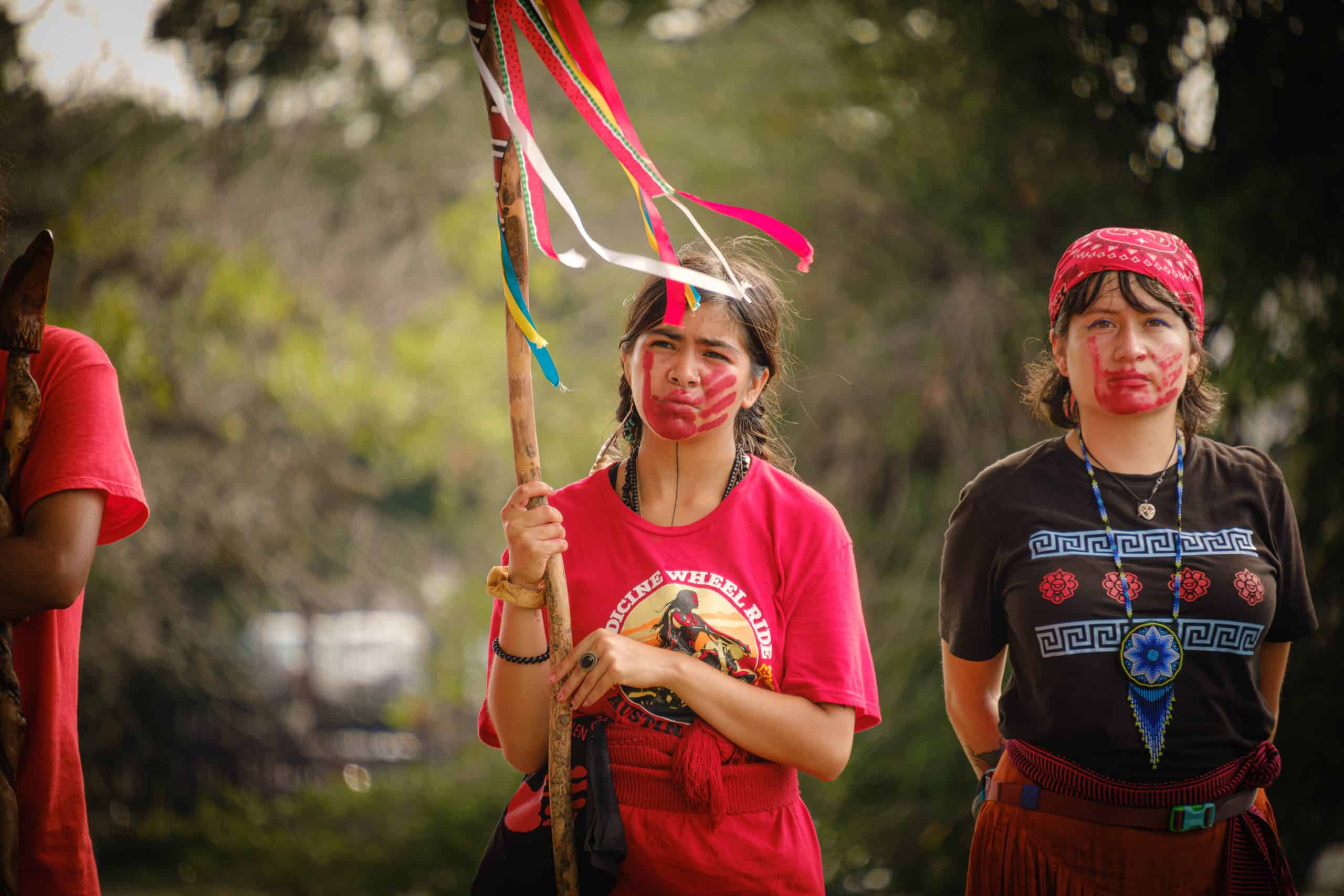
Though officially begun in 1992, the routes run by the Peace and Dignity Journeys trace an unbroken ancestral history of migration and ceremony across Abya Yala that continues in 2024.
Here’s an essential report back from this year’s prayer run as it moved its way south through San Pedro Park in San Antonio.
Danielle López
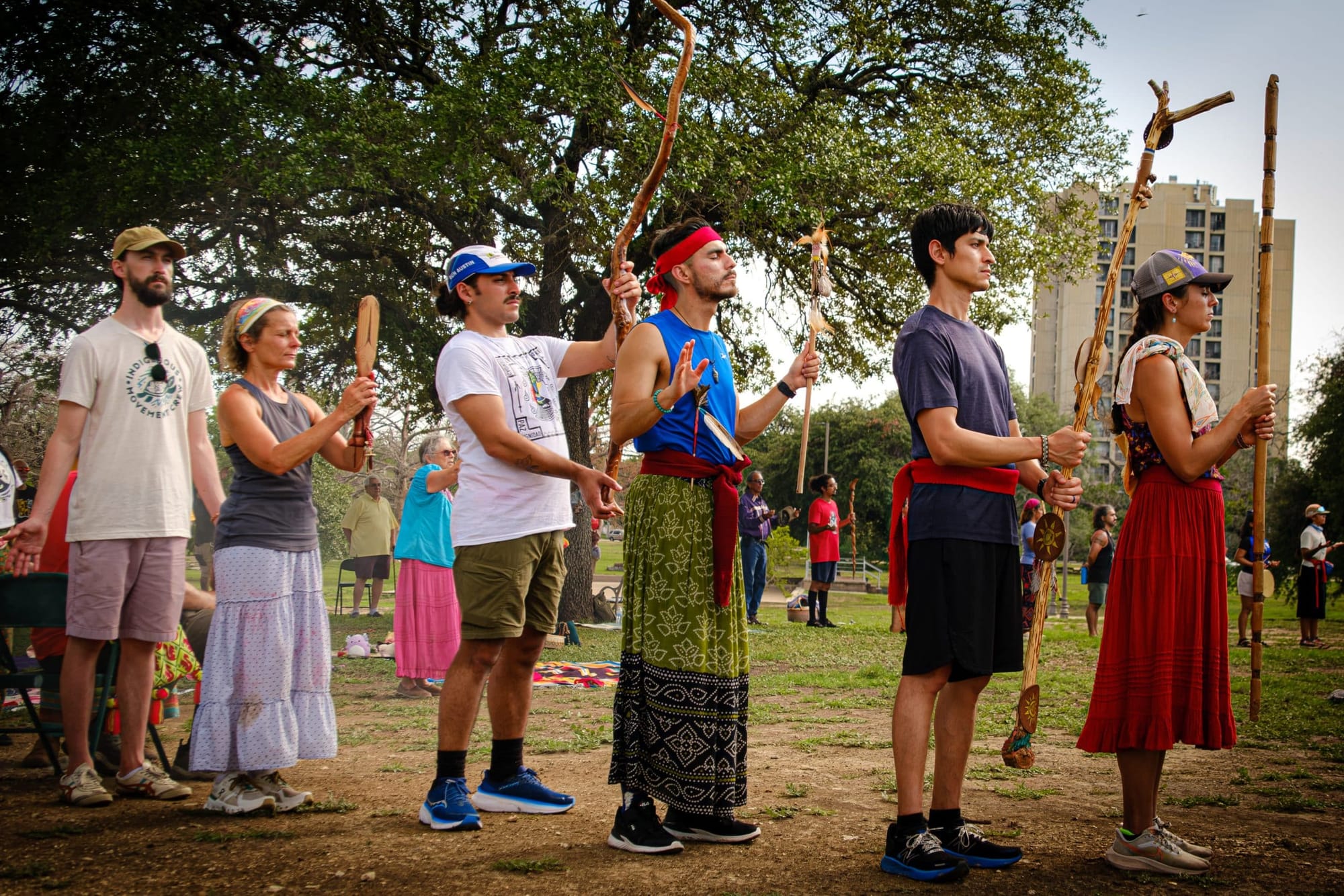
As they spotted the first runners, an electric synergy of exuberant joy elevated the crowd at San Pedro Springs Park. For an hour they had waited patiently: elders had laid out an altar on the grass, and the children had run around in play like shooting stars in flight. But as the prayer staves came bobbing into view, held up by the runners as they entered the park from the north, a soothing presence entered the space. The group quieted, sensing a rush of comfort that can only be described as pure medicine.
Dozens of attendees had gathered late on Sunday afternoon, July 28, 2024, for a ceremonial welcome of that year’s prayer runners in the Peace and Dignity Journeys. The runners had chosen to pass through the park on their Texas stretch largely for its deep historical and spiritual significance. Not only is San Pedro Park the second oldest public park in the nation, it is also the site of sacred springs—now mostly dry—where the original peoples first gathered in what would become San Antonio, thousands of years before Spanish colonial settlement.
The Journey sought to remember the land prior to the onset of settler and colonial violence, continuing its tradition of including sacred sites in need of deep healing. For similar reasons, this year’s PDJ route visited Uvalde, Texas. There runners offered an important prayer of respect for the 21 victims of the 2022 Robb Elementary School shooting, remembering that how we treat our children determines the state of a people’s soul. Without centering our children, we cannot nurture the peace and dignity of our collective future.
The Peace and Dignity run rests on this foundational intention to honor and offer healing to our beloved relations across Abya Yala. As if by spiritual decree, the runners arrived illuminated by the blazing sun. Their most recent route from Austin to San Antonio had met them with fierce rain relieved by the warmth of the sun, both answers to the prayers they offered. As a meditative pathway, the run had included San Pedro Park as sacred site to honor our ancestral founding spring waters, but also to honor migration both as human right and prayerful rite. Beyond any border, obstacle, or danger, this prayer run has persevered, continuing to represent longstanding traditions of sacred migration and diplomacy among Indigenous nations.
At the heart of PDJ is a vision of intercontinental unity. In accordance with the prophecy of the Eagle and the Condor, the run begins at opposite ends of the continents—in Fairbanks, Alaska, to the North and Tierra del Fuego, Argentina, from the South—with runners converging this year at El Cuaca, Colombia.
This route holds ancestral understandings of the land. In the beginning it was Anahuac and Tahuantinsuyu, which is together known as Abya Yala, or Turtle Island. Though the land has since been divided by colonial borders into what we commonly call North America and South America, the descendants of these proud Indigenous nations remain connected across the Western hemisphere through prayerful migration, rooted both in ceremonial routes and peaceful trade.
Before the invasion of colonizers there already existed many ceremonial routes just like today’s prayer run, and original peoples engaged in trade with special reverence for the land, spirits, and people encountered in those travels.
Many of the precious items traded were invaluable to the most honorable ceremonies performed to maintain a kinship between land, spirit, and intercontinental relatives. In this way, the routes for what we may better understand today as pilgrimage honored the seasonal and medicinal rites of tribal nations.
Trade along these routes would have included copper, turquoise, animal products, medicine, and ceremonial items, but also shared inventions, philosophies, and religious and spiritual practices of the nations. Often trade was seen as ceremonial itself, and in this regard ancestral travelers gave due respect to the intercontinental kinship formed in the process. For this reason, it must be emphasized how long standing prayer routes like the PDJ have been. The same routes we use today can very well be traced to those ancestral roads for travel, trade, pilgrimage, and celebration.
Reflecting on the way the route reconnects the line of springs traversing Central Texas along the Edwards Aquifer artesian zone—Barton Springs, Comal Springs, San Pedro—Vanessa Quezada, a member of the Xarame clan of the Tap Pilam Coahuiltecan Nation, echoed this idea.
“Part of this prayer is reactivating our trade routes,” she said. “And becoming more sensitive to the ways that we traveled in the past. And so each step that we take is a prayer. And it’s reconnecting us and its prayer for all of our relations.”
RELATED: “Bridge to the Ancestors: Indigenous Run Decries Colonial Violence in Texas“
Though it began in 1990 as a counterstory to the quincentenary of Columbus’s genocidal arrival in the Américas, the Peace and Dignity Journey effectively embodies that longstanding history and purpose, serving as one of the most sacred and enduring prayers among all relations intercontinentally. Despite the challenges created by centuries of colonial violence, PDJ shows that our ways of prayer and bridging have persisted. If readers take time for deep reflection and study, they will find the heritage of this prayer run in our ancestral oral histories, our traditional writings, and the cultural emblems of trade relationships.
The runners’ presence in San Pedro Park reflected this continuity. As the runners entered, our attention and mutual joy opened an immense talking circle. Elders began their blessing, graciously moving through the circle to grant all in attendance an honorable smudge blessing. Following this, Iriany Itzel López-Hernández of the Hñähñú/Otomí people, who was joining the prayer run for the second time, gave the opening ceremonial remarks.
Gifting us with the origin story of the PDJ run, she described how the sacred intentions she carried as a runner are rooted in her prayers for all life: “To contribute my little piece of sand,” she said, “it may seem small, but if we collect all the pieces of sand, we may have a shore.” Her allegorical shore beckons us toward the making of a brighter future, and visiting the sacred sites along the run brings that healing sand toward reclaiming peace and dignity.
López-Hernández also shared the importance of offering affirmative prayers for all the nations connected by the run. As she eloquently put it:
“We get to hear a lot of different messages from different communities. Sometimes they share with us the prayers they would like for us to keep in mind. There’s prayers for the youth, there’s prayers for murdered/missing Indigenous women, there’s prayers for sacred sites, there’s prayers for sobriety. It’s a prayer for all life.”
This prayer for all life is something members of the PDJ Council convey as well, as relayed by Vanessa Quezada with understanding and compassion. Reflecting on the theme for that year’s run, the Nahuatl concept of tlatoa or “palabra del corazon, aliento de la vida” (word from the heart, breath of life), Quezada said:
“I feel like what a lot of what this prayer is teaching us is how to, number one, take care of our word. And that in taking care of our word, we are taking more responsibility for how we are outwardly affecting all of life. And that also has this reflective piece for us to take care of ourselves inside. … And that will help us to rebalance where we need to be on the earth, so that we can all be able to sustain life together.”
These collective intentions were echoed by a MJ Léon, a young runner in this year’s PDJ who carried the run’s lead staff that day and recalled a profound moment on the route between springs.
“I was praying for rain,” he said, “because before starting the run we had gone to the Blue Hole [headwater springs of the San Antonio River] and it was dry. And I wanted to keep that spring in my prayers, that it gets flowing again, that people are able to pray at that spot with the water there. So that was my prayer that morning. And then we got drenched, and blessed by the rain!
RELATED: “Judge Refuses to Slow Brackenridge Redevelopment Project Over Indigenous Lawsuit Claims“
López-Hernández beautifully captured the message that all people—those already familiar with the Journeys and those who are not—can receive from this prayer.
“Even though it is a Native/Indigenous-led running prayer,” she said, “it is for everyone. It is open for everyone who, their heart is called to this prayer. And it’s for the Earth. So it’s focused on this continent, but it’s intertribal, intercontinental and a global prayer.
“There’s a lot of different things that are going on right now,” López-Hernández continued. “There’s a lot of different pains, there’s a lot of different sorrow, a lot of different rage. It’s all kind of valid, right? And I think our ancestors thought of us a long, long, long, long time ago and gave us these tools, gave us these practices. So that we are able to take care of ourselves and be able to not just freeze and stay frozen in the midst of pain, in the midst of sorrow, in the midst of rage. Rather, to be able to say, ‘Okay, you’re here!’ And then like, ‘Let’s move it, let’s transform it!’”
When asked how youth who may feel disconnected from their indigeneity might describe the connection they feel to the Journey’s energetic blessing, López-Hernández explained it this way:
“What moves this [run], and what I think moves many traditions that are still standing with integrity—it is that love. Maybe for them, they cannot say, ‘It’s the Eagle, the Condor, the Quetzal.’ But anytime they’re able to tune into that love, to that unconditional love, that’s part of this prayer. … Even if it’s just for a second, to that unconditional love, they have that reference, they have a key that can slowly start opening other doors.”
-30-
Danielle López, PhD (two spirit) is a born & raised Nepantlera from the settler occupied medicine gardens of Aztlan, Coahuiltecan, Ndé Kónitsąąíí – Lipan Apache, Esto’k Gna (Carrizo/Comecrudo) territories, better known as the Río Grande Valley of the Transfronteriza at the U.S-Mexico Borderlands. They are a seventh generation curandera in practice, activist, researcher, and educator of the spiritual literacy of their ancestral medicine. Centering curanderismo, their Border Arte-scholarship focuses on empowering communities via their ancestral wellness praxis. They promote the collaborative plática of all healing cultures to foster pathways for spiritual reparations. Their autohistoria-teoria is archived at the Latin Smithsonian Museum, the University of Houston Center for Public History, and the Indigenous People’s Caucus of Texas.
For more information or to support the Peace & Dignity Journey, visit or contact their website here.

Like What You’re Seeing? Become a patron for as little as $1 per month. Explore ways to support our mission. Sign up for our newsletter (for nothing!). Subscribe to our podcast at iTunes. Share this story with others.


