

Originally published in Deceleration's 'Alternative Futures' newsletter. Become a subscriber today.
Seven years ago, in 2018, half-way through Trump's flailing first term, Greta Thunberg began her Fridays for Future school strikes, Sunrise Movement activists occupied Nancy Pelosi's office to demand a Green New Deal, and political economists Geoff Mann and Joel Wainwright published their book Climate Leviathan.
With the Paris Agreement just three years old and the pursuit of climate justice a quest that crusaders across the world had taken up, the book had an undeniable salience.
In it, Mann and Wainwright describe how climate change, and the way governments respond to it, will resurface the geopolitical landscape—uplifting new foundations as old norms erode, throwing the world into fresh relief. As the theorists elaborate those dynamics, they articulate how the future of global governance must look to make true, robust climate justice possible.
They saw four broad categories of possible political futures for our planet according to where the world lands along two axes: how it relates to capitalism, and where sovereignty and authority is founded: at the level of the planet or down at the roots.
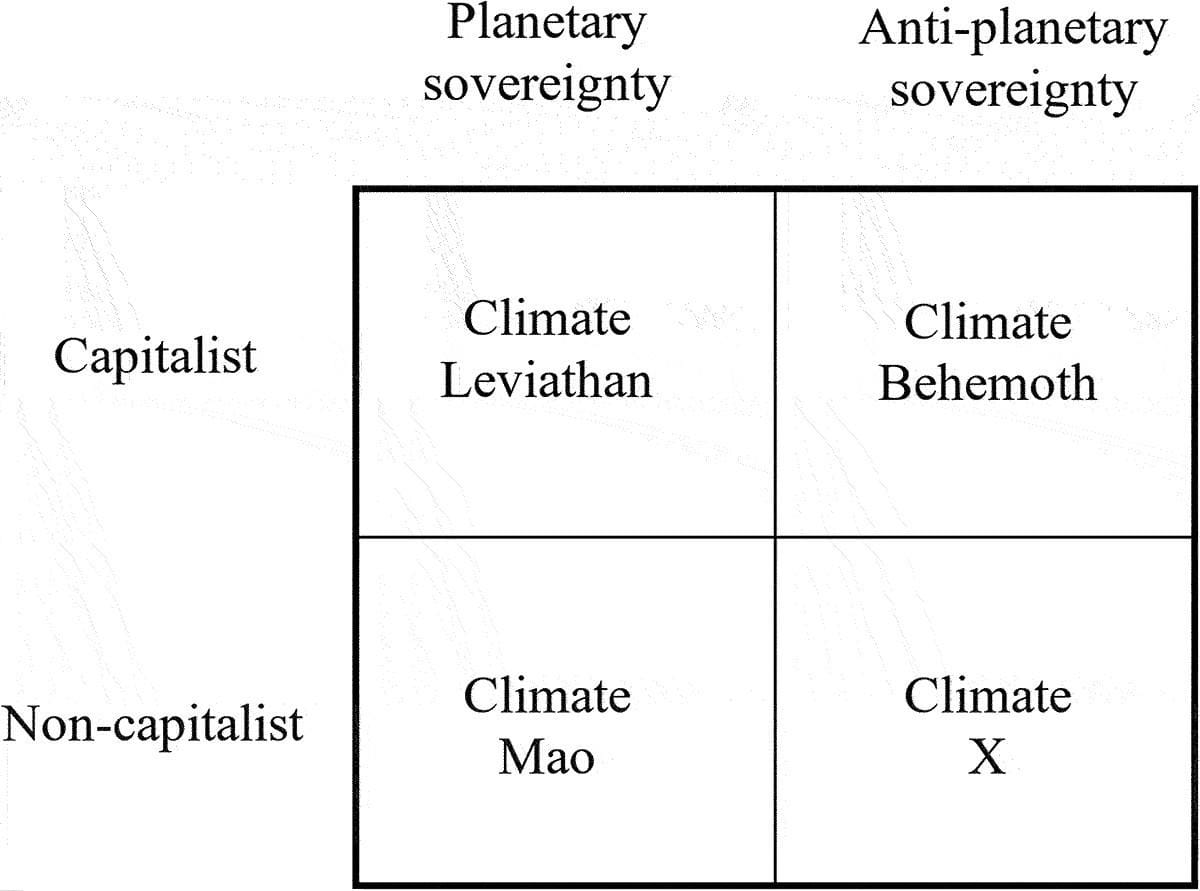
Should sovereignty and political authority come to be abstracted further away from the people to sit at the level of the globe and exist to protect and serve capital, this would create what Mann and Wainwright refer to as “Climate Leviathan.”
This would function as something like a super-charged United Nations empowered to institute global environmental regulations and rig the Earth to a life support system that allows its scientific apparatus to monitor the planet’s vitals; but any solutions to the climate crisis would remain rooted in the belief that today’s industrial titans can innovate us out of the dilemma their precursors innovated us into.
If, on the other hand, planetary sovereignty should emerge undergirded by a centrally planned, anti-capitalist economy as U.S. influence waned and China’s rose, it would create what the authors call “Climate Mao.” Such a government, with its ability to expressly direct and dictate global climate action, “reflects the demand for rapid, revolutionary, state-led transformation today,” the authors write.
The other two possible futures would likely emerge as a response to the increasing tilt toward true global governance, the authors argue, whether in the name of “reactionary populism” or “revolutionary anti-state democracy.”
The former case would birth a so-called “Climate Behemoth” that privileges free market nationalism above all, making climate action nigh impossible.
The alternative would be what Mann and Wainwright refer to as “Climate X,” a somewhat nebulous title because of their desire to avoid prescribing how this inherently multifaceted approach would look. One of the primary principles of such a future borrows a phrase from the Zapatistas; it would be defined, in part, they write, by “solidarity in composing a world of many worlds.”
In such a nested world, communities would be empowered to collectively dream up solutions to the problems they face, solutions that would transcend the restrictions of capitalism and afford all people dignity, inclusion, and equality.
The dream of Climate X, the authors admit, is somewhat utopian and will require a quite large and revolutionary movement to manifest. Still, it’s the best — possibly only — chance we have of achieving true climate justice for everyone around the world. But everyday this radical, hopeful, just alternative seems to slip further below the horizon.
Given the ruptures and upheavals that have happened in the years since Climate Leviathan was first published — a devastating pandemic and the rise of American fascism to name but two — I called Joel Wainwright, a professor at Ohio State University, to ask him about what our present moment means for the political futures he and Mann describe in their book and what it will take to redirect course toward Climate X.
When he and Mann started working on the manuscript, Wainwright told me, it was just after the Paris Agreement had been signed. That moment seemed to signal “a turning point in history,” he said. A global government of the Climate Leviathan had shown its bud, but had yet to fully fruit.
Over the coming years, the Paris Agreement would face a common and recurrent critique: It’s not enforceable. Rectifying this shortfall and affording the UN the authority to mandate actions and punish those nations that fall short of their obligations would cement the rising leviathan. Such a path has been deemed ideal, necessary even, by scholars like Nils Gilman and Jonathan Blake who argue for a global government in their 2024 book Children of a Modest Star.
“But what we have seen,” Wainwright said, “is that the ability of the elites to reorganize the world system has been very difficult, and we are essentially in a war now between Behemoth and Leviathan — not as things, but as potential futures.”
For the moment, at least, Behemoth seems to be winning. But Wainwright refuses to accept that it will win out in the long run: “Because what that means, frankly speaking, is that humanity is in very, very serious trouble; because there is no livable future under Behemoth.”
The ideals of Climate X, however, remain firmly cemented in the minds and actions of the most radical thinkers and activists working today. Japanese political philosopher Kohei Saito even provides his own argument in favor of it in his 2024 book Slow Down: The Degrowth Manifesto. Still, Wainwright acknowledged “the odds are longer today than they were at the time we wrote our book.”
Back in the 2010s, the momentum for comprehensive climate action was swelling in every corner of the world. “By contrast, today,” he said, “it's hard to find the pulse of the climate justice movement.” Add in the fact that the Trump Administration is tearing apart America’s climate science infrastructure, and even many of Wainwright’s own students, he said, see discussions of Climate X as “almost meaningless utopianism.”
No one can deny that, in this moment, solutioneering feels fraught. “There's a lot of work to be done everywhere to kick start a new climate justice movement,” Wainwright added. It’s the same work that organizers have always put into constructing social movements: “building networks, organizing, consciousness raising, building organizations that are well rooted,” and using those organizations to challenge systems of power and oppression by, among other things, targeting economic pressure points.
“The priority must be to organize for a rapid reduction of carbon emissions by collective boycott and strike,” Wainwright and his co-author write in the book.
Wainwright pointed out in our call that we can, right now, look to the one-day general strike in protest over the murders perpetrated by ICE agents in Minneapolis, his hometown, for inspiration: “I think that is incredibly inspiring to see how people under the most difficult circumstances are able to return to classic strategies like strike and boycott and protest and turn them into a new social movement.”
Watching those actions and learning from past movements isn’t just idle theorizing. A study published just this week showed that teaching people how collective action has worked across nations and generations is a critical way to get them engaged today.


