

Earlier this month, Round Rock City Council approved a rezoning request to allow Skybox Data Centers to become the ninth data center in this city just north of Austin. The vote paves the way for Skybox to begin construction on their third facility in the region, adding to similar facilities in nearby Pflugerville and Hutto.
Due to what some residents describe as shoddy community outreach, eight data centers were approved and moved to construction before local residents noticed—though they quickly formed up into a potent force of opposition. Among those was Gary Oldham who, alongside his wife Pamela, created the Protect Round Rock website and began to fill community meetings with neighbors skeptical of their community transforming into a "hot spot" for artificial intelligence infrastructure.
Oldham spoke recently with Deceleration about their experience raising awareness of the project, and the stonewalling their efforts faced from local elected leadership. We first shared this interview last week with subscribers of our Water & Power newsletter, while also highlighting a similar effort in San Marcos that resulted in a win for data center opponents.
Community members in both cities told Deceleration just how difficult it is to fight these developments when local governments appear to be functioning not to empower and encourage residents in managing the affairs of their communities, but instead to facilitate the transfer of water and power to the data center owners at the expense of those they are sworn to serve. The following has been edited lightly for context and length.
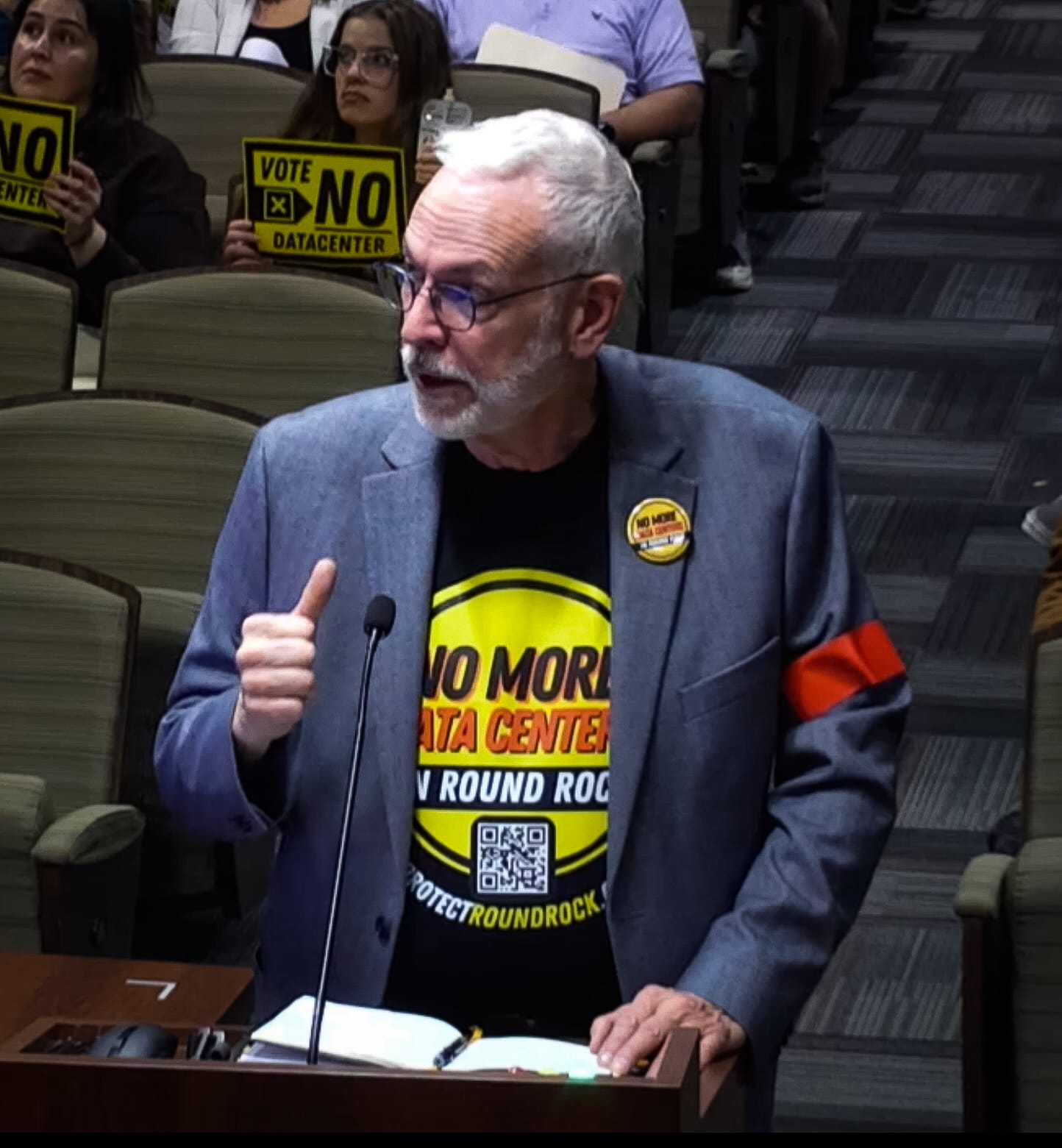

Greg Harman/Deceleration: I've been trying to catch up with communities around the state who are facing off with data centers. It seems like y'all got a lot of traction on social media quickly. How did you know what to do next?
Gary Oldham/Protect Round Rock: In some ways we didn't. We've done some community organizing here, mostly around political campaigns. My wife's got a lifelong history of activism. So we decided to throw up a website. The city council meeting was December 4th. They're going to do the first reading on this. So we bought a domain name and put a website up on December 2nd.
Oh my gosh.
To our pleasure and satisfaction we had 25 people come out and speak at the first reading and the first hearing of this, which was awesome at basically 48 hours notice. Usually nobody comes and does public testimony. So we then started having people reach out to us, saying they want to get involved.
We formed a core team of six or seven people and kind of worked on strategizing. We got social media presence out there on Instagram, on Facebook, Nextdoor, on Reddit, Twitter, and BlueSky, and just kept building it. We had a really talented graphic artist on the team, some social media people, so we got signs and buttons and stickers.
We were doing guerrilla marketing, wearing a button in the grocery store and having impromptu conversations when people would comment on it. We weren't accosting people, but people were asking, and it was a great opportunity to have human-to-human contact.
And through this process fairly early on, we were stunned to learn that eight data centers were already either operational, under active construction, or approved in Round Rock. This would be the ninth.
That's incredible.
So we started doing tons of research. We put up a ton of links on our website and started realizing there's concerns over water. Closed loop [systems] are better than non-closed loop, blah, blah, blah, but it's still a concern. In order to meet the huge demand of the influx, there has to be increased generation and delivery of electricity. And all of us, all ratepayers, are involuntarily subsidizing the data center industry through increased utility rates. And through the increased generation [of electricity] there's an increased usage of water by the generators of electricity.The process of generating more electricity draws a lot of water.
The biggest concern for a lot of folks, including me, is the low frequency sounds generated by all data centers. They can't be mitigated by construction or trees or any other things that have impact on cognition, on sleep, on concentration, have a much higher impact on the neurodivergent population, folks with autism, dementia, Alzheimer's.
And I went out and measured low-frequency noise at data centers in Round Rock and Skybox in Pflugerville. And, as a baseline, the proposed Skybox site. And the numbers are off the charts.
We started an online petition that was done outside of our loose organization Protect Round Rock but still in conjunction. And ultimately presented the city council with more than 3,000 signatures on that online petition.
Every year Deceleration surveys readers: 'What do you want to know about? What do you want to hear about?' And this last year, water and data centers just came up. Like water had been going, right? Concerns about water in the midst of this drought? Of course, we're in a 1950's drought of record, if we're not busting that. But coinciding with this is this data center thing, which just seems to be like a deluge across Texas, across the country. And maybe other countries in a similar way. I'm just looking at the headlines here.
So I looked at the Round Rock planning and council presentations. And [Skybox] was presented by maybe somebody in planning or someone at the city manager's office. They were saying, 'Oh, yeah, well, we don't really have zoning for a data center, right? It doesn't fit any of these industrial categorizations. But that actually makes it easier or better for the public because every time we have one, we need to have a public hearing. And that gives people the opportunity.' It seemed like they were doing a good job of assuaging, trying to assuage concerns.
How do you see that? You're on number nine in Round Rock. Is that area targeted because of its proximity to other populations? How do you feel like these targets happen to begin with? And are political networks up to the task of involving the public, informing the public?
Oh, they're up to it. They just choose not to. It's a very deliberate choice.
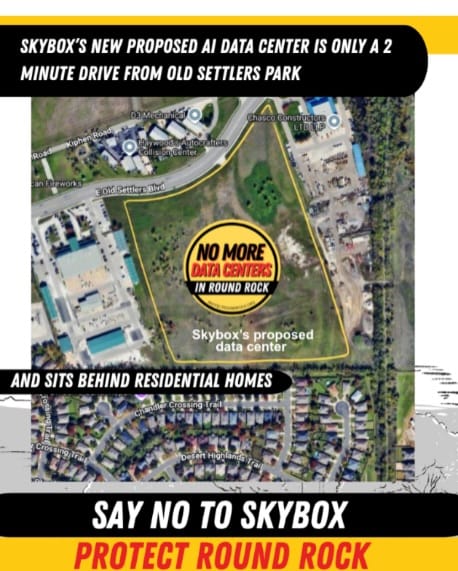
I think areas are targeted for a number of reasons. One is having available power, you know, transmission lines. The data center developers have to pay to connect to the grid. So not having to have Oncor build infrastructure to get that connectivity to them is a plus. The Skybox facility has a 345 kVA line going directly overhead. So it's going to be cheaper for them to build it there than it would be, you know, five miles from an attachment point like that.
I think having a friendly city council is also high on their list of targeting. And those are probably the two biggest. They've managed to slip eight of them in with nobody noticing. In the dark of night. With any kind of rezoning or public hearing, you see there's signs posted on the property saying public hearing is going to be on this date. About this thing: those signs for Skybox were placed on a dead-end street in a residential neighborhood that only two people live on that stub. It has no traffic going by.
The other is placed in Old Settlers Boulevard, which is speed limit 45. So people are going 60, and it's on an S-curve, and the sign was down a driveway stub. So unless you're looking 90 degrees to your right while negotiating an S-curve at 45-plus miles an hour, you'd never see it. But more importantly, those signs were both placed face down in the dirt.
They were placed in these locations and then ended up face down in the dirt? Or just the way they were placed on a fence or in the ground?
I wasn't watching them place the signs. My Spidey senses tell me they were placed face down, but I obviously do not have evidence of that and did not witness that.
And do they have to publish them in the local paper, like the back pages of the [Austin-American] Statesman or something?
Oh, the Statesman? No. People have heard of the Statesman. You wouldn't want to put it there. The Round Rock Leader, which was absorbed by the Statesman, has—I thought it went out of business 15 years ago when the Statesman bought it. I did manage to find a copy at the local library. But nobody subscribes to the Leader. It's a four-page rag.
Very low circulation, small readership?
Very low circulation. Nobody reads it. It's posted on the city website. I mean, even the signs that they use give you a link, roundrocktexas.gov slash notices, when you get to that site, when you get to that page, you have to scroll through all the pending public notices for all kinds of things and try and associate it with the property you're looking at, which is not always easy. And if you're doing it on mobile, you can't even scroll the page.
So it's not a flashing "data center! water use! power demand!" top of the website.
No. But if you follow the City of Round Rock on any social media outlet they're posting three, four, five times a day with stupid memes and cutesy memes and bragging about this, that, or the other thing.
So this comes up to your attention. You're organized. You're coming. You're showing up. And on the day of the vote there was a rally, like a march. And how did that turnout materialize for you?
This is an ongoing process. We had the 25 people testify on December 4th. Typically, [the city] will waive that second reading and go ahead and vote the first night it's before them. They didn't do that this time. They postponed and told us it would likely be in January. So we used that time. We had multiple people reaching out, requesting one-on-one meetings with the city council. None of those were returned.
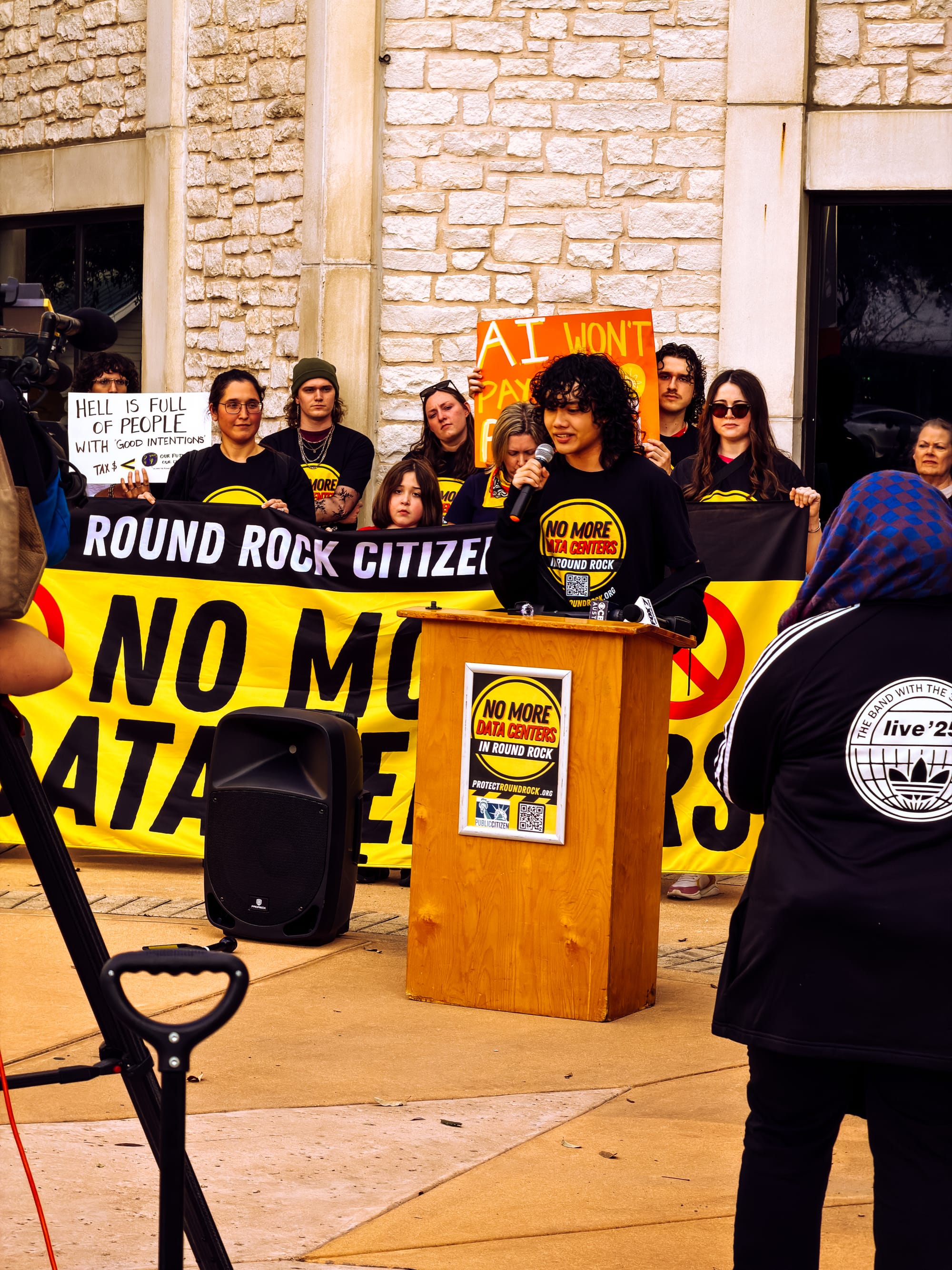
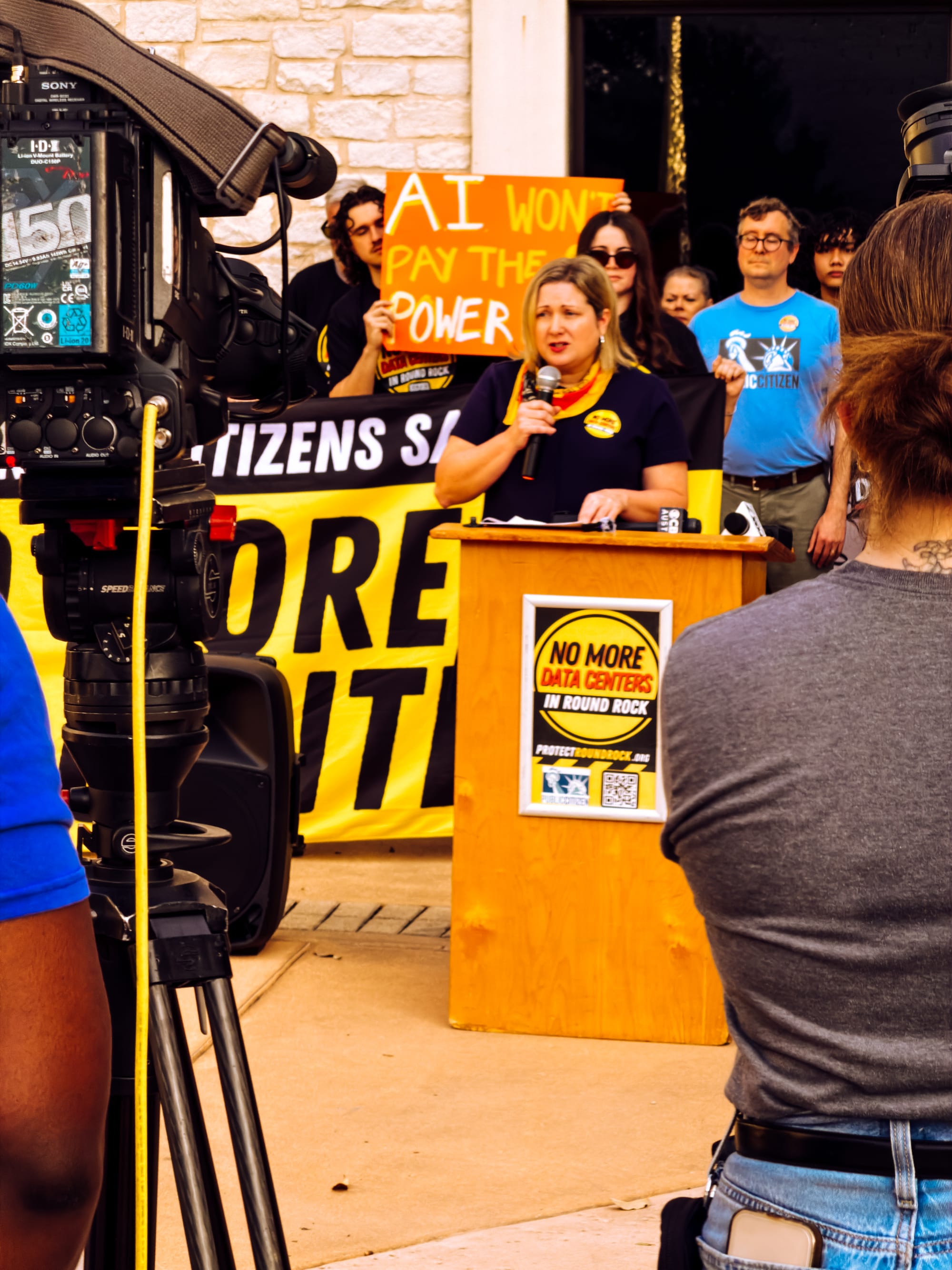
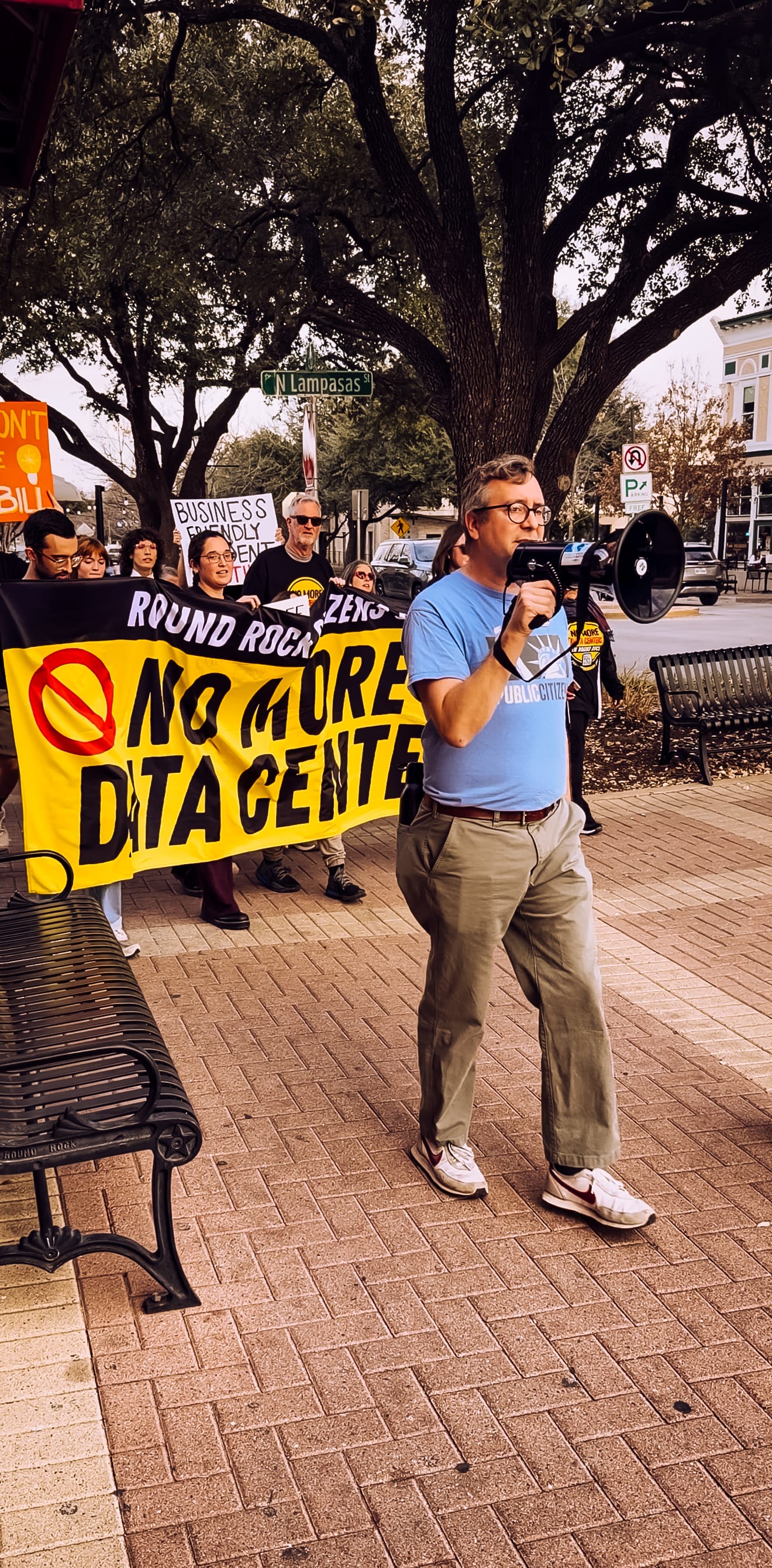
Rally and march before the Round Rock Council meeting. Images: Courtesy
Wow.
We had hundreds, hundreds of emails generated through our website, and probably outside our website, to council that were at best responded to by a form letter from an assistant city manager telling us how swell the data centers are.
Skybox ended up hiring a global PR slash damage control slash reputation management company to help them. Because it's, you know, it's an awesome thing. They needed help from experts to sell it to us.
They threw up a website about this project. The city threw up a website about data centers and Round Rock and why they're so spiffy.
So we kept organizing. An organization called Public Citizen, who has a Texas office, reached out to us and says, 'Hey, we'd like to help.' So we worked with them. They came up with some of these ideas about the pre-meeting events. And so we organized that. We had an art build at the library this prior Sunday and had the rally or march and rally from the library through downtown to City Hall. Trying to trying to raise awareness.
Everybody we spoke with when they learned we already had eight [data centers] approved were stunned and shocked, just like we were. Nobody we spoke to said, 'I'm cool with data centers.' Yeah. A few people on social media, but no humans we spoke to. And 99 percent of the feedback on social media was also what the hell's going on in our city? And then we had well over 100 people show up in council chambers overflowing into the lobby and outside. About 50 people spoke.
There were probably 10 or 12 that had to leave before their names got called because it dragged out, as you'd expect with that many people speaking. I've lived in California, Virginia and Texas. I've been to [public hearings] in all those places. Plus, in my work, I've been to council meetings in many other states.
Never before have I seen when public testimony is given that when a member of the public says their piece, the presiding officer, the mayor, was calling up Skybox to rebut the person's concerns or comments. I've never seen that.
And of course, the person speaking, who is supposedly getting rebutted, had no right of cross examination.
So anyone who showed up for a negative comment, they would invite Skybox each time?
They didn't do it each and every time. They were heavy on that at the very beginning. And after a few selected speakers. There were three people speaking in favor of the data center. One was a Skybox employee. Shocker. And two were people that lived on that dead end street that backs up to this. And they've been swayed and they stated their support. We had the Texas director of Public Citizen as the second speaker. They called people up to rebut him. It was appalling. The utter disregard for the people they're supposed to represent.
And what has been kind of like the postmortem for folks? I mean, we've been looking at San Marcos. They had a very different outcome at Council this week. One woman I spoke to said, 'I'm going to leave San Marcos if they build this.' How are people feeling in Round Rock about their representation, about their quality of life, and what kind of organizing do you think is required now? Are people just fried or is there kind of like another level of organizing that you feel like you're moving towards?
I mean, there's some of each. I'm sure some people got burned out by this and may choose to stay through it. But other people are still around. We're not going anywhere at this point. I don't think we will. One of the fascinating components of this is that originally we were told that the second reading would take place in January, first or second meeting in January. So we were planning around that. Well, ultimately, it didn't happen until February.
Interestingly, we had our hearing on February 12th and 5 p.m. and on February 13th was a filing deadline to declare candidacy for any of the three slots: the mayor and two council members are up for reelection this year. And we are convinced that that date was chosen knowing what their vote would be and knowing how unpopular it would be.
So we couldn't stand up candidates to run against them. Which is a damn shame. We will have a slate of highly qualified candidates next year and going forward.
The only way to effect change is to replace the council with people who will represent their constituents. Our council was representing Big Business and ignoring the will of the people. Very clearly. Round Rock promotes itself as business friendly. They are business friendly. The other part of that equation is they're resident hostile. That was made quite clear. Quite clear. So "business friendly, resident hostile" should be the motto of this city.


