

In 2019, city and utility leaders in San Antonio adopted a climate plan and commitment to zero out all planet-warming emissions by 2050. And—thanks to City-owned CPS Energy’s early closure of the JT “Dirty” Deely coal plant the same year—they made quick early progress.
From 2019 to 2021, emissions went down by over 500,000 metric tons of carbon dioxide equivalent, according to an accounting shared in a reconstituted SA Climate Ready Advisory Committee meeting held Monday, October 26. However, reductions proved harder to sustain. Between 2021 and 2023, the most recent year for which federal data is available, those emissions rose from 16,726,424 metric tons to 16,860,381 metric tons.
While only a small increase, it’s the opposite direction called for in the City’s Climate Action & Adaptation Plan, embraced by San Antonio’s City Council in a 10-1 vote and unanimously voted up by the board of trustees controlling the source of most local emissions: City-owned CPS Energy.

“The takeaway for me is…we don’t want to see it going up,” Doug Melnick, San Antonio’s assistant director of the Office of Resilience and Sustainability told committee members. (The department is a recent merger of the Office of Sustainability and Office of Resilience.)
The increase occurred while the city grew in population from 1,454,319 to 1,487,588 residents. When divided out over the population served, it represents a slight per-capita drop. But, Melnick continued, “This isn’t a per-capita issue. This is about the fact that we need to accelerate. We’re not tracking where we should be at this point in time.”
The increase included rising emissions from city fleet operations, in spite of buying increasingly into lower-carbon options.
“So [the question] is: What are we doing as a municipal organization to not just buy more hybrids, buy more electric vehicles, but how do we reduce fuel consumption?” Melnick said. “As we start looking at how we’re implementing the climate plan, it’s what are the targets that we’re setting for the organization and departments to make sure we ‘re getting there?”
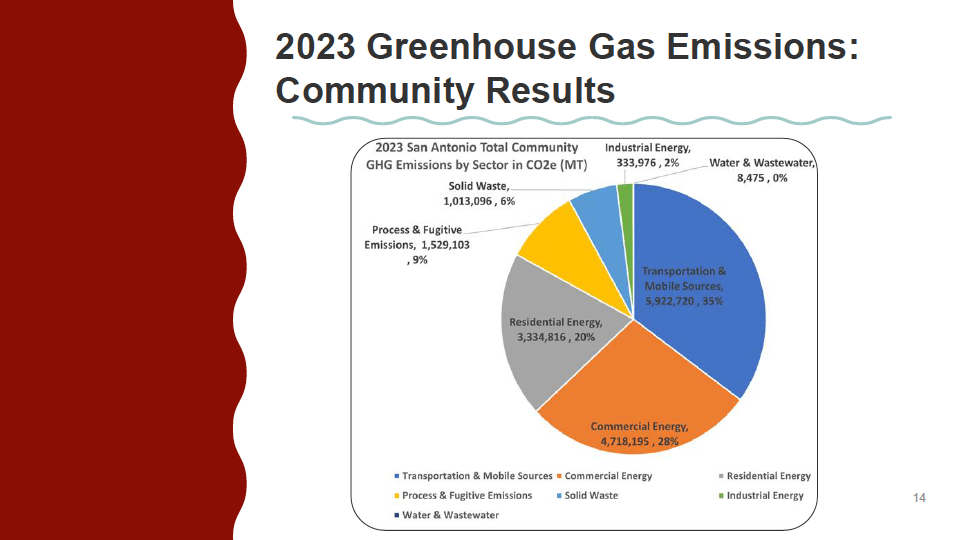
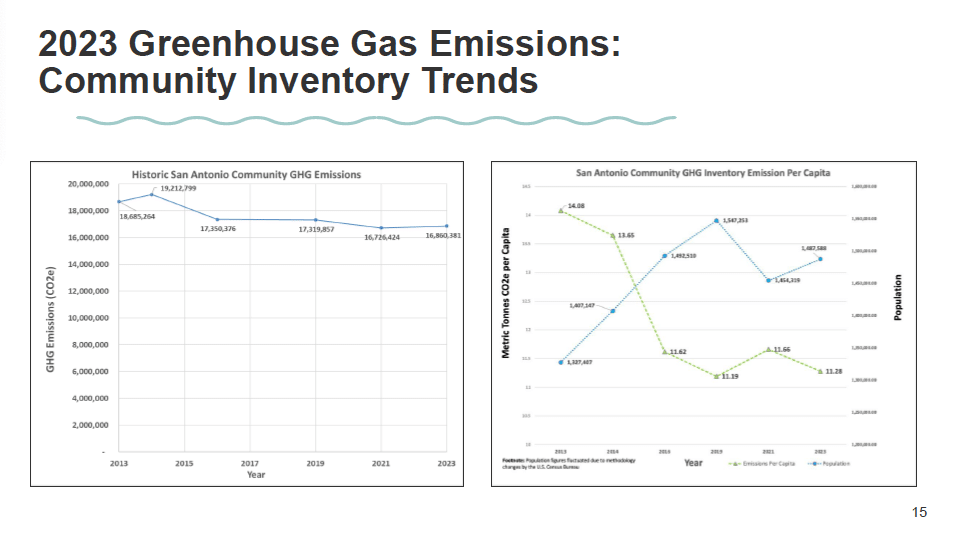
The San Antonio Office of Resilience & Sustainability is preparing a more formal report on the increase to present to local elected leaders in the near future.
As the power source behind virtually all residential and commercial facilities in the greater San Antonio region, CPS Energy is the source of most greenhouse emissions. Energy produced for commercial and residential energy needs is responsible for roughly half of the city’s total greenhouse releases. This is followed by transportation, where emissions are released mostly through the fuels burned, largely carbon-dense liquid fuels, such as gasoline and diesel.
The outsized role of the utility shows that “we can’t get to our goals unless we’re aligned with CPS,” Melnick said.
In spite of sizable recent $1.4B purchase of gas-fired power plants, CPS Energy remains committed to closing or converting to gas its last two coal-burning units at Calaveras Lake—Spruce Unit One and Spruce Two—and achieving a 41-percent reduction of greenhouse gases by 2030 and 71 percent reduction by 2040, said Angela Rodriguez, CPS Energy’s head of sustainability.
However, a new vision, or “refresh,” on how to achieve those reductions will be rolled out this December for public comment.
CPS adopted its current guiding vision for generation in January 2023 after a lengthy public process. At the time, Deceleration highlighted that, considering the high rates of methane leakage from regional shale extraction zones like the Eagle Ford and Permian Basin, the conversion from coal to gas is unlikely to result in the promised emissions reductions.
“The world is changing,” said Rodriguez. “Some of the assumptions that went into that planning process have changed. We’re not restarting the whole thing over. But we’re refreshing some of the assumptions that went into that plan to get feedback on. So just be ready for that. Hopefully we’ll have a quorum in December because I’m excited to share those results.”
Responding to a question from a committee member, Rodriguez said the gas plant purchases “were already part of the plan, we just purchased them ahead of time.”
Melnick said the charge for the committee, which met for the first time in April, followed by two meeting cancellations for a lack of quorum, will be to refine the focus of the department’s efforts.
“There’s over 90 mitigation strategies and 45 adaptation strategies [in the City’s climate action plan.] Ninety strategies is a lot. The question becomes, what do we really want to focus on? How do we ensure we are making progress year over year?”
That could be achieved by developing a five-year-plan, he suggested.

“We need to make sure this isn’t just a list of 80 things we could do, so this is our plan that we have to move forward with,” Melnick said.
This refinement of mission is occurring as the department’s budget is in retreat, with the City apportioning 25 percent less funds to the office in their 2026 budget. Several of the office’s most impactful programs, including its Community Action Fund, Low Income Community Resilience Program, and Climate Ready Neighborhoods, were declared on one slide to be “at risk.”
Deceleration wrote recently about the zeroing out of two programs, including Climate Ready Neighborhoods.
Committee members asked if the city even had access to the data to guide future climate work, considering the dismantling of large portions of the federal agencies responsible for tracking and reporting climate pollution—reporting once intended to help guide a national transition to cleaner fuels. That goal was jettisoned with the return of President Donald Trump, who has only grown more antagonistic toward global climate concerns.
Not only has the Trump administration pushed to boost oil and gas production at every turn—including opening the vast Arctic National Wildlife Refuge to drilling in one of the most protected stretches of wilderness in the nation—it has demonized and penalized lower-carbon alternatives such as wind and solar. The administration is also committed to making it hard if not impossible to accurately track emissions, thanks to defunding and mass layoffs at the U.S. Environmental Protection Agency, closure of a Hawaiian observatory, and plans to incinerate the CO2-sniffing satellites now orbiting the Earth.
But Laura Patiño, now head of the newly merged office, said the data exists—that due to the amount of work done locally, there is “a lot of granularity here in San Antonio that other areas [don’t have].”

Though the Climate Ready meeting was delayed by a several months due to an inability to get a quorum, the team lost little time appointing a chair and co-chair to help guide future meetings. Adelita Cantu, an associate professor at the University of Texas Health Science Center at San Antonio School of Nursing, was named committee chair, with Liza Meyer, a longtime sustainability professional and program manager at USAA, serving as co-chair.
A number of subcommittees are also being spun out; members appointed include Chris Wilcut to head the Energy & Buildings subcommittee, Debra Ponce to head the Transportation & Mobility committee, and Shaun Donovan to lead the subcommittee on Natural System, Biodiversity, & Climate Adaptation.
During public comments, local Sierra Club chair Alan Montemayor said he had heard it’s been hard to get members of the business community to participate and asked everyone to “urge them to come.”
-30-
Follow the committee’s progress by signing up for updates from the Office of Resilience & Sustainability or watching for meeting alerts on SASpeakUp.com.


