

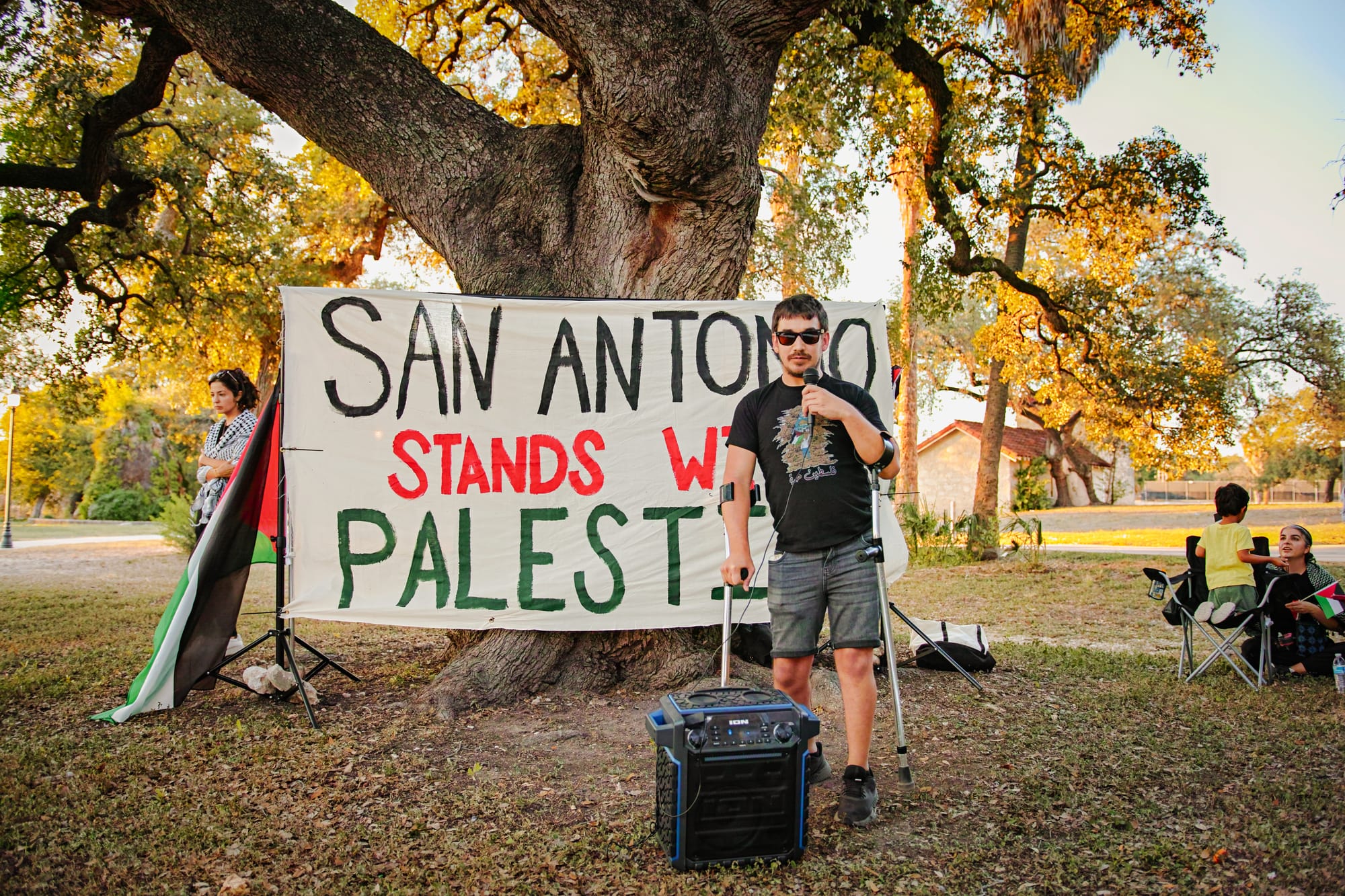
On Oct. 6, 2024, several dozen community members actively opposing Israel’s genocidal war on Gaza gathered under a towering oak tree in San Pedro Springs Park in San Antonio. They arrived in a quiet procession, coming into the shade to share their grief and reflections on the day’s film screening of The Night Won’t End: Biden’s War on Gaza, held earlier that day at the Esperanza Peace and Justice Center. The group was met at San Pedro Park by a visual timeline spread across the grass to illustrate Gaza’s long history of occupation and oppression, setting October 7th within a much deeper historical context than many official commemorations have acknowledged.
“The narrative that is often told over the last year is [that] history seems to magically start on October 7 with Hamas’s attack,” said Sara Masoud of San Antonio for Justice in Palestine. “But what we wanted to demonstrate and emphasize reflection on, as we mourn and we grieve the losses of the last year, are the losses of Palestinians over the last 76 years.”
While the Hamas attacks on October 7, 2023 resulted in over 1200 Israelis killed and around 250 taken hostage, SAJP noted that for Palestinians, that date marks the beginning of an “extraordinary escalation in Israeli violence” which has killed around 42,000 Palestinians to date, according to the Gaza Health Ministry, about 40 percent of them children. Other estimates from the Euro-Med Human Rights Monitor put this number at 50,000, while a letter signed by 99 American health care professionals who have volunteered in Gaza estimates 120,000 casualties, and recent correspondence published in the Lancet, a medical journal, estimates that the true death toll plausibly approaches 200,000 out of a total population of 1.2 million.
These deaths are only made possible by U.S. armaments provided to Israel, devastation delivered largely by fuel provided by San Antonio-based Valero Energy’s refineries.
The following day, nearly as many local residents gathered on the steps of the San Antonio City Hall to mark the one-year anniversary of October 7 by offering a broader vision of justice. Organizers around multiple local issues—public education, police accountability, anti-racism, migrant, voting, and workers rights—addressed the many ways Palestine solidarity movements necessarily intersect with struggles closer to home. In the words of SAPJ organizer Alex Birnel, “what we accept for Gaza, we accept for ourselves.”
Post-event, Deceleration invited Masoud and Birnel to sit down and reflect more deeply on these public commemorations and the bigger questions motivating and generated by them. Unfortunately Masoud was under the weather, so we spoke just with Birnel. Interview has been edited for length and clarity.
Deceleration Q&A: Alex Birnel, San Antonio for Justice in Palestine
Marisol Cortez/Deceleration: Tell me a little about how these events came about. Why did you organize it in two parts?
Alex Birnel/San Antonio for Justice in Palestine: I think collectively we felt a responsibility, in recognition of a year since October 7th, 2023, to contextualize the meaning of that year. Because without contextualizing it, I think people would be left to just sit with their own feelings of despair.
Because I think accepting a reality where a genocide can persist—[but also] concurrently, a year with incredibly impressive and daring organizing really at every level conceivable, whether it be organized labor stopping weapon shipments or State Department bureaucrats resigning or countries withdrawing their economic support and ambassadors to actions at the city level, passing 175 ceasefire resolutions, or multiple disruptions of hearings with the Secretary of State, multiple occupations of the US Capitol, blockades of roads, direct action, massive protests of an unprecedented size—processing and contextualizing [the past year] means, how do we hold both? How do we hold both the truth that the world did something together simultaneously, and at the same time with the reality that none of it has stopped the gears of the machine, and the consequence of that is that the genocide has roared on? And so we felt an obligation and responsibility to come together and at least be able to speak to, well, after a year of genocide and organizing as best as we know how, what do we have to show for our efforts? And I think out of that, we need to acknowledge that there’s a lot of grief, but there’s also a lot of power. And so that was the goal of both of our events.
That it is the case that people have embraced Palestine over the last year who are otherwise very local in their orientation, and in their approach to doing work on issues here in the city—drawing internationalist connections, having internationalist conscience that, if it’s an injustice here, it’s an injustice there, and vice versa. And that power and awareness and consciousness are not going away.
And then, to just put my feet back on the ground with it, I think there has been a lot of reflection on, what does it mean when so much of the world’s powers are arrayed against your existence?
And that’s not a question that I can speak to with first hand experience. I can only know what the Palestinians in my life are feeling in that same paradox of, like, here is all of this solidarity which is deeply moving—but it is not yet to stop the bleeding and the bombs in Gaza. That paradox is a philosophical one, but it’s also a frustrating organizing question. How do we find the levers of change which will work? And then I think to be confronted with that conundrum while the room is on fire—it’s very challenging and taxing to one’s brain and heart.
You had mentioned internationalism. For folks that are less familiar with that term or who are hearing it for the first time, can you say a little bit about why that’s an important lens for thinking about Palestine?
A couple of phrases matter here, because they are a window into the depth implied by internationalism. Oftentimes people will say free Palestine, but also that Palestine will free us. In other words, recognizing that many of the systems that Israel imposes on Palestinian life, whether it is aggressive policing, environmental destruction, the flexibilization of labor, the racist logics that underpin all of it—these forces and ways of thinking are present in other places on the planet.
But it’s not so often that we have an entire social model defined around these things in a such a clear eyed way, and turned up to 10, as they are in Palestine, and especially as they are in Gaza. So what we accept for Gaza, we accept for ourselves, right? And because the UN declared Gaza unlivable in 2020, long before 2023, largely talking about how the infrastructure couldn’t sustain the threat of climate change—and with the response of the Israeli state just to manage an increasingly subjugated and precarious population in forms of counterinsurgency—that’s the world that’s coming for us all, if we fail to act on the climate crisis and things like this. You know, this is the way that Gaza provides a sort of an indicator of the future.
There’s a degree of objectification that I don’t like, though, because Gaza isn’t just an object for us to see our own future through. But it is a way in which people understand that if [Gaza] is acceptable, if this is permitted for another people, there’s no inherent reason why it couldn’t be brought back upon me. The imperial boomerang—like what we do abroad to others tends to come back home to us. So you see Cop City in Atlanta, and the fact that their training facility is called Little Gaza, right? And so we begin to understand that, even though there are differences in language, in culture, in history, is it more important to think about the world in terms of countries and nations? Or is it more important to think about the world in terms of people, and what we permit people to be subjected to?
And so I think people are also looking for how do we rebuild institutions of internationalism? And one way that comes up is, people like the Black Panthers used to actually go and travel around the world and make genuine connection with others. And there was connective tissue between the left across borders. And they actually had means to work together. And I think that’s what’s missing in the 21st century is that we have emerging internationalist consciousness in the way that we think about each other.
But we don’t have vehicles by which we can do cross-border organizing, which is how we actualize those feelings. And that takes us back to the reason why it can be concurrent that we have some of the world’s most impressive protests ever and the most impressive pressure campaign ever against the genocide, and yet it not stop. And it’s because we’re not connected enough. We have to have actual vehicles to deliver our politics on the strategy and tactics level.
My next questions are much more concrete. Who were you most wanting to reach with these events? And what were you most wanting to convey?
We know to start that the City of San Antonio, in terms of its City Council and many of the businesses here, when it’s convenient to them, will characterize themselves as local, as municipal, emphasizing the smallness, the pedestrian. You know, we work on sidewalks and stop signs and that’s our jurisdiction and that’s our role. So what do we have to do with what is going on in Palestine? And it couldn’t be further from the truth, because we are the 7th largest city in the country. And the consequence of that is that many of our businesses and our City Council are not only nationally connected, but are internationally connected as well. And so we’d be pretending if we didn’t say we had leverage over some of these questions.
Not complete leverage, but Mayor Ron Nirenberg certainly talks to Joe Biden enough to campaign for Kamala Harris, as he is right now. He definitely talked to the federal administration about the launch of heat.gov, which was a website for what to do in extreme heat conditions. All this to say, we know he had the ear of the president, the person who does have the power to stop the genocide, and that it was a cop out to say that this is a puntable jurisdictional question. All pressure matters because consent from below, including at the level of cities, is part of how we prop up the status quo.
And knocking down those pillars, flipping those pillars, sending that pressure upwards to the administration is a way to stop genocide, or at least part of how we might be able to stop the genocide. And so not allowing our city to have this sort of position where it’s not relevant to them. Not allowing our corporations and their connections to go unnoticed.
So Valero providing jet fuel to Israeli planes and being stationed here, and also being responsible for the reshaping and remaking of our climate plan, right? And Caterpillar and Holt Cat being here, the company that provided the bulldozer that built the separation wall, the bulldozer that ran over Rachel Corrie. And that to this day demolishes Palestinian homes. These are not local companies but deeply embedded in international capitalism, with a whole philanthropic, front-facing corporate social responsibility campaign, as they inflict harm on untold peoples around the world.
Related: “Welcome to the People’s University for Palestine”
The People’s University for Palestine is a new popular education project that compiles resources for educators and community members who see learning and teaching about genocide in Gaza as central to halting it.’
And then to show to others that, look—there are organizations who, day in and day out, devote themselves to justice questions in this city. There is moral power here and there is organizing. And if our city’s government and corporations are going to take a back seat—or not a back seat, but to actively put the thumb on the scale of the oppressor—then here is a counterargument for the type of San Antonio that we could be. [Are we] one that props up the imperial powers of the world to oppress and foreclose people’s freedom? Or can we grow this movement with many more organizations than we’ve ever had, use it to put pressure on flipping some of these [Council] folks that would rather either stay out of it or keep their involvement with it in secret and largely out of the public eye? And so our goal was to say, hey, this power is not going away. San Antonio is on the map in the fight for a free Palestine.
And the last thing that I will say, it was also a test for media. The press release [for these events] was an opportunity to say, you know, there was a dearth of interest in coverage [a year ago]. We struggled a whole lot to get Palestinian perspectives into media. And after a year of the world’s first livestreamed genocide, were people’s perspectives changed? Did their positions change? Did they feel compelled to acknowledge this day in the same way that we feel compelled? And regrettably, the press conference was not well covered by local media.
And this just helps to perpetuate the failures in other places, right? Because one of the things we heard from City Council while trying to achieve a ceasefire [resolution] is that, again, it wasn’t pertinent, it wasn’t germane. And you can only get away with that if you’re not reading about local Palestinians in the news.
You started to open up the question of the intersections between Palestinian liberation and climate specifically, but environmental justice more broadly, which is the lens through which we think intersectionally about all of these different issues. Can you say a little bit more for folks in environmental movements why is Palestine a matter of climate and environmental justice?
Absolutely. This dates back to one of many master narratives about Israel. One of the most famous mantras of Zionism was that this was a land without a people for a people without a land. And apparently nobody was checking the internal consistency of these different positions, because [at the same time] it was supposed to be a land without a people, there was also a lot of early writing by Zionists that said, you know, the native and indigenous population isn’t tending to the land in a way that maximizes its yield. And so there was simultaneously, “this is an empty land” and “we will make the desert boom, unlike the inhabitants,” right?
And then because of engineering and that Promethean impulse—you know, we’re able to turn an incredibly water scarce place into a model for the rest of the world in terms of “green ecology”—left out is the theft of water from Palestinians. And so Israel is able to market itself as sort of a green innovator and green entrepreneur, because we have the sensibility about, we turned the desert green. There’s this innovative resonance without people thinking about relationships to land that are actually thoughtful and considerate to the ecology, and what makes sense to grow here and what doesn’t.
So it definitely is an example of people thinking they have dominion over the earth, to transform it as they see fit. And that’s a lot of the origin story. In terms of the politics in the present—for starters, every time you destroy infrastructure, you damage how people inhabit urban environments with weather and the climate crisis. So when people in Gaza experience extreme heat—you know, questions of cooling stations, a/c—these questions of [climate] mitigation and adaptation don’t even enter into it. Because a layer deeper, infrastructure itself has been destroyed, and left overexposed to the extremes of weather. Much of the sanitation systems, the plumbing systems are questions of environmental justice as well. Large [amounts] of the water that is available in Gaza has traces of tuberculosis and is unsafe to drink. And then, to the extent that centralized power plants provide intermittent power to the people of Gaza as an act of war, Israel destroys these things. And so is bombing solar panels that exist on people’s homes to generate energy in a place where centralized power plants are few and far between.
Not to mention all of the weaponry that they use toxifies the environment—white phosphorus, missiles that are marketed as being able to liquidate the earth. And so for all of these reasons, Gaza is an environmental question and a question of climate justice. And then I would also say that because it’s such a militarized place, subjected to counterinsurgency—I think that dense urban environments in a period of climate catastrophe will be the predominant model of the future.
And I just think, through the work of a guy like Mike Davis in Planet of Slums and Stephen Graham in Cities under Siege, how [that model] will combine the urban warfare question [with concerns] around resource density. Gaza is a paradigm for how you treat people as the enemy in a resource scarce environment. And Israel is able to market itself to governments around the world who see, you know, increasing numbers of refugees at their borders in a period of climate crisis. And they provide one very scary social model of fortressing oneself with guns and surveillance technology. And we [people organizing around Palestine] are talking about a whole different architecture of existence which allows Gaza to live. And this returns us to the fact that Gaza will free us, if we see Gaza as an embodiment of all these overlapping forces for constraining life.
So the election’s coming up in a few weeks. And I’m wondering, for those who might be still wrestling with, on the one hand, a very urgent need to block not just Trump, but the far right movements that have empowered him and that are in turn empowered by him, but who might also feel profound disappointment, disgust, rage, grief at the failure of the Democratic Party to to refuse to stop arming Israel and to condemn occupation and apartheid—what’s your advice for us? I know you have some experience with voter registration work, so I’m wondering how you’re thinking through that and how you’ve seen folks wrestle with that.
I’m somebody who does get aggravated when the refrain is just a context-less insistence on the necessity of just voting, right? Like anybody who spends any time out in the world with other people will encounter a concerned person who emphatically insists, just vote. And we know that person probably has good intentions. But I think we do have to embed things like the vote as a tool in the system that the vote sits in. And the structure it exists in is one that’s increasingly characterized by features of minority rule.
And so what do I mean by that? Some examples [are] gerrymandered maps, which are drawn in such a way to undermine the efficacy of each individual vote within a district, to make districts either noncompetitive, because they’ve been [broken] up, or noncompetitive because voters have been packed in and given a seat rather than making other districts competitive. [Or] we have multiple trifectas in the country, where one party controls all three branches of government at the state level. Oftentimes that means veto power at the level of committees at the legislature. We have control of the courts, which entrenches positions and precedent for decades and decades. We have a “first past the post” system in individual races—so, first one to 50 [percent] gets all the representation, and so positions are counted out. We have the Senate, which, in a period where demography really skews urban, disproportionately gives power to rural states and to a lot less people. And once you ask the question, What does the Senate do that the House of Representatives doesn’t do, other than slow the system down? And if you think of the slowness as a feature of the system that’s worth admiring, even when it throws our democracy into crisis, as it has with questions of the Voting Rights Act, the John Lewis Voting Rights Act or the IRA—I think this is great evidence of the dysfunctionality of the Senate. So that’s the system your vote is entering into when you try to use it.
And we do a disservice to people when they insist, “just vote!” and we don’t explain to them the Rube Goldberg machine that is [the system of] American democracy that their vote enters into. Because then there’s a deep frustration that I’m just voting and nothing seems to be happening. And it’s because we’re not giving the full picture. I think we actually have to understand how anti-democratic American democracy is, and then make an assessment at what levels we can actually affect things by thinking of our vote not as individual expression. Thinking of our vote as individual expression is a response to how disempowered the vote is. We think of the vote as strictly a question of conscience rather than organized people putting themselves together as blocs and delivering votes, as the Uncommitted movement did, right? Trying to organize a large number of people to exercise a protest vote is much more efficacious than one individual saying, because my conscience opposes this, I’m going to register a protest vote in isolation.
And your vote also doesn’t have the same impact at every level. I would argue that the more local the context gets, the more impactful your vote is. And sometimes we dichotomize, like the vote as electoral strategy and then we put other organizing strategies on the other end of the dichotomy. But that doesn’t recognize the diversity of tactics, and the way these two different approaches can actually complement and interact with one another to effect political outcomes.
For example, especially in the Palestine movement, people have a lot of skepticism of electoral politics. And I would say that at the local level, there’s great examples of the consequences of one person sitting in a political office versus another. Delia Garza being the county attorney in Travis County meant the difference between hundreds of students at UT, following Palestine protests when DPS cracked down, having charges or not. And Delia Garza threw those charges out. The consequences of that politically [is], if people had caught charges that are permanent, it changes their risk assessment as individuals for their other political activity going forward.
And so [with voting,] instead of thinking, we’re anti-system over here and over there are those reformist system people, instead we need to relate to this as, how do these variables combine to either decrease options or increase options? And I think we need to be more nuanced in our judgment about engagement with power, because [while] I do think the elections represent the power system, and we need to be wary of it, abstaining fully from it or having a sensibility that it is pointless or meaningless, or [that it] is providing window dressing for elite politics—that misunderstands that the vote is a tool that we can use at multiple levels of government.
Lastly, on how and what we commemorate. A couple weeks ago, I saw in the City’s “Compassionate San Antonio” newsletter a flyer for an Oct 7th commemoration that made no mention of the over 42,000 Palestinian lives lost after that date. But then the press release for San Antonio for Justice in Palestine’s commemoration events likewise makes no mention of Israelis killed on Oct 7 or hostages taken. I don’t think this omission is equivalent; I draw a parallel to the post-911 Bush years where, if there had been an event focused solely on the over one million Iraqis killed by US sanctions, invasion, and subsequent occupation of Iraq, I wouldn’t read this as a denial of the humanity of those who died in the World Trade Center attacks. Because the humanity of “us,” those who died on 9/11, is already assumed and doesn’t have to be affirmed. Whereas the humanity of “them,” those killed by the retaliatory violence of the US after 9/11, never is. In fact, exactly the opposite is assumed.
But for those who may be starting to just learn about these histories, I do wonder how we can fight the dehumanization of Palestinians without needing to not mention those killed/taken hostage in Israel on Oct 7? Is there a decolonial framework that can refuse “settler moves to innocence” without needing to refuse acknowledgment of Israelis as people with families and loved ones? Or is this question itself historically ignorant or problematic?
I think one has to relate to October 7th as a painful but consistent example of the basic pattern that defines the Israel and Palestine relationship: it’s one of staggering asymmetry. In nearly every incursion where the dead must be counted, Palestinian death far exceeds Israeli death. In media attention, Israeli stories command column inches and airtime, while Palestinians struggle for the opportunity to narrate their suffering. Our imaginations are lopsided thanks to this consistent disparity. It shapes our sense of concern, our measures of pain and so much else.
How does October 7th exhibit this same unequal treatment? The racist moral universe Israel has asked the world to live in for the past 365 days is the following: that nothing justifies October 7th, but October 7th justifies everything. Think about this trajectory from the Palestinian perspective. People in Gaza go from living under an occupation, a siege by land, water, and air, and a total blockade that amounts to a huge open air prison, an existence where your diet is carefully calibrated to avoid outright starvation, while ensuring malnourishment. Where military operations are so regular and brutal, Israelis have a crude metaphor for their function. “Mowing the lawn” is the euphemism they use for killing Palestinians before they grow up and potentially resist their living nightmare. Existential violence engulfs the potential for life in Gaza. Scholar Sara Roy calls this an economy of de-development, where instead of the point of policy being improvement on social metrics, Israel’s goal is to drive measures of a good life down and backwards. Palestinian life in Gaza goes from this condition, a system of total abjection, to a livestreamed genocide.
If you want to understand October 7th, look up the 2018-2019 “Great March of Return,” when the world continued humming along as Israeli snipers opened fire on nonviolent marchers as they approached the fence [the border wall between Gaza and Israel] that enclosed them. We cannot pretend, without detaching ourselves from reality or engaging in wishful thinking, that these events didn’t pose an existential challenge to nonviolence, or at least fog it with an ambivalence, that then led to a brinkmanship that shattered the status quo of languishing and silently dying. And when that powder keg inevitably exploded, like Langston Hughes warned of [in his poem “Harlem”]? Israel responded to this with ethnic cleansing and genocide, collectively and indiscriminately. We cannot ask the people of Gaza to be hypermoral superheroes when Israel ensures no horizon beyond continued destruction, disease, and death.
The powder keg of suffering in Gaza is entirely preventable. Israel could declare support for one state tomorrow, and issue a commitment to ensuring human and civil rights for Palestinians in the land between the river and the sea. It could honor the right of return, undertake a process of reparations and be a genuine partner to a truth and reconciliation process so that a post-colonial Palestine could emerge.
Such moves would also undercut the political resonance of groups that Israel insists exist to hate only Jewish people, as if the research of a guy like Robert Pape doesn’t clearly show that the common denominator among ideological groups that use extreme violence as a tactic, across distinctive histories and grievances, is resistance to land theft and occupation. The people of Palestine are no different.
We are in this over-determined place of events like October 7th because as a world, we have not stood up to Israel, or more accurately, we have not located the right levers of change to alter the configurations of power so that people are in the driver’s seat of foreign policy. It is clear to any student of the subject that Palestinians have tried every method of freedom making at the near guarantee of slaughter. If we do not want October 7th, we have to acknowledge that fact and grapple with the moral seriousness it imposes. We should all agree that languishing and dying vs genocide is not a real choice. And to act on that understanding, we have to understand in our bones that that’s exactly what we’ve asked the Palestinian people to impossibly tolerate.
We have begun the work of giving real options breathing room, stopping the guns and the torment, so that the demand of freedom has a chance on the ground.


