Editor’s Note: There is something that grabs me in the throat when I read about what is happening to coral reefs around the world, remembering the diorama of Australia I made in 4th grade—the cardboard background painted ocean blue, the landmass coated with glue and dusted with sand, the continent hugged at one corner by a string of styrofoam crumbles to represent the Great Barrier Reef. The ocean’s forests felt far away but somehow intimate, even then invoking in me a tenderness that now makes reading about the fragility of reef health feel almost unbearable. In late 2025, scientists announced that warm-water reefs have reached a global tipping point due to climate change, following a mass die-off underway since 2023. Centuries of extraction and combustion of fossil fuels have pumped so much carbon into the atmosphere that the seas have warmed to the point of being inhospitable to the multiverse of creatures that reefs historically have sheltered. As poet and physician Katherine Roth writes—why can I not think of the coral reef / I mean, why can I not stop thinking of the coral reef.
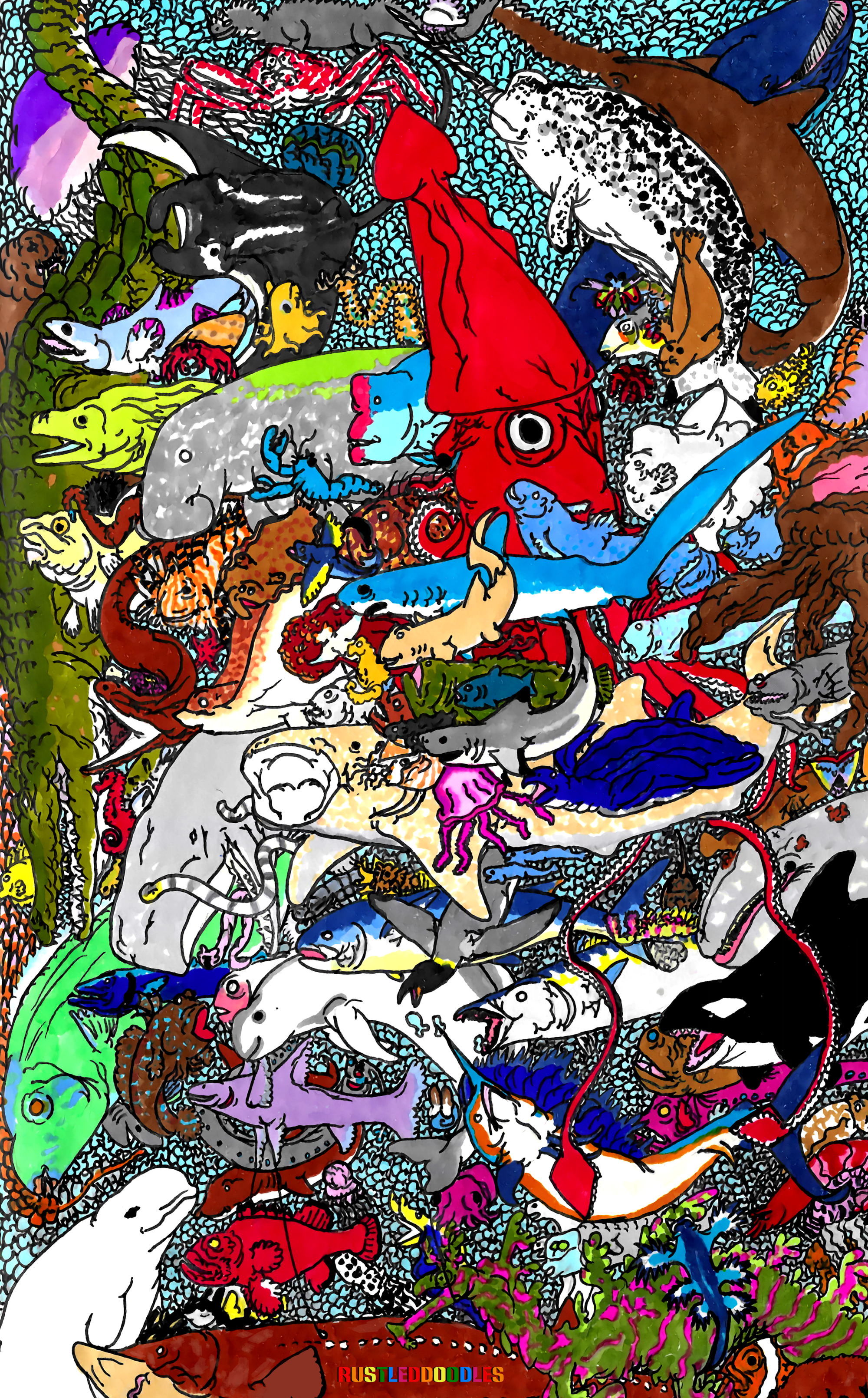
And yet the art and writing here burst with the colors of the many lives we continue to cherish and fight for—a “sea of creatures,” to borrow from the title of paleoartist Seth Anson’s image above. Like the pockets of biodiversity still held by “refugia”—or places more protected from climate impacts where coral have persisted—these poems and paintings contain the seeds for recovery we will need for a world yet to come, a world whose future is yet unwritten, a world we are still writing and fighting for.
Deceleration publishes our themed Creative Reviews every quarter to invite response to the crises of this moment through the power of visual art, poetry, prose, sound, and other creative forms. 'Sea of Creatures' is our second installment. Our first is here: ‘Vanishing Ice, Melting ICE.’ Our heartfelt gratitude to all who submitted to this most recent call. Look for another in the spring! —Marisol Cortez
eye of fire
Gaby Benitez
are you overwhelmed by it too? the vast expanse
of cyan, aquamarine, sapphire, and cobalt
I saw the open ocean once and haven’t
gotten it out of my head since. I saw the ocean
open once and haven’t gotten it out of my head
since, fuck! the grey and greasy water of the gulf
oily and charred, haunts me with its horizon
all of us walking on ancient seabed
surrounded by swimming ancestors
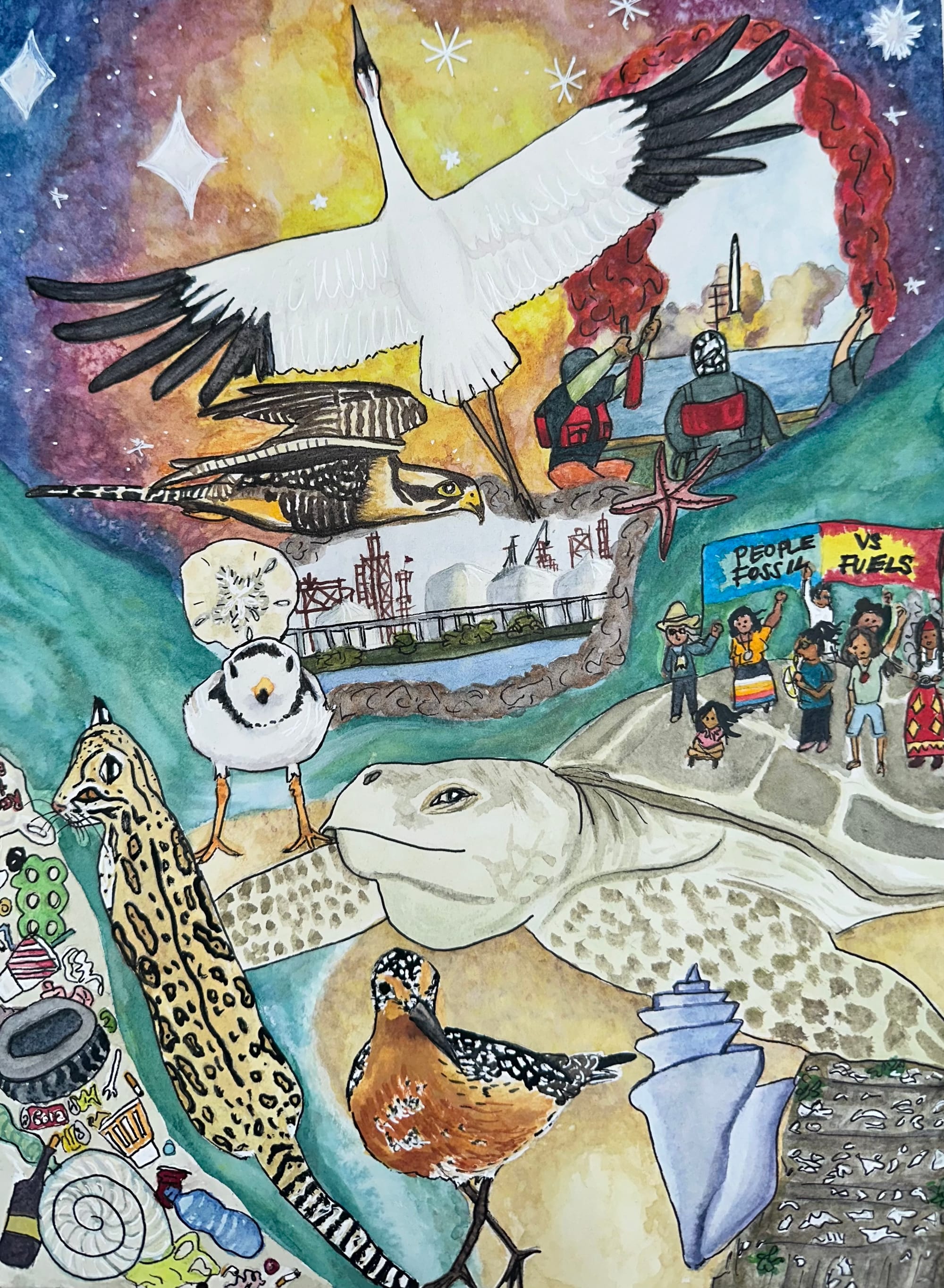
what diving bird saw the sea aflame
and knew that nothing mattered that anything
was possible. did they go about their day?
carry twigs to their nestlings
coo sweet nothings to a mate
guard their fledglings from what could be
until they were ready to soar above
the blaze again into the all-knowing blue?
if we can burn the ocean to absence—
this is where the volta should appear
as if I could think of anything
besides mass death
this is where the bird dips and drops
until, last minute, they change direction
To the Dolphins
Jason O’Toole
To the dolphins of the future who might read this –
Sorry, for all the flights I’ve taken
and all the flights I’m going to take,
including the one booked this February.
Sorry, for the cars I’ve owned,
every one of them a combustion engine.
To my credit, I didn’t drive to the gym,
unless it was cold or wet.
Also, when it comes to tuna,
I look for the dolphin-safe stamp,
and this might amuse you,
I’ve taken a bite out of a few sharks.
A bit of payback for you.
All joking aside, I’m rooting for you
or the octopi to make it,
even the sharks,
because it can’t be us.
Unseasonable Seas
Jason O’Toole
Too warm, this Wingaersheek water, mouth of the Annisquam,
intertidal zone, aberrantly comfortable
for a post summer swim.
Will it cook the periwinkle clinging to rocks,
boil the invasive shore crabs,
before fishermen can claim their bounty?
Sex-changing slipper snails, discarded shells,
crushed to sand under our recycled, polyurethane flip-flops.
Will they live long enough to transition and mate?
Striped dolphin swimming north,
far from bleached coral reefs deprived of algae armor,
trampled seagrass meadows, and consumptive plastic choked mangroves.
Turning 11, the kid knows the mess she’s inherited, and will pontificate
on the plight of the penguin as glaciers melt, as men-in-charge
fire cannons at imaginary serpents menacing our coast.
She catches a snail in her palm
names him, feeds him seaweed,
asks me to rate her seagull calls,
splashing in water
too warm for September.
A Few Degrees
Katherine Roth
~for Gaia, our earth
i.
If you walk through the garden at daybreak
and smell the lofty high notes of the lily
do you pause—
even the ants
may wonder why
your footsteps grow quiet
ii.
It’s not like me to shrink from death.
I follow my patients into the Hospice House
wait for hands to grow cold, breath to cease
Then why can I not think of the coral reef
I mean, why can I not stop thinking of the coral reef
Pulsating city of polyps
crumbles in my hands
brown and vacuous as the water warms
a few degrees
Immortal coral—
how could I not know something essential
like air
is disappearing
iii
The monkey’s hand is trapped in the bottle
holding the banana so tight.
Can he learn that to save his hand
he must release the object of his desire?
iv
Sunday, July 23rd : chance of rain
arc of sun; tilt of earth
a few degrees—
Let us harvest garlic for our courage
the perfect time—
half the leaves are brown
Radiant
Mobi Warren
for Bruce Jing-Hai
i
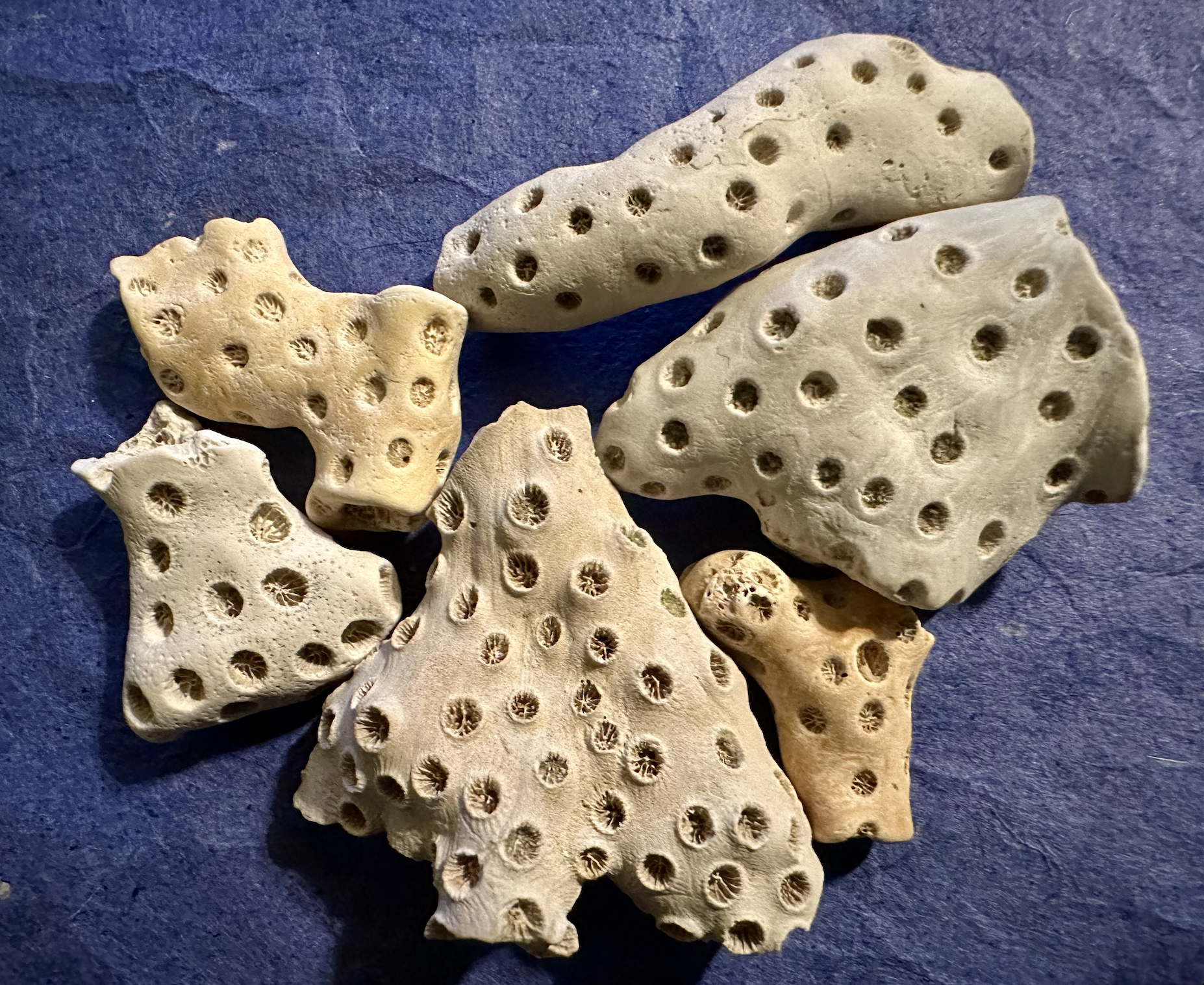
From my son, fossils tucked in soft cotton for my birthday
creamy stems of dimpled coral, shards of sand dollar, bone
Eighteen million years rest on my palm
I think of him scanning the beach with his enormous patience
how he tracks a sudden glint in a wave’s pulse
and plucks a shark’s black tooth
My son whose middle name means Radiant Sea,
radiant the way sun threads light through water
a thick embroidery of dragon fire
Pregnant, I dreamt I crossed the sea with my father
in a gyroplane. Large, gleaming fish leapt in arcs
through the open cabin
and I knew then I carried the sea within
Explosion of wet light and cold, muscular wonder
re-ignites in my hand as I hold these fossils
A sacral flood, a spangled wonder
ii
My son has devoted his gifts for policy
and persuasion, worked with others
to spin clean wind energy
Wind farms now halted
by a demented president
as climate chaos heats the seas
and bitters the waters
brings death to coral reefs
Each reef a womb of life
that protects sea horses
sea turtles, sponges and sea stars
sharks and rays, the sensitive octopus
gleaming fish of every hue
coral reefs that have flourished
for millions of years
whose creamy stems of fossil
sit upon my hand
explosion of wet light
cold, muscular wonder
sacral flood and spangled wonder
all this radiance in peril
Consulting the Watershed
Gaby Benitez
I know I was a girl once because I have spent years trying to shapeshift and fit into the frame I was handed, molded myself through blood sacrifice and fasting in prayer to the girl-gods, by denying myself, or if I failed to abstain—by repenting with two fingers down my throat, hovering in offering over the toilet bowl. Because I fantasized about sawing my body down to bone, to splinter/shard/papercut. Because I spent years drinking potion after potion passed to me to erase my own inconsistent memories of myself – to prevent myself from making more. Tweezing and plucking away at myself in hope of metamorphosis, or at the very least, to be found acceptable and uncontroversial/inoffensive, for that girl to be revealed. I know I was a girl once because I failed at all of my attempts to be a girl.
So, then what? I’d rather be an elm leaf, a cup of coffee, a speck of that quartz I dug up once on the trail behind Onion Creek, fragmented and kaleidoscopic, fragrant with the place’s namesake. Maybe it's my gemini rising that always has me nonsensical and roundabout—never straightforward. Maybe the hole in the fence that lets you through but claims something of yours on the way. The rock path across the creek that you can use to step across when the water’s not too high and you’ll only barely get your shoes wet. Findable as long as you know what you’re looking for, where to step. The thruway, the route.
I’d rather be sunlight on water—the one cloud in the Texas-wide sky that tells you up from down. Rather be succulent, the cactus’s sponge-skeleton soaking up water before the drought, curves and spines filling in—both habitat and defensive line. The persimmon—with bright green leaves and silvered bark, still understated with its deep purple fruit—a pulpy haven for the ravenous who know how to pay attention; lichen or moss in the desert; the red clay you can taste on the breeze in early spring. More hellgrammite to dobsonfly than caterpillar to monarch. The way that you can tell how clean the water is by whose babies are breathing it in through gill and skin.
Where do you look when no language is shaping itself to your tongue? When you have found yourself undefined and uncertain? Ask yourself: Where does your water come from? Trace the fault lines below your skin—map the watershed to its source. Crook of elbow, curve of skull to spine. Roof of mouth. Your queer heart (is it beating?) Ask that thumping thing your fortune instead. And reverse it all, finish the cycle—when your body flushes itself of the toxins you took in yesterday and the day before—where are they headed?
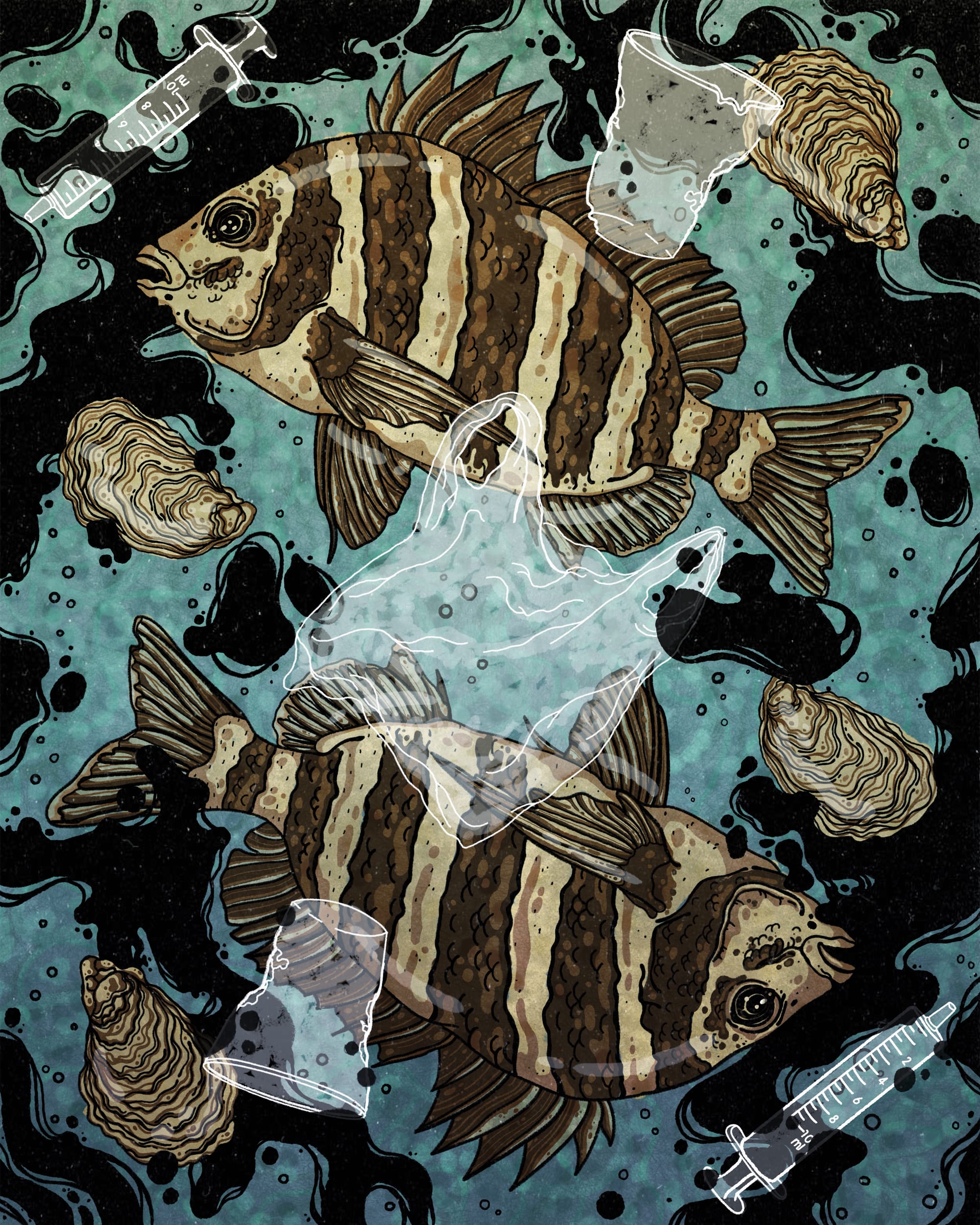
Where I am now—they took the waste to create a wetland in the desert, back where I was born they made resting ponds for migratory birds. From there, your shit flows to the sea. Ask the in-between guide, the river, before it’s nothing but cracked earth—ask the sand, littered with a billionaire’s toys, littered with your amazon packaging; ask the gulf’s inhabitants, gasping for air —how it’s possible to drown alive in water you were designed to breathe freely in? Did they feel it as the pockets of death crept up to meet them? Ask the current if they feel parts of their body losing oxygen, becoming lost. Ask them when they first noticed the pools of oil contaminating bloodstreams, ask them at what point you’ll recognize that you are losing part of yourself. Ask the oxygen who would steal such a thing as life. Ask the ghosts of sting ray and sanddollar if they condone violence for the sake of survival. Ask the hollow in the ocean if you are worthy of being its mirror. Ask yourself if you choose absence over ecosystem. Ask yourself whose existence yours is woven into, is inseparable from.
***
Resistance has always grown despite despite despite—the dandelion weeds in the cracked concrete eroding the foundation, the wildflowers whose work it is to cleanse polluted soil, but yes maybe this is my limited imagination: that I can’t see what the field will turn into, that I can’t quite glimpse the old growth forest, the prairies and their roots reaching towards the center of our small world, purifying years of poison. I am waiting for the signs of that clean water: shimmering and amphibious, the insect babies waiting a lifetime before they become airborne for a day or two.
When I listen hard enough, they are the ones to tell me to stop erasing myself in real time. To continue dreaming up my gender and beyond that, myself, as something inextricable from the world around us. To stop talking about dreaming and imagination and start building the world we need to survive in this lifetime, in all future lifetimes, a world that gives life and memory to all of our past selves, to our ghosts (known and lost), and to our stories. To burn down every white house and replace it with frog song, with music so loud it breaks the sound barrier, with dance that stamps the seeds in just tightly enough to be born after the first rain, to wash the debris away and let the oyster reef do its work.
Galapagos
Paola Carrasco
The black island burns under the sun’s zenith;
our star lights up the equatorial concavities
with his blazing lips as we spin outward with
a violent centrifugal force.
Lava cacti bear a fruit for finches
and iguanas thirsty
in an arid, jagged landscape echoing
the flames that sculpted it once.
Roots like golden yarn embroider patterns
across the crevices of the basaltic surface;
symbiotic bacteria brandish
Wari-Tiwanaku fangs and claws
that tear away into the night-colored rocks
with a silent desperation for life.
The turquoise ocean crashes against the obsidians
and the aging gray succulents;
vibrant red spondylus and strombus shells mirror
Pre-Columbian symbols for man and woman, agents
of death.
Frigata magnificens
R.H. Booker
This poem was dictated to me
by a frigatebird I met on a limb
of the Goose Island Oak,
a Quercus virginiana itself
over two thousand years old.
The bird spoke in a slow, smooth
cadence obtained from a life
of riding rising thermals.
We sat on a middle branch.
He told me he would die
before the next full moon.
He explained to me how
he was performing his death migration.
How four moons ago his mate of this life
had completed her final journey,
and now it was his turn.
How twenty seasons ago
they had met in this great oak,
vows taken near the highest limb,
eloping afterwards to Ecuador.
How they flew as close as
aerodynamically possible
to each other,
such was their love.
For her death migration
she had wished to see a glacier.
And she did.
Passing away in her sleep
as they recovered on a limb
of a box elder in Buenos Aires,
tango music floating through the park
carried by nudges of Atlantic air.
He had not left the sky since then.
That he made a promise to her in his mind
to remain in the great ocean above
until landing here.
The starting point for
his exodus from Earth.
From here he would travel along
the coast of Mexico,
attempting to see things
as they had for the first time.
Rest for a while in Colombia.
How there were hummingbirds
he enjoyed speaking with.
How sometimes their seasons
synchronized and he would
also see them near the great tree,
how such a small bird could have
such a large wingspan at heart,
how remarkably
they crossed the Gulf
flying just at
or slightly above
the cold spray of the sea.
He was ready now to tell me his haiku.
Though before I could ask,
he told me a humpback whale taught
him and his lifemate the poetic form.
How all of us have poetry
somewhere interspersed
within the beating of hearts
and wings, he said.
How there had been
a typhoon in the Pacific
that had almost killed
the young pair, early
in their days of soaring together.
How they had cried
on the surface of the
tumultuous ocean,
helpless,
until the Earth rose around them.
The whale bellowed,
for them to hang on:
they would have to ride out the storm,
the only chance of taking flight again
dependent on dry feathers.
And throughout the night they clung
to the massive condor of the water.
Waves and fury beat against them,
and by the way the bird told me the story,
it still beat against him these many years later.
He continued, describing how
the sun rose to a cloudless horizon,
the ocean herself as still as
stars in the night sky.
Water lapped at the sides
of the massive animal
which had learned the haiku
as a calf near the Ryukyu island chain.
The bird still remembered the poem
the whale shared with them
then:
the ocean river,
shallows and fathoms, always
carry me to you.
The whale explained it was dedicated
to his love of many years who perished
at the hands of a harpoon from a vessel.
That he was bound to swim perpetually
until his own death, his own burial at sea.
And that leads me to my own poem,
the bird said, which I will share with you
before I rise along with the morning.
I nodded and he waited for me
to turn a fresh page in the notebook.
He watched the waves while saying it, and
then there was silence,
interrupted afterwards by the beat of his wings,
climbing steady with the eastern wind.
I jumped down and ran to the surf
to watch my friend
as he turned South,
along his final migration.
there along rivers
of wind, one finds you and me,
closer to Heaven.
VACATION BIBLE SCHOOL UNDER THE SEA
Susanna Schantz
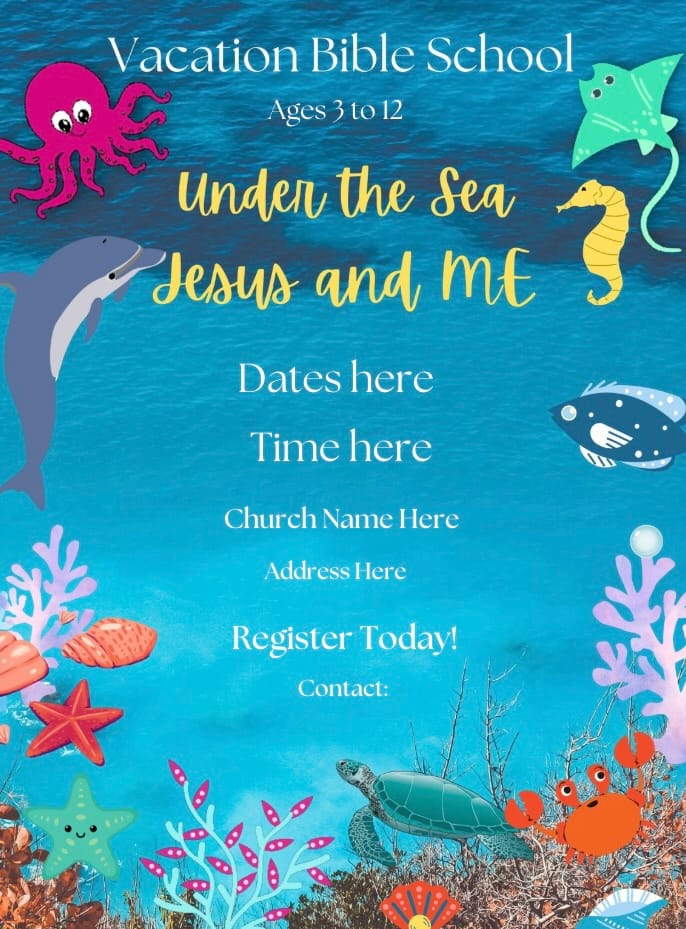
LED church sign—with two bright images of orange coral—spotted near my home.
Already the adventure isn’t
aging well, bright coralline
diodes exercises in nostalgia,
neon dreams of antecedents
now nearly achromatic.
Meanwhile, unseasonable storms
crash the party early, summer
no longer antediluvian.
A bleached postcard home is
in the mail, its hide-away
garden, once guardian to
angels, almost imperceptible.
But our mind’s eye still teems
with soft saddle-carpets where
sweetlips sip and bubble tips
cuddle clowns, harlequins
entertain octopi and horns and pipes
beguile brains to groove, fans
to finger-whip, great stony stars
to come out in the night deep.
But we keep making such a big
splash. As the sea’s salty tang
spreads out further and further
upon the earth, its depth of love
eclipses ours. Which fishers of
men will throw out a net to us,
struggling to stay afloat, this
summer camp soon permanent.
Dirty Skeletons (The Second Pentacle of the Moon)
Jason O’Toole
If a god as cruel as yours
exists, it will be necessary to kill him.
If nails don’t work we will
drag it to deeper waters
where to be baptized is to drown.
Washed up on trash-strewn beach
would you point to its water-logged,
seagull picked blue body and shout
HE LIVES!
listen closely for his orders,
(which only you can decipher)
over the cries of your children.
Feed mewling mouths
with closed fists,
children wound
in shrouds of
wild nettles
their bent bones
get up and walk
past the altar
constructed of
all the things they’ll never have,
this shrine
to your sea-drowned god.
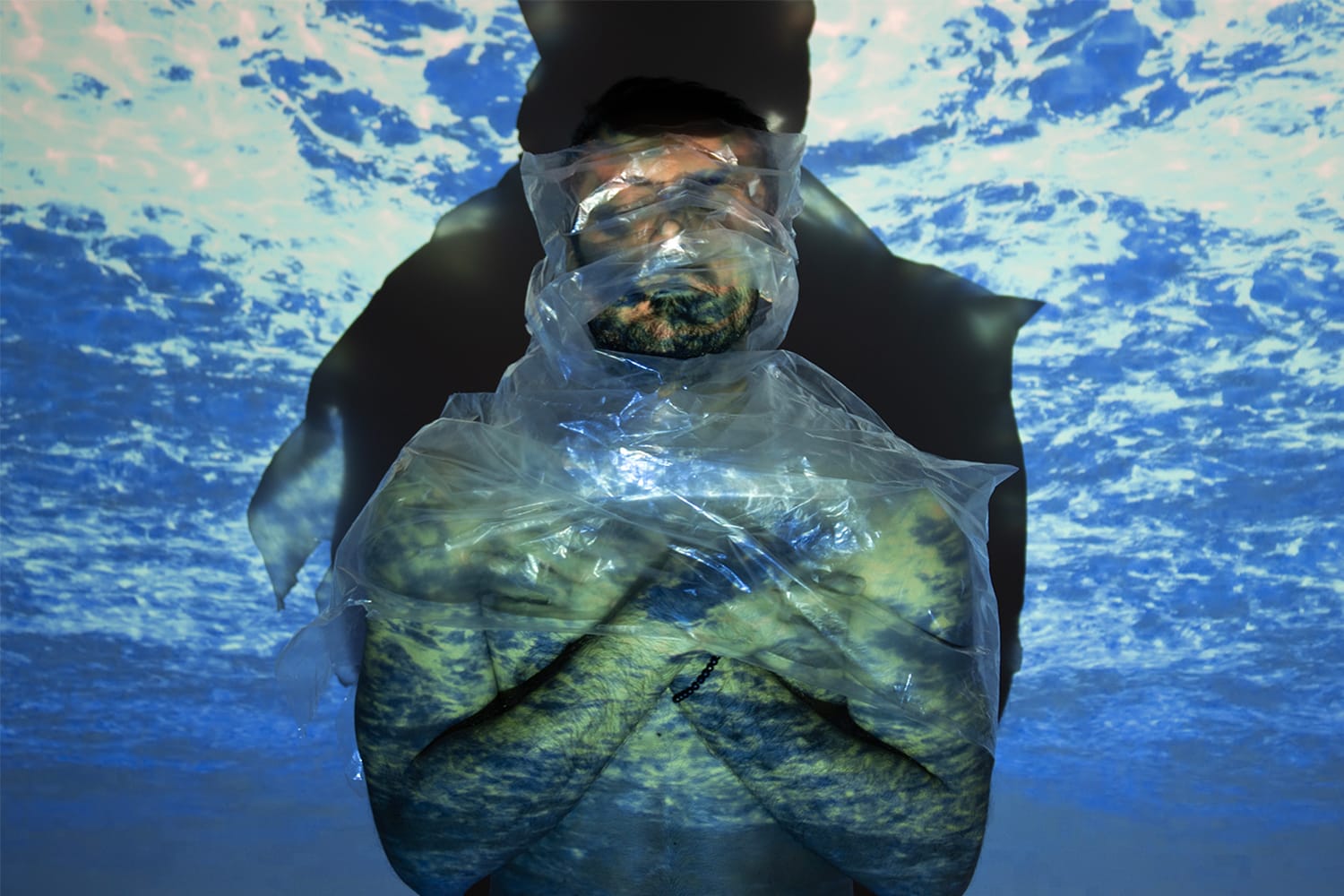
Parallels
Wallis Monday
Laguna Madre, October
I often see myself as some sort of flounder woman—
asymmetric, pallid, dreaming of mud. Buttery and quiet.
The latest local gossip says that the new mayor is a flat
earther.
Has she crawled out of the mudflats towards the evolutionary peak of municipal
government? What are the implications for us bottom feeders?
I am still unoptimistically looking on the bright side.
You, Waterkeeper (After Diane Wilson)
AnaKaren Ortiz Varela
You live in a purple house with red trimmings
You drive a red old pickup truck
and raised five children
You fourth-generation shrimp boat captain
that grew up Pentecostal
You, a Libra, ruled by Venus, life path 22
You persistent hardheaded hellcat of a woman
You—who lost everything and gained her soul
You—fearless as all fuck
You—not scared of death
not scared of men
You—fierce and firmly planted
You excellent problem
You principled opponent
to the oil giants
and giant refineries
giant chemical plants
and sold out politicians
sold out lawyers
sold out neighbors and
sold out hearts
You combatant of high rank
You defender of our bay
You record keeper, memory keeper
You waterkeeper
You formidable warrior
You dangerous dangerous fisherwoman
You multidimensional banisher of plastics
You, meticulous sampler
You, refuge to whistleblowers
You resolute hunger striker, tower climber
You who knows very well that water is life
water is life
WATER IS LIFE
You Gulf Coast legend
You tenacious truth teller
You absolute misbehaved protector
You epicenter of change
You serious concentration of light
You of admirable dedication
You of glorious fury
You of extraordinary insistence and
even more extraordinary resilience
You with boundless spirit
You with monumental dignity in your step
You with righteous reverence for Mother Earth
For our ocean beds
You beloved blessing
Blessing that the water gave us
You waterkeeper
You, waterkeeper, you
You. Oh you.
They will never get rid of you.
Author’s note: I had the pleasure of attending the first People’s Microplastics Conference in Port O’Connor TX in November 2025. After two days of intense learning and communal exchange, this poem came pouring out of me. I started writing it in the morning and by the end of the day, I was reading it as a tribute to Wilson and a way to close out the conference. It was an incredible feeling for me—never before had I stepped into the role of movement poet such as this one. It was an honor to synthesize the energy of the room. Before I read the poem I told the audience that the last line was about them, too. It’s for lovers of our oceans everywhere.
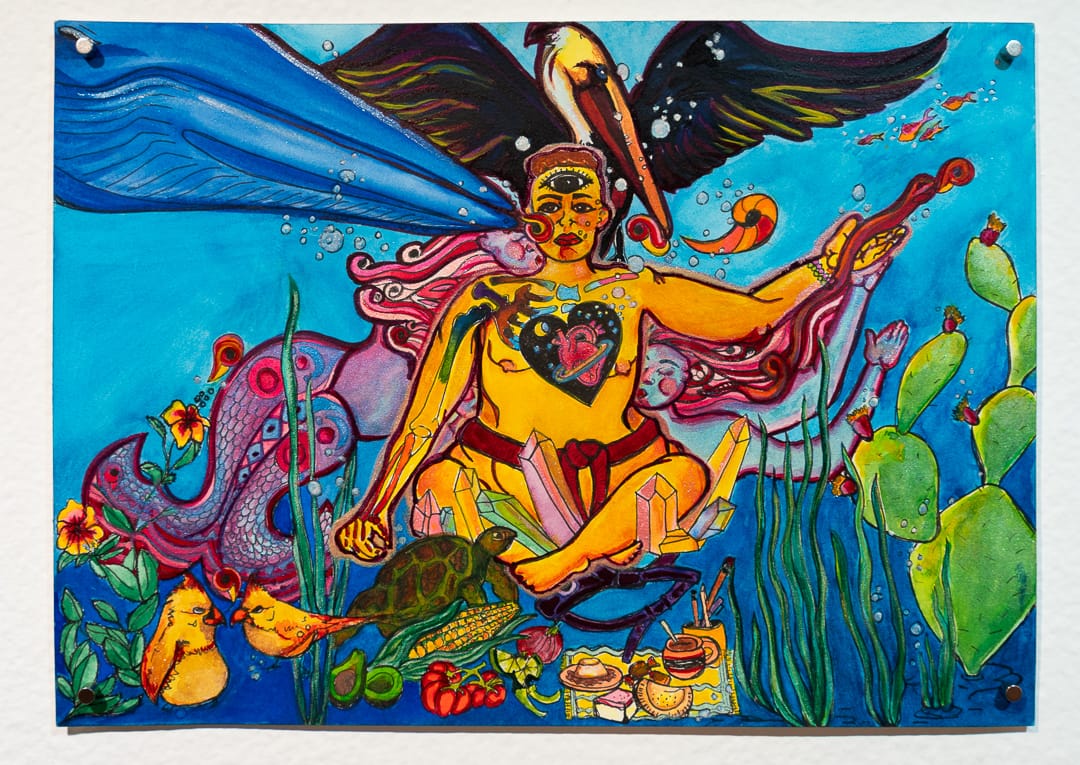
Artist Bios