

Sierra Club’s Beyond Coal campaign released a report this month that scores utilities across the country according to the decarbonization and renewable energy targets scientists say we must hit by 2035 to avoid the worst impacts of climate change. Titled The Dirty Truth, the report evaluated 75 utilities that together account for about half of all fossil fuel-generated electricity production in the United States, including San Antonio’s CPS Energy, which scored a C—not terrible, but not great either.
The Sierra Club used three specific benchmarks to rate utilities’ progress on climate over the past five years: 1) progress toward retiring all coal-fired power generation by 2030; 2) progress toward building the renewably sourced energy required to replace fossil fuels and meet energy rising demand by 2035; and 3) whether utilities planned to build new gas plants before 2035. The first two metrics added points to a utility’s score, while the third one subtracted them.
After taking stock of the portfolios and clean energy plans for the nation’s most prominent belchers of planet-warming gases, the findings were…not great, especially amidst the Trump Administration’s gutting of federal support for renewable energy and priming demand for power use by data centers and crypto miners.
Xcel Texas wrangled a B for plans to retire the Tolk coal plant in the Panhandle ahead of schedule, while the Lower Colorado River Authority (LCRA) earned an F due to its decision to keep one of the nation’s dirtiest power plants in operation—the Fayette coal plant outside Austin—while failing to advance on renewables.
“LCRA professes a mission to enhance Texans’ quality of life while keeping open a dirty, expensive coal plant and investing almost nothing in the most affordable forms of energy,” Cyrus Reed, legislative and conservation director of the Sierra Club Lone Star Chapter, stated in a prepared release from the nonprofit.
“In fact, LCRA got one of the lowest clean energy scores in the entire United States even though reversing course would help lower bills for its city and co-op customers.”
Overall, American utilities have committed to retiring only 29 percent of the coal in their portfolios by 2030, and seem to be replacing that with new gas-fired generation more than clean energy sources like wind, solar, and battery storage, the report states. While 65 percent of utilities surveyed have improved their clean energy scores over the last five years, 69 percent worsened on gas and 33 percent on coal. And the amount of new clean energy collectively planned by these utilities would replace just half of existing fossil fuel use—not accounting at all for projected demand (or “load growth,” in utilityspeak).
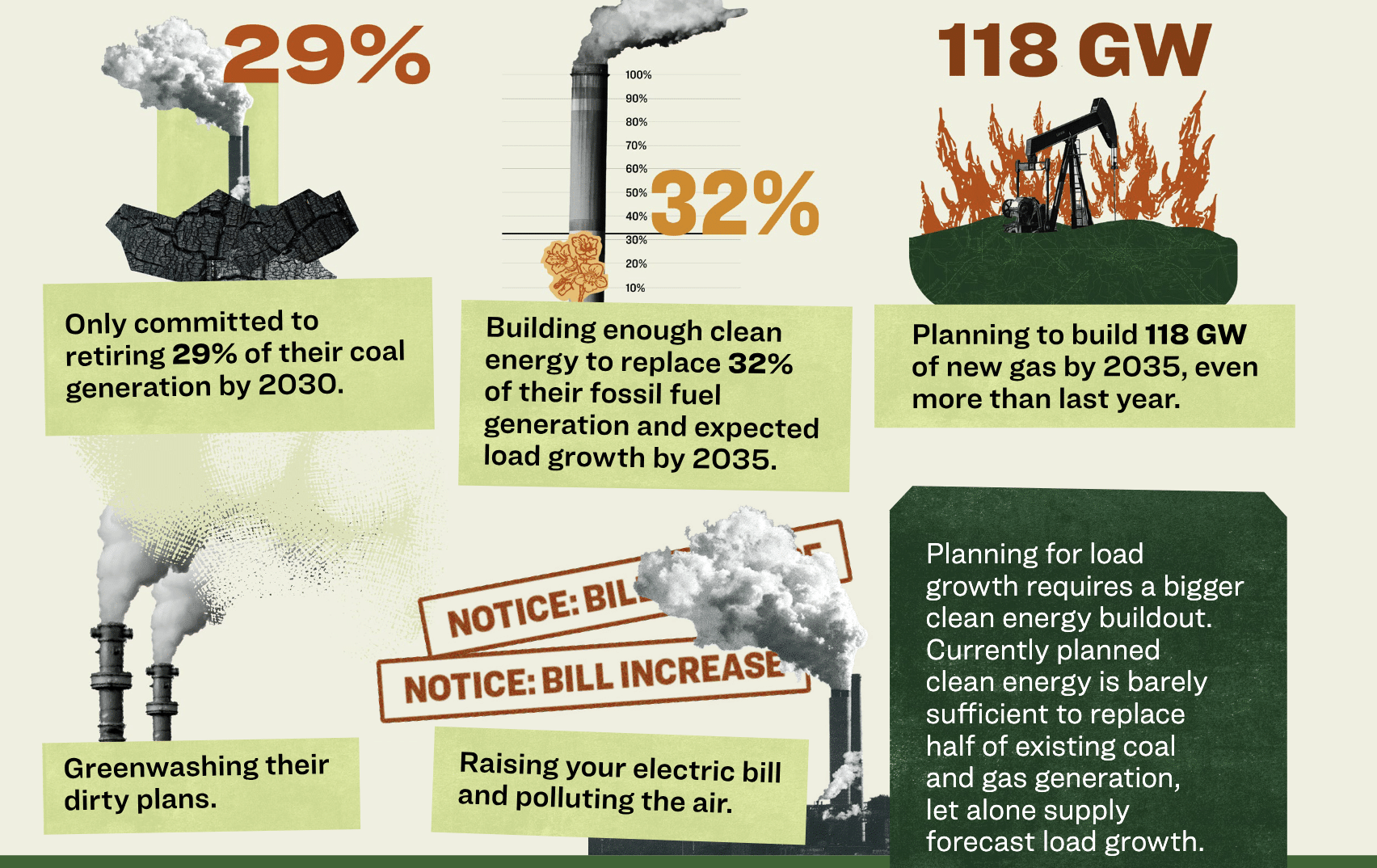
Sierra Club summed up its findings as such:
“[I]nstead of correcting course, many utilities continue to stall, wasting time as projected power demand increases and the transition [from fossil fuels to clean energy] becomes more urgent. This failure has contributed to rising affordability issues, which these companies are now using as excuses to justify continued reliance on fossil fuels.”
Maybe not surprisingly, Sierra Club’s assessments turned up a significant degree of greenwashing: though 65 of 75 utilities (about 87 percent) had made some kind of climate pledge on paper, their promises were not borne out in practice, given that 60 percent of utilities scored a D or F. Conversely, the report found “a clear pattern: utilities that set ambitious, near-term goals take more action to transition to clean energy. Meanwhile, companies that delay action try to hide their lack of progress behind vague, long-term climate pledges.”
Responding to the City of San Antonio’s own Climate Action and Adaptation Plan—which sets specific and actionable targets, aiming for a 41 percent reduction of greenhouse gas emissions by 2030, a 71 percent reduction by 2040, and carbon-neutrality by 2050—CPS Energy has taken significant steps to close its dirtiest coal- and gas-fired power plants and increase the share of renewables in its portfolio, alongside conservation goals (albeit less ambitious ones than in decades prior). But CPS has also undeniably leaned heavily on gas-fired peaker plants to make up for shuttered coal and aging gas, including a buying spree on existing plants across South Texas—three last year and four just last week.
And so, for its efforts, CPS gets a C—a passing grade, compared to the vast majority of utilities.
But the devil is in the details. According to a more granular breakdown provided via an online tool, CPS scored 100 percent on its current progress toward retirement of all coal by 2030. But it scored just 30 percent in its progress toward transitioning to all-renewable energy by 2035. And though Sierra Club reports that (as of July 1, 2025), CPS has “0 megawatts” planned from new gas plants through 2035, this doesn’t account for CPS’s 2024 and 2025 acquisitions, which together add 3,332 MW of gas-fired generation to its portfolio. Nor does it account for the nuclear energy in CPS’s portfolio—still projected at 10 percent in 2030—which although low-carbon during power production is hardly renewable or “clean” on the mining, refining, or disposal side.
One other caveat here is that the Sierra Club report grades on a generous curve. Unlike Texas public school students, who are required to earn at least 70 percent to pass for the semester and graduate for the year, a C in utility world means earning just 35 points out of 100. In fact, the average score across utilities was 15—three points lower than the Sierra Club’s baseline assessment in 2021.
Did anyone even get an A? the students might be heard to grumble. According to The Dirty Truth, three utilities did: Public Service Company of Oklahoma, Entergy New Orleans, and Xcel Minnesota/Wisconsin, though in Texas the highest grade given was a B (Xcel Texas/Mexico).
What we can say is that, viewed against the backdrop of national trends—building some clean energy capacity but not nearly enough to meet rising demand, turning to gas in the name of affordability—CPS appears, well, entirely average. Mid, as the kids might say.
But if there is one main takeaway from this report, it’s that a C isn’t terrible. In fact, it’s pretty good…for a utility. Which is a problem.
-30-
Greg Harman contributed reporting.
Correction: An earlier version of this story incorrectly stated that none of the utilities receiving an ‘A’ grade were listed in the report’s appendix. The authors pointed out the column where this is listed and story has been updated to reflect this.


