

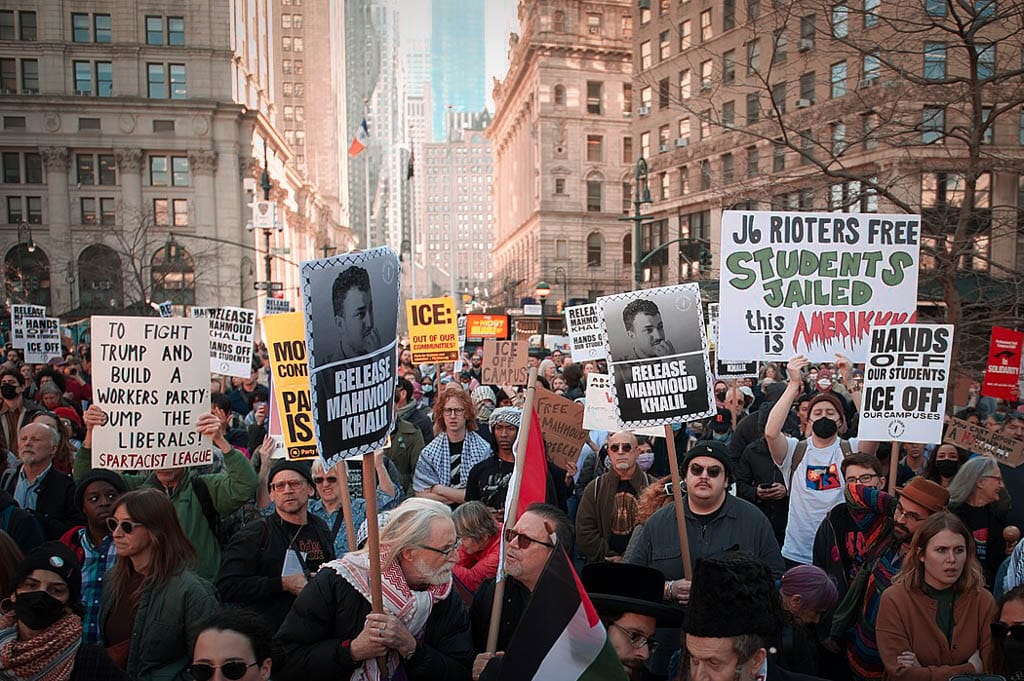
The U.S. government is trying to disappear Mahmoud Khalil. A Palestinian permanent resident who recently completed his graduate studies, Khalil is now in detention and facing deportation—not for any crime, but for daring to organize anti-genocide protests at Columbia University. His case is part of a growing crackdown on Palestinian activism in the U.S., where students and organizers are being surveilled, arrested, and silenced for opposing Israel’s atrocities in Gaza.
As members of the San Antonio-based People’s University for Palestine (PUFP), we are outraged by Khalil’s detention and the broader assault on pro-Palestinian advocacy in the United States. We formed PUFP in June 2024, after Governor Greg Abbott issued Executive Order 44, which falsely equates criticism of Israel with antisemitism, and explicitly targets Palestine-related activism on college campuses. E.O. 44 has not only emboldened Texas university administrators to punish student protest, but has also helped pave the way for Donald Trump’s own executive order, E.O. 13899, which criminalizes Palestine advocacy nationwide.
Columbia University’s failure to support Khalil and its complicity in this repression highlight a dangerous reality: universities are no longer sites of open debate and learning—they are active enforcers of authoritarianism and state violence.
Texas institutions have complied with state repression, abandoning their responsibility to the pursuit of knowledge and protecting freedom of expression. Most visibly, they invited police to break up peaceful protests and to arrest students and faculty, all the while ignoring violence against demonstrators. In response, PUFP has hosted community events on the history of Palestine, indigeneity, militarism and policing, and religion, emphasizing how struggles for freedom and justice in Palestine are deeply connected to life in San Antonio and to broader movements for a livable future amid ecological violence, racial capitalism, mass incarceration, and the criminalization of migration. Those of us in Texas have witnessed in recent years an increasingly militarized and expansive border apparatus alongside attacks on education and curriculum and other indicators that the state is a testing ground for repression.
Related: ‘Texas Colleges Rolled Over For Anti-DEI Bill—And Set Themselves Up for Broader Attacks‘
Khalil’s case, thus, is “shocking but not surprising,” to borrow a phrase from writer, historian, and activist Rebecca Solnit. In particular, it exemplifies the “Palestine Exception”—the tendency of Western liberals to champion universal human rights, democracy, and equality, except when it comes to Palestine.
While defending Israel’s right-wing ethno-state, they ignore its occupation, apartheid, and war crimes. This double standard extends beyond rhetoric to the systematic suppression of speech on Palestine in the U.S., where criticism of Israel is equated with antisemitism, and First Amendment protections are routinely denied to those advocating for Palestinian rights.
The Palestine Exception is particularly evident in American academic institutions, a fact that has been made clear by administrations’ responses to pro-Palestine student protests over the last year. Universities should be spaces of critical thought and open debate. Instead, they have become enforcers of state repression and censorship. Under pressure from political forces and major donors, universities have weaponized administrative policies to suppress critiques of Israel and Zionism. Faculty members have been denied tenure or fired for their public support of Palestine, student groups have been suspended, and events have been canceled under bureaucratic pretexts. This repression has caused a chilling effect that isolates dissenters and makes even the mention of Palestine professionally and personally dangerous.
Thousands of students, faculty, and staff have been arrested or disciplined for pro-Palestinian advocacy, according to a 2024 report by the American Association of University Professors (AAUP). These crackdowns are not isolated events; they are part of a deliberate infrastructure designed to silence dissent and curtail academic freedom, or the protection of teaching and research from political or industry censorship.
As Jairo Fúnez-Flores argues, academic freedom and free speech are not universal rights—they end where Palestine begins.
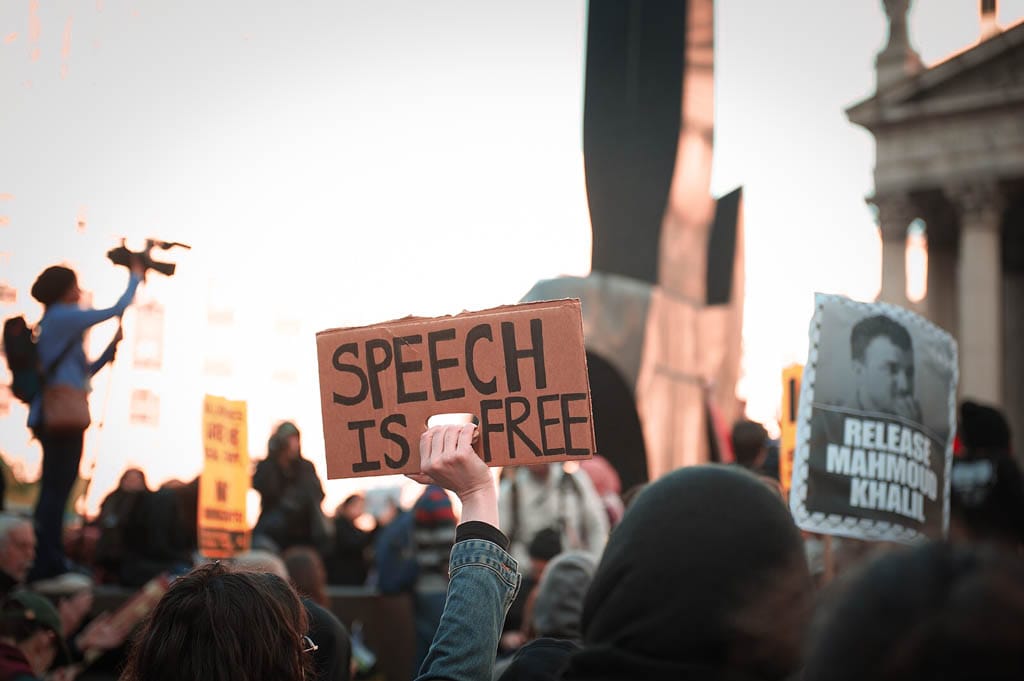
Despite the perception of academia as an “ivory tower,” academic freedom is not merely about protecting knowledge for its own sake; it is about ensuring that education serves the “common good,” which is precisely why fascists target education.
Columbia’s failure to protect Khalil mirrors its betrayal of its students and faculty more broadly, highlighting how universities in the U.S. have abandoned their responsibility to truth in favor of their political and financial interests. At its core, academic freedom is essential to a free society. Universities that fail to protect dissent are not simply neglecting their duty, they are actively complicit in state repression. The heart of the university is not its board of trustees, donors, or political administration—it is its students, faculty, and staff. Yet, in siding with the state over their own communities, universities have abandoned the common good and stifled the very intellectual inquiry they claim to protect.
It is easy to blame the Trump administration for the surge in state-led suppression of free speech on college campuses, but this repression predates Trump. The latest wave of campus crackdowns emerged with President Biden in the White House and took place in so-called “blue states” as well as in states such as Texas. This bipartisan assault on academic freedom reveals a deeper reality: that the Palestine exception is not an anomaly but rather a defining feature of U.S. academic and political institutions.
Khalil’s imprisonment should shock our consciences, not just because of the fact that he is a legal permanent resident of the U.S., or because he was separated from his pregnant wife. Rather, Khalil—like Palestinians more broadly—was targeted for existing, for defending his people, and for refusing to accept annihilation. His case is not just about Palestine, therefore, but also about fascism in America, the criminalization of dissent and the erosion of American civil liberties, and the role of education as a necessary part of a free society.
In short, his case is a test: of whether the state can disappear a permanent resident and destroy educational institutions, or whether our collective commitment to justice is strong enough to protect ourselves and what we care about.
If we do not challenge the Palestine exception, in Texas and elsewhere, it will not remain just an exception. It will become the model for repressing labor organizers, racial justice advocates, reproductive justice efforts, immigration rights advocates, climate activists, and anyone else who threatens capital and the status quo.
As James Baldwin reminds us, “if they take you in the morning, they will be coming for us that night.” The fight for Khalil is the fight for us all, and if we fail to act, the repression we allow today will shape the world we inherit tomorrow.
-30-
Sajida Jalalzai, PhD, is an Assistant Professor of Religion at Trinity University in San Antonio, Texas. She is an expert in the study of North American Islam and is interested in questions about Muslim leadership in secular, religiously plural societies.
Noah Collins is an adjunct professor of philosophy at the University of the Incarnate Word. He is also an organizer for the Liberation Library.
James Finley, PhD, is Associate Professor of English at Texas A&M University—San Antonio and is a core member of San Antonio for Justice in Palestine and a member of Our Schools San Antonio. His research and teaching focus on abolition, the environment, and disability in nineteenth-century American Literature.
Habiba Noor, PhD, teaches in the Department of Education at Trinity University where she teaches courses on Urban Education, Social Justice, and Schooling in America.


