

A cheery howdy-do to you, readers. As cheery as one can muster in the midst of our present madness. And welcome to Alternative Futures: a Deceleration newsletter about the work happening at the grassroots around the world to architect new ways of living, being, and relating.
With fascism on the rise, climate action falling by the wayside, and world-renowned experts declaring that doomsday is closer than it’s ever been before, it’s easy to believe that all is woe and there’s no point in trying anymore. Alternative Futures is here to show not only that our actions still matter, but to provide you with clear examples of the work people are doing in their communities to transform the world and lay the foundation for something radically new. Hopefully, by doing so, Alternative Futures will ignite in you the inspiration to undertake an endeavor of your own.
Each month, I’ll bring you original reporting as well as links to important, exciting stories from across the web and world that will leave you armed and ready to act when the moment demands it.
If you know anyone who needs a dose of radical, actionable hope, pass this newsletter along to them.
Yours Truly,
– Syris Valentine, Delusional Optimist
As climate justice drifts further out of reach, how do we create the political landscape necessary for it to become possible?
Looking back at a 2018 proposal by two academics can help us see a path toward a more just future
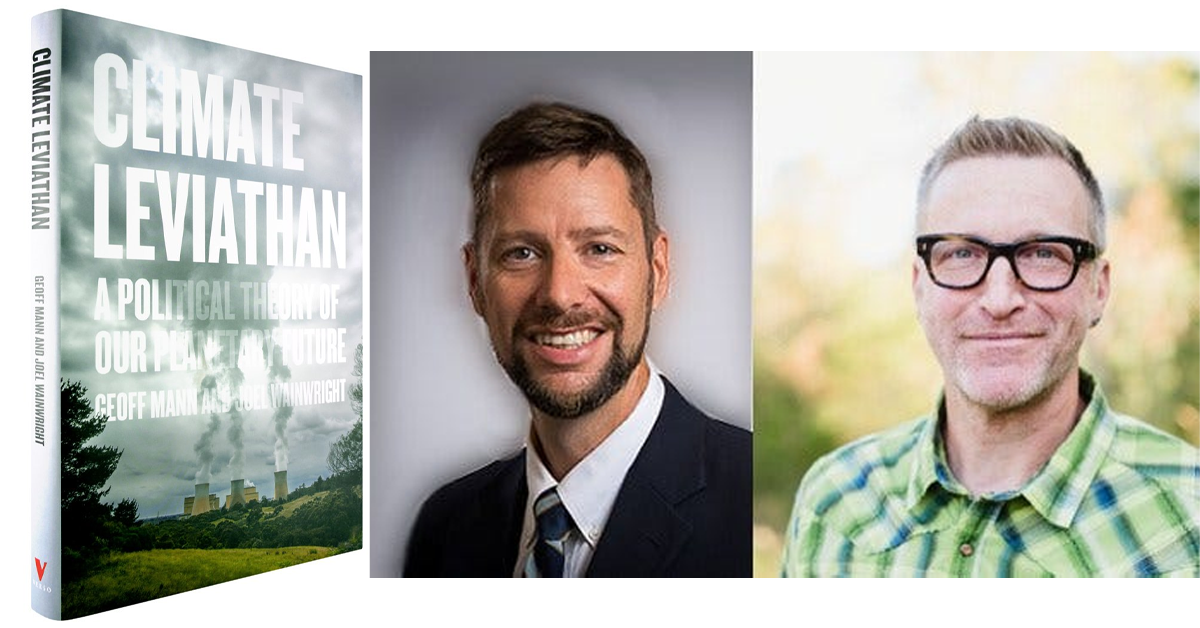
Seven years ago, in 2018, half-way through Trump's flailing first term, Greta Thunberg began her Fridays for Future school strikes, Sunrise Movement activists occupied Nancy Pelosi's office to demand a Green New Deal, and political economists Geoff Mann and Joel Wainwright published their book Climate Leviathan.
With the Paris Agreement just three years old and the pursuit of climate justice a quest that crusaders across the world had taken up, the book had an undeniable salience.
In it, Mann and Wainwright describe how climate change, and the way governments respond to it, will resurface the geopolitical landscape—uplifting new foundations as old norms erode, throwing the world into fresh relief. As the theorists elaborate those dynamics, they articulate how the future of global governance must look to make true, robust climate justice possible.
They saw four broad categories of possible political futures for our planet according to where the world lands along two axes: how it relates to capitalism, and where sovereignty and authority is founded: at the level of the planet or down at the roots.
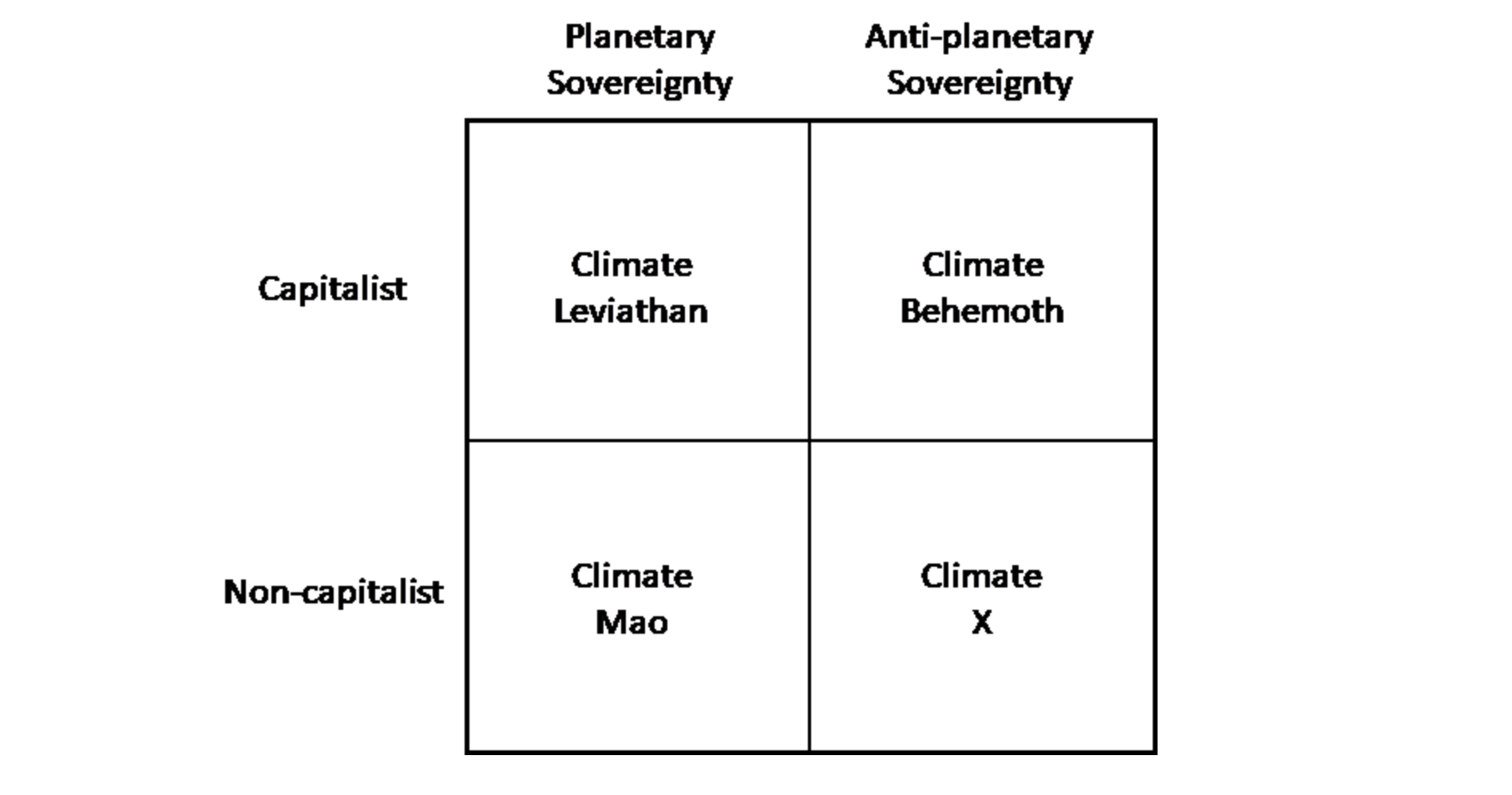
Should sovereignty and political authority come to be abstracted further away from the people to sit at the level of the globe and exist to protect and serve capital, this would create what Mann and Wainwright refer to as “Climate Leviathan.”
This would function as something like a super-charged United Nations empowered to institute global environmental regulations and rig the Earth to a life support system that allows its scientific apparatus to monitor the planet’s vitals; but any solutions to the climate crisis would remain rooted in the belief that today’s industrial titans can innovate us out of the dilemma their precursors innovated us into.
If, on the other hand, planetary sovereignty should emerge undergirded by a centrally planned, anti-capitalist economy as U.S. influence waned and China’s rose, it would create what the authors call “Climate Mao.” Such a government, with its ability to expressly direct and dictate global climate action, “reflects the demand for rapid, revolutionary, state-led transformation today,” the authors write.
The other two possible futures would likely emerge as a response to the increasing tilt toward true global governance, the authors argue, whether in the name of “reactionary populism” or “revolutionary anti-state democracy.”
The former case would birth a so-called “Climate Behemoth” that privileges free market nationalism above all, making climate action nigh impossible.
The alternative would be what Mann and Wainwright refer to as “Climate X,” a somewhat nebulous title because of their desire to avoid prescribing how this inherently multifaceted approach would look.
One of the primary principles of such a future borrows a phrase from the Zapatistas; it would be defined, in part, they write, by “solidarity in composing a world of many worlds.”
In such a nested world, communities would be empowered to collectively dream up solutions to the problems they face, solutions that would transcend the restrictions of capitalism and afford all people dignity, inclusion, and equality.
The dream of Climate X, the authors admit, is somewhat utopian and will require a quite large and revolutionary movement to manifest. Still, it’s the best — possibly only — chance we have of achieving true climate justice for everyone around the world. But everyday this radical, hopeful, just alternative seems to slip further below the horizon.
Given the ruptures and upheavals that have happened in the years since Climate Leviathan was first published — a devastating pandemic and the rise of American fascism to name but two — I called Joel Wainwright, a professor at Ohio State University, to ask him about what our present moment means for the political futures he and Mann describe in their book and what it will take to redirect course toward Climate X.
When he and Mann started working on the manuscript, Wainwright told me, it was just after the Paris Agreement had been signed. That moment seemed to signal “a turning point in history,” he said. A global government of the Climate Leviathan had shown its bud, but had not yet to fully fruit.
Over the coming years, the Paris Agreement would face a common and recurrent critique: It’s not enforceable. Rectifying this shortfall and affording the UN the authority to mandate actions and punish those nations that fall short of their obligations would cement the rising leviathan. Such a path has been deemed ideal, necessary, by scholars like Nils Gilman and Jonathan Blake who argue for a global government in their 2024 book Children of a Modest Star.
“But what we have seen,” Wainwright said, “is that the ability of the elites to reorganize the world system has been very difficult, and we are essentially in a war now between Behemoth and Leviathan — not as things, but as potential futures.”
For the moment, at least, Behemoth seems to be winning. But Wainwright refuses to accept that it will win out in the long run: “Because what that means, frankly speaking, is that humanity is in very, very serious trouble, because there is no livable future under Behemoth.”
The ideals of Climate X, however, remain firmly cemented in the minds and actions of the most radical thinkers and activists working today. Japanese political philosopher Kohei Saito even provides his own argument in favor of it in his 2024 book Slow Down: The Degrowth Manifesto. Still, Wainwright acknowledged “the odds are longer today than they were at the time we wrote our book.”
Back in the 2010s, the momentum for comprehensive climate action was swelling in every corner of the world. “By contrast, today,” he said, “it's hard to find the pulse of the climate justice movement.” Add in the fact that the Trump Administration is tearing apart America’s climate science infrastructure and even many of Wainwright’s own students see discussions of Climate X as “almost meaningless utopianism,” he said.
No one can deny that, in this moment, solutioneering feels fraught. “There's a lot of work to be done everywhere to kick start a new climate justice movement,” Wainwright added. It’s the same work that organizers have always put into constructing social movements: “building networks, organizing, consciousness raising, building organizations that are well rooted,” and using those organizations to challenge systems of power and oppression by, among other things, targeting economic pressure points.
“The priority must be to organize for a rapid reduction of carbon emissions by collective boycott and strike,” Wainwright and his co-author write in the book.
Wainwright pointed out in our call that we can, right now, look to the one-day general strikein protest over the murders perpetrated by ICE agents in Minneapolis, his hometown, for inspiration: “I think that is incredibly inspiring to see how people under the most difficult circumstances are able to return to classic strategies like strike and boycott and protest and turn them into a new social movement.”
Watching those actions and learning from past movements isn’t just idle theorizing. A study published just this week showed that teaching people how collective action has worked across nations and generations is a critical way to get them engaged today.
That’s exactly why this newsletter exists.
I can't pretend to have answers guaranteed to ease your justified anxieties. But the world is full of theorists and activists holding jigsaw segments that, when pieced together, may reveal a map providing viable paths we can follow to escape our troubled present and reach those fabled lands possessed of justice and equality for all. So, every month, in this newsletter, I intend to flip over piece after piece that we can rearrange, assemble, and conjoin in creative ways to uncover that much-needed treasure map.
I hope you’ll join me on that journey.
Climate Leviathan in Context
Taking inspiration from historical and contemporary movements from the Paris Commune, to Black radicalism, to the Zapatistas, and the recent General Strike in Minneapolis, we can rebuild a a climate justice movement to ensure autonomy, survival, and thriving for ours and future generations.
Bioregional Restoration & Degrowth for Lovers
People continue to dream of bioregional futures: the idea that our governments and economies should conform to, and serve, the ecologies and ecosystems we inhabit. Next week, Regenerate Cascadia, a bioregional nonprofit in the Pacific Northwest, where I live, will be hosting two online events to showcase the landscape hubs they’re supporting.
Learn more and register here:
 Deceleration Staff
If you speak Spanish and want to spend your Valentine’s Day learning and dreaming about radical alternatives to the status quo, organizers in Spain will be hosting a “Foro Social: Mas alla del crecimiento” (Social Forum: Beyond Growth) on February 13 and 14.
And videos of the sessions will be available here after they wrap. (You can also view sessions from last year’s conference there as well.)
News for a Future
- Colombia to host first global conference dedicated to fossil-fuel phase-out in April 2026
- Together with the Netherlands, the Colombian government will convene the first-ever international gathering of world leaders, academics, and activists from at least 24 different nations to discuss plans to bring an end to the fossil economy. Given the repeated failures of recent international climate negotiations, this summit is being organized wholly outside of the structures and strictures of the UN Framework Convention on Climate Change. (GCN)
- The Time to ‘Daylight’ Buried Urban Creeks Is Now
- In Vancouver, British Columbia, life-long residents are working to resurface creeks that have long been submerged in concrete culverts underground. Not only does this beautify the neighborhoods and landscapes the streams are returned to but it also helps heal the species and ecosystems who depend upon their waters. (Magic Canoe)
- Advertising has no place in a Wellbeing Economy
- Our lives are aclamor with marketing and advertisements: from billboards, buses, roadsigns, postered walls, social media feeds, radio announcements, and so on. Activists with Adfree Cities, an England-based nonprofit, are working to change that by blocking billboards and replacing them with art, among other things. (WeAll.org)
- “We’re Going to Still Be Looking Out for Each Other When They’re Gone”
- In a revival of the mutual aid networks that emerged after the murder of George Floyd, Minnesotans are rallying together to confront ICE by organizing patrol chats on Signal to sound the alarm when agents are spotted nearby and organize food and resource distributions to support those whose lives are being disrupted by the endless assault on innocent people in the city. Julia Lurie provides a first hand account of how everyday people are supporting each other in Minneapolis. (Mother Jones)
- King County Farmers Collectives Grow Community and Food Sovereignty
- In Washington State, farmers collectives have begun to emerge in growing numbers to provide immigrant and BIPOC communities with access to cheap, nutritious, culturally relevant produce they can’t find anywhere else. (South Seattle Emerald)
- In Bangladesh, thousands of volunteers are battling climate-fueled disease at its source
- In the South Asian nation where pollution causes over 272,000 deaths each year, tens of thousands of people mobilize almost every Friday through Bangladesh Clean to remove detritus clogging waterways and neighborhoods across the country that would otherwise poison water and foster the spread of disease-spreading insects. Over the decade since the organization was first founded, they’ve held around 15,000 clean up events throughout Bangladesh. (Grist)
- A New Year’s Resolution for an Uncertain Future
- Reporter Liza Featherstone joined a neighborhood food co-op back in 2017 as part of her New Years resolution. These local institutions help ensure food security and strengthen local food systems, something that will be increasingly essential as the climate crisis (and Trump’s actions) destabilize agriculture and supply chains globally. (The New Republic)
- ‘I Am the River’: How Indigenous Knowledge Reshaped New Zealand’s Law
- New Zealand’s government has bestowed legal personhood on the Whanganui River, the island nation’s third longest waterway. A Maori guardian and a government official, together, are the joint spokesperson for the river, offering it a formal voice in policy processes and a vehicle for suing should its rights be violated. (Inside Climate News)

Buy Syris a Coffee
We invite you to become a Deceleration supporter and subscribe to all of our newsletters at deceleration.news, but if you want to send $5 to Syris for a special appreciation, just add a note with your gift on this link. Cheers!


