

Beyond ‘Faint Words on the Page’
My first contact with the Association for the Study of Literature and the Environment (ASLE) was a flyer on a bulletin board outside a faculty office at UT Austin, when I was a Ph.D. student there almost half my life ago, not long after ASLE came into being in 1992. Standing in that hallway, I felt promise in the faint words on the page: that there might be others out there investigating a juxtaposition of interests that resonated with where I wanted my dissertation study to head—namely, cultural studies and environmental justice.
Because this was a few years before googling hit my grad program, further information did not exist digitally, and was not at my fingertips. A search meant following up on the scant info posted via flyer, and I started by asking the professor who posted it what they knew. Still, it would be another few years, when I was teaching on Long Island, NY, before I participated in my first ASLE Conference in Kalamazoo, Michigan.
At that time, ASLE was in the throes of defining itself as an organization: was it focused on conventionally defined nature writing? Or was it open to broader definitions of both “literature” and “environment”?
While this felt like a contentious question, and though the paper I was delivering made clear that I was in league with environmental justice, I also felt close to books from a childhood in which nature was integral to everyday life, no matter where we were.
My roommate at that conference was an environmental justice organizer I’d met through a NYC colleague. He had suggested we invite her to be with us on an environmental justice literature panel we were planning in NYC; she was headed to school in California, intent on bringing her environmental justice organizing into her academic study. I felt gratification in aligning with others who valued routes of action, study, and discernment similar to my own.
We were building on foundations of our previous experiences and education, pushing against boundaries we found unhelpful, and redefining both “environment” and “culture” based on writing, artwork, and leaders that had moved us. My Ph.D. program had helped shape the work I was doing, but I did not have mentors with years in the field of environmental justice cultural poetics. Over the years, ASLE has provided this space—limited, sometimes unattainable, but always open for making connections with others around the world who study nature and culture from distinctive lived experiences and often marginalized perspectives.
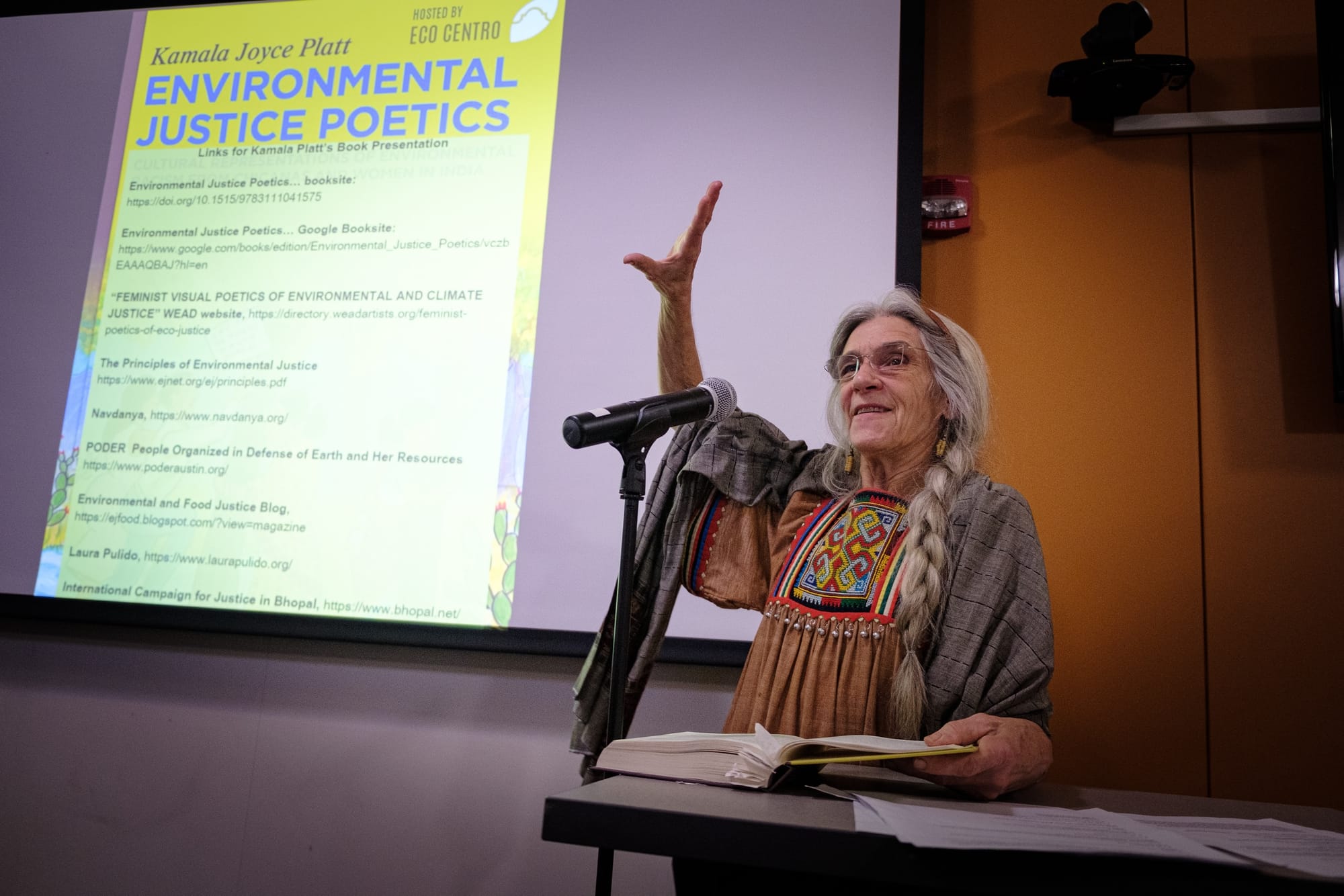
In addition to this long history with ASLE, my experiences with this year’s conference culminated nearly two years of ASLE’s spreading the word about Environmental Justice Poetics: Cultural Representations of Environmental Racism from Chicanas and Women in India. This is the book I was just beginning when I first became involved with ASLE. When the hardcover was published by the German publisher De Gruyter in October 2023, I knew I would need to publicize it to my communities. ASLE has been the best in doing that, featuring the book on its “Member Bookshelf” in March 2024, including my work in an ASLE Spotlight in January 2025, and accepting a review of the book for its journal Interdisciplinary Studies in Literature and the Environment.
The book was also chosen as a finalist for the ASLE Ecocriticism Book Award. My interest in sharing this book is largely about sharing the stories, ideas, and actions of the mostly women whose work I studied, so ASLE’s interest in and honoring of this book tells me much about where the organization has come since that first Kalamazoo conference I attended in the late 1990s. My enthusiasm for their work was only heightened by my participation in ASLE’s virtual conference in mid-July, including my attendance at keynotes livestreamed from its on-campus conference at the University of Maryland the week before.
Collective Atmospheres
Amid the pandemic, academic institutions, like many of us, had to figure out how to share our work without endangering our communities. Virtual spaces blossomed, and we discovered that, for all their lack of brick-and-mortar comforts, synchronous communication across the world is among their greatest strengths.
Now, with our nation under an authoritarian dictatorship hellbent on worsening climate catastrophe, feeding weapons to chronic genocide, ecocide, and scholasticide, deporting folks to dangerous if not deadly places, and incarcerating immigrants (along with many of our nation’s own most disenfranchised folks), life sometimes feels like we are in a second pandemic.
Suspension of rights to speak, and vicious attacks based on fraudulent accusations against many university students and faculty, especially those with international status, top it off for those of us in academia. We are compelled to have each other’s backs, and to be vigilant and not paralyzed or terrorized.
Equally, we must figure out how to protect our collective health, build our way out of dis-ease, and not carelessly endanger others. As during COVID, virtual meetings have provided a safer space for sharing scholarship and new ideas in a time of authoritarian crackdowns, and ASLE’s opening of virtual conference and hybrid options made it easier to include international scholars unable to travel safely under present conditions.
This year’s conference theme, “Collective Atmospheres: Air, Intimacy, and Inequality,” is still growing in significance for me as I think back on the gathering, especially its keynotes.
The call for papers summarizes this theme:
“Reflecting on the use of tear gas and other chemical weapons during the 2016 Standing Rock protests,” it begins, “Paiute scholar Kristen Simmons notes that ‘[t]he conditions we breathe in are collective and unequally distributed.’ … The atmosphere is increasingly a sphere to be weaponized.”
In such conditions, this sentence from ASLE’s vision statement stands out to me as I reflect on the conference’s emphasis on what I’ve come to think of as “feeling the world”: “We do not have easy solutions to the problems that face us, but we do have faith that widened community is our best way forward” (emphasis mine).
In “Olfactory Worldmaking,” the opening keynote given by Hsuan Hsu, professor of English at the University of California at Davis, we heard a spectrum of examples, from environmental justice struggles to speculative fiction, which “experiment with smell as a medium of more-than-human communication and kin-making.” This lecture truly opened my nose, and I am still considering both real world and fictive examples of the role of smell in how we experience the world. It was unusually hot in Maryland where the on-the-ground conference was happening, and Professor Hsu started by saying that perhaps his air conditioning research would have been a more appropriate topic. His recent book Air Conditioning, part of a series on material culture called Object Lessons, observes that A/C “makes temperature a non-issue in (some) people’s daily lives, [even as] thermoception—or the sensory perception of temperature—is being carefully studied and exploited as a tool of marketing, social control, and labor management.”
Hsu’s talk pointed to the many ways our “feeling the world”—olfactorily, thermoceptionally—points to the environments we share and also experience differentially.
In addition to reading alongside other FlowerSong Press authors, there was an exhilarating feeling for me in chairing two panels. Combined, these two panels included speakers from Goa, Jammu, Bangladesh, North Carolina, Vienna/Taiwan, California, London, and Helsinki. All the speakers were dynamic, focused on truths of which they had immediate, often primary, knowledge. They simultaneously spoke of and to a planet with troubles and triumphs in climate justice across shared eco-cultures.
“Indian Ocean Environmentalisms” truly embodied its many intersecting conference tracks (borders, commons, regions, transnationalism, and urban spaces), tracing the coastline of the South Asian continent and beyond in our hour and a half time slot. Without a physical room needing to be cleared, we carried on our virtual discussion for 40 minutes beyond our allotted time. There was a serendipity to the way the panel played out—we were joined by a scholar who had missed her hybrid panel the week before and presented a facet of her work on Amitav Ghosh, the Indian novelist whose writing frequently returns to environmental and climate change themes, in ways that resonated with another panelist’s take on Ghosh.
I had chosen to chair another panel called “Energy in Art, Literature, and Activism” for its inter-arts and activist focus, and for the common focus across presentations on nuclear issues– subject matter that has been marginalized in many climate discussions, but which continues to threaten and decimate particularly Indigenous communities worldwide. I was deeply moved by the panelists’ presentations and discussions on both counts, and have been feeling ever since the heaviness and immediacy of the threat of expanding our nuclear future, especially as it is playing out in Texas with the perennial threat of nuclear waste disposal in West Texas and Gov. Abbott’s recent promotion of small reactors. The compelling visual art, literature and activism discussed in this panel only reinforces my sense of dread and urgency to bring nuclear back to the main stage of environmental discussion tables.
One final highlight of ASLE was the closing virtual keynote by Nerea Calvillo, an architecture scholar who asked what it might mean to “queer air”—approaching it beyond binary judgments of “good” or “bad,” “polluted” or “pure,” but rather as a medium of profound entanglement between bodies, chemicals, buildings, water, germs, machines, and systems of measurement and regulation, one that “teeter[s] … between the controlled and the ‘wild.’”
But the story Calvillo told that made the biggest impression on me was how, years back, they had been encouraged by friends to send their first book to Nicole Seymour, one of ASLE’s now co-presidents, because her work on “queer ecologies” had been so influential. That act started a comradeship that years later led to the “Collective Atmospheres” theme of this year’s conference.
Feeling the World
Initially, the phrase “feeling the world” came to me as a less banal, more inclusive phrase than “thinking globally.” It drifted in as I woke in the dusky light before dawn with Arturo Madrid’s “On the Responsibility of Latin@ Academics, Artists, and Cultural Workers” on my mind, alongside the ever-present tug of the everyday-intensifying violence of forced starvation in Gaza. Dr. Madrid’s conclusion is very effectively a to-do list, but before the list, he writes that “of fundamental importance is to take issue with public officials who are setting, implementing, supporting or going along with policies inimical to our wellbeing, and supporting those who are challenging those policies and actions.”
The question in my mind from Madrid’s urgings, which I think we may each answer for ourselves, has to do with the possessive, our. Who are ours?
There is a significant impulse to humanize the people our nation is doing wrong—those now condemned as immigrants by this “nation built by immigrants,” those imprisoned in this nation that incarcerates more people than any other, and those whose people and land are being destroyed by our seemingly infinite weapons supply.
To humanize is indeed crucial. But as ASLE would say, we must include the “more than human” in this imperative. To speak inclusively of “our well-being” as the whole human and more-than-human world—our kin and our ecosystems—in this manner does this, and more.


