

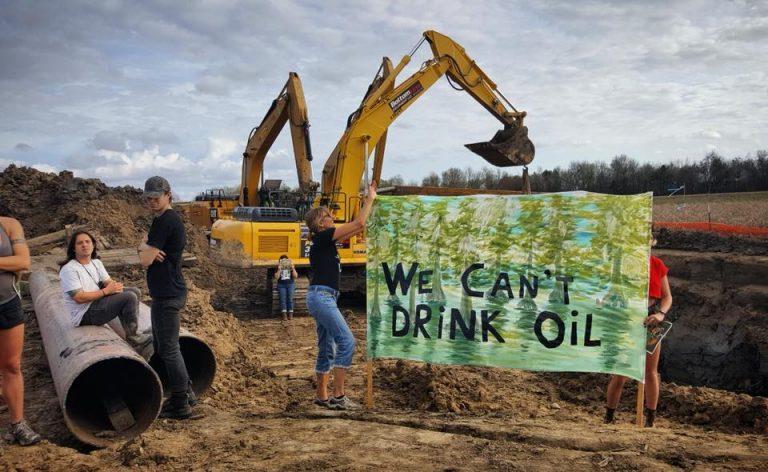
The physical camp is now home base for a network of pipeline resisters who organize, protest and monitor construction along the BBP’s route. A rotating group lives on the land, running educational workshops and uploading photos and videos of digging and deforestation to their Facebook page and website. On May 24 and July 3 of this year, water protectors blocked access to work sites in St. James and Iberville Parishes, with multiple arrests each time.
Growing opposition to the BBP has also meant an increase in both state and corporate policing. Last year, the private security firm TigerSwan — infamous for its surveillance of the Standing Rock protests — was denied a license to practice in Louisiana. But The Intercept reported in March that an apparent TigerSwan front organization was also seeking a license. And in Baton Rouge this May, legislators pushed through a weakened version of a bill that initially attempted to criminalize pipeline protest activity under the broad heading of “conspiracy.”
Meanwhile at camp, Foytlin has noticed a shift in local police tactics. “We have a little conversation out there, a few of us gather, and five police cars just roll up. For what? We go out to eat and come out and there’s cops out there taking our tags. For what reason?” Most recently, two mobile surveillance stations have appeared at the construction site across from the property.
Foytlin lives a short drive from camp, just across the parish line. “I realize the land I’m on is not my land either,” she said. “In the meantime, this is where I’m raising my family.” Before buying the Vermillion Parish resistance camp property, Foytlin explained, “The first thing we did is we asked the Atakapa Nation if it would be okay if we used this land to oppose the pipeline and to build this space.”
In total, the BBP’s route passes through 11 of Louisiana’s southern parishes — territory that has seen centuries of settler violence and dispossession, often in the name of resource extraction. But communities of Atakapa Ishak, Chitimacha, Choctaw and Houma people continue to live along this corridor.
Monique Verdin is a member both of the Tribal Council of the United Houma Nation and the council of the L’Eau Est La Vie camp. She sees the BBP as embedded within the history of this region. “We’ve been doing this for a very long time. The Bayou Bridge pipeline is just the newest pipeline,” she said. “We’re facing rapid land loss here. My people are all at the ends of the bayous. We’ve been experiencing this cycle of injustice and this is just the newest case.”
There are 17,000 members of the United Houma Nation, most of whom live in the Yakne Chitto, or Big Country — “technically between the Atchafalaya and Mississippi Rivers, but really between Bayou Lafourche and the Atchafalaya,” Verdin said. “There were these scattered settlements and sites where our people retreated as they were dodging the Trail of Tears.” Counting the Houma, Bayou Lafourche provides drinking water to 300,000 people along its course. The BBP would pass under it as it approaches the refinery and export terminal at St. James.
“You have to remember that what you’re looking at is a reflection of what the plantation and colonial mindset has bred here,” Verdin explained. “I like to remind people that where plantations once sat, prisons and petrochemical plants sit now. Before we had oil and gas we had cotton and sugarcane. Life has changed a little bit, but the control of the corporations? I compare it to the colonial system.”
She reflected on the changes that her grandmother — born in 1915 — witnessed as the oil and gas industry moved into southern Louisiana. “I think it’s really appalling to now be in the 21st century, and to have Louisiana judges coming out with rulings against [oil companies], and then the company still just does what they want to do because they have the corporate, colonial power to do it. Our government, our justice system, has their hands tied. But the truth is, that’s how this state has been run for decades.”
The United Houma Nation is a state-recognized tribe, but despite the United States agreeing to honor tribal treaties at the time of the Louisiana Purchase, the Houma still lack federal recognition. Their current petition has been pending since 1996. “That’s one of the things that’s really been frustrating,” Verdin said. “Because we’re not federally recognized, we don’t have to be consulted in the same ways. We don’t have the same rights, and we don’t have authority over our sacred sites. So even in our own backyards, literally, where we have these ancient mounds that are disappearing into the water, we have no jurisdiction because we’re not federally recognized.”
—
The ongoing struggle for recognition, combined with economic dependence on oil and gas, has made many Houma reluctant to speak out against the BBP and other development projects, Verdin explained. “We’re a blue collar coast. Our people are barely getting by. They can barely pay their bills, let alone go sit in a public meeting and have to say, ‘Hey, my community matters.’”
But Cherri Foytlin is optimistic about the broad coalition that has emerged to fight the pipeline in the courts and on the ground. “It’s a beautiful thing that we’ve been able to create here that I’ve never seen before in southern Louisiana. We are all very much committed to standing in solidarity to protect what we have.”
Earlier in June, outside the Louisiana capitol building where dozens of protesters had just occupied the governor’s office, Alicia Cooke — an organizer with environmental justice group 350 New Orleans — explained the importance of these emergent networks.
“If you’re not building trust as you go, these fights simply aren’t going to be sustainable,” she said. “If you do lose — if pipelines do get built — are you going to be left with just a sense of despair that you weren’t able to stop them? Or will you have at least gained a community from that, who’s now strengthened for the next fight? Because there’s gonna be another fight.”
-30-
Sheehan Moore is a PhD student in anthropology at the CUNY Graduate Center in New York and an organizer with the CUNY Adjunct Project. This article was originally published by Waging Nonviolence.


