

"This treaty represents a collaborative commitment to challenge the anti-Black and settler colonial systems that have historically sought to position our communities as mutual antagonists to one another. But to move forward, this treaty is our way, together, of formalizing and inaugurating a process of truth and accountability.
—THE TREATY OF KÓDEESLÍ’Í, Signed June 20, 2026
BRACKETVILLE, Texas—Over the Juneteenth weekend, four Lipan Apache Ndé and Black Seminole communities came together to sign the historic Treaty of Kódeeslí’í near Las Moras Springs on the former Fort Clark, roughly 30 miles from the US-Mexico border in far Southwest Texas. Kódeeslí’í is the Ndé name for the springs, meaning “the water that flows.” Yet since 2022, Las Moras Springs, located just outside of Brackettville, have consistently run dry for about a third of the year, a pattern that correlates with drastically expanded groundwater pumping in the area.
During the treaty signing ceremony, Gage Brown of the Las Moras Springs Conservation Association acknowledged this:
"For thousands and thousands of years, Native people have lived in relationship with this water," Brown said. "But for the first time in recorded history, the spring and creek have dried up for almost half the year, every year since 2022."
Underlying these contemporary conservation struggles are long histories of settler colonial violence that have pitted Indigenous and Black communities against one another in this part of Texas. In the 19th century, Black Seminole refugees from Florida served as U.S. military scouts in exchange for promises of land, helping to dispossess Ndé (Apache) and Nʉmʉnʉʉ (Comanche) groups from the Rio Grande borderlands that had been their traditional homelands since at least the 15th century.
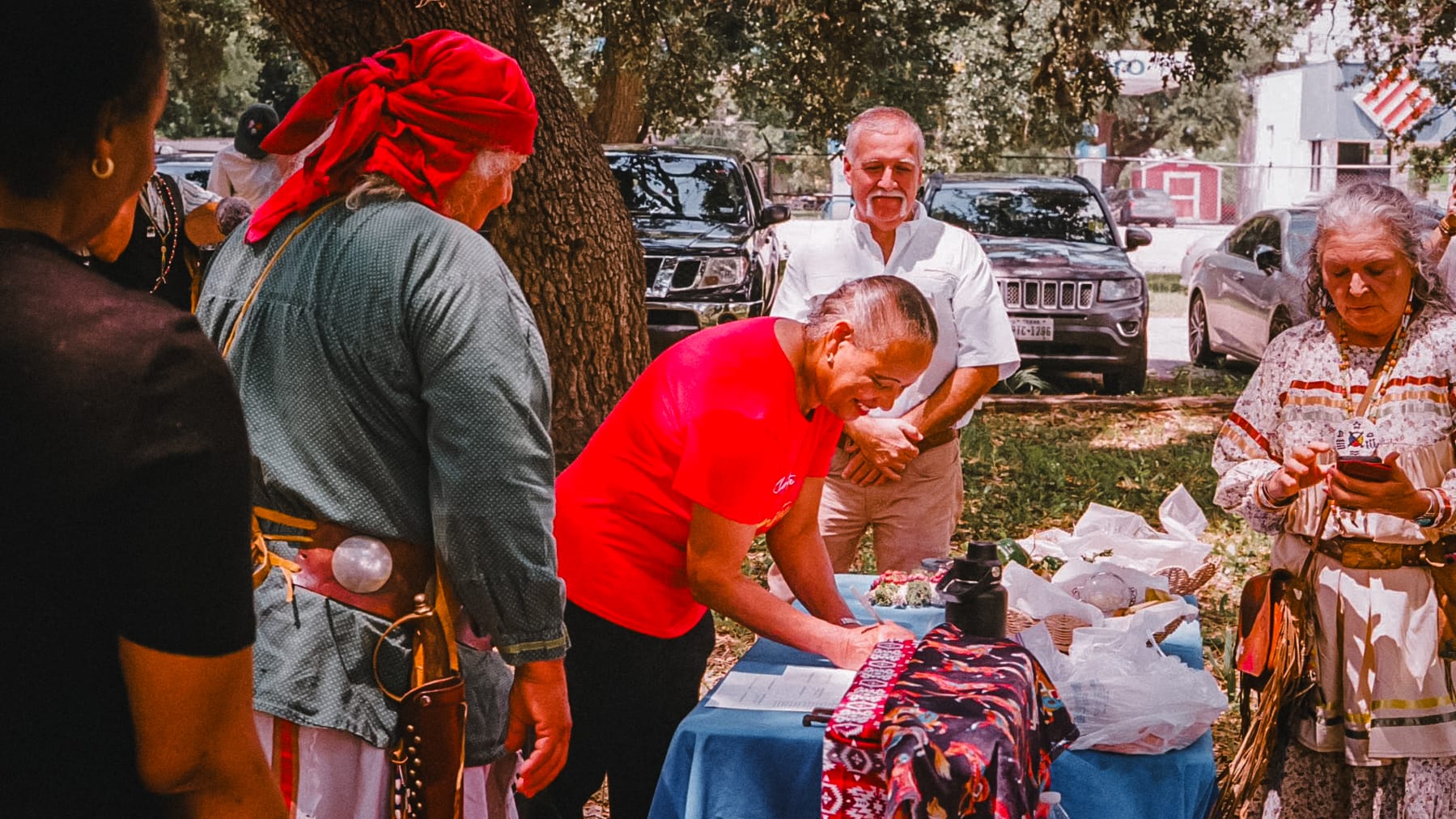
The Treaty of Kódeeslí’í, signed by representatives from the Lipan Apache Tribe of Brackettville, Texas, The Lipan Apache Band of Texas Cuelcahen Ndé, the Seminole Indian Scouts Cemetery Association (SISCA), and La Casa of the Black Seminole Diaspora, acknowledges this painful history and declares the communities’ shared intention to “challenge the anti-Black and settler colonial systems that have historically sought to position our communities as mutual antagonists.”
Through its name and composition, the treaty affirms the ground and waters of this region as first Native and now something more complex and shared.

As conservationists struggle to save Las Moras Springs and pressure the Kinney County Groundwater Conservation District (KCGCD) to adopt a drought plan, the treaty seeks to heal a deeper wound: the colonial foundation upon which the current water crisis is built.
Ko’ee, The Place of Water
Las Moras springs are sacred to both communities, with archaeological evidence of human presence going back at least 8,000 years. Speaking before the treaty ceremony, Andrew Austin, a member of the Lipan Apache Tribe of Brackettville, related how “the sacred 68-degree water that's coming out of the Edwards aquifer, it is truly one of the most special places in the state."
"There's no other reason to live here other than the spring," said Austin. "That's why my Ndé ancestors came here. It's why the Coahuiltecan groups were here. It's why settlers came here. It's everything in this community.”
Fort Clark was built around the springs in 1852. While serving as Seminole Negro Indian Scouts for the U.S. Army from 1870 to 1914, Black Seminoles also came to understand Las Moras Springs as sacred. Augusta “Gigi” Pines, president of SISCA, described how she’d “heard many stories about the camp, especially about the river going along there. I've heard that my ancestors used that river for everything, for watering the gardens, for cooking, for watering the animals, for bathing, for everything.” Describing her feelings wading in the waters of Las Moras Creek, Pines stated: “I just could feel a peace when I went down in there … I feel like their spirits are still in there.”
However, in 1914, when their use to the Army had concluded, the Black Seminoles were evicted from their military reservation along Las Moras Creek where they had lived for nearly 50 years. For some community members, Fort Clark Springs, a gated community formed after Fort Clark was decommissioned in the 1940s, represents a persistent architecture of exclusion that continues to segregate the sacred waters of Las Moras Springs from the people to whom they belong.
"They took our lands, we lost a lot of our culture, and now we can't even have our spring," said one Ndé community member who called Fort Clark Springs a "relic of segregation.
“A lot needs to change," said Gage Brown, "including returning full and free access to this place to Native people like the Lipan and the Seminoles."
Today, the 19th century colonial order which prioritized settler land acquisition over Indigenous land tenure has matured into a system of extractive capitalism where the “rule of capture” allows a handful of large-scale irrigators to deplete the aquifer. The rule of capture dictates that if you legally extract a resource, such as water from the Edward Aquifer, it is yours, even if it naturally migrated from beneath a neighbor's property.
Previous reporting details how Kinney County has long been an epicenter for struggles over water use in this part of southwest Texas. Historically, the county’s economy was built on stockraising, but a significant shift occurred in 1957 when oil drilling accidentally uncovered an abundant source of recharged groundwater in Pinto Valley. This led to 25 years of intensive vegetable farming before economics forced a shift toward livestock feed crops like sorghum and water-intensive alfalfa. In 1997, a new state mandate for regions to secure water supplies for the next 50 years, combined with Kinney County’s small population and vast groundwater, attracted the attention of thirsty cities like San Antonio. In response, voters overwhelmingly approved the creation of the KCGCD to regulate pumping and protect local water.
Over time, however, the KCGCD has largely been captured by the county’s largest irrigators that it was ostensibly created to regulate. The KCGCD board is currently divided between major permit holders and those pushing for a drought plan. According to Andrew Austin, some large-scale farmers “moved here because the groundwater district is useless...because there's no restrictions.” Andrew Austin and Richard Gonzalez, general chairman of the Lipan Apache Band of Texas Cuelcahen Ndé, both emphasized the need for the KCGCD to adopt a drought plan to protect the long-term health of the springs.

KCGCD President Wes Robinson has publicly opposed limiting pumping permits or adopting a drought plan. According to reporting by Carolea Hassard at the Brackett Beacon, Robinson holds two water pumping permits totaling 3,100 acre-feet. An email statement from Robinson offered a striking shift in rhetoric, however, claiming his goal is to "determine how much we are impacting Las Moras Springs, then plan on how to reduce those impacts" through high-tech, capital-intensive strategies such as "conjunctive use, aquifer storage and retrieval, rainfall enhancement and/or relocation of [municipal] wells."
But this stated concern for the springs is inconsistent with his record of dismissing spring-flow mandates as "pie-in-the-sky" and his assertion that groundwater usage "increases during a drought." Robinson’s focus on relocating municipal wells does not seem to take into account a 2006 report indicating municipal wells likely draw from a “different source than the springs,” or the relatively low municipal usage compared to irrigation pumping, which has nearly tripled over the last decade. By suggesting multi-million-dollar technical fixes at a time when a recent state audit has pointed out substantial financial weakness in the district, and while he continues to oppose a standard drought plan, Robinson's proposal raises questions about whether the district is willing to pursue more immediate measures to protect the springs.
Questions about groundwater management formed an important backdrop to the treaty ceremony, but speakers repeatedly referenced how the dispute over Las Moras Springs could not be reduced to a technical debate about pumping permits or hydrology. Gage Brown argued that the dispute over groundwater cannot be separated from the region's colonial history.
"That attitude, that we should take whatever we want and still demand more is an echo of the same colonizer mentality that drove Native people off this land," she said.
Those remarks reflect a broader theme of the ceremony: that justice for water and justice between communities are inseparable projects. While the struggle to save the springs is a legal and political battle against the "rule of capture," which treats water as a private property right to be extracted for profit, the treaty offers an alternative Indigenous logic for relating to water.
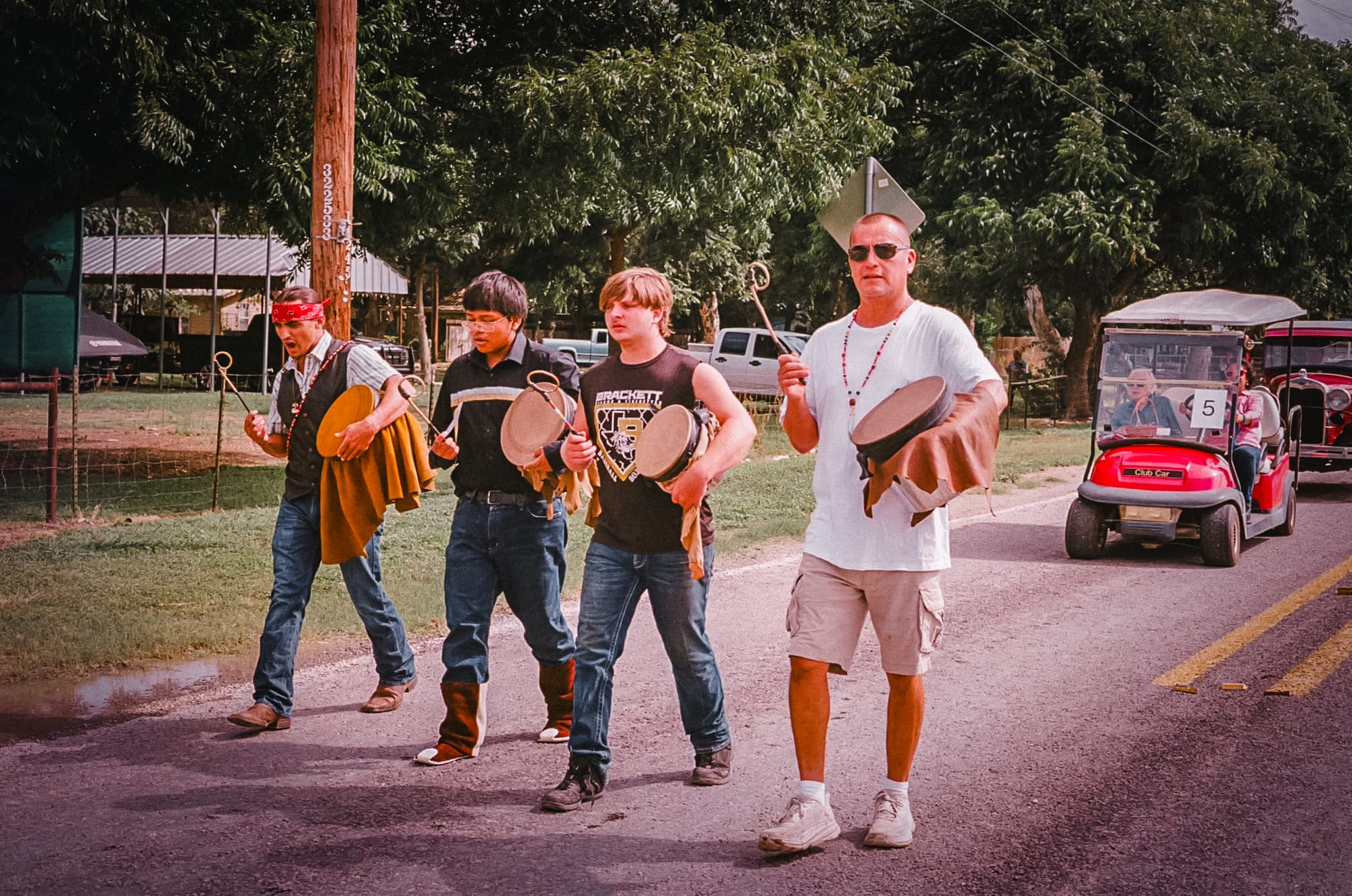
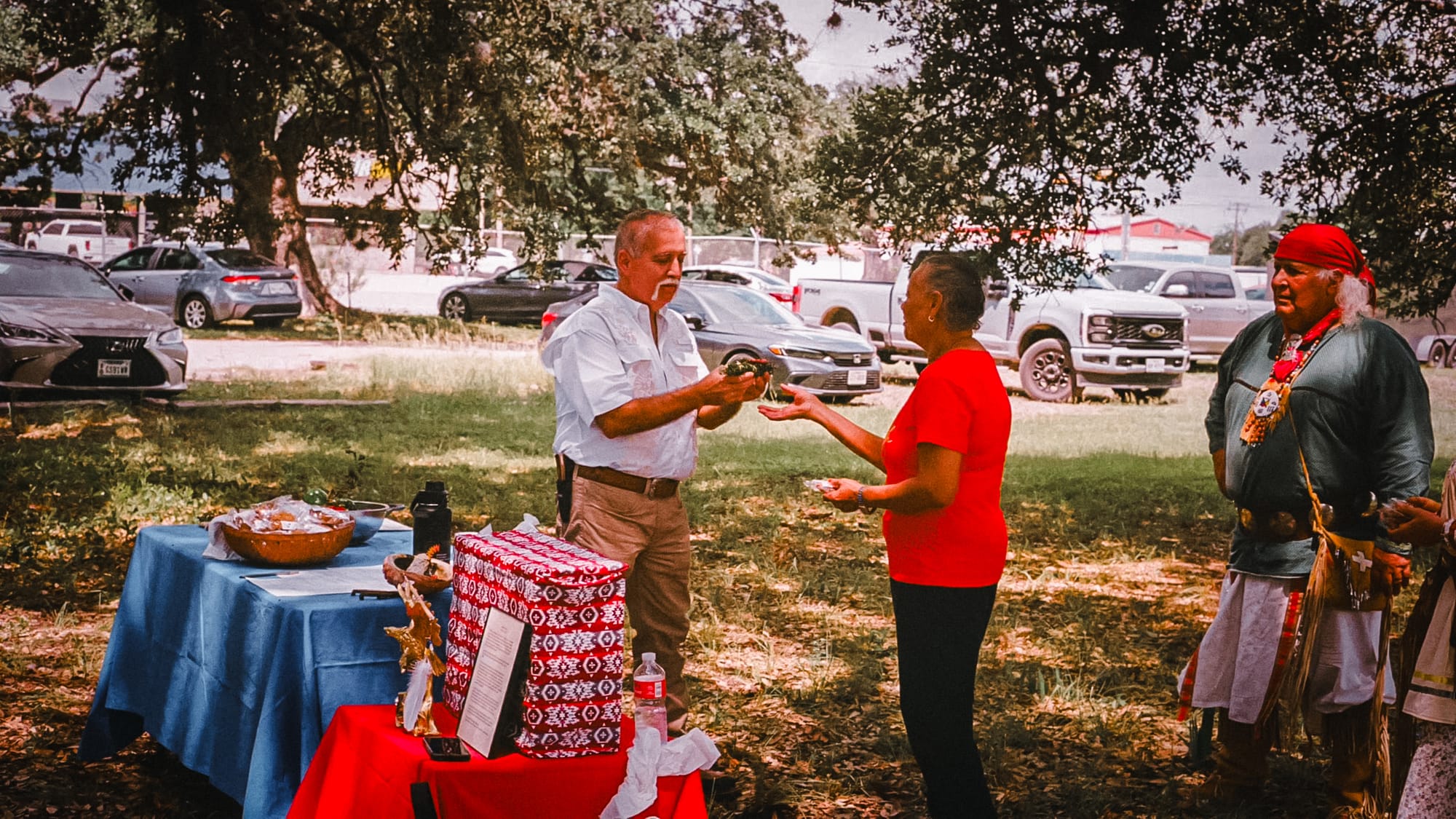
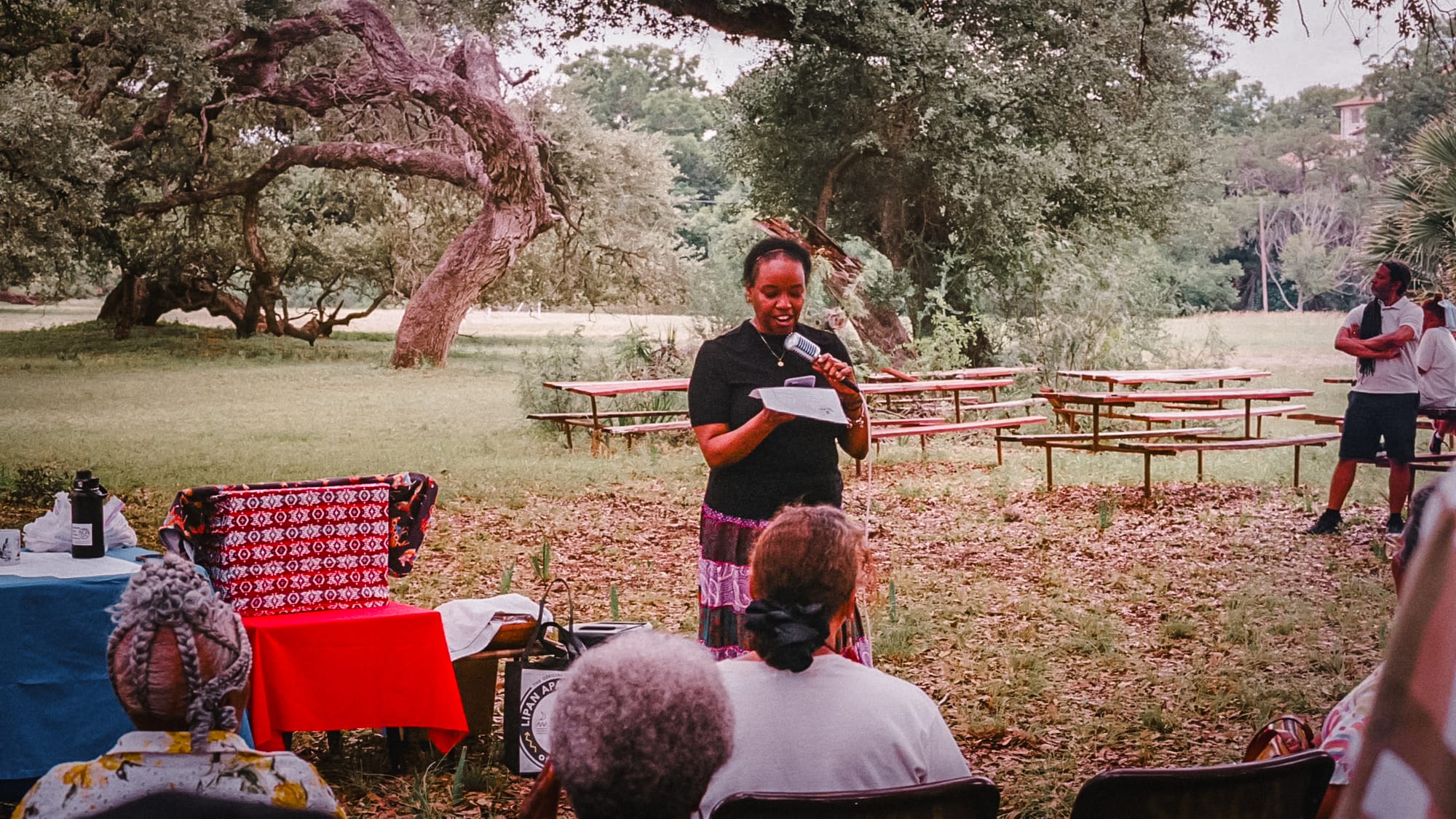
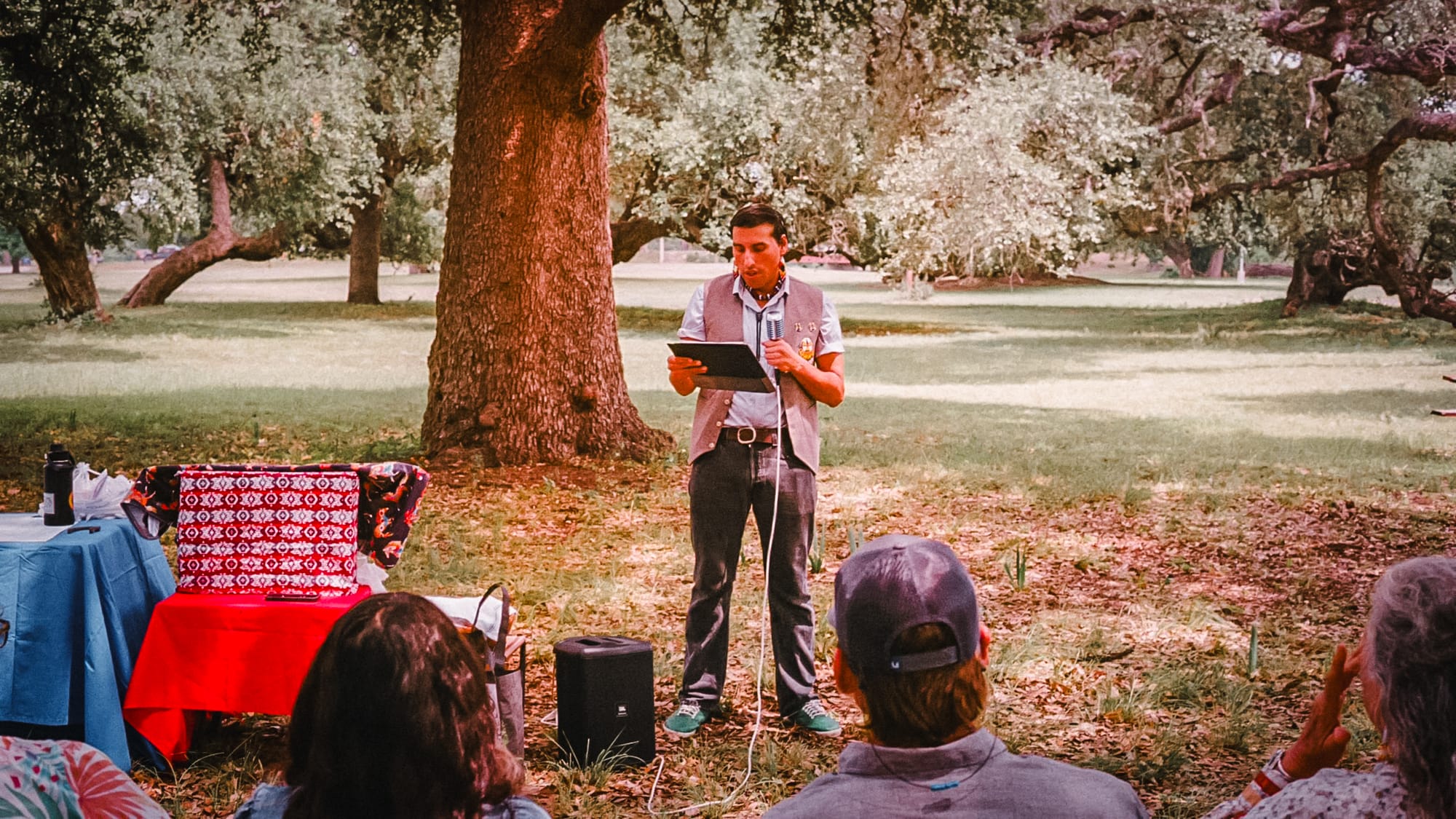
Clockwise from upper left: Juneteenth parade in Bracketville, Texas; Jason Davalos of the Lipan Apache Tribe of Brackettville, Texas, gifts Gigi Pines of the Seminole Indian Scouts Cemetery Association a bundle of sage, cedar, and mescal beads; Windy Goodloe reads a welcome message during the Treaty of Kódeeslí’í signing ceremony; Gabriel Sánchez reads the Treaty of Kódeeslí’í during the signing ceremony. Images: Mark Mallory
Kódeeslí’í, The Water That Flows
Rather than treating water as a resource to be possessed, participants in the Juneteenth signing of the Treaty of Kódeeslí’í framed the springs as the basis for reciprocal responsibilities.
"That water to us is key [to] life...and I expect other people to treat it like it belongs to us all, not just to them," said Richard Gonzalez. "We share the water. And it's not my water."
While the springs run low for yet another summer, the treaty contrastingly “represents an opening dialogue, a wellspring covenant for life, peace, and harmony moving forward.”
In this way, the treaty is a bold act of grassroots diplomacy that emphasizes the painful history of settler colonial dispossession underlying the contemporary crisis. Its text outlines how it “represents a commitment to tell the unvarnished truth—the entire history that has brought our two communities together, both good and bad.”
Anita Anaya, enrollment committee officer of the Lipan Apache Band of Texas, captured this, saying that “We can't forget, but we can forgive. And I feel that's the only way we both can grow and be united.”
Richard Gonzalez’s grandmother taught him a critical lesson when passing along her memories of surviving the 1873 Remolino Raid, where Black Seminoles and other U.S. troops attacked Native villages in northern Mexico:
“You forgive those things," she said, "because it releases that anger that you have inside. That's going to hold you back...forever, not just you, but your family and future generations."
Richard Gonzalez, general chairman of the Lipan Apache Band of Texas Cuelcahen Ndé, recalls how his grandmother survived Remolino's Raid in 1873 as child. Native Voice TV
The Treaty of Kódeeslí’í emphasizes the complexity of these communities’ shared history, as well as their status as Indigenous peoples unrecognized by the United States. It states, for instance, that “[r]egardless of designation by other sovereign entities…the Black Seminole community has long acknowledged our dual indigenous roots from Africa and from North America.” Or as Seminole Indian Scouts Cemetery Association (SISCA) secretary Windy Goodloe put it, “I don't think we should ever wait for a government entity to acknowledge us. If we wait for the government, it probably will never get done.”
Corina Torralba Harrington, SISCA treasurer and representative of La Casa of the Black Seminole Diaspora, echoed this, saying:
"We have documents ... that cannot deny who our people are. And I feel like we don't need the government to acknowledge that. We know who we are."
The treaty outlines the history of broken treaties between Ndé communities and various governments, along with the history of broken promises by the United States to the Black Seminoles. It relates how “[b]oth communities have faced forced dispossession at the hands of colonial powers.”
Goodloe agreed.
"To tell this story as just the good guys versus the bad guys does a disservice," she said. "The more that you make sure that every player in this story is seen as human, hopefully the mistakes that were made won't be repeated again.”
The treaty is rooted in the worldviews and teachings of both communities, emerging from years of relationship-building on both sides of the U.S.-Mexico border. Gigi Pines recounted how “Miss Charles,” who founded SISCA in 1967, “taught us that we should love each other and try and get along with each other, no matter who we are or where we came from. It's good for the younger generations to see how organizations can come alongside each other and try to get along.”
For more than a decade, Ndé community members have participated in SISCA events; in Goodloe’s words, "if we weren't on good terms with the Lipan Apache ... this would not be happening.”
Anita Anaya said similarly of the Black Seminoles that “we feel a relation to them,” emphasizing her friendship with Gigi Pines. The treaty ceremony, held as part of SISCA’s annual Juneteenth celebration, also took inspiration from previous ceremonies held in El Nacimiento de los Negros, in the Mexican border state of Coahuila. Corina Harrington described how “[w]e had a sweat lodge. We did songs. You know, we cooked together,” relating how “they've become like family”:
“It’s becoming so natural,” she said, “that they come into the community and we do something together. It’s been a blessing to be able to have this relationship with the Ndés."
How the largely symbolic treaty’s promise of truth and accountability will be carried out in the future remains to be seen. Nonetheless, it invites the possibility of joint ceremonies and of greater cultural and educational exchanges connecting people, land, and water in the future.
Most importantly, by acknowledging the harm of coerced Black Seminole participation in Ndé dispossession while simultaneously celebrating their renewed friendship, the treaty participants are cultivating practices of accountability that challenge the colonial structures underwriting the contemporary water crisis in Brackettville and across the American West.
Beneath the shade of towering oaks near the low-running Las Moras Springs, burning white sage perfumed the air with its purifying smoke as representatives of the four organizations gathered with community members and supporters for the treaty ceremony. The treaty was read aloud before representatives exchanged signatures and gifts representing the cultural heritage of each community.
Punctuated by traditional songs from both communities, the ceremony included remarks from each organization, ending with a traditional Ndé dance—an invitation for all those in attendance to rise to their feet and come together.
-30-

This article is licensed under Creative Commons (CC BY-NC-ND 4.0), and you are free to share and republish under the terms of the license.


