

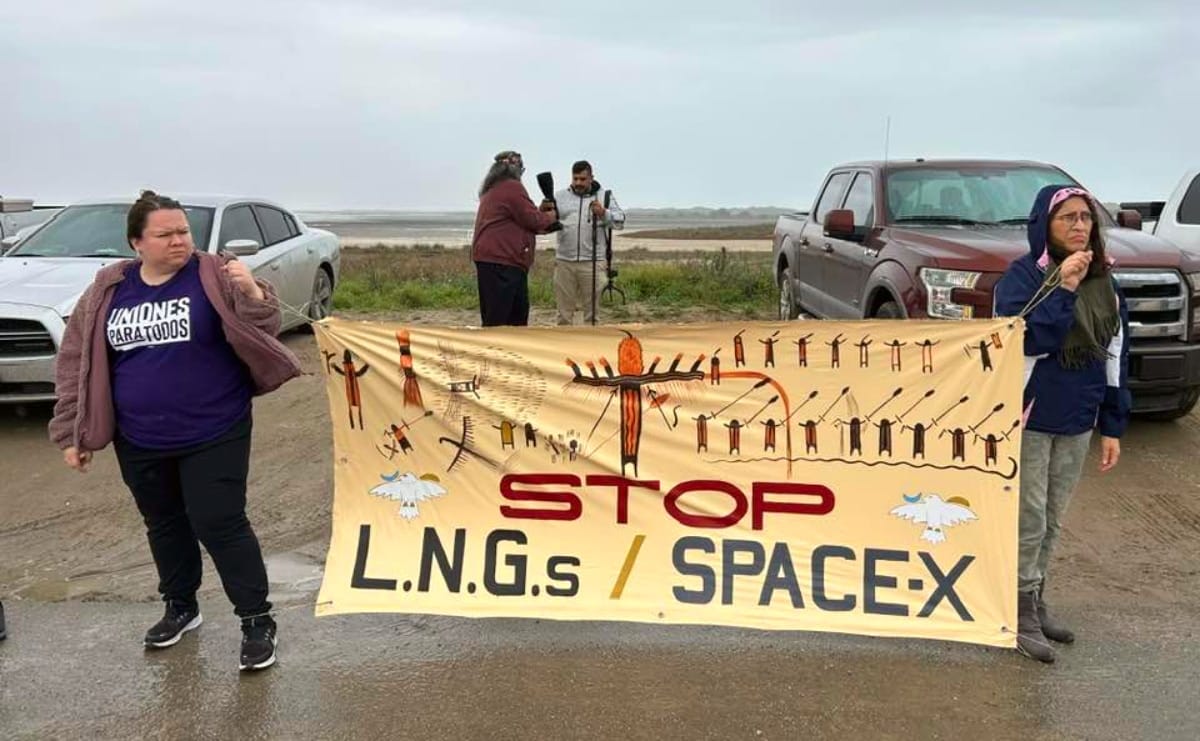
Environmental justice advocates and community members are celebrating in Texas this week after a D.C. Circuit Court finds federal review of two LNG projects failed their environmental analyses.
James Courtney
On Monday, a Circuit Court in Washington, D.C., ruled against the Federal Energy Regulatory Commission’s (FERC) approval of three massive gas projects intended to move huge volumes of fossil fuels from Texas to the world market. The ruling was quickly hailed as a victory for tribal and environmental advocates dedicated to protecting the lands of the lower Texas coast and Rio Grande Valley, an area of rich biodiversity and—for the Carrizo/Comecrudo Tribe of Texas, in particular, which has pre-colonial roots in the area—great cultural significance.
The projects in question are the multi billion-dollar Rio Grande LNG and Texas LNG and the related Rio Bravo pipeline. Plaintiffs working to stop the projects include the Sierra Club, the City of Port Isabel, the Carrizo/Comecrudo Tribe of Texas, and Vecinos para el Bienestar de la Comunidad Costera.
The Court found that the FERC had “erroneously declined to issue supplemental environmental impact statements addressing its updated environmental justice analysis for each project and its consideration of a carbon capture and sequestration system for one of the terminals.”
The ruling itself was mixed in substance, but ultimately vacated both authorizations and kicked them back to the FERC for further work.
The court also cited the Commission’s puzzling choice not to take into account air quality data from the air quality monitor at Isla Blanca State Park near Port Isabel.
Nathan Matthews, the Sierra Club attorney who argued the case, spoke to Deceleration a few days after the momentous decision. He said it largely came down to FERC failing to do what it basically exists to do: authentically gather good data on environmental and community impacts and act upon it.
“We think that a lot of things FERC did in its new analysis were wrong on substance,” Matthews said.
FERC, he said, did its recent analysis without any meaningful public commentary or publishing its results in an environmental impact statement, among other neglected Environmental Protect Act stipulations.
The new ruling also requires that carbon capture measures should be considered in the planning process and application for potential future permits.
Matthews said that the hope now is that if FERC does a more thorough analysis “it will reveal that the harms associated with these projects are so high that they are contrary to the public interest and that FERC should deny them.”
He takes heart in the fact that FERC could immediately halt construction already underway—which has happened before in a similar case in Virginia.
Matthews suggests that the danger that remains with FERC is, at least somewhat, philosophical.
“FERC has misplaced faith in markets and thinks that if someone is willing to put up the money to build something then it must be in the public interest,” he said. “That’s obviously not our position.”
For the moment, however, area shrimpers, fishermen, tribe members, landowners, city leaders, activists, and others contributing to this struggle have reason for optimism.
As prime port territory, this area of the lower Texas coastal region has been increasingly targeted by heavy industrial interests. It also contains sacred Indigenous grounds and a range of ecologically rich coastal wetland habitat, some of which are protected as state or federal reserves, refuges, and parks.
The growing coalition resisting industrial development here have arrived at an understanding that somehow eludes many decision-makers around the world today: that such extractive development cannot be sustained endlessly. This win, therefore, represents a statement of limits and of the people’s willingness and ability to enforce those limits when needed.
In a statement distributed by the Sierra Club, Port Isabel’s City Manager Jared Hockema called the Court’s ruling “a great victory in our battle to protect public safety and preserve our environment and quality of life.” He also noted that the decision represents a “setback for corporate polluters” and called upon LNG developers and the Port of Brownsville to take note and ditch these types of projects more broadly.
Juan Mancias, tribal chair of the Carrizo/Comecrudo Tribe of Texas, referred to the court’s decision as a triumph for his ancestors and for the land itself. He also echoed Matthews’ sentiment that the FERC must do its job and do so independently of “false archeological and false solutions reports from gluttonous fossil fuel corporations.” Mancias sees the fight against these projects as part of his people’s continuing efforts “to resist ongoing colonization by the fossil fuel industry.”
In a statement released by Texas LNG and reported by Inside Climate News, a company spokesperson said that they view the matter as a “procedural” setback only and “have full confidence FERC will address this matter judiciously and efficiently.”
Bekah Hinojosa—a community advocate and founder of the South Texas Environmental Justice Network, who has worked in the fight against these projects for many years—told Deceleration that she too sees “fossil fuel colonization” at work. She explained that Garcia Pasture, one of the areas that would be largely destroyed by the projects, houses burial grounds and artifacts of cultural and historical significance to the Carrizo/Comecrudo.
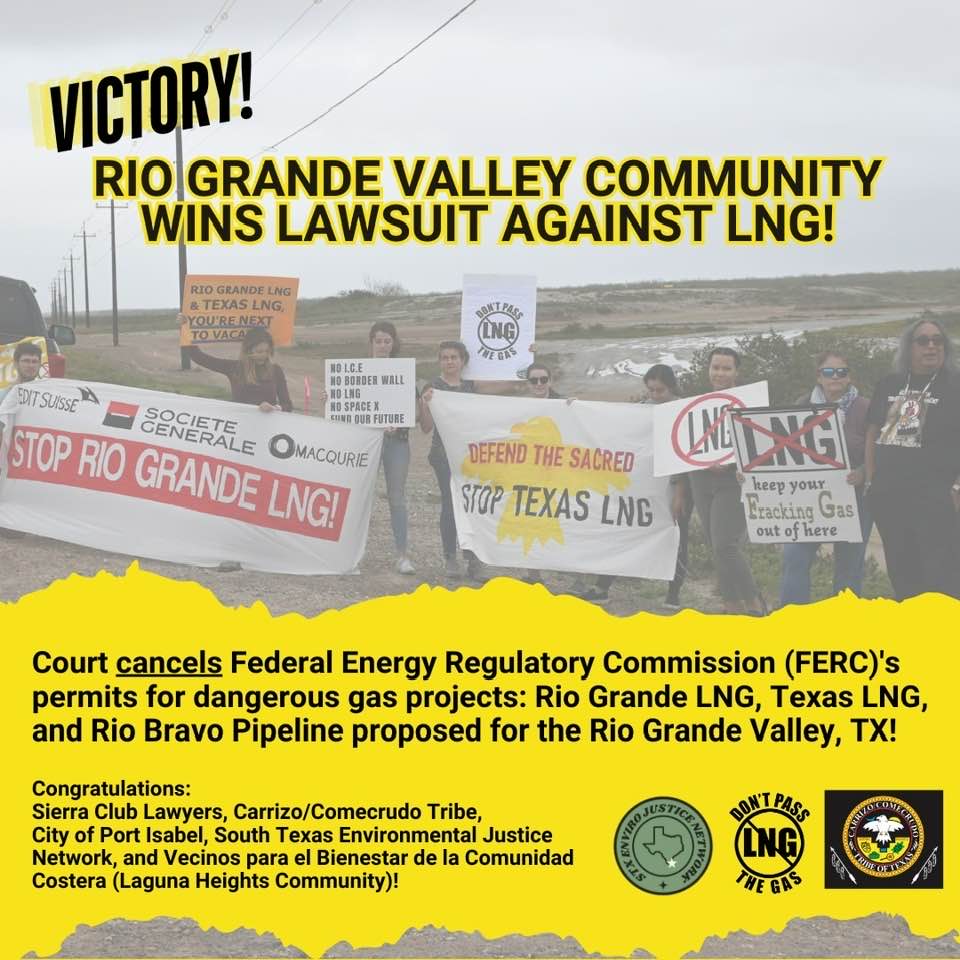
“They are trying to build in a low-income, brown, and Indigenous community,” she said. “They promise jobs and exploit the fact that our community is impoverished.”
Hinojosa stressed the importance of waging these fights on multiple fronts, noting that she and other organizers have also confronted some of the insurance companies and private equity firms that help make these kinds of projects happen.
“One day we are in a high school here in Brownsville educating kids and helping them fill out postcards to the County, and the next day we are in the streets of New York City protesting at an insurance company,” she said.
Speaking about this legal victory, Hinojosa says she hopes to see “a big celebration in town,” once the word gets around.
Hinojosa already has another battle in mind. She plans to direct more of her energies to the fight to stop Elon Musk’s SpaceX from continuing its expansion and operation unchecked in the region.
“We are not going away; we live here, and we will continue to push back,” she said.
-30-

Like What You’re Seeing? Become a patron for as little as $1 per month. Explore ways to support our mission. Sign up for our newsletter (for nothing!). Subscribe to our podcast at iTunes. Share this story with others.


