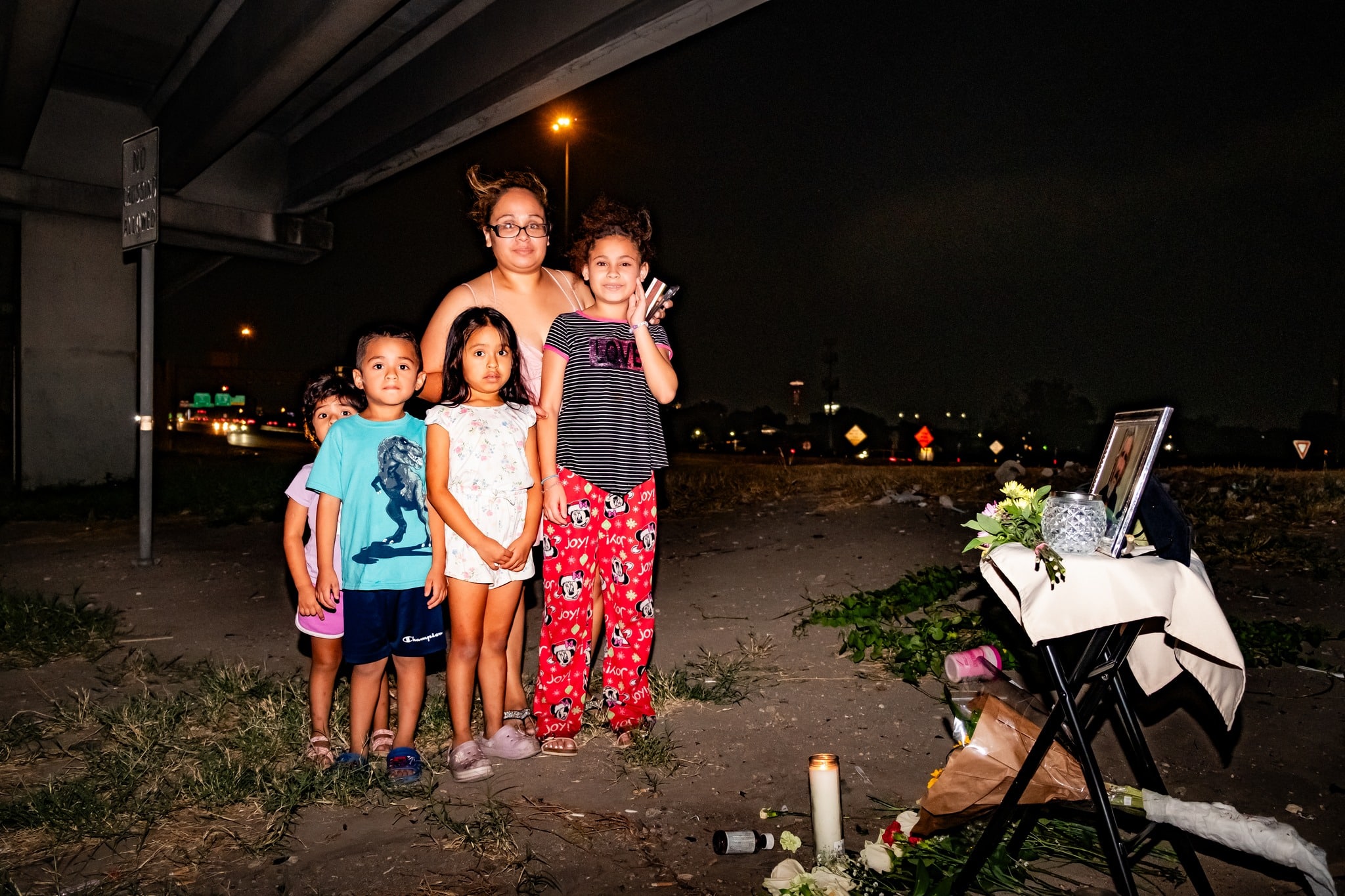
SAMMinistries has tracked deaths within the unhoused community for years. Their CEO thinks extreme heat may have directly caused dozens of deaths and contributed to even more during 2023’s unprecedented heatwave.
There is no local research initiative that can prove them right or wrong.
Greg Harman
Last year, there was a 12 percent statewide surge in Texas’s unhoused population. More than 21,000 people were estimated to be experiencing homelessness in the state, according to the U.S. Department of Housing and Urban Development.
2023 was also the hottest summer that anyone living here had ever experienced—the hottest summer on planet Earth in at least 125,000 years packed with excess heat driven “primarily” due to the burning of fossil fuels, according to federal and international researchers.
Yet San Antonio’s Metropolitan Health District, which maintains a month-to-month accounting of heat illness and heat strokes for Bexar County, hasn’t reported any 2023 heat deaths. Under deaths, their heat report reads: “N/A,” not available.
As Deceleration has reported previously, heat-related deaths are largely not being recorded locally because the Bexar County Medical Examiner feels that her office and first responders here generally are not collecting reliable data quickly enough about heat’s potential role in local deaths to include heat as a cause of death in most cases.
“If I stay strictly scientific,” Medical Examiner Kimberley Molina told Deceleration thorugh a County public relations employee, “I cannot say this was hyperthermia unless I was right there or I was there within a half hour.’”
That means that, unless someone succumbs to the heat under direct observation of a medical professional, there is virtually no chance they will be classified as a heat-related death.
Metro Health relies largely on records produced by the Bexar Medical Examiner submitted to the state related to causes of local deaths. That means for all but one year Metro Health has reported the data as “not available.”
On heat illnesses, however, we have more reliable data. It shows a rapid rise in negative health impacts due to extreme weather in recent years.
From 2018 to 2021, Bexar County averaged about 318 documented cases of heat exhaustion per year, according to Metro Health data.
In 2022, that shot to 489.
In 2023, it shot up again: to 764.

Cases of heat strokes also rose—from zero recorded in previous years, to 14 in 2022, and 23 in 2023.
The only heat-related death listed by Metro Health—for 2022—was one that was well-documented by OSHA and area media.
Recently, the Texas Tribune reported that 334 Texas residents died in 2023 from exposure to extreme heat. That was up from 304 the previous year and 203 the year before that.
Texas Department of State Health Services data shared with Deceleration the day after this story was originally published* showed 357 heat-related deaths in Texas in 2023—up from 203 and 306 in 2021 and 2022, respectively. The data was delivered with a caveat that the numbers for these years are still not considered final. Interestingly, the data shows 28 heat-related deaths for Bexar County between 2019 and 2023; that’s 27 more heat-related deaths than Metro Health heat reports currently include.
The actual number, however, is likely much higher. Many counties—like Bexar County—have grossly inadequate systems for counting those killed by heat.
Dallas-based medical anthropologist Rose Jones, coming to San Antonio next week to speak at a “Heat Emergency” forum and community conversation, blames a range of failures for that, including official disinterest and broad lack of medical training in heat illness.
“In a nutshell what we have is a dearth of missing information, knowledge gaps, problems with training; it’s just not being done,” Jones told Deceleration on a recent podcast. “This is important because if you are not counting it accurately, you are not addressing it,” she said.
Staff at SAMMinistries, a local nonprofit dedicated to reducing houselessness in San Antonio, have documented the deaths happening within that population for years. The data is highlighted at an annual memorial service held at the end of each year for more than a decade.

Historically, deaths among the unhoused population hovered in the upper 60s, SAMMinistries President and CEO Nikisha Baker told Deceleration. In 2020, SAMMinistries staff recorded 102 deaths. In 2021, that dropped to 72. But in 2022, they organization logged 165 deaths.
Last year saw a surge in recorded deaths: 322.
Much of this increase, Baker said, was due to additional resources that have enabled her teams to better understand the populations they serve. However, much of that rise was also due to the unprecedented heat, she said.
Baker estimates that as many as 60 of those who died in 2023 could have died primarily due to exposure to extreme heat.
“We don’t have cause of death for most of deaths,” Baker said. “If I were to wager a guess, I’d say it’s probably 20 percent or so relative to exposure.”
As a contributing cause of death, the figure would like be much higher. Heat insinuates itself into many other health challenges for those living unhoused.
“We do know that folks who are unsheltered absolutely have a lower mortality limit generally because exposure includes things like lack of access to normal hygiene routines, which makes sores turn into infections turn into sepsis,” Baker said.
“If [heat is] a contributing factor, I’d say that increases to 40 or 50 percent [mortality],” she continued. “Because the unshelteredness adds to issues that if you were housed could be addressed preventatively or at onset, which doesn’t happen when you are unsheltered.”
Without improved local surveillance data, of course, there is no way of knowing how many residents died from the heat—either directly or as a contributing cause. But more advanced surveillance efforts elsewhere in the U.S. show there is good reason to be concerned about the unsheltered community.

Maricopa County, Arizona, for example, has a well-developed heat-tracking system. It involves multiple agencies, including the Maricopa County Department of Public Health, the regional Phoenix Heat Relief Network, the local medical examiner, and state health department, among others.
The effort has been recording heat-related deaths since 2013.
Just as San Antonio’s Metro Health has logged a steady rise in local heat illnesses, Maricopa County has seen a corresponding rise in heat-related death.
«Mortality from environmental heat is a significant public health problem in Maricopa County,
especially because it is largely preventable,» the 2023 report opens. «Sharing this information helps community stakeholders to design interventions to prevent heat related deaths among vulnerable
populations.»
In 2019, the Maricopa County Department of Public Health recorded 199 heat-related deaths in Maricopa County. That number swelled to 323 and 339 in 2020 and 2021, respectively. It grew again in 2022 to 425. In 2023, local deaths shot to a record-setting 645 deaths.
Researchers include deaths where heat either caused or contributed to mortality. They draw on both death certificates and preliminary death reports from the local medical examiner.
More than half of 2023’s 645 deaths were among people experiencing homelessness, according to the county’s annual report.
While Arizona did trend hotter than Texas (by about 8 degrees F in June 2023, for example; check our math here), it’s worth noting that those 645 deaths happened within a population of 4.5 million. Texas as a whole, reporting less than half that number of heat-related deaths for the year, has a population more than six times Maricopa’s population size.

Last December, San Antonio Mayor Ron Nirenberg spoke at the 17th annual memorial service to highlight efforts being made in affordable housing and permanent support of housing.
The deaths among unhoused neighbors, he said, served as a reminder “that we have a long way to go to ensure homelessness is rare, brief, and non-recurring in San Antonio.” He did not speak about the extreme heat that had wrapped the city in 100-degree-plus temperatures for three months solid.
Extreme heat has not captured the attention is needs in Texas in terms of its impact on public health, Jones told Deceleration.
Evidence of that is clear in San Antonio. Metro Health, for instance, convened a Health Equity Symposium in September 2023 that, in spite of the immediately preceding public health crisis that was our blazingly hot 2023 summer, had no time reserved for the topic of extreme heat. Council member Teri Castillo and others fought for local heat protections for workers on City of San Antonio projects. However, in spite of the knowledge that the 2024 summer will be at least as brutal as 2023, Deceleration is aware of no emergency committee assembled to match the convening that following Winter Storm Uri in 2021, a storm that claimed 16 lives in Bexar County.
RELATED: Winter Storm Survey: Unmet Physical and Emotional Needs a Year After Winter Storm Uri
Noting the ubiquitous and deadly heatwaves wrapping the planet in 2023—»from Pakistan to Tunisia to Texas»—the U.S. Agency for International Development (USAID) and the International Federation of Red Cross and Red Crescent Societies (IFRC) hosted a Global Summit on Extreme Heat last month.
On that call, USAID Cheif Climate Officer Gillian Caldwell said the world’s governments need to «walk and chew gum at the same time,» meaning they must aggressively reduce the pollution driving the climate crisis while creating adaptive solutions to reduce heat-related suffering.
United Nations Executive Climate Secretary Simon Stiell this week said that there is only two years left for the rapid actions needed to interrupt the worst manifestations of climate crisis. “We still have a chance to make greenhouse gas emissions tumble, with a new generation of national climate plans. But we need these stronger plans, now,” Stiell said.
“Who exactly has two years to save the world? The answer is every person on this planet.»
President Biden has reportedly been «racing» to tuck billions into climate-related programs he hopes can’t be erased by a possible second Trump presidency, the Guardian reports. While an analysis by Carbon Brief found that a Trump election this year could result in an additional 4B tons of US climate emissions by 2030—enough to tank global efforts.
Not only was 2023 the hottest year in at least 125,000 years, the opening of 2024 has continued that trend, with planetary high temperature records being shattered now month after month for 10 months running.
Meanwhile, surging ocean heat over the last two years have some researchers fearing that fossil fuel pollution and rampant consumption have finally and «fundamentally» altered the climate system for the worse in ways that may be, essentially, irreversible.
Back on the street, for those without benefit of homes they can retreat into, water stations and shade will become increasingly critical to survival.
Where to put that water access and shade, however, is more challenging, SAMMinstries’ Baker said, adding that she has been in conversation with the San Antonio Office of Sustainability about the feasibility of capturing rainwater to use at dedicated cooling stations.
“We often as a community think about District 1 [downtown] as kind of the hub for homelessness. That’s where Haven for Hope and the Salvation Army folks reside,” Baker said. “I think about the pockets in Northwest San Antonio and Southwest San Antonio that are away from center city and are often not thought about in terms of the grand scheme of homelessness.”
In Texas climate forecasts, unfortunately, extreme drought, exacerbated by rising strain due to rising consumption, appears co-joined to extreme heat.
While state water planners largely ignore climate science, a 2020 paper co-authored by Texas State Climatologist John Nielsen-Gammon nonetheless found that “projections indicate drier conditions during the latter half of the 21st century”—drier “than even the most arid centuries of the last 1,000 years that included megadroughts.”
Recent research has found that one out of every three Texas springs have already dried up in recent decades.
Lotus Rios, another panelist speaking at the April 17 Heat Emergency event, has operated the Harlandale Sunshine Pantry distributing food to members of her community for several years. She also does regular outreach to those with other needs, including medical expenes or utility bills. She said that she has seen several neighbors die, at least in part, she suspects, due to the impact of extreme heat and extreme cold due to lack of resources or support.
«We’ve had some elderly [neighbors] that don’t have proper air conditioning and they have diabetes or are on dialysis. We’ve had some families where it’s just extreme heat and it’s such a long process to get and obtain assistance that people give up,» Rios said.
«They go through all these lines or lists or whatever…and then they have to re-certify. It’s more labor that many of them want, or have the strength, to do.»
She said even designated cooling centers in her part of town do not allow unhoused residents to shelter.
«I hate to say this but it’s the City’s failure. We shouldn’t have anyone treated this way or pass away this way,» she said.
-30-
* This paragraph was added to reflect data supplied to Deceleration by the Texas Department of State Health Services late Friday, April 12, 2024.

Like What You’re Seeing? Become a patron for as little as $1 per month. Explore ways to support our mission. Sign up for our newsletter (for nothing!). Subscribe to our podcast at iTunes. Share this story with others.