

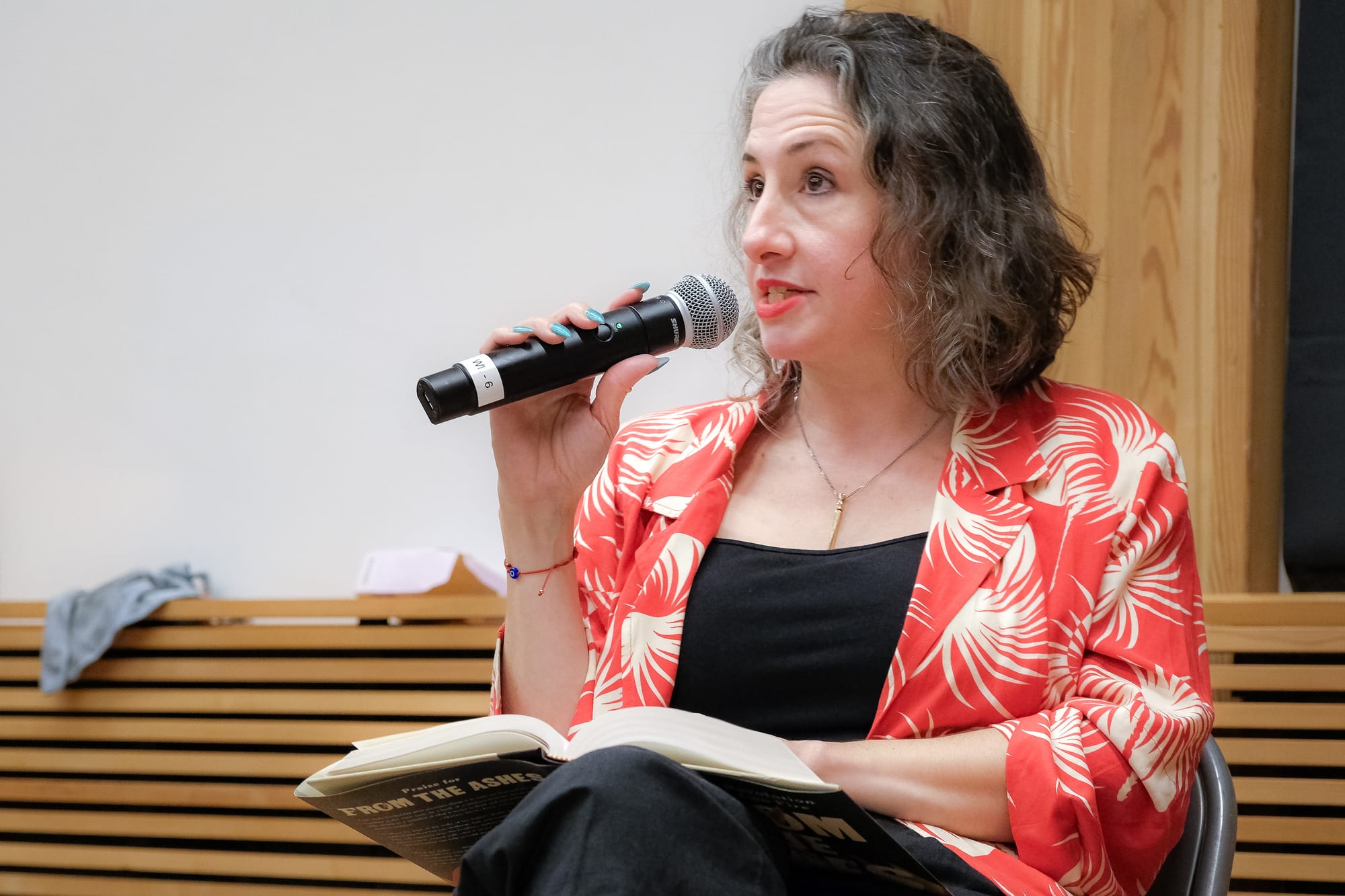
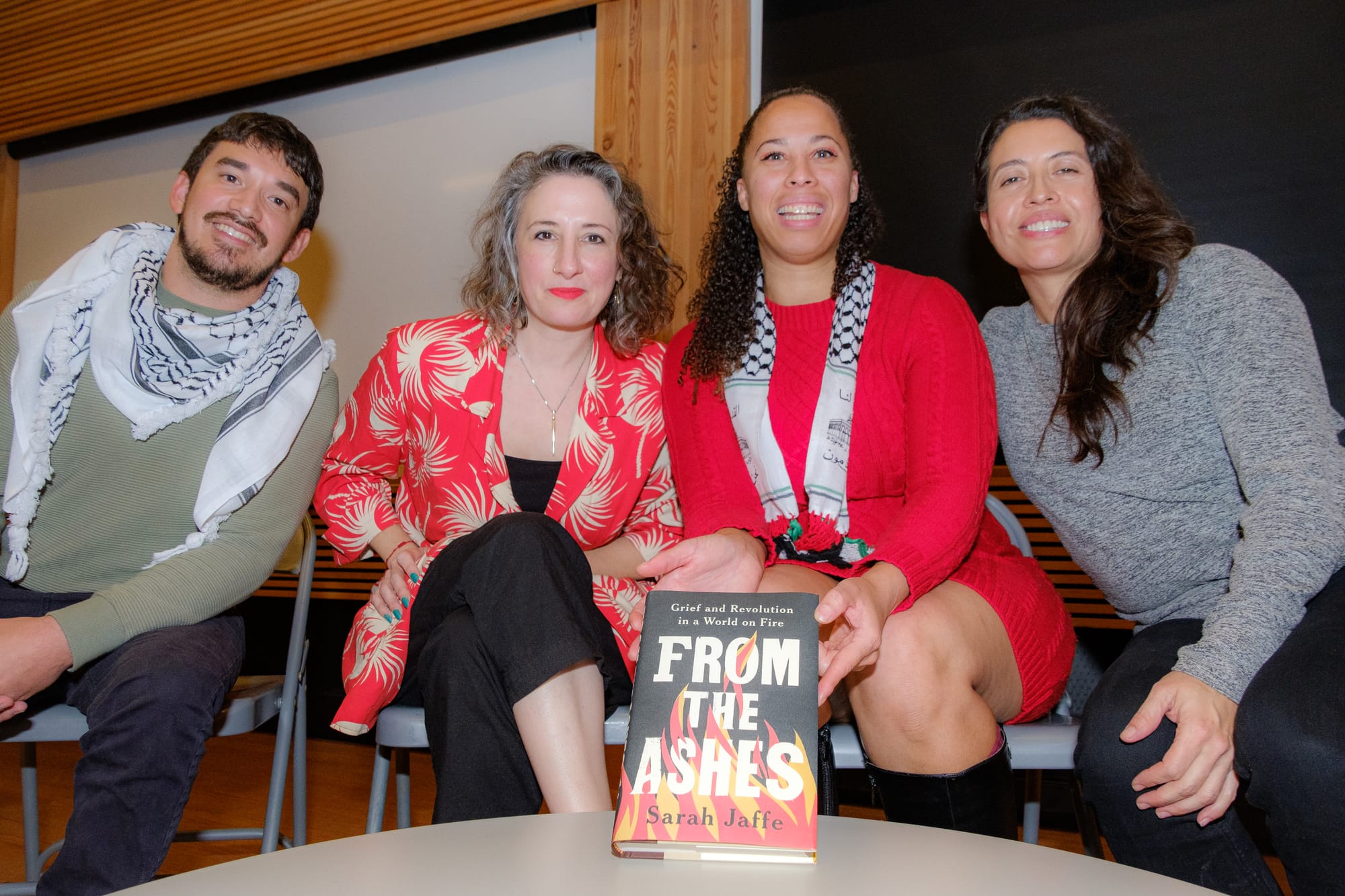
Editor’s Note: Last month, Louisiana-based reporter and writer Sarah Jaffe made a swing through Texas to discuss her recent book From the Ashes: Grief and Revolution in a World on Fire. It’s a work urging those fighting to better our world to pay attention to the embodied vulnerabilities of affect, in particular those emotions of grief often called up by oppressive politics—but which also offer a common experience that unites us all. It was clear during Jaffe’s conversation on December 5, 2024, with a trio of experienced San Antonio organizers—Ananda Tomas, Joleen Garcia, and Alex Birnel, who helped out with logistics on Jaffe’s Texas swing and offers this week’s Q&A—that the suffering of campaign losses, of living and working on hard economic margins, of powering through on disappointments left ungrieved, are not only damaging to individuals. Movements suffer too.
As Jaffe wrote Deceleration as we prepared to share this Q&A and video:
“Grief is not a simple emotion, but rather a process that contains many emotions, a process that is conscious and unconscious, intentional and automatic. It’s not a thing you can opt out of; if you try to avoid it, it will show up in ways you least expect it, and so we must make room for it in our lives and, importantly, in our organizing.”
Entering 2025 with MAGA ascendant means a physical and psychic scramble as we prepare to protect those around us who are immediately vulnerable to long promised campaigns of state violence. It is increasingly clear that Trump 2.0 will also require surviving and fighting an ‘imperial’ presidency committed to redrawing international borders, historically a recipe for large-scale conflict. The emotional toll of this onslaught of threats, followed by the groveling of too many who could have provided a degree of buffer for the less resourced, has put “brace for impact” into regular journalistic usage. MAGA at home and abroad means the fracturing and crushing of undocumented families, of trans and queer people, a constant labeling and weeding out of a fabricated “enemy within” to justify the erosion of rights, and a raffling off to the highest bidder (entry price $1B) of the marvelous network of beings often sterilized as the “environment” as the Earth continues to boil and spark from fossil-fueled abuse. Deceleration offers this conversation, and many more to come, in the hopes that those working for justice will make heartfelt and thoughtful space for the needs of the broad-based inter-generational movement materializing now. It is a movement full of pain and humor. Of joy and terror. Of grief and all stages of grieving. Prepare room. — Greg Harman
Alex Birnel: Good morning, Sarah. You were recently with us in Texas, and it’s good to see you again. You were here to discuss your latest book, “From the Ashes: Grief and Revolution in a World on Fire.” Could you summarize what the book is about?
Sarah Jaffe: Sure. It’s an unconventional book—a Marxist book about grief, which might sound odd. But I wanted to explore if concepts like commodity fetishism could help explain why capitalism struggles to assimilate grieving. Some readers think it worked, so maybe I’m onto something. The book’s about organizing and grieving. It’s about how my father’s death upended my life and how grief became something I saw in everything I was already writing about. It interweaves personal grief with broader struggles. There are five chapters covering state violence, immigration, deindustrialization, COVID, and climate change. My grief narrative is woven throughout, even though it was uncomfortable to share. But I felt it would be hypocritical to ask others to confront their grief if I couldn’t confront mine. The discomfort is part of the journey, but the book ultimately lands somewhere transformative—not necessarily hopeful, but something akin to it.
Thanks for that. After spending some time in Texas, what stood out to you? Did you enjoy your visit and the people you met?
I really did. Visiting Texas right after the election might seem odd, but I’m from Louisiana—the belly of the beast—where organizing often feels like fighting against the worst of the worst. It was refreshing to be around people who are used to navigating heartbreak and adversity but haven’t given up. There’s no room for denial or shock in these spaces—just a determination to keep going. And I can’t forget the breakfast tacos. The ones you took me to were phenomenal.
Maria’s! Best taco spot in Texas.
Absolutely. Those tacos deserve their own shout-out.
Texas has this dual political identity. Some see it as destined to turn blue due to changing demographics, while others see it as a conservative stronghold. How does this tension reflect themes in From the Ashes?
The ‘demographics is destiny’ thing drives me nuts, because it’s just another end run around doing politics. Voter suppression and deportation undermine the power of the demographic groups that are supposed to be destiny. Liberalism 2024 is any way we can possibly avoid doing actual politics. But you have to. You have to make people’s lives better. If you’re not, you’re going to lose the people [to those] who promise to make people’s lives better, even though they’re lying. Donald Trump’s not going to make anybody’s life better, except probably his own. He’s just going to create a bunch of misery.
Despite having written a book about grieving, about emotions, I think those emotions have material roots. They don’t just come from nowhere. You’re grieving because somebody has died, because you have lost something significant, because you’ve lost a home, a job, some really important facet of your world, and politics has to find a way to mitigate or prevent those losses or at least give people time and space to experience the inevitable ones, because we’re all going to die eventually.
Texas’s political landscape often gets boiled down to a rural-versus-urban divide. Do you think grief manifests differently depending on geography?
Grief is universal but uniquely personal. It doesn’t matter whether you live in a rural area or a big city—it’s about whether you have a community to support you. You could be surrounded by people in a city and feel completely alone, or live in a tight-knit rural community where everyone shows up when you’re grieving. Late capitalism’s social isolation exacerbates grief everywhere. Community structures are eroding—churches, unions, social spaces—leaving people alienated. Grief’s impact is compounded by this lack of connection.
After talking with people in San Antonio, Austin, and Houston, did any of those conversations inspire new ideas for future writing on grief, activism, or organizing?
Definitely. Though I’m not planning to write more on grief—I’m ready to put this book down—the conversations in Texas reaffirmed my commitment to organizing in the South. Texas, whether you consider it Southern or its own thing, has so much to teach. The resilience of organizers here is inspiring. They’ve been in the trenches for so long, navigating electoral and material struggles, often without much national attention.
In Texas, faith communities often play a significant role in providing emotional and material support. How do you see religious traditions intersecting with grief and hope in political movements?
Faith communities often fill the void left by collapsing social structures. They meet emotional and material needs—from food banks to ritual support during grieving. That’s why movements like the Poor People’s Campaign and faith-based organizing are so powerful.
Gramsci admired the Catholic Church for its total social institution model. He thought the left should emulate that—becoming a space where people find community, care, and purpose. That’s what’s missing in so many of our movements today. When we alienate people’s faith or fail to engage with these traditions, we leave that terrain to right-wing leaders who weaponize it.
You’ve talked about the role of history in organizing. Texas seems intent on burying its radical traditions. Why do you think that is, and what’s the relationship between a usable past and dealing with grief in the present?
The powerful bury radical histories to delegitimize alternatives to the status quo. Highlighting Texas’s radical past—from labor struggles to civil rights movements—challenges their narrative of inevitability. But clinging too tightly to history can also be a trap. Historical materialists like me emphasize understanding the present’s unique conjunctures. The past is a guide, not a blueprint. We have to recognize how current forces differ—whether it’s climate catastrophe or technological shifts—to avoid fighting today’s battles with yesterday’s strategies.
Your book covers grief as a collective and personal experience. Do you think understanding systemic processes like deindustrialization helps people navigate grief, or does it make it harder?
Often, people don’t realize they’re grieving. Recognizing systemic processes can help contextualize their pain. Deindustrialization, for example, isn’t just an economic shift; it’s the loss of jobs, community, and identity.
When I interviewed a union leader in Lordstown, Ohio, he described the grief of workers stuck in limbo because the plant wasn’t officially closed—it was ‘unallocated.’ Understanding this as grief can be liberating. It validates the pain and shows it’s not personal failure but systemic injustice.
Have you noticed patterns in how different audiences respond to your book? Does age, gender, or experience shape their reception?
The common thread is loss. People connect with the book because they’ve experienced grief—whether it’s losing a loved one, a job, or a way of life. The depth of connection often depends on how deeply someone has grieved. It’s like being on the other side of a wall. Those who haven’t experienced profound grief may not fully grasp it yet.
Organizing spaces often struggle with addressing complex emotional processes like grieving. How do you see these dynamics playing out?
Organizing spaces often replicate the denial of care we experience in broader society. When we’re not creating spaces for emotional care, grief and trauma bubble up in harmful ways—in meetings or interpersonal conflicts.
Abolitionist organizers have taught me a lot about creating spaces where people’s needs are met. Movements can’t just mirror the capitalist work ethic—we need to build a culture of care to sustain our work and each other.
What media or writers influenced you while writing “From the Ashes”? Where would you direct readers who want to explore these themes further?
I didn’t read much about grief directly, but Cindy Milstein’s “Rebellious Mourning” is a great anthology on collective grief. Miriam Kaba and Kelly Hayes’ “Let This Radicalize You” also address these issues in accessible ways. For those interested in political defeat and burnout, Sara Marcus’ “Political Disappointment” and Hannah Proctor’s “Burnout” are excellent.
Finally, what did you gain from your time in Texas?
Cowboy boots! But seriously, the conversations I had were energizing. They reminded me why I do this work. Organizing can be isolating, but connecting with others who are thinking deeply and working tirelessly to create change is invaluable. I left feeling both challenged and supported—and grateful for the tacos. I’m gonna convince you to write that people’s history of Texas!
-30-
Sarah Jaffe is the author of From the Ashes, Work Won’t Love You Back, and Necessary Trouble, all from Bold Type Books, and the co-host of Heart Reacts, an advice podcast for the collapse of late capitalism. You can find links to all of her work at sarahljaffe.com.


