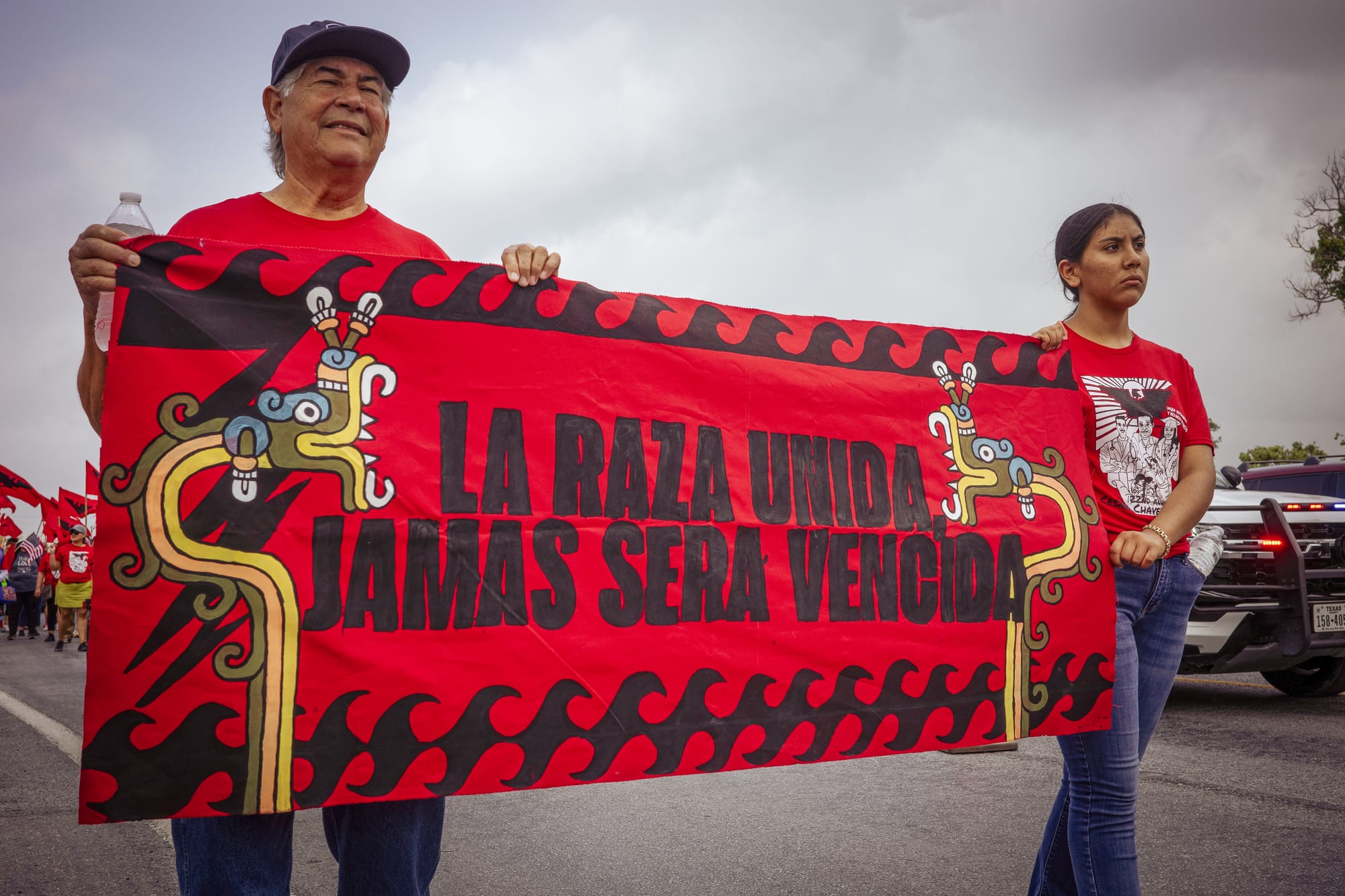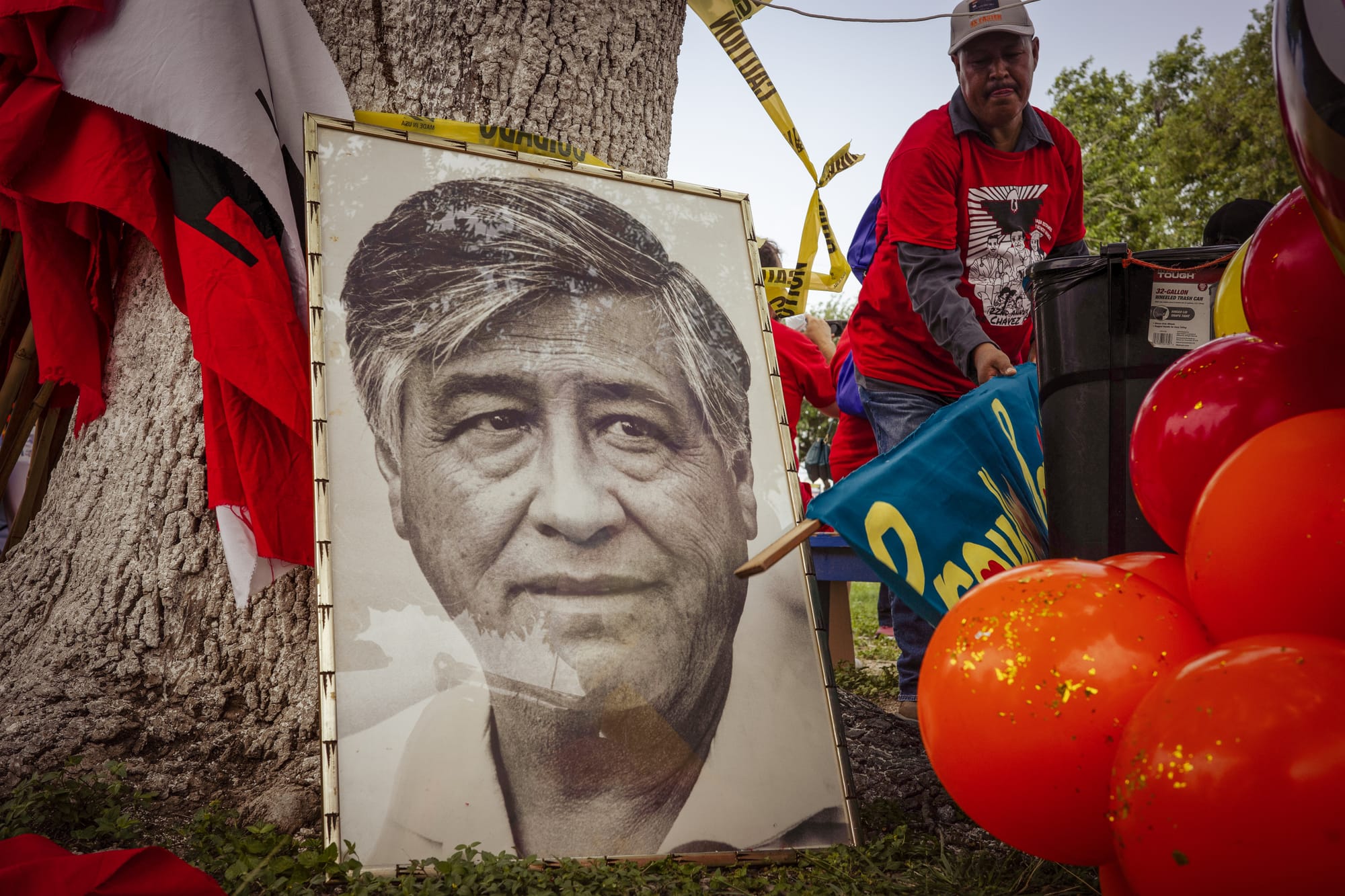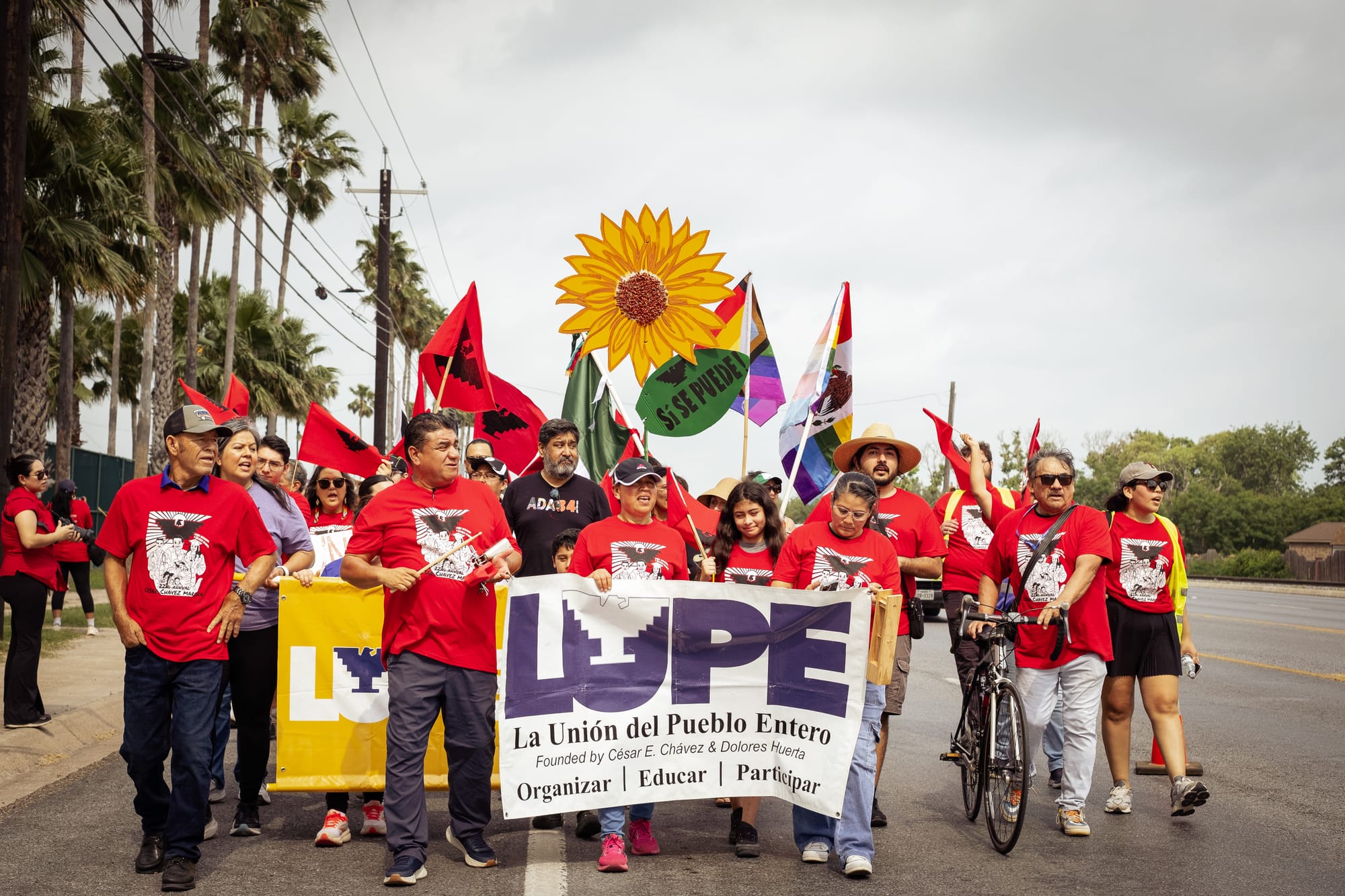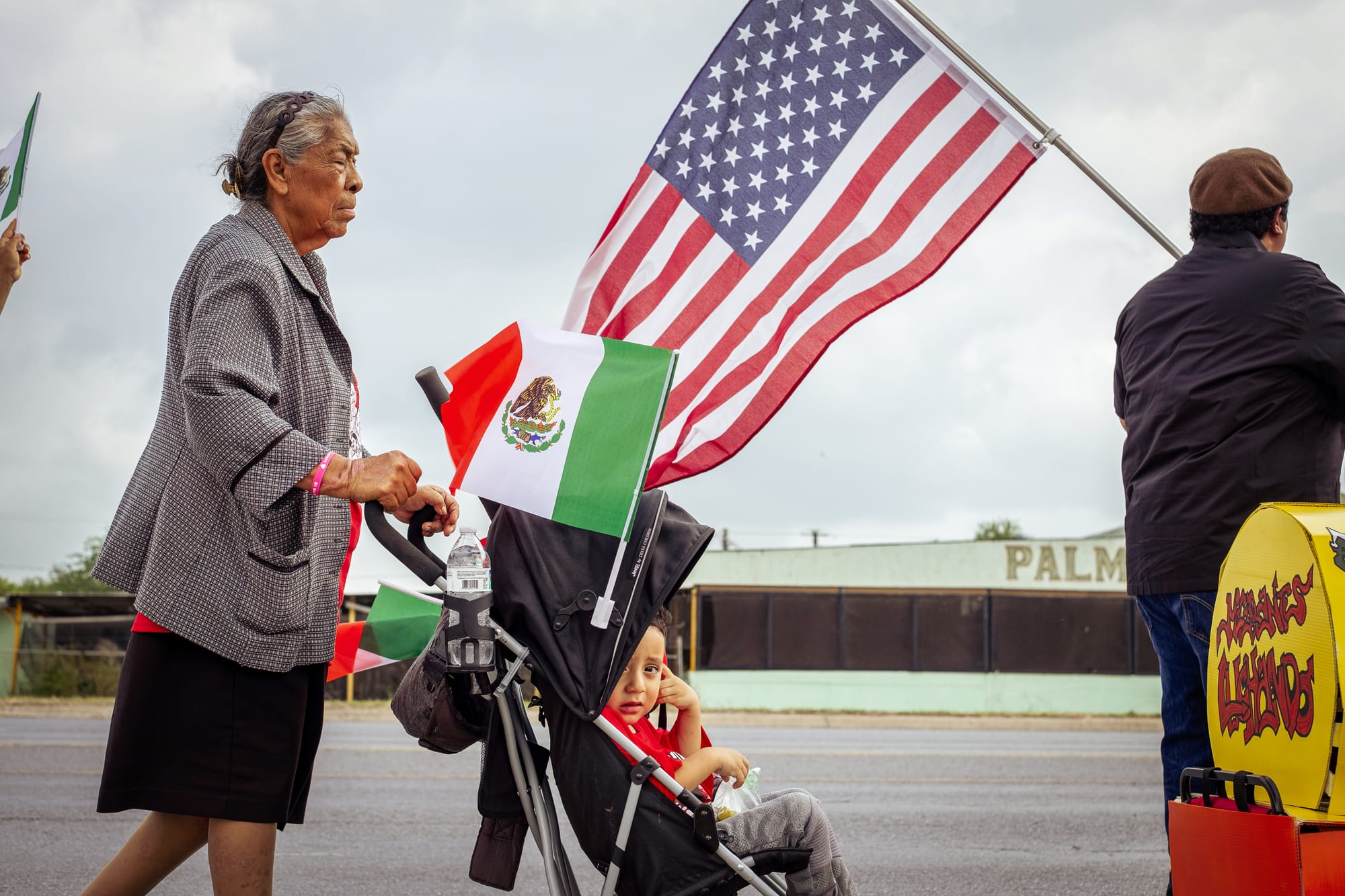
SAN JUAN, Texas—Right now the Rio Grande Valley’s in pre-summer, which is called spring elsewhere. That’s when the usual season’s humidity arrives but not the 100-degree temperatures, just 90-degree ones. Clouds and wind didn’t cool things down on Saturday, but a few hundred people came out for La Union del Pueblo Entero’s (LUPE) 22nd annual Cesar Chavez March in San Juan anyway. There’s plenty to march for and against, especially now, in the Valley and across the country.
“Aquí estamos, y no nos vamos,” is the first chant I hear. Here we are, and we’re not leaving. It’s also this year’s theme for the march.
Tania Chavez Camacho, LUPE’s executive director, highlights the aims of the Trump administration and the larger white nationalist project clearly from a stage outside LUPE’s headquarters: “Quieren separarnos y quieren dividirnos,” she said. “Quieren crear fronteras y difundir mentiras para hacernos sentir diminutos y sin poder.” They want to separate us and they want to divide us. They want to create borders and spread lies to make us feel tiny and powerless.
Chavez Camacho, LUPE’s director since 2023, references preceding leadership, like the now-retired Juanita Valdez-Cox, who brought LUPE to the Valley in 2003, and the organization’s founders, Dolores Huerta and the march’s namesake, Cesar Chavez (no relation). There are not many organizations besides LUPE that have been taking an active role in defending the Valley community as of late, throwing themselves into the open with moral clarity.
“Tenemos que defender a nuestras familias, a nuestras amistades, a nuestros vecinos, a nuestros niños, a nuestra comunidad,” Chavez Camacho said. “Porque tanto ha cambiado en estos últimos 100 días, pero no nos vamos a quebrantar.”
“We have to stand up for our families, our friends, our neighbors, our children, our community. Because so much has changed in these last 100 days, but we’re not going to break.”
Huerta and Chavez founded LUPE in 1989 as an advocacy organization for colonia residents and farmworkers. Colonias, as defined by Merriam-Webster, are unincorporated settlements “usually near the Mexican border that typically [have] poor services and squalid conditions.” The RGV has the most colonias in Texas, a state boasting the most colonias in the U.S. Many of them are in Hidalgo County, where LUPE is headquartered.
Not surprisingly, it was colonias that severely flooded, some for weeks, during last month’s storm that brought down over 20 inches of rain in some areas. Colonias are also where some of the ICE raids accelerate across the Valley.
This annual march was not the first public demonstration in the Valley this year and likely won’t be the last. The Trump administration’s specific targeting of migrants and undocumented people at large turned tangible within weeks of his getting into office.
Immigration and Customs Enforcement (ICE) and Homeland Security Investigations (HSI) came to my hometown, Port Isabel, and to Brownsville, McAllen, Los Fresnos, and elsewhere, in what the agency called “targeted operations.” Videos circulated on social media of agents in unmarked cars pulling over drivers or parked in front of homes. Recently, a video allegedly shows a hotel employee on South Padre Island getting arrested by what appears to be ICE officers. The person taking the video repeatedly tells the agents that they’re trespassing and don’t have a warrant but they arrest the employee anyway. A subsequent post alleges the employee was released but I couldn’t confirm this.
LUPE’s membership have been busy, holding Know Your Rights trainings, helping people reapply for the Deferred Action for Childhood Arrivals (DACA) status, and, recently, town halls for residents to submit damage surveys and apply for resources after last month’s flooding.

In the communities where these raids happened, residents protested in the weeks after against ICE, family separation, and criminalizing people who are undocumented. A protest in McAllen was the largest, with hundreds of people on 10th Street with only a couple days’ notice.
The public action was met with a selfie and condescension from the city’s mayor, a former GOP Chair for Hidalgo County, which was more attention than the other demonstrations in the Valley have received from elected officials, which was none.
Adorned in red and soundtracked by Los Tigres Del Norte’s “Cesar Chavez,” hundreds of people walked on Saturday down Business 83 to downtown Alamo and back. You could hear them chanting nearly a mile away, the semi-trucks honking in solidarity, and the wind blowing against your eardrums muffling both.
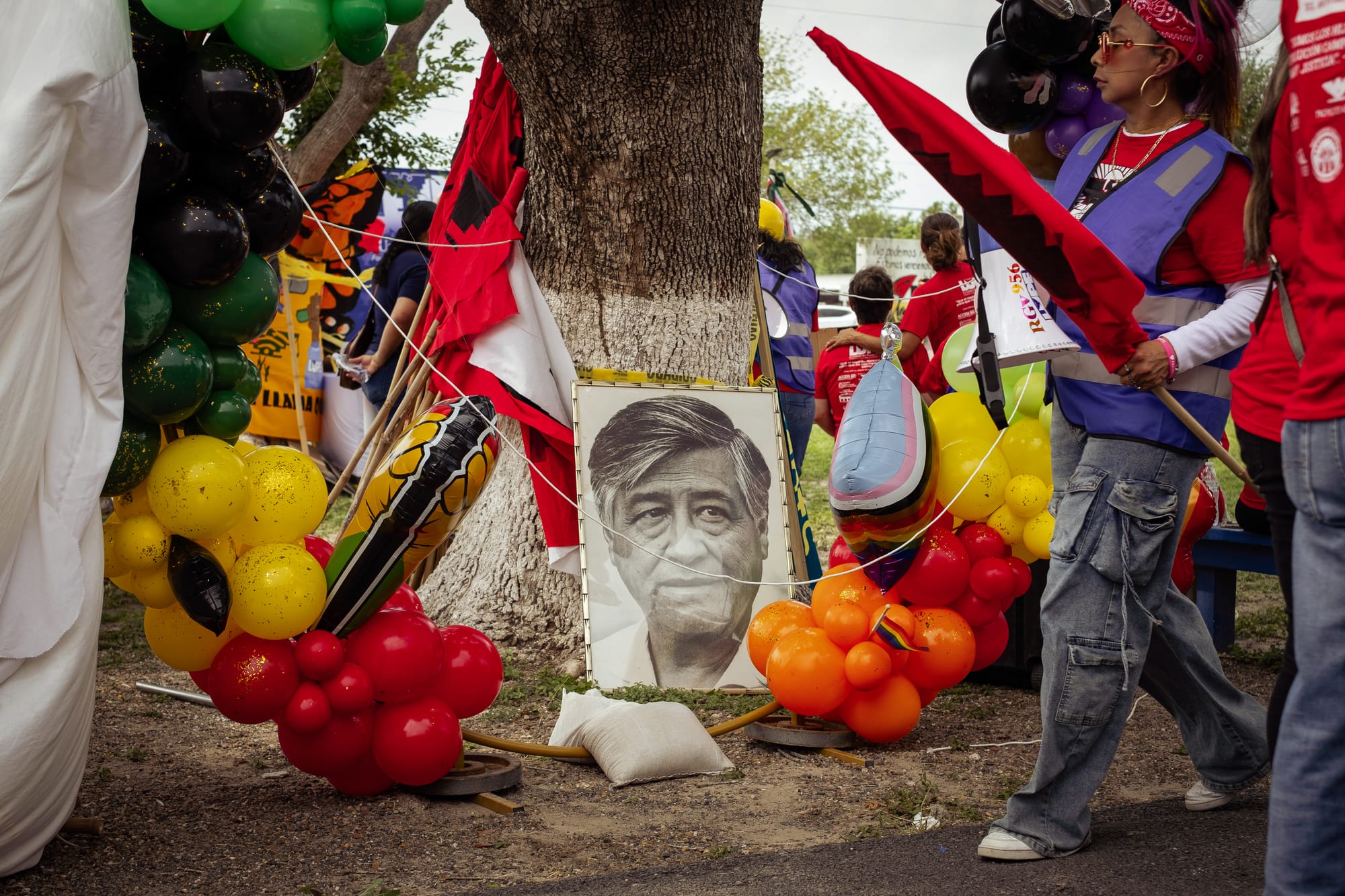
The march ended where it began, back at LUPE’s headquarters, turning into a community event. This is when I met Marco Lopez, one of LUPE’s community organizers out of their Alton office, who was leading some of the organization’s flood town halls in the last month, and who was also leading chants during the march. While those march goers enjoyed agua frescas, elotes y mas, he and I talked about the connected struggles of the community, namely in colonias.
“One of the things that I’ve actually been wanting to work on is how to connect [infrastructure issues] into colonization, and how this used to be all part of Mexico or whatever, and it seems like it’s always been people of power that have just taken things from us,” he said.
He refers to one of many original sins of this place, the “Magic Valley,” a moniker coined by land developers in the early part of the 20th century. The phrase was used in advertising to convince midwestern farmers to buy citrus groves and use local Mexicans to labor them.
“They called it—they still call it—the ‘Magic Valley,’ because they continue to exploit us,” Lopez said. “There’s still this colonization, this exploitation, that still exists. And I feel like the community keeps marching and participating in these things to kind of show that we’re still here. We’re not going anywhere, and we’re going to continue to struggle until we finally feel that peace in our own home.”
LUPE’s “Know Your Rights” training for residents to avoid unlawful, warrantless arrests and searches from ICE and police are part of a nationwide effort—and are working. Trump’s “Border Czar” Tom Homen said in January these trainings were making it harder for ICE to arrest people. Specifically, he said the trainings were teaching people “how to escape arrest.”
“It’s not that we’re teaching folks to evade the law,” Lopez said. “These are basic laws that everybody should know.”
LUPE’s members teach the law to enable communities to protect themselves against an administration bent on imprisoning those without (and sometimes with) citizenship documents. Residents increasingly under attack by anti-immigrant federal and state policies have also been failed by local elected leadership. While city leaders here have touted how they’re not involved in ICE operations after being called upon by their communities to do something, LUPE acted.
With climate change increasingly feeding destructive weather events, forecasters were taken by surprise by the behavior of last month’s storm system, giving no time to low-lying communities to prepare for the massive rains. The Valley’s drainage systems couldn’t handle the rain either way. Even the area’s backup plan, sending water into the Arroyo Colorado, failed because there was too much debris and overgrown vegetation in the watershed. Floodgates that could’ve been opened weren’t. Drainage systems are either substandard or nonexistent in some of the area colonias.
Topography-wise, the Valley is already at a disadvantage when it comes to flood drainage. Add that with proliferating subdivisions and administrative incompetence, these floods became needlessly deadly. In response, LUPE’s town halls were held in some of the most drowned parts of the Valley. Throughout the whole month of April, staff helped residents fill out a state damage survey called iSTAT and other resources they could use. In some instances, they gave money directly to people who had lost food and other necessities.
Last week, the Texas Department of Emergency Management (TDEM) told me about 8,600 people submitted an iSTAT survey, with 3,500 of those people reporting that their homes either suffered major damage or were destroyed. Texas Governor Greg Abbott, U.S. Senator John Cornyn, and local U.S. Congressmember Monica De La Cruz, all Republicans, are now asking the Trump administration for a federal disaster declaration for three of the Valley’s four counties along with assistance from the Federal Emergency Management Agency (FEMA).
Trump hasn’t granted that request. As has been reported elsewhere, Trump, playing with the idea of abolishing FEMA altogether, has also been regularly denying federal aid to people hit by storms and floods since returning to office, including in Arkansas, West Virginia, Washington state, and North Carolina.
In Abbott’s letter to the president, the governor says 3,700 of the people who submitted surveys were uninsured. FEMA officials, as of April 14, said they’ve confirmed 1,911 homes with major damage and 235 homes destroyed. The letter acknowledged that the Valley’s population has financial hardship—over 334,000 people are on foodstamps—and that previous storms have made recovery untenable.
“Texans living in the affected area are no stranger to disasters, but many have reached their breaking point, given repeated incidents this year alone,” the letter said.
Abbott and his office can acknowledge these truths about the Valley yet fail to see the intersectionality of it all. His support of local LNG projects and oil extraction statewide, the theater of Operation Lone Star, the continuing allegiance to a federal administration that wants to expand fossil fuels while attacking immigrant families, cannot exist simultaneously with a sincere attempt to stop the Valley from flooding. A changing climate will only continue to exacerbate that lack of infrastructure. Unsurprisingly, Abbott’s letter doesn’t mention climate change or the drainage issues.
So goes the first 100 or so days of this administration. A silver lining might be that because local Republicans are asking for help, maybe the Valley will actually get the aid it needs. That aid is usually in the form of Small Business Administration loans, which undocumented people don’t qualify for, which is why some people who lost their homes in the 2023 tornado in Laguna Heights couldn’t get any federal help. Tom Hushen, Cameron County’s Emergency Management Coordinator, told KRGV that FEMA has come to the Valley to survey but there’s no timeline on when or if they’ll give people here aid.
Meanwhile, back at the rally, the sun’s broken through the clouds now and people are getting under the tents. “I love seeing everybody being together,” Lopez said, as kids played and their parents laughed. “They’re eating together, they’re sharing a table together. That kind of stuff is important, especially in our movement. The only way we’re gonna win this is through love.”
I couldn’t help but think of all these folks, many of them older, having to come out and march on a hot Saturday morning and doing so repeatedly. They march not just to honor a civil rights leader but because, even 30 years after Chavez’s death, basic premises of humanity are still not being granted to the folks who live here.
Local coverage over the years hardly ever explores why these marches still happen other than that they’re “making their voices heard” or some other maxim that’s lost meaning. Looking at photos of the demonstrations over the years, many of the signs have the same messaging, the anger and resolve still palpable in the people carrying them today. Twenty-two years on, millions of steps taken in these marches, and little has changed.
What hasn’t changed is that people in the Valley won’t stop supporting each other.
One sign reads, “No deporten a las manos que te dan de comer!” “Don’t deport the hands that feed you!”
There are also deeper reasons why we shouldn’t deport undocumented people than the fact some of them are picking and packing produce. Their worth shouldn’t be measured solely in their labor or what capital they can create. Their worth is in the community they foster alongside all who descend from peoples who found themselves on the opposite side of a border that existed only in water and on paper. That creation is evident at the Cesar Chavez march every year, this year perhaps especially, in spite of those trying to destroy it.
More pics from Gaige Davila