

UPDATE, 10/15/2025: Committee members, including San Antonio Mayor Gina Ortiz Jones, unanimously overrode the staff’s recommendation for “no action” and referred the proposal to the Community Health and Equity Committee for further discussion and potential action.
On Wednesday morning, members of the City of San Antonio’s Governance Committee will consider an April 2025 proposal by two of their Council colleagues to partner with Bexar County on tracking heat-related deaths. Thus far, these deaths have made up a kind of silent epidemic as industrially driven climate change intensifies the frequency and duration of extreme heat events.
While the San Antonio Metropolitan Health District regularly reports the numbers of heat-related illnesses observed, for instance in local emergency rooms, neither the City nor County tracks heat-related deaths.
The request came after years of rising temperatures around the world and a corresponding rise in heat-related deaths across Texas—including in San Antonio.
“We request that Metro Health explore best practices of tracking heat-related deaths in the City of San Antonio through an intergovernmental collaborative effort with the Bexar County Medical Examiner’s Office, City and County public safety departments, and local hospitals,” the request by D2 Councilmember Jalen McKee-Rodriguez and D5 Councilmember Teri Castillo states.
But in its response to this request in an informational packet distributed this week, city staff have suggested that, “based on conversations with the Bexar County medical examiner,” the process of determining heat’s role in a death is overly “complicated” and the number of heat-related deaths is “very few.” How exactly this has been determined in the absence of a program to track the deaths is unclear.
Extreme heat is the leading cause of death of all weather-related disasters that impact the United States.
Due to rising temperatures in recent decades, the number of heat-related deaths in the United States is rising dramatically—with researchers noting a 117 percent rise between 2019 and 2023.
National and international public health agencies, including the World Health Organization, U.S. EPA, and the U.S. Occupational Safety and Health Administration have all stated that the impact of heat on mortality is poorly reported and therefore widely undercounted.
“Federal records say that heat caused or contributed to at least 2,300 deaths in 2023. But the counts rely on death certificates filled out by coroners, medical examiners and other doctors, who often don’t consider heat’s potential lethality before certifying cause of death,” writers for E&E News wrote last year.
“Heat is regularly omitted from death certificates of people.”
In spite of these challenges in reporting, the National Association of Medical Examiners calls on their members to properly account for the health impact of extreme heat.
While uncommon across Texas, many U.S. cities track heat-related deaths, including New York City, Phoenix, Arizona, and Las Vegas, Nevada.
Phoenix recorded 608 heat-related deaths in 2024 and 201 so far this year—with more than 300 still under investigation for 2025. Though even their numbers are being increasingly challenged as downplaying the true impact of extreme heat.
New York City estimates about 500 heat-related deaths per year.
Las Vegas has recorded 260 heat-related deaths this year and 402 heat-related deaths in 2024.
Until a few years ago, the San Antonio Metropolitan Health District included a tab in their heat illness data for noting heat-related deaths. For most years, that category was populated by designations of “N/A,” denoting, Metro Health officials told Deceleration, “not available”—but not, importantly, “not applicable.”
The Bexar County Medical Examiner reports only heat-caused deaths (or deaths where heat is the primary or direct cause) but does not report or track heat-related deaths (where heat plays a contributory role).
As stated in City staff summary to the four-member Governance Committee this week, recent staff conversations with the Bexar County Medical Examiner’s Office suggested that “defining a death due to heat is complicated as the individual’s body temperature must be recorded at the time of death and all other causes must be ruled out.”
This information is incorrect according to a retired coroner interviewed by Deceleration. While taking a core body temperature is ideal to determine heat’s role as a cause of death, medical examiners and coroners can and do frequently rely upon records of environmental conditions to assess whether or how heat played a role in a death.
“It is not necessary that ‘all other causes must be ruled out’ before implicating heat as a cause of death, especially as a contributing factor,” Christina VandePol wrote Deceleration. “It’s well known, for example, that those with heart disease or other chronic illnesses are more likely to succumb to excessive exposure to heat.”
VandePol, a physician and former coroner who writes frequently about heat and public health, said that while taking a core body temperature at the time of death is ideal, it “rarely happens.” For that reason, “a thorough documentation of circumstances and environment is just as important and can tell the story.”
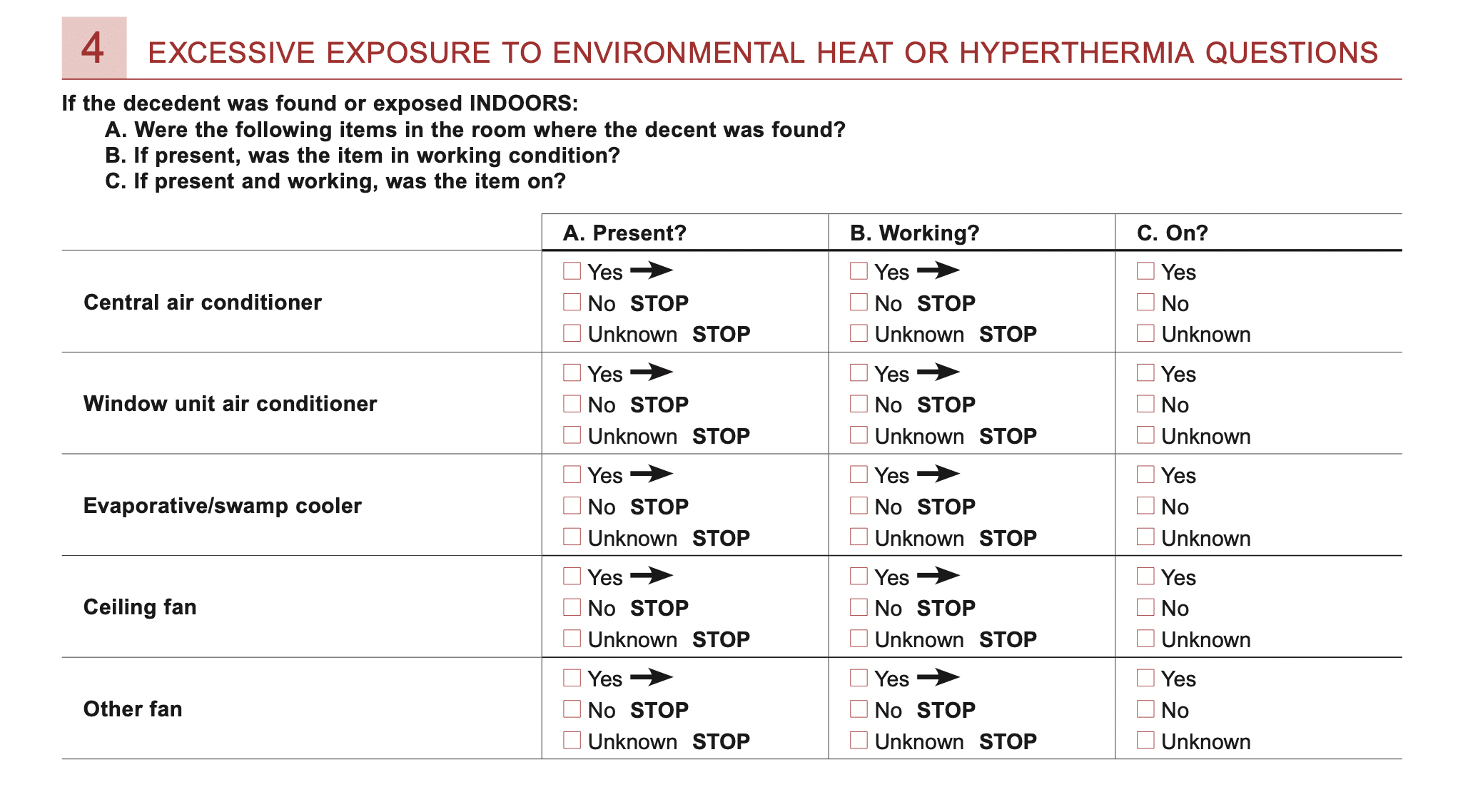
What is needed, then, is a method that assists public health agencies and frontline responders in collecting the best data possible, but environmental conditions bare minimum. Such reporting tools have been developed, including this death scene investigation form intended for extreme heat events from the U.S. Centers for Disease Control.
Meanwhile, in describing how a dashboard reporting heat deaths back to the public might work, as McKee-Rodriguez and Castillo suggested be developed in their original Council Consideration Request, City staff again in their response Governance Committee members implied that such an effort would be fruitless. “Given that each year there are very few heat-related deaths, the data would most likely be suppressed [to comply with HIPAA] and be noted as such on the dashboard,” they write.
Of course, without a method for tracking those deaths, like the one used by Maricopa County—where daily summer high temperatures are only about 8 degrees hotter compared to Bexar County—it is impossible to state with certainty whether local numbers are low or high. San Antonio is known for extreme (and rising) summer temperatures, which the Office of Sustainability expect to grow increasingly hot in the years ahead.
“I was surprised to see that there are ‘very few heat-related deaths’ every year,” VandePol wrote, before adding that it is critical to track not only heat as a primary cause of death but also as a contributing cause, as nearly half of all heat deaths in Maricopa County involved heat in a contributory role.
But even in cities where heat mortality is not tracked, cases can still leak up to the state level, as when emergency room doctors witness a heat-related death directly or when there is a federal investigation of a heat death that circumvents local accounting.
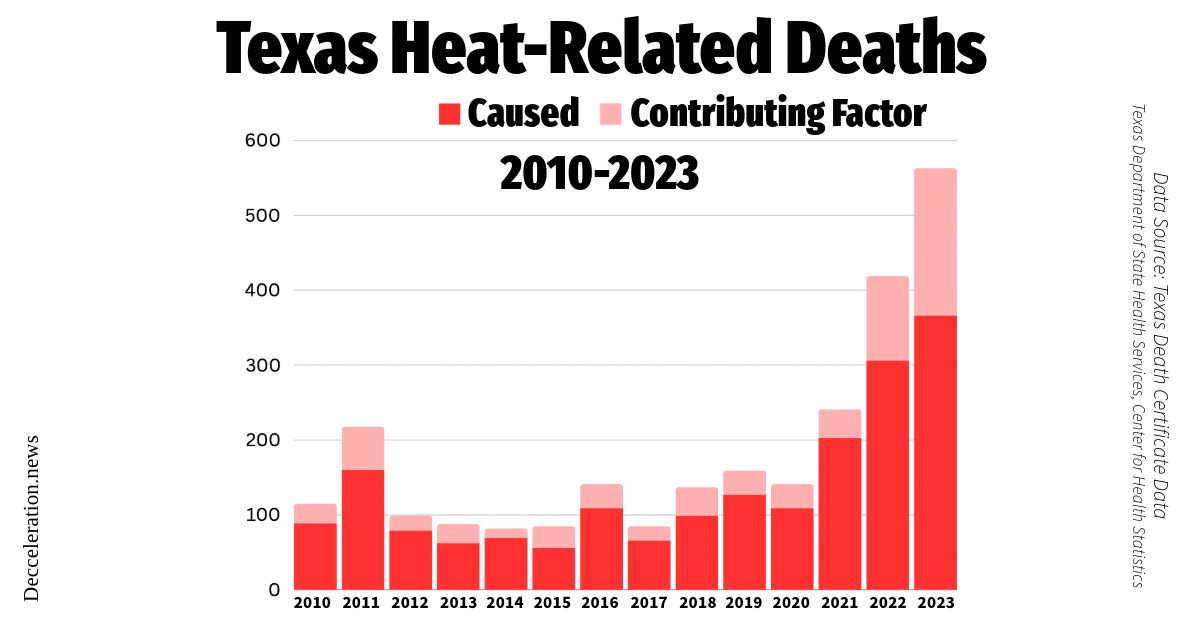
The Texas Department of State Health Services records deaths directly caused by heat (Method 1) as well as deaths where heat contributed to those deaths (Method 2).
State numbers show 563 heat-related deaths in 2023, according to data released to Deceleration by open-records request. In 2022, there were 419 heat-related deaths in the state. There were 241 in 2021 and 141 in 2020. These have been increases over heat-related deaths over the previous decade, which averaged about 124 per year, according to state data analyzed by Deceleration.
Bexar County specifically showed 16 heat-related deaths in 2017, 66 in 2022, and 19 in 2023. Deceleration has not yet reviewed data from 2024 or 2025.
Among those 66 heat-related deaths in 2022, 53 were attributable to a mass death event linked to human smuggling.
Without the Bexar County Medical Examiner’s Office tracking heat-related deaths, like many other Texas counties, the numbers trickling up to the state can only be understood as undercounts.
In the meeting issue summary, City staff also appear to downplay the need for accurate tracking of heat-related deaths given heat-reduction efforts underway at the community level. For instance, the largest heat mitigation project in the 2026 $4.04B budget includes a “Cool Pavement” program. However, the science behind so-called cool paving technologies is uncertain. Some studies suggest it cools the roadway by a few degrees but raises the temperature for pedestrians by reflecting more light into the surrounding neighborhood.
This also does virtually nothing to slow global warming driving increasing hotter weather, which is now on track to meet or beat some of the most pessimistic forecasts.
“Billions of people are facing an extreme heat epidemic—wilting under increasingly deadly heat waves, with temperatures topping 50 degrees Celsius around the world,” said United Nations Secretary-General Antonio Guterres recently. “That’s 122 degrees Fahrenheit and halfway to boiling.”
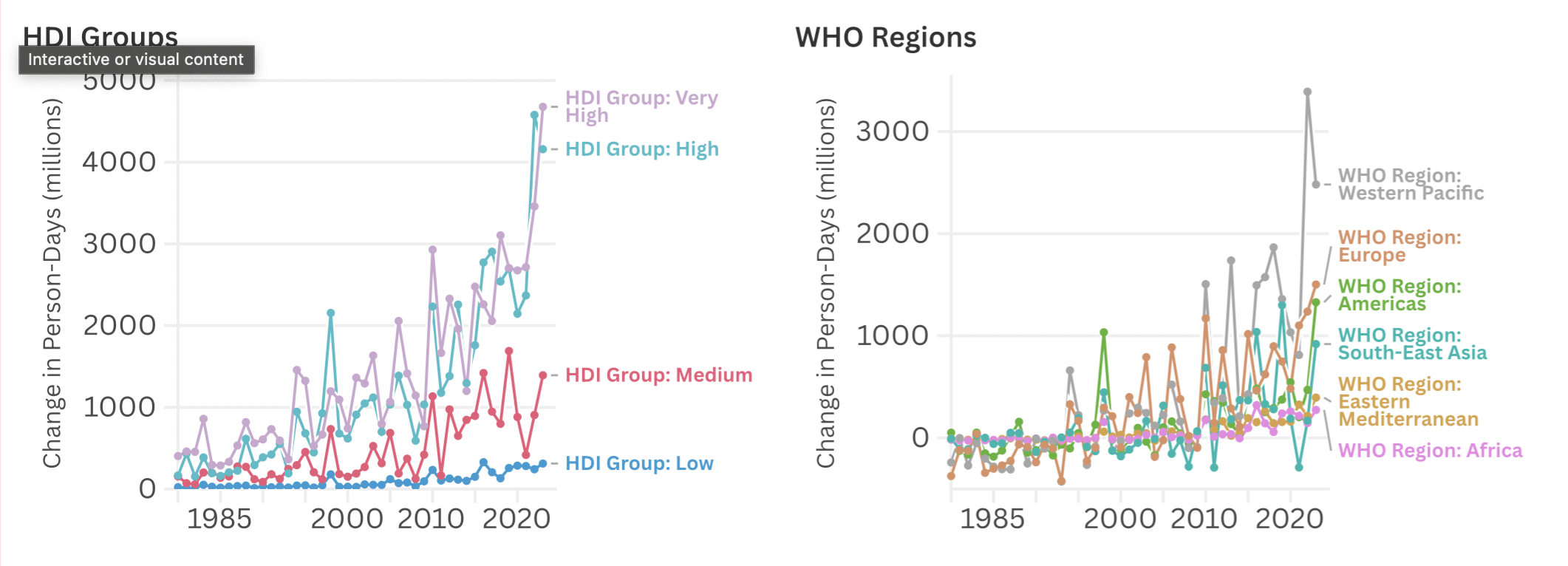
According to Lancet Countdown, a project of the peer-reviewed medical journal The Lancet, infants across the Americas suffered through an estimated 5 million “in-person days” of extreme heat in 1985. In 2023, that number was 209.3 million. For those over 65 years of age, the number of “in-person days” of extreme heat experienced across the Americas climbed from 51.3M to 1,328.6M during the same period. (“Person-days refer to the cumulative number of days of heatwave that people were collectively exposed to (e.g., if 100 people are each exposed for 5 days, there would be 500 person-days),” the Lancet writes.)
The staff narrative fails to mention that the most promising heat-busting program, which applies a variety of complementary strategies within a limited South San Antonio area, was defunded in this year’s budget and is currently kept alive only by the Office of Sustainability’s “drawing forward” of 2025 dollars to fill the gap. It is unclear how or if such programs will continue in 2027.
Even that small program, the South San Heat Resiliency Project (PDF), which Deceleration highlighted last week, has revealed that homeowners in South San have been living with indoor temperatures of as high as 110F. Such conditions are known to bring on heart attacks in older residents, deaths subsequently frequently attributed (as VandePol notes) to organ failure alone—not to the heat that led to the heart attack in the first place.
The Governance Committee convenes at 10 a.m. Wednesday, October 15, 2025, in the City Council Briefing Room and will be broadcast locally at AT&T channel 99, Grande channel 20, Spectrum channel 21, digital antenna 16, and www.sanantonio.gov/TVSA. The meeting will also be available by calling (210) 207 5555 (English and Spanish available).


