

Over the last two and a half years, the City of San Antonio has spent roughly $3M harassing and displacing migratory birds in city parks like Brackenridge, Elmendorf, and Woodlawn Lake, records released to Deceleration show. These costs have gone almost entirely unreported in spite of a shrinking municipal budget that resulted in cuts to public health programs and the City’s first property tax increase in more than 30 years.
The costs related to bird deterrence activities—justified by City staff as preventing conflict with the San Antonio Zoo, or U.S. Air Force operations at Kelly Field, or the health of the general public—have piled up almost entirely outside the oversight of the public or City Council. They have never, for instance, been identified in the City’s annual budget for reflection or discussion by the City Council in setting their annual spending priorities.
The only references Deceleration could find about bird deterrence after reviewing 10 years of city budgets was a goal of the San Antonio International Airport, stated as: “Reducing the impact of migrating birds on airport operations and appearance.”
Deceleration secured the records detailing millions spent on bird deterrence in city park operations only through multiple state open records requests, a process that City attorneys resisted and, at one point, asked the state Attorney General for permission to withhold records, before withdrawing that request.
Rosie Torres, a dance instructor and activist who organizes with the Society of Native Nations, was outraged to hear of the costs involved while so many social services have been cut in the communities she serves.
“How can San Antonio, officially recognized as a Bird City Texas community for its extensive urban green spaces, native habitat restoration, and conservation programs, spend $3 million displacing birds that are drawn to the area river and trees inside the city ‘sanctuary’?” asked Torres.
“During the spending of 3 million on birds, the real displacement was our youth: school closures, food programs cut, and ICE enforcement breaking families apart.”
The financial records released to Deceleration show that COSA has spent a minimum of $2,918,191 on bird harassment campaigns since the spring of 2024, with $2.3M flowing to private contractors Alpha Building Corporation and Omega GC. Both companies operate out of the same office space, both led by Jonathan Rogero.
In fiscal year 2026, which ended September 30, 2026, those efforts were brought largely inside of the City of San Antonio’s Parks Department in an effort to reduce costs, according to a city spokesperson. In that period, $79,500.00 went to the contractors, while $571,421 was spent on a team of City staff for comparable work.
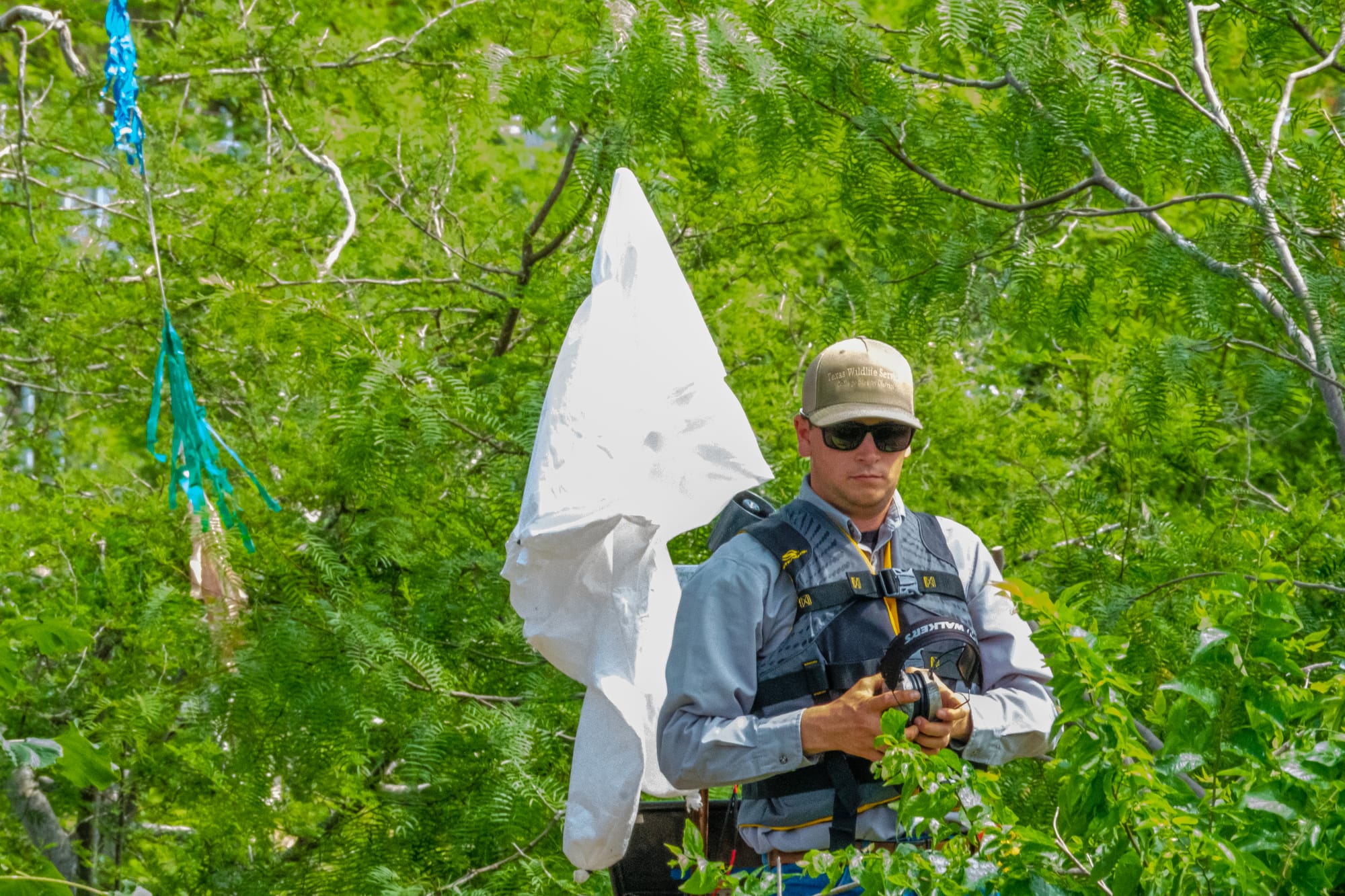
Whether contracted or staff, workers in these parks are tasked with clapping wooden boards after the birds, agitating them with laser pointers and pyrotechnics, all with the intent of preventing nesting and the formation of rookeries, large colonies of migratory birds where egrets, herons, cormorants, and other species gather to breed and raise their young. The harassment operations have prompted protests and complaints for years—including one federal lawsuit.

A history of fighting for—then against—birds
Massive federal and local investments in restoration along miles of the San Antonio River and area creekways have been rooted not only in flood control, but also the improvement of habitat for migratory birds.
Ecosystem restoration was a primary benefit of the San Antonio River Improvements Project when it first lifted off nearly 20 years ago—with promoted benefits for birds, including falcons, kingfishers, woodpeckers, and egrets.
When similar energy was directed toward Westside creeks, birds were so much in mind they were listed in the project’s initial draft as Objective 1; namely, to “[r]estore…habitat for aquatic and riparian dependent migratory and native resident bird species.”
It is unsurprising that in the midst of a global collapse of many migratory bird populations, these are values shared broadly by residents. When asked about flood control and water quality projects at Elmendorf Lake Park on San Antonio’s West Side in 2012, for instance, the most popular request from community members was to “support habitat for the birds, ducks and other aquatic life.”
But within a few years of that study, the City of San Antonio completely razed “Bird Island” at Elmendorf Lake. And every year since, the City has made investments in the harassment and displacement of migratory birds.
While Deceleration is seeking a full accounting of those costs since 2018, the City has limited responses to our records requests to only the last few years.
To date, the City has justified its actions with claims that rookeries are a public health threat and water-quality hazard.
“The safety of park patrons and wildlife is a priority. Large rookeries can harm the health of park goers and birds alike,” City spokesperson Brian Chasnoff wrote Deceleration.
“High concentrations of bird fecal bacteria affect water quality, and bird rookeries are significant contributors to that pollution. Bird feces may also carry diseases that cause respiratory problems in humans. By minimizing the impacts of large rookeries, these efforts are expected to improve wildlife biodiversity, water quality, and park amenity access.”
When asked if the City had any examples of park goers harmed by birds or bird excrement, Chasnoff said:
“No. The City’s proactive measures demonstrate a commitment to safety for park patrons and wildlife. Prevention, through mitigation efforts, is key to ensure our community and wildlife can safely enjoy park amenities throughout the year.”
While odor certainly can be an issue, the USDA-APHIS reports that herons and egrets are not species of significant concern when it comes to fungal Histoplasma spores, which are “not commonly found in soils from heron/egret rookeries.”
Partner calls for greater transparency
Other cities and communities—including the UT Southwestern Medical Center, which hosts a long-standing active rookery on its campus—have weighed the potential risks to the public with the needs of migratory wildlife and chosen to make room for the birds.
In the midst of its harassment activities, however, the City has established important allies, formalized in the Coalition for Sustainable Urban Rookeries, and granted $129,000 to mostly university partners for an "egret research study," according to a City spokesperson.
But even in this research relationship, tensions exist.
Britt Coleman, former president of study partner Bexar Audubon, has engaged in this research effort in the hopes that it will help lure the birds away from central San Antonio and thus the City’s harassment activities.
Today, however, he supports more transparency around these activities and the City’s broader objectives.
“I fully support trying to get the city to be more transparent on the rookery deterrence program and to allow rookeries of controlled sizes to exist within our park system,” Coleman wrote Deceleration.
“That is the goal we’ve been working towards for the last 6 years.”
Coleman said he had previously been told that the harassment activities were costing the city around $150,000 per year, though he admitted that this figure “sounds way low, given the manpower it takes to do the deterrence.” In fact, the City of San Antonio has spent more than 23 times as much on bird harassment than they’ve invested in research intended to “better protect egrets and other bird species."
That’s the price of what Coleman criticized as a policy of “total deterrence.”
It is likely the expenses incurred to date add up to much more than $3M, considering that the City only provided Deceleration with a portion of the requested records.
A recent State of the World’s Birds report found that 43 percent of all migratory bird species across the Americas are in decline. Global economic operations continue to strongly favor the destruction over the preservation of nature.
“Harmful subsidies have continued to increase, with an estimated US$30 invested in destroying nature for every US$1 invested in restoring it,” the authors found.
A similar ratio appears to be at work in San Antonio today.
Deceleration reached out to the councilmembers for all of the most impacted parks—Sukh Kaur (D1, Brackenridge) Jalen McKee-Rodriguez (D2, Brackenridge), Teri Castillo (D5, Elmendorf), and Marina Alderete Gavito (D7, Woodlawn). We also reached out to San Antonio Mayor Gina Ortiz Jones. We wanted to ask each if they supported ongoing harassment operations or if they believed that they may benefit from more Council oversight. None made themselves available for interviews.

The cost of ‘total deterrence’ on residents
Low-level harassment via chemical sprays was first discovered in Brackenridge Park in 2018. But efforts took off with the razing of the “Bird Island” rookery at Elmendorf Lake Park in 2019. That mass displacement of hundreds of egrets, herons, and cormorants was premised largely on claims that cattle egrets at the long-established rookery were flying across runways at Kelly Field on their way to forage. But bird-strike accounting by the Air Force showed that only four collisions out of roughly 500 logged were known to involve cattle egrets.
After that eviction, bird numbers began to swell elsewhere, including momentarily along the San Antonio River in Southtown, before harassment got underway there, too.
The City accelerated efforts inside Brackenridge Park after a bond-funded redevelopment project was approved by voters. Although the destruction of Brackenridge’s rookery was justified in the original project language, City staff later insisted the bird harassment was unrelated to redevelopment plans and instead were necessary to protect public health and improve water quality. Later, they would emphasize conflict between the rookery birds and the birds inside the San Antonio Zoo.
Lynn Cuny, founder and executive director of Wildlife Rescue and Rehabilitation, said that calls to assist injured and orphaned egrets and herons surged during this period, between 2019 and 2022, with her teams and volunteers taking in nearly 2,000 birds during that period.
“There have been many, many fewer since 2022,” she said.
After both Brackenridge and Elmendorf’s rookeries had been destroyed, bird populations shifted location again, this time to Woodlawn Lake Park. This was followed by another wave of harassment by the City.
Many hoped that this out-of-the-way spot at Woodlawn would be tolerated by the City. But Deceleration and others soon had to insert themselves in the situation when board-knocking contractors began to harass nesting birds with eggs, a potential federal crime under the Migratory Bird Treaty Act (MBTA). Crews in yellow vests remain active in Woodlawn Lake Park today.
“There was no justification of the deterrence at Woodlawn that I know of except for the current CoSA policy of total deterrence in all public spaces,” Coleman wrote Deceleration.
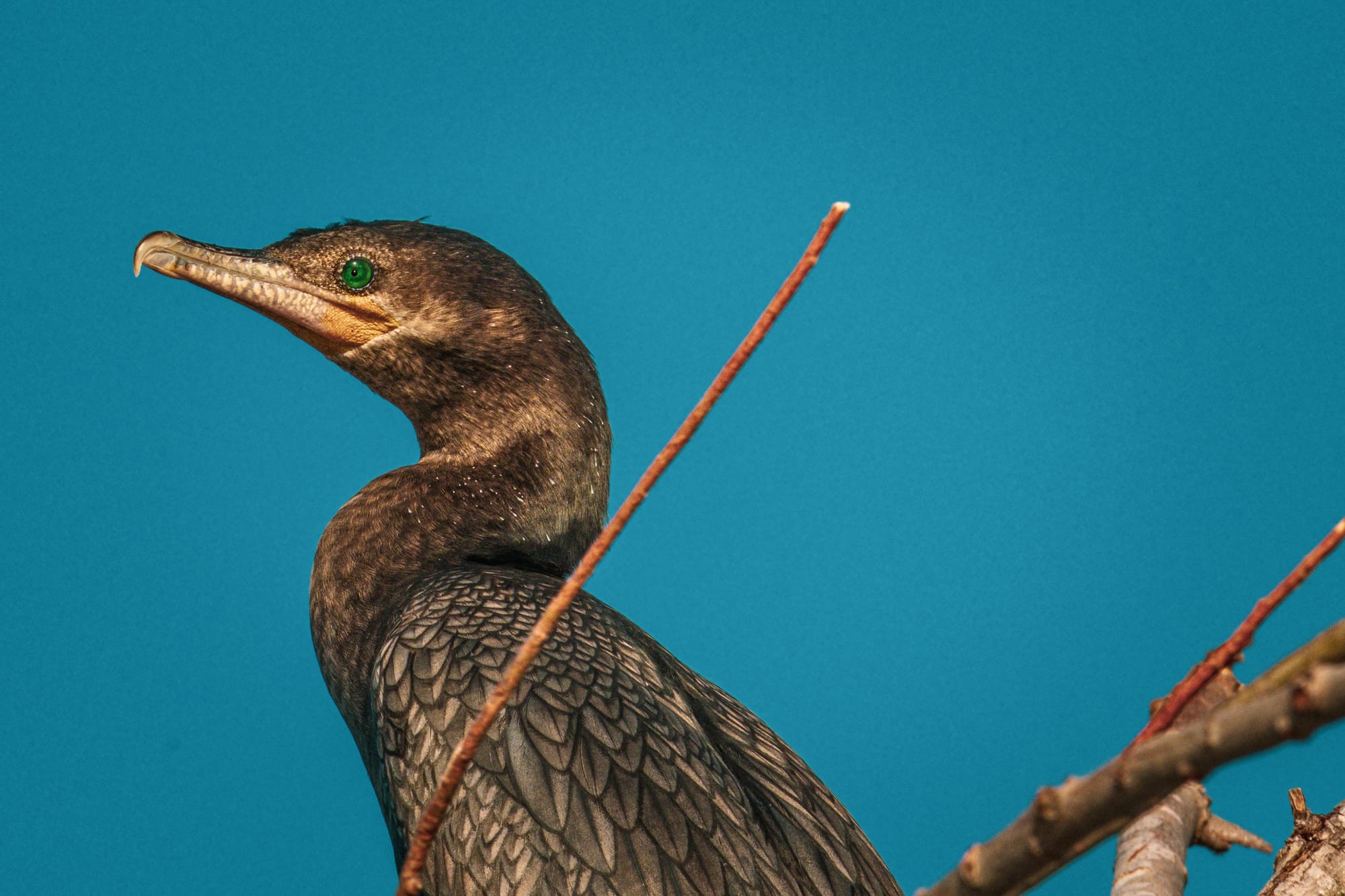
For bird lovers, these attacks have reduced the likelihood of encountering migratory birds in San Antonio’s city parks. While hundreds or even thousands of cattle egret sightings were common in Brackenridge Park from 2015 to 2024, for instance, they dwindled to a mere six sightings in 2026, according to crowd-sourced records maintained by eBird and iNaturalist. But—since many of these migratory birds nest in proximity—it’s not just the officially targeted cormorants and cattle and snowy egrets that have been impacted. Sightings of the far less common Little Blue Heron went from dozens of annual sightings in Brackenridge Park before the displacement efforts ramped up to only 1 recorded sighting this year.
Photographer-turned-activist Alesia Garlock described how her own health has suffered from witnessing the bird harassment in park after park through the years, including the use of pyrotechnics by city crews, which she said came dangerously close to striking her on occasion.
“You can’t tell me they can’t coexist,” she said. “They could have let them nest in their forest, set up a place for people to watch and learn as part of Bird City.
“But the problem is just the [Brackenridge Park] Conservancy, the City, probably the Zoo. … They don’t care. They want what they want.”
Coexistence is Possible Required
As Garlock suggests, coexistence is possible. In fact, in the midst of the global collapse of so many migratory species—birds that are drawn to highly illuminated landscapes like our modern cities—it could be argued that it is our primarily obligation.
A study of the local ecology shows how critical greater San Antonio’s rivers and creeks are to the survival of many of these species.
“Historically, after passing through the Texas coast, the riverine system of the San Antonio area was one of the first productive stop-over habitats for northbound neotropical migratory birds, and one of the last highly productive stop-over habitats during the southern migration,” the authors of the Westside Creeks project draft write.
“The energy reserves for birds are severely depleted during spring and fall migrations, and with the current trend of decreasing availability of structurally sound and functioning riverine systems, stop-over habitat has been identified as a limiting factor for their successful completion of migration and subsequent breeding success.”
Despite the rhetoric of inevitability suggested by local conversations about "urban-avian conflicts" in San Antonio parks, several communities around the country have looked at the challenges to migratory birds and chose to tip the scale, even slightly, in their favor.
Dallas Medical District Hosts Rookery
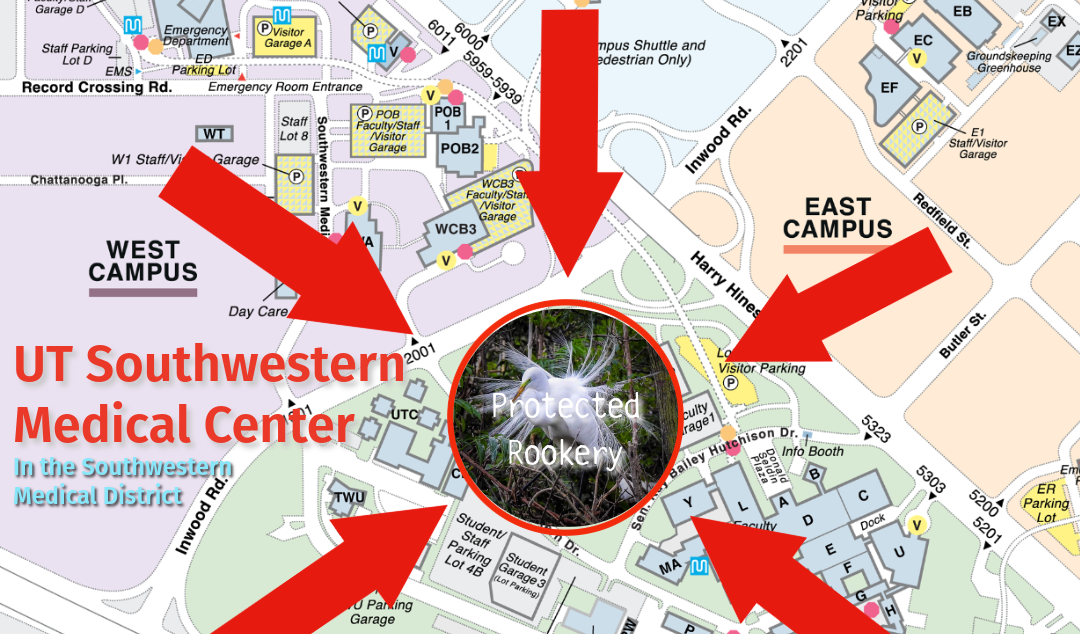
A few hours north of San Antonio, the UT Southwest Medical Center considered its migratory bird rookery, present in the area since at least 1966, and made another choice than displacement. Here you can watch the courtship displays of mating egrets and observe the young being raised from a parking garage rooftop. Or approaching by foot, you’ll encounter a paved hiking trail, dedicated parking, and even a memorial garden. But if you approach too closely, you may also see a “No Trespassing” sign.
“UTSWMC rookery opponents tried to stoke fears of histoplasmosis, an infection caused by breathing in spores of a fungus found in bird droppings,” writes Amy Martin at Green Source Texas. “But that's only an issue within the rookery core where people are not supposed to venture.”
"The medical district manages the rookery to keep it from spilling outside of its dedicated space by trimming trees along the periphery,” Martin writes.
Paddleboard with Great Egrets
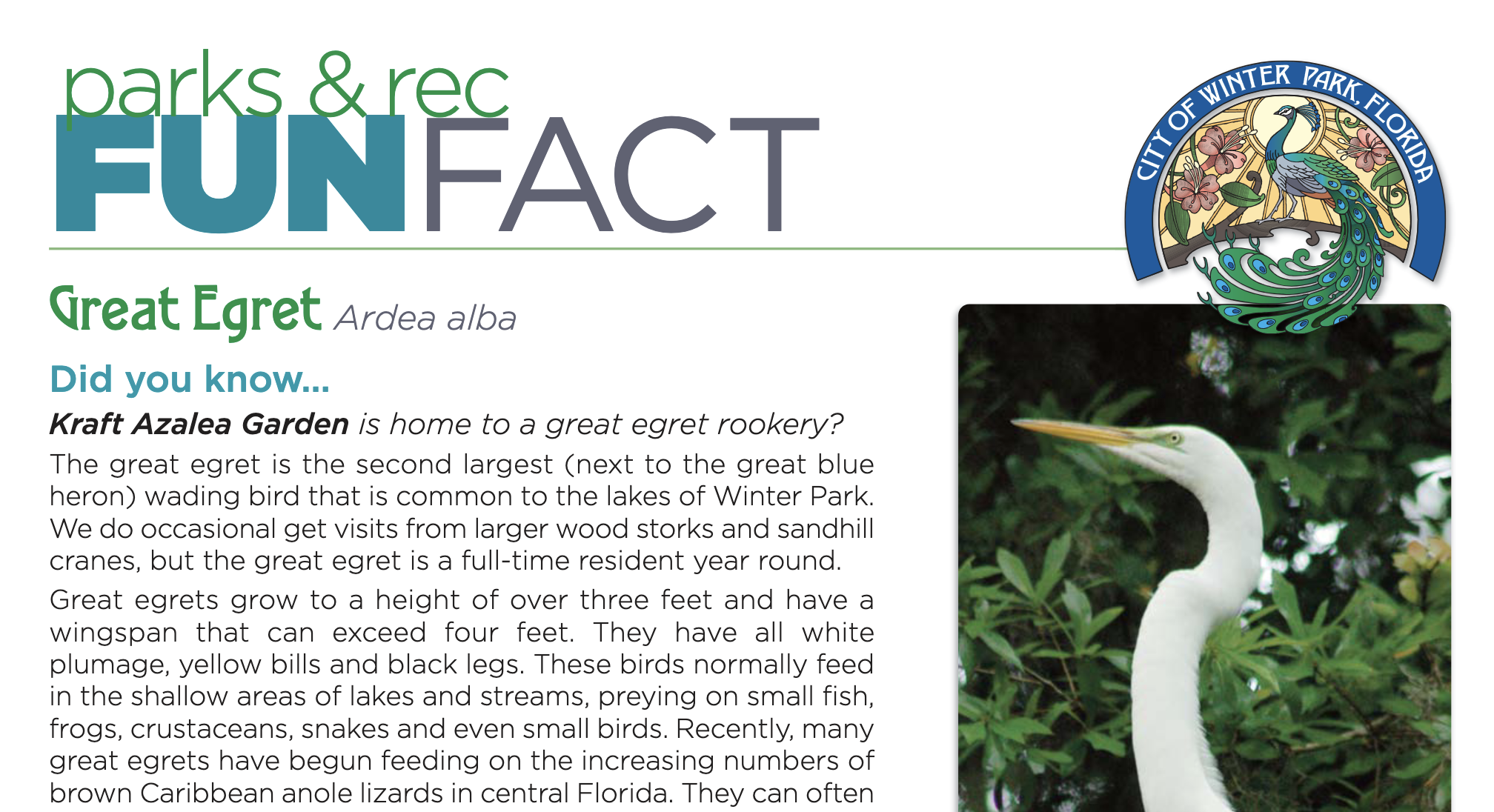
In Winter Park, Florida, a year-round rookery of great egrets camps out on Lake Maitland. Paddleboard rentals are a stone’s throw away from the rookery home at Kraft Azalea Garden. Rather than chase away these majestic birds, city staff instead seek to educate residents instead.
“Winter Park is fortunate to have a rare urban rookery for this stately bird,” a recent newsletter states. “Every year between late February and early June, up to 50 nesting pairs of great egrets gather at Kraft Azalea Garden to begin nesting rituals.”
It is, in other words, the public that modifies its behavior to allow room for their feathered relatives, not the other way around. What an opportunity for birdwatchers, known to spend over $100B every year on birding trips and supplies.
“If you look carefully you may also see other species of birds nesting in the garden, including ospreys, pileated woodpeckers, and our state bird, the mockingbird,” the newsletter states.
Parks Dept. Embraces Vancouver’s ‘Flying Dinosaurs’
‘Flying Dinosaurs in the City' documentary video about the year-round great blue heron rookery in Vancouver, British Colombia.
In San Antonio, it is the Parks Department that is the spear driving bird displacement. But in Vancouver, British Columbia, a year-round rookery of great blue herons makes their home on the doorstep of the local parks department (between the offices and the adjacent tennis courts, to be specific). Rather than chasing these birds off as a public health threat, the heronry has been integrated into local parks operations and enshrined as a key part of the board’s community education, outreach, and celebration of wild nature since 2004.
“The Stanley Park rookery is absolutely beloved by locals,” Rose Wilkin, the urban wildlife programs coordinator at the rookery, wrote Deceleration. “Our educational programs about the herons are extremely popular, and definitely turn the rookery into a vehicle for education (and fundraising for us as a charity).”
Stanley Park Ecology has been monitoring the heronry since 2004, working alongside the Vancouver Park Board and the Canadian Wildlife Service.
Members of the public are even able to “adopt” a heron nest and watch the breeding and chick-raising via a livecam.
If these cities can make space for co-existence, why not San Antonio?
-30-
Top image: Great Egret along the Mission Reach of San Antonio River. Image: Greg Harman


