Full event video from Deceleration. Follow Deceleration on YouTube.
Dozens of residents filled a meeting room at Northwest Vista College's Cypress Campus Center on Tuesday evening for a town hall on data center development, hosted by the Greater Edwards Aquifer Alliance and Public Citizen Texas. The campus sits directly across Highway 151 from a dense cluster of data centers, including a Vantage Data Centers facility that is now the subject of a lawsuit brought by a group of environmental organizations.
The heart of the meeting was an unpacking of the City's recent efforts to rewrite its Unified Development Code so that San Antonio can regulate where data centers operate — something it currently cannot meaningfully do.
District 6 Councilmember Galvan, whose district holds the largest concentration of the facilities in the city, said that concentration represents a build-out of fiber and energy infrastructure that arrived roughly 20 years ago with the National Security Agency campus on the city's Far West Side.
"You don't build something next to something that has no road," Galvan said. "For data centers, the same thing is true for fiber optic networks as well as for energy infrastructure."

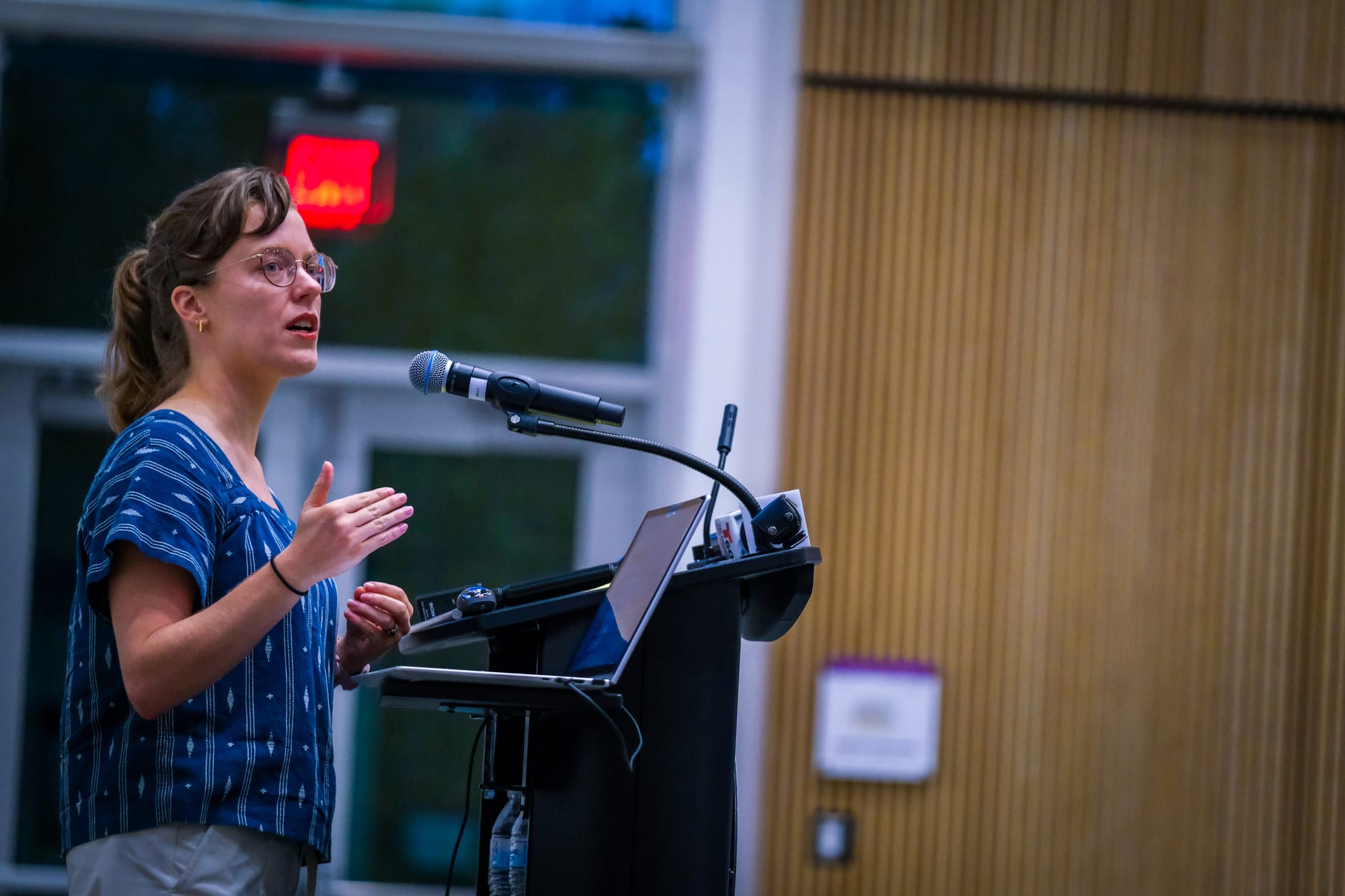
While data centers have only an outdated definition in the local zoning code, efforts underway now, largely due to Galvan's leadership, have produced two competing visions of potential regulation. Rachel Hanes, policy director at the Greater Edwards Aquifer Alliance, said GEAA and Public Citizen are backing the more restrictive of the two.
Two Proposals, Critical Differences
Proposal One would permit data centers "by right" in seven zoning districts: general commercial, light industrial, business park, and the general, heavy, mixed, and mixed-heavy industrial categories.
Operators would have to meet a fixed set of conditions — a 500-foot buffer measured from the nearest on-site structure (not the property line) to residential uses, schools, daycares, assisted living facilities, or hospitals. Fuel stations would require setbacks of at least 50 feet from the property boundary. And no accessory structures, substations, or fuel storage would be allowed over the Edwards Aquifer recharge zone.
Meet those conditions, and the permit is automatic. Council would not vote. There would be no public hearing. Organizers noted that general commercial zoning is the category that typically accommodates an H-E-B warehouse or a Target—a poor fit, in their view, for an industrial-scale computing facility.
Proposal Two would allow data centers in the same seven districts, but only with a specific use authorization. Every new facility would go before Council for a vote, with public comment, and would also be subject to lighting and noise standards, more stringent landscape buffers, and expanded emergency-services requirements — a response to concerns about fire risk and first-responder access at battery- and generator-heavy sites.
Buffer distances would be left to Council's discretion rather than fixed at 500 feet, allowing tighter setbacks in heavily industrial areas and larger ones near sensitive uses. The proposal also adds an abandonment clause: a facility that goes three years without operating would be considered abandoned, and the property owner would have to remove all equipment within 90 days.
"The CCR [Council Consideration Request] that the councilman submitted did ask that it be a specific use authorization," said Rachel Hanes, policy director at the Greater Edwards Aquifer Alliance, referring to Galvan's council consideration request.
"Proposal One came back as by-right permitting, which was not the ask."
Hanes said specific use authorizations are widely used across the United States, pointing to Loudoun County, Virginia, as "the world leader in data center development."
"We feel it is the best way for the city to move forward, she said, "to balance the concerns of those who want to ensure that we are reaping the economic benefits of data centers while also ensuring that we are protecting the citizens and natural resources of our city."

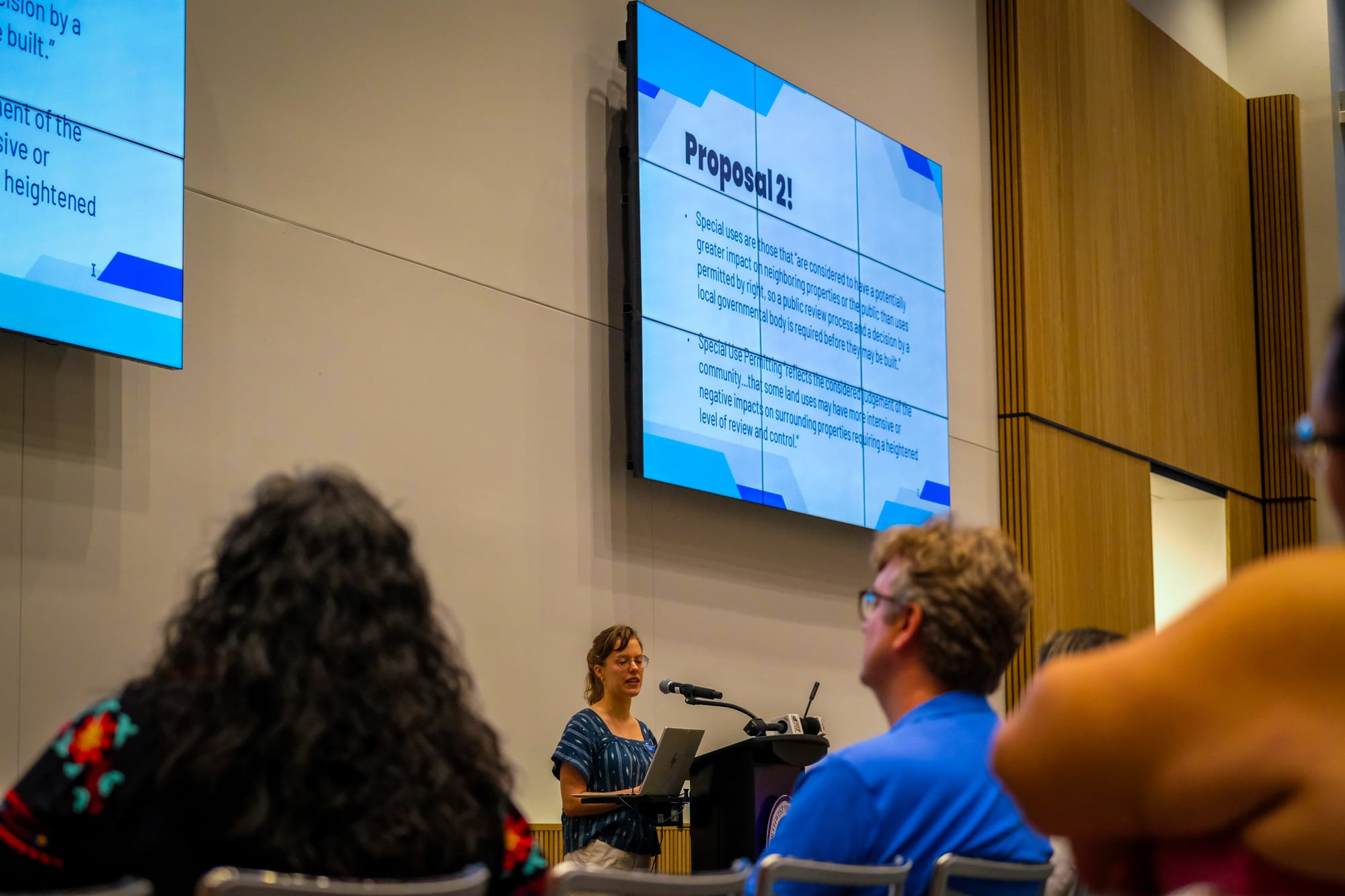
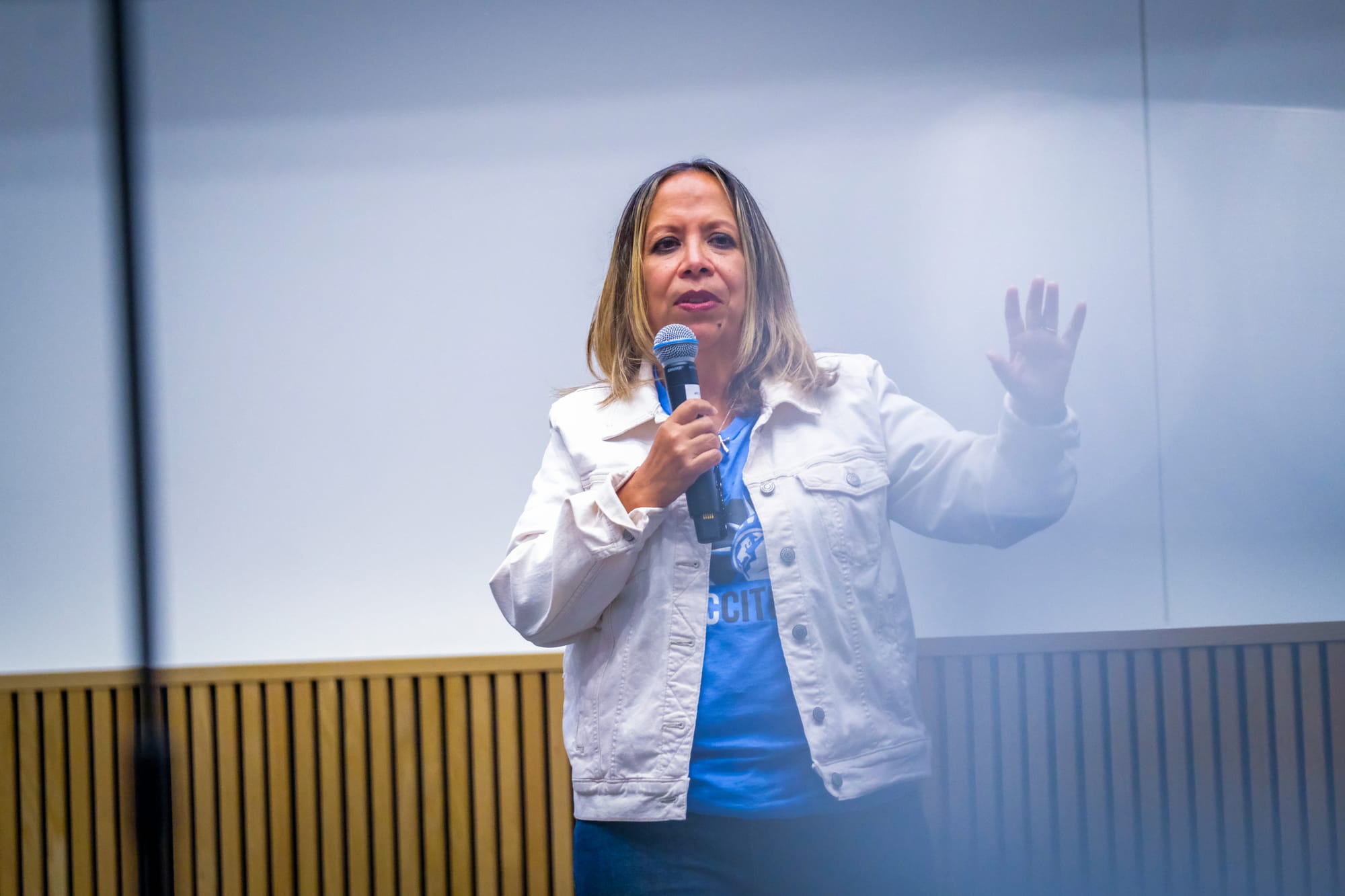
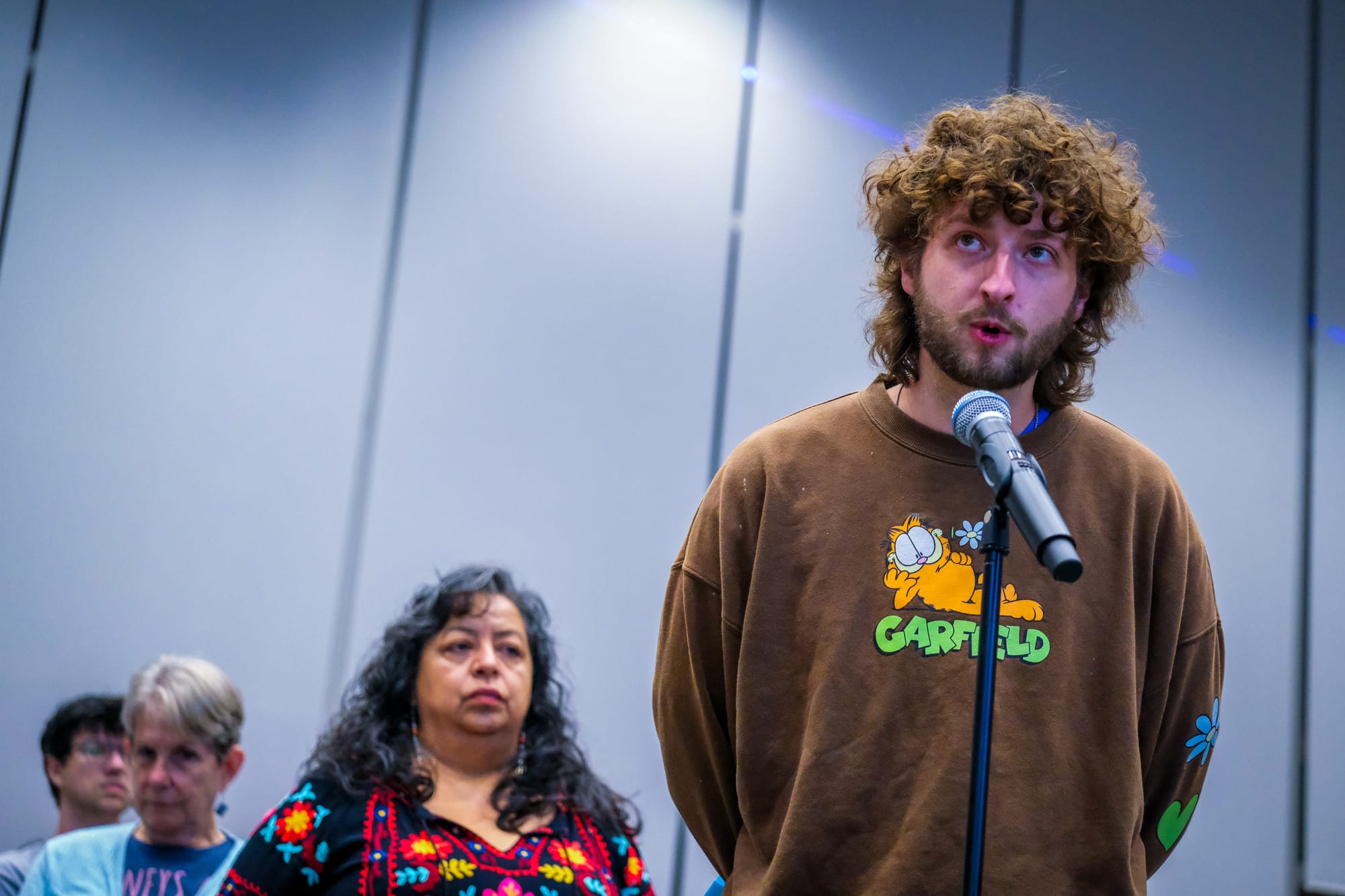
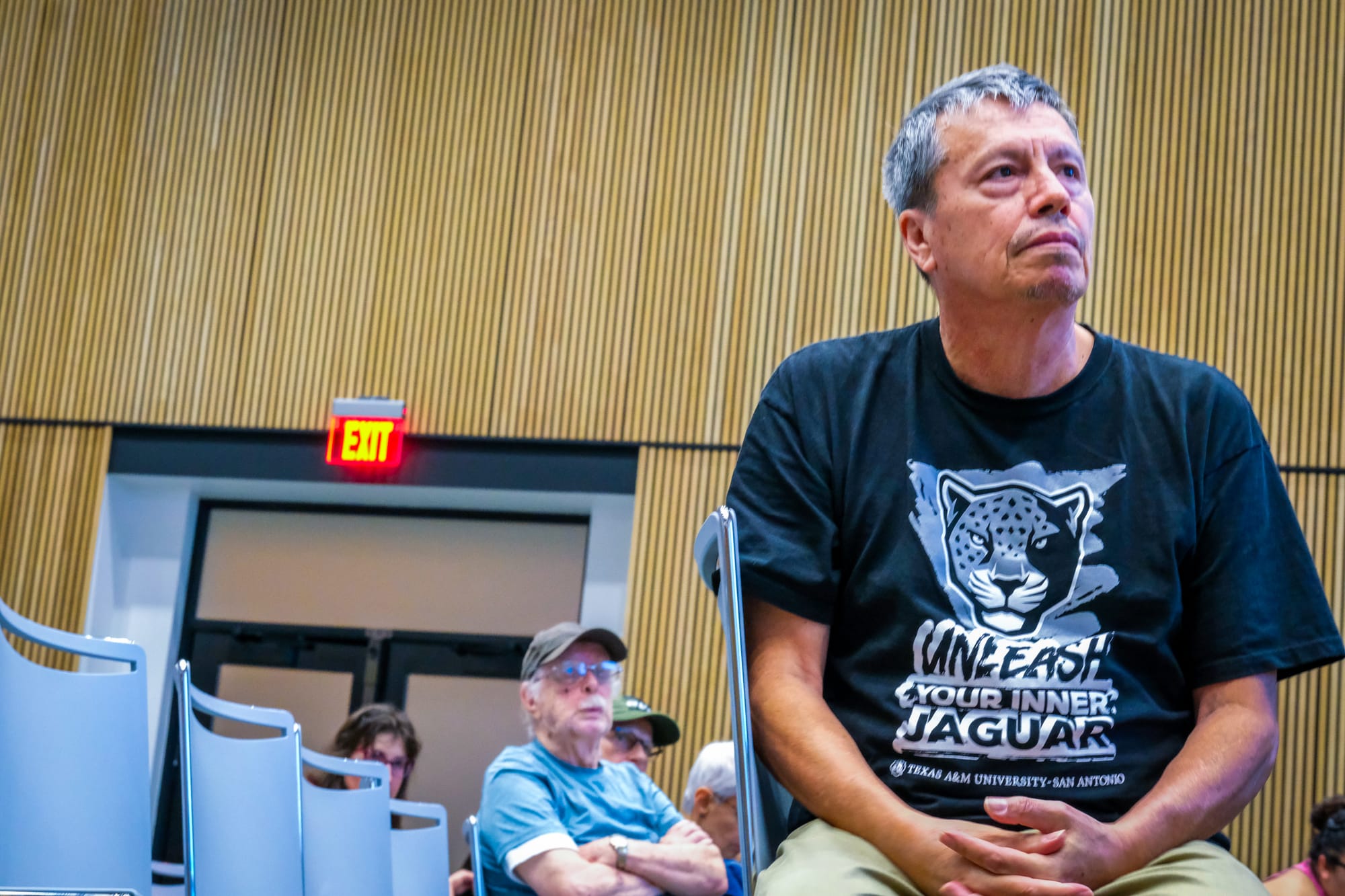
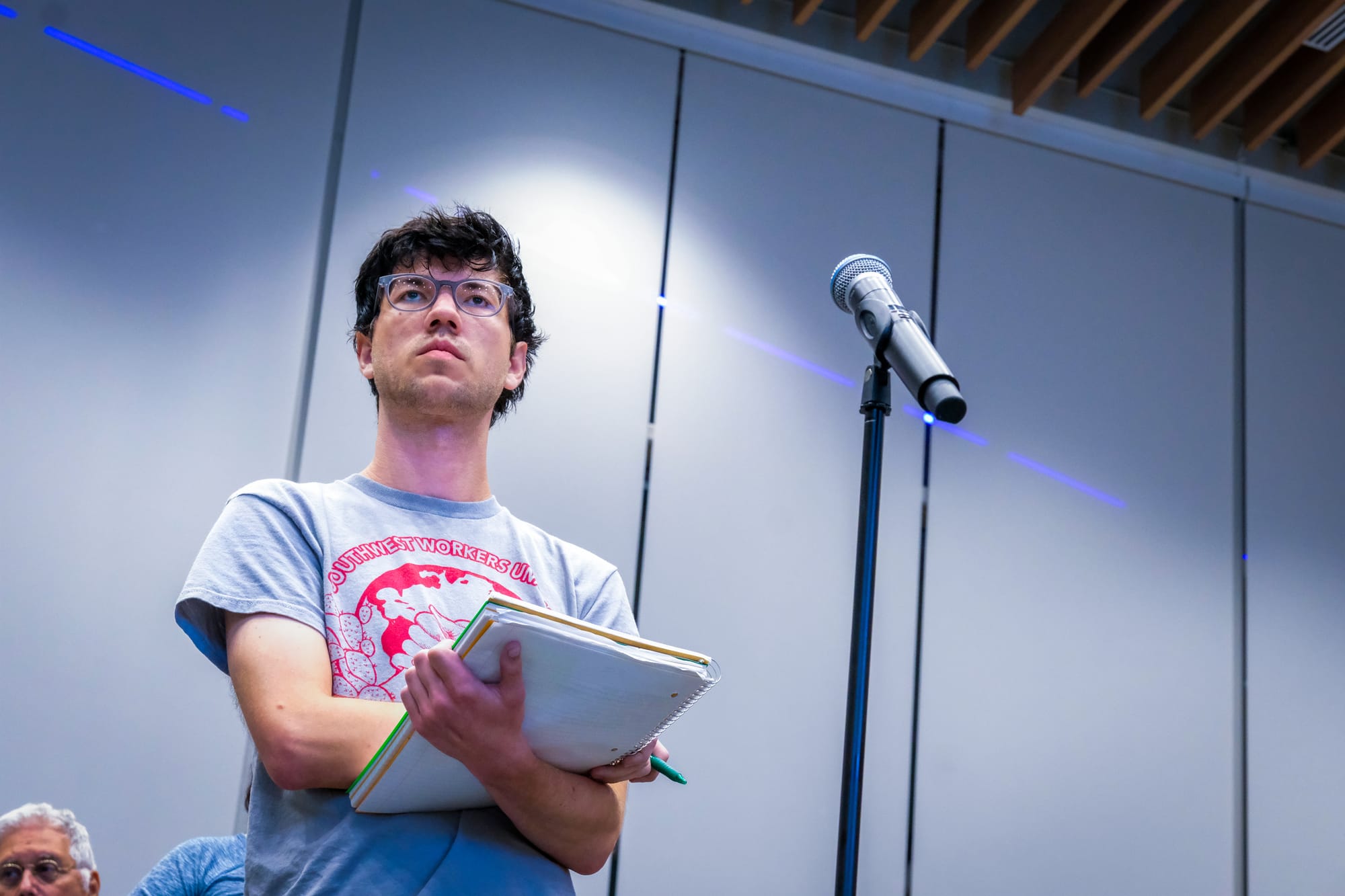
Clockwise from top left: Hanes, Public Citizen's DeeDee Belmares, and members of the public in attendance. Images: Greg Harman
What Neighbors Say They Didn't Know
Public Citizen organizer DeeDee Belmares said the most common complaint she hears from residents across Texas is that they only learned about a data center when land clearing was underway.
"We've been talking to neighbors in District 6 since May about data centers," Belmares said.
"It was very concerning when we told them: did you know this data center is going to have 65 diesel generators? Did you know that this data center is going to have a 120 or 240 megawatt gas line? People did not know this."
Those backup systems have drawn scrutiny on their own. In May, the Texas Commission on Environmental Quality (TCEQ) held a hearing on a Vantage permit application to operate backup diesel generators and a gas plant on Rogers Road. More than 100 people showed up to comment—with support in the room hard to find.
 Greg Harman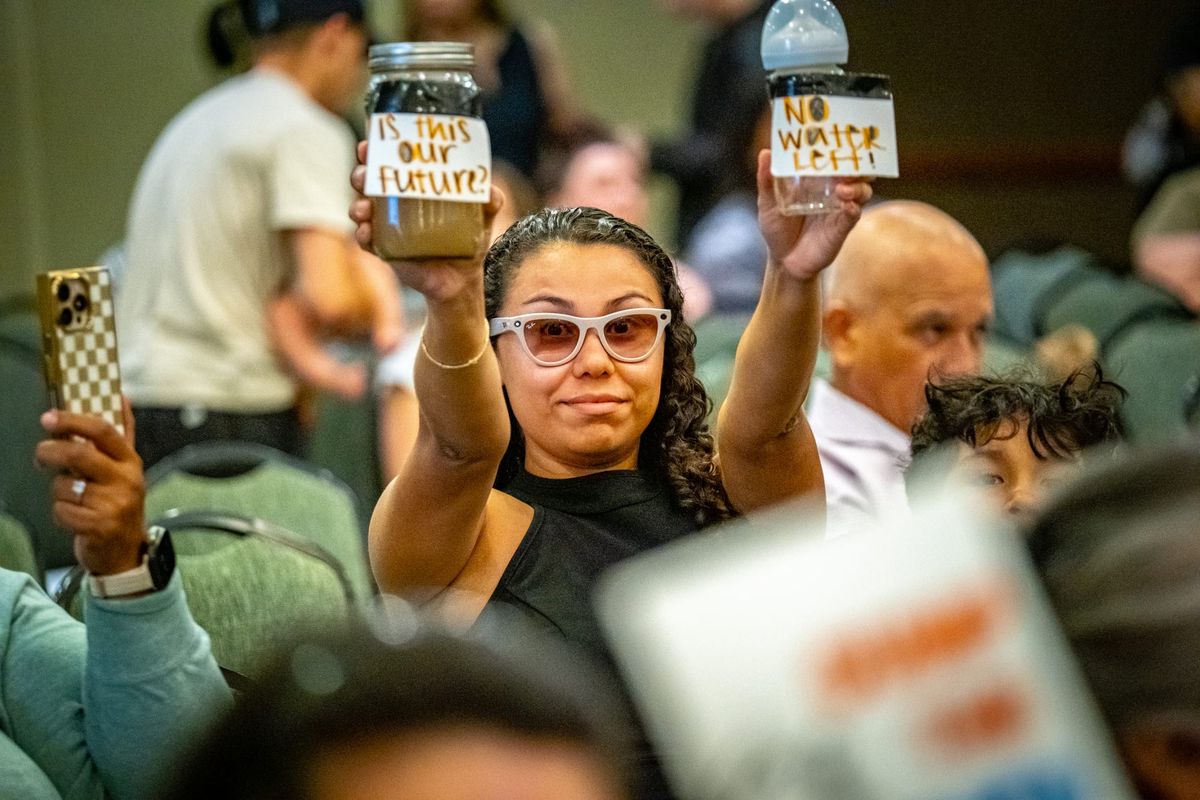
First TCEQ public hearing coverage from Deceleration.
A second TCEQ hearing scheduled for August on another Vantage facility under construction off Omicron was cancelled. TCEQ’s official statement was that it was cancelled because there was so much public interest that new avenues for engagement were being created. However, nothing has been scheduled yet.
Data Center Heat: What Neither Proposal Addresses
Neither proposal would require mitigation or prevention of waste heat vented from the facilities—even as the city spends millions on programs like "cool pavement" and white roofs aimed at slowing the rise of local temperatures.
As Deceleration wrote in August, an international team of researchers from a collection of universities and research institutions reviewed decades of heat data for their study considering data centers across the planet.
They found heat increases ranging from just half a degree Fahrenheit to 16.4 degrees Fahrenheit. The average across all hyperscale data centers studied was 3.73F. And it was heat that could still be measured up to seven (or more) kilometers away.
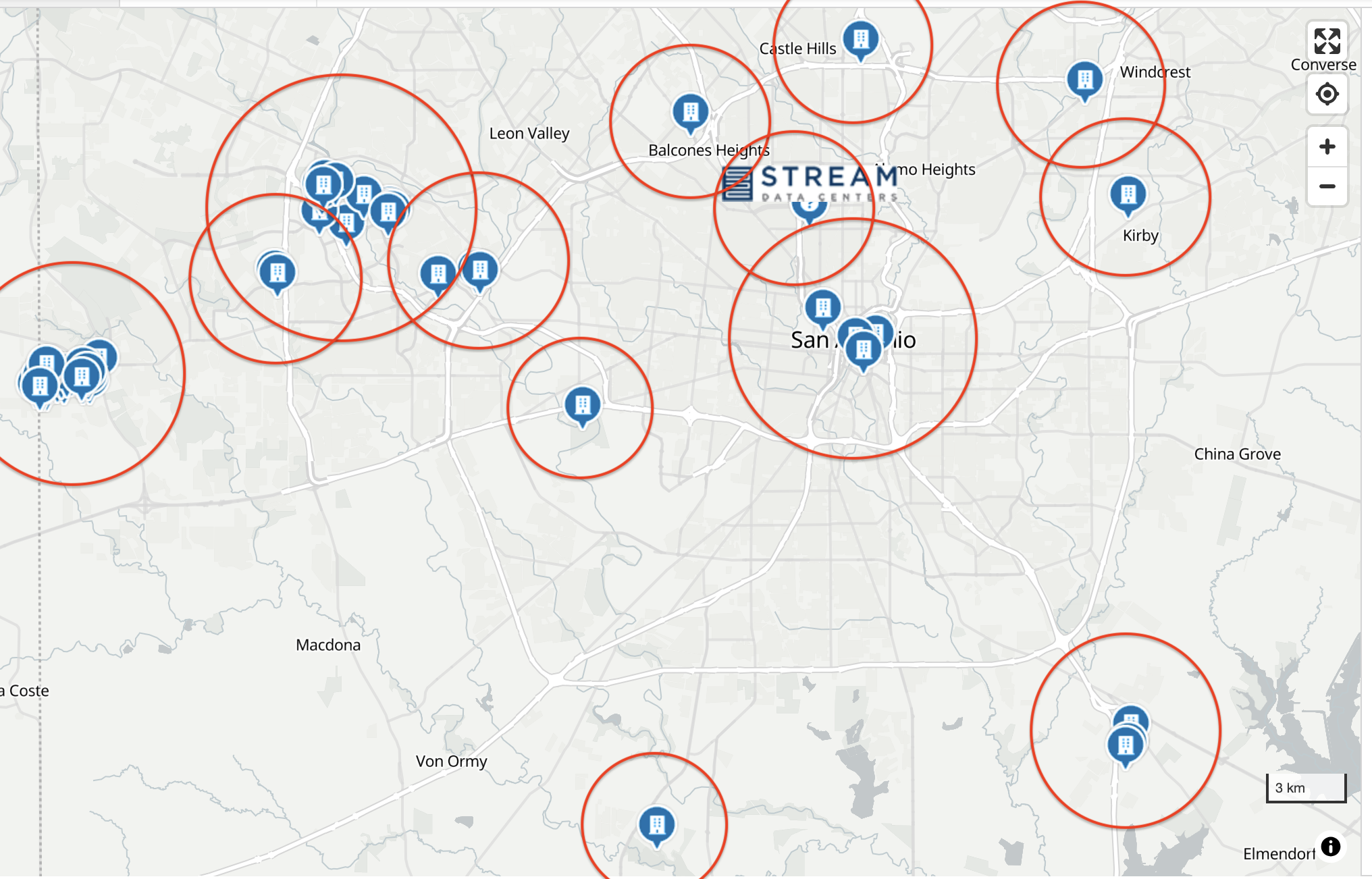
A peer-reviewed study of Phoenix, Arizona, meanwhile, published in the Journal of Engineering for Sustainable Buildings and Cities places that average heat impact of large data centers at 1.5F. This is heat that doesn’t stop at the fence line, but radiates out for miles.
"Data centers generate heat fluxes of thousands of W/m2, far exceeding any previously studied urban source," the authors of that paper write.
Deceleration’s research in San Antonio found temps downwind of the Vantage and Microsoft data centers on Rogers Road were up to six degrees hotter than multiple locations measured upwind of the facilities.
What Happens Next?
San Antonio's Development Services department presented both proposals to Council in a B session this week.
- The item next goes to the Zoning Commission on Tuesday, October 20 (1901 South Alamo Street, San Antonio, TX). Public comments will be heard at the 1 p.m. meeting.
- Council is expected to take up the proposals for consideration and potential approval at its regular 9 a.m. meeting on Thursday, October 29 (114 West Commerce Street).
- Materials for both proposals are posted at SASpeakUp.
An earlier effort to impose a moratorium on new data center development failed at council in August, with four members vocally supporting it. Galvan said Tuesday that he would bring it back if he can secure the votes.
Anayanse Garza of Vecinos en Acción 210 framed the fight in longer historical terms.
"My ancestors are rooted in this land," she said. "It's very troubling to see the data colonialism that is happening, and that continues a long legacy of colonialism that is extractive, that is destructive.
"Corporations cannot be good stewards of the land because they are not people," Garza added. "It is the people and our responsibility to be stewards of the land, because we are connected to the land. Because our ancestors are in this land, they are literally part of the land."