

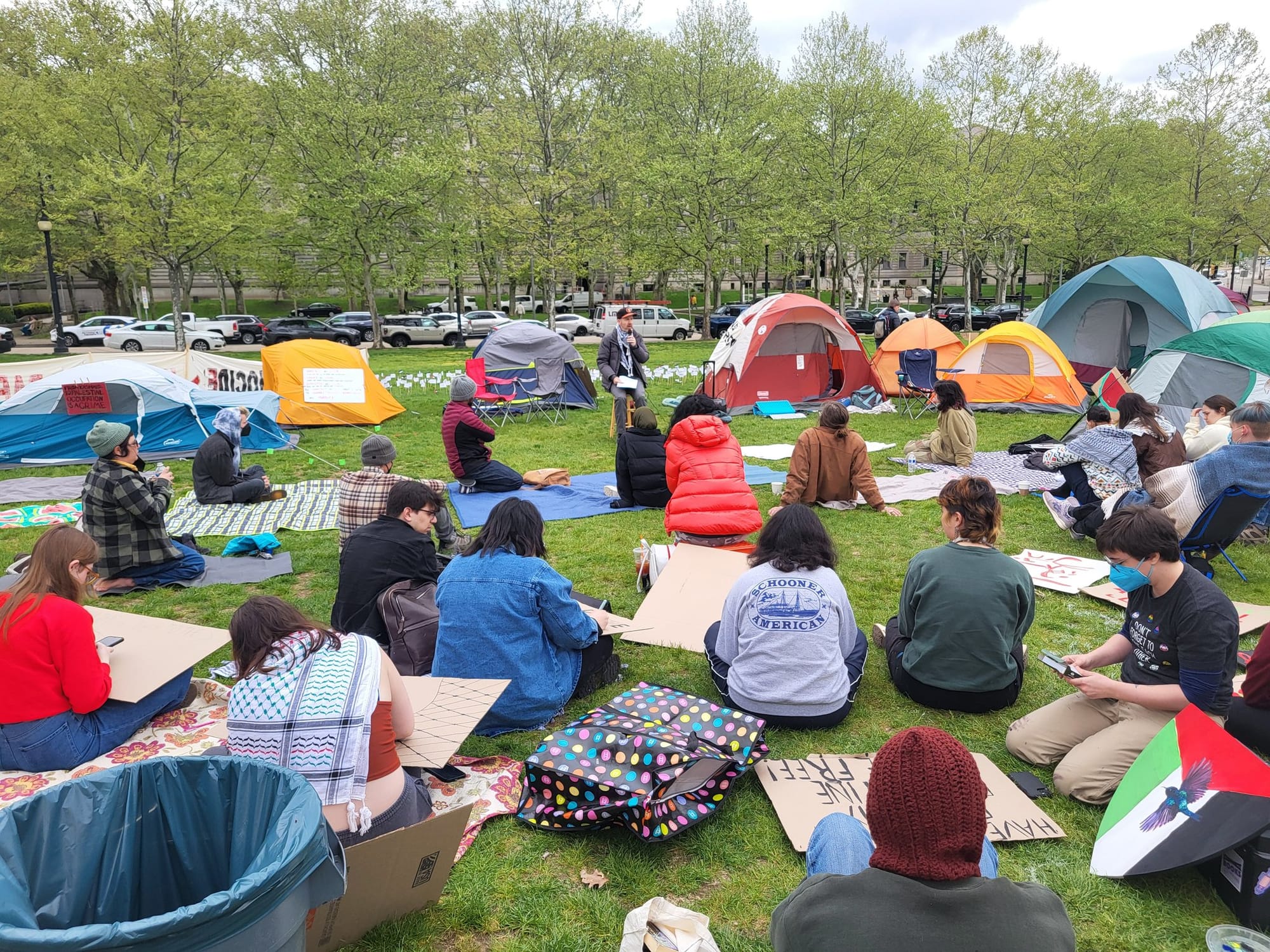
For the encampments to alter America’s ‘common sense’ on Palestine, they must center solidarity, speak to the majority, and popularize an alternative to Zionism.
Karim Safieddine | Waging Nonviolence
The United States is in the midst of a generational uprising in higher education. The Palestine solidarity encampments and associated academic divestment campaigns are a powerful expression of the drastic transformations taking place in American society. Students around the world are challenging the attempts of state, military, and financial interests to reduce politics to an armwrestling match between forces of coercion and mechanical destruction; the campaign of genocidal mass murder led by Israeli forces in Gaza is an acute manifestation of this global order.
The encampments are a bold response from below by students who are relying on their knowledge, audacity, and literal physical bodies. Naturally, they face a number of challenges, obstacles, and issues which ought to be addressed in the pursuit of strengthening the movement in the face of repression from authorities, university administrations, and counter-protester thuggery.
Learning from this experience is just one step towards contributing to the creation of sustainable movement organizations not only within the universities, but also in the cities which surround them. Beyond pressuring our administrations to divest, these protests have the potential to create a massive ripple effect which may well alter the American “common sense” on the Palestine question.
Here are four long-term lessons demonstrators and advocates should consider as encampments and protests develop to sharpen their messaging and strengthen their solidarity.
1. Interconnected global solidarity must be upheld
The Palestine-solidarity movement is not merely building on its own isolated movement; it is directly benefiting from and enhancing a wider political ecosystem within the U.S. context, including movements protesting the carceral state, gender-based violence, war and neoliberal economic structures. In that sense, the movement is part of a wider web of decentralized yet more-or-less organized “political workers” building locally and speaking globally.
These workers are simultaneously building local communities and generating a transnational public opinion which is attempting to rethink and counter ongoing colonial violence, which in turn is quite clearly protected by authoritarian and securitized systems of policing and economic systems of inequality and exploitation.
In light of the wider movement community of those opposing U.S. imperial aggression, state violence and economic inequality, Palestine’s friends can be found amongst feminists, abolitionists, anarchists, unionists and progressives challenging systems of exploitation, authoritarian governance and bodily coercion. Nevertheless, it’s not easy to sustain that ecosystem when the movement in of itself becomes larger than any organization, collective or group; consequently, it has the capacity to attract voices who want to break that solidarity.
From antisemitic right-wingers to Stalinists with a soft spot for their preferred autocrats in Damascus, Tehran, and Moscow, it is not difficult for these voices and forces to find their way into the wider movement “public sphere.” They are interested in challenging the foundational assumption of intersectional solidarity in favor of protecting authoritarian regimes and reinforcing a “fascist investment in Palestine.”
This is characterized by 1) interpreting the Palestinian cause as part of a “geopolitical football” in which one ought to take the side of supposedly “pro-Palestine” states using the cause as symbolic capital to reinforce their own rules and structures of oppression, and 2) misrepresenting the central issue of Israel and Zionism by resorting to antisemitic conspiracy theories which “globalize” the conflict and dilute its key local specificities.
Crowding these voices out is absolutely necessary.
2. Speak to the majority
True solidarity does not rely on reproducing a language of activism which is only intelligible to a subset of professional intellectuals and organizers. Solidarity in practice needs to intersect with the silent majority of Americans who want the war to stop but are not equipped with highbrow social science discourse on social movements and decolonization.
Americans, like all peoples, know what they want; the polls all show it. Most want jobs, healthcare, infrastructure, a sustainable future and an end to violent conflict. The Palestine movement here in the U.S. is mainstream because it naturally intersects with the values of Americans who hope to see a ceasefire, i.e. an end to the killing. Speaking to the majority does not mean diluting the movement’s ambition and high ceiling (which accompanies the political messaging of intersectional solidarity); it means highlighting slogans (such as “Ceasefire NOW”) which resonate with most Americans.
The Palestine movement also cannot restrict itself to a specific constituency, particularly the constituency of progressive Democrats and radical leftists. Again, solidarity as elaborated by progressive political workers is the spirit, but sound tactics and strategy ought to accompany it if we plan to make it an effective oppositional force, and not merely a marginal political statement.
There’s a need to intersect with Americans who want a less belligerent foreign policy and the prioritization of state investment in those living in the U.S. Producing a discourse which is inherently antagonistic to “patriotism” is to isolate oneself from the silent majority, meaning the majority who don’t entirely understand the heavily problematic foundations of the United States, but are at least open to learn.
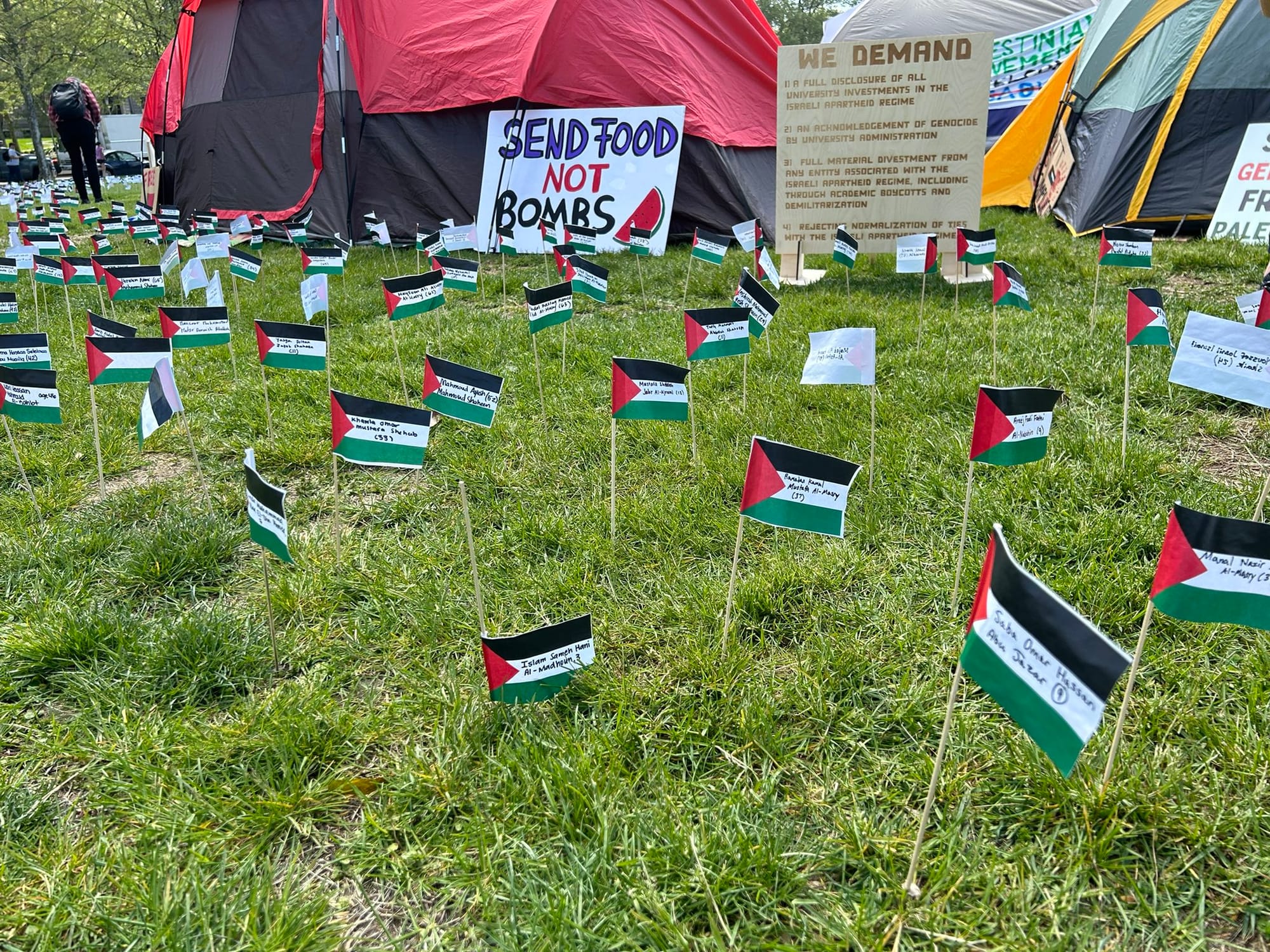
3. We must remain confident in the vision
Critique is necessary.
Crowding out fascist voices is absolutely essential. However, we shouldn’t let anyone convince us that this movement, built by Arabs, Jews, and allies from a variety of backgrounds, is anything but a cosmopolitan and inclusive anti-racist movement for justice, freedom, and democracy.
Critics come in different forms — not everyone is interested in advancing the movement. Since the start of the encampments, we’ve been hearing comments, even from many progressives and liberals, suggesting that the movement hasn’t upheld “safety,” particularly the safety of Jews on campus.
When one delves deeper into this concern, they are mostly referring to the loud, robust, and even vitriolic debate and conversation taking place between protesters and the pro-Israel counter-protesters. In response to students from a plethora of ethnic, racial and religious backgrounds facing imprisonment due to their courageous stand against their country’s complicity in genocide, counter-protesters proudly raising the flag of a country committing mass violence are complaining about safety. Meanwhile little thought is spared for the safety of Palestinian students on U.S. campuses, nevermind in Gaza.
This is not “whataboutism.” Palestinians aren’t complaining about safety because they understand the implications of practicing politics under a government and authority which is financing their extermination.
The pro-Israel crowd is using “safety” — which is supposed to be a legitimate critique stemming from the first lesson (“Intersectional solidarity must be upheld”) — to threaten the safety of protesters, even calling on the carceral state to punish them.
Safety is thus cynically utilized as a tool which exploits the legitimate fears sensed by Jews amid a rise in antisemitic attacks over the past few years. Such an interpretation of “safety” is not entirely separate from its usage in the context of Palestine, particularly where Zionism was seen as a project of “safety” from the “dangers” of the Indigenous population.
In the context of these malicious attempts, critique cannot blind us. What has been created is one of the most noble, courageous, and politically sophisticated movements in the past few decades. The Palestine encampments are being led by people who will be remembered decades later to have caused a paradigm shift in the direction of progress towards a just and inclusive future for both the U.S. and the region.
Calls for critique based on liberal conceptualizations of “safety” rely on institutions, educational and governmental, to intervene in order to “resolve” what is labeled as “hate speech.” But democracy cannot solely be protected by so-called liberal institutions supposedly trying to marginalize right-wing populist voices. Democracy ought to be protected from these very institutions when they intend on reducing campuses to machines that produce careers, not new imagined social possibilities.
4. We need a convincing alternative to Zionism
A project for politics can’t be replaced by a project for identity.
If there is anything we have learned from the crisis of “social justice politics” in the past decade, it’s the fact that a moral hierarchy and set of norms acknowledged by a tight circle of activists won’t necessarily be accepted by wider society.
We also learned that creating an oppositional front against a form of injustice doesn’t necessarily translate to a political project with concrete principles and a particular constitutional and social trajectory. In other words, Zionism, a project which cannot be understood without understanding its incorporation of European colonialism and ethnic supremacy, cannot be replaced by an alternative identitarianism which solely centers victimhood as its primary focal point.
We need an alternative to Zionism. It can’t be a chauvinistic, ethnoreligious alternative which doesn’t responsibly think of the future of the region. It can’t be an authoritarian alternative which reinforces U.S. or Russian-backed dictatorships in the Middle East.
It has to, at the very least, respect part of the historic legacy of some of the Palestinian Liberation Organization’s main leftist factions: freedom from the river to the sea entails a democratic, secular alternative which centers the socio-economic and political rights of workers and citizens regardless of their background and history.
-30-
This story was originally published by Waging Nonviolence.
Karim Safieddine is a leftist organizer and PhD student in sociology at the University of Pittsburgh. Back in Lebanon, he’s a coordinator in the student-led youth network, the Mada Network, which constitutes the secular clubs across universities, regions and sectors. Twitter: @safieddine00


